Tennis court surfaces, and why grass sees half the retirements
Key takeaways · 9 min read
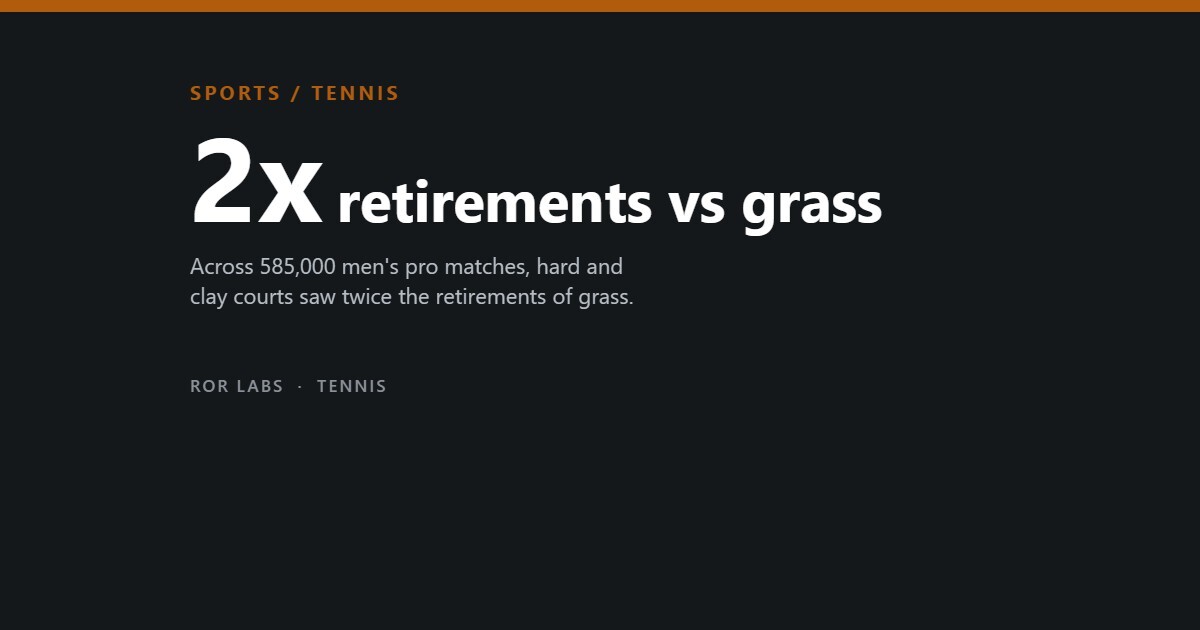
- Across more than 850,000 professional matches below the main tours, players retired about twice as often on hard courts and clay as on grass, at least among men.
- Clay lets the foot slide: in lab studies mean foot force was about 12% lower and contact 30% longer than on an acrylic hard court.
- Club players who played on several surfaces reported more injuries than those who stuck to one, and 61% of problems treated at Wimbledon began before the tournament.
- Surface rankings rest on retirements, small elite samples and mixed denominators; they cannot separate the surface from heat, match length and who chooses to play.
On 8 July 2025, in the first game of his Wimbledon fourth-round match on Centre Court, the world number one, Jannik Sinner, slipped and fell on the grass. He played the rest of the evening with a sore right elbow and was two sets down when his opponent, Grigor Dimitrov, crashed to the turf after serving an ace and could not go on. It was the fourth major in a row that Dimitrov had left injured.
Grass has a reputation as the treacherous surface. The largest count of unfinished professional matches says the opposite. Across 584,806 men’s matches at the level below the main tour, players retired 1.59 times per 1,000 games on hard courts and 1.60 times on clay, but only 0.79 times on grass. Women’s matches showed the same pattern, less steeply.
This article covers what the court does to ankles, knees and hips, where the risk seems to concentrate, including the weeks when the tour switches surface, what has been measured to help, from shoes to schedules, and why those tidy surface rankings are less solid than they look. The answer is not to avoid any surface. It is to play each one carefully.
What the court does to a tennis player’s legs
Tennis is a game of stops. A match can contain 250 to 400 changes of direction, and most of the acute injuries happen below the waist. At Wimbledon over ten years, lower-limb problems made up 47% of injuries seen in men and 49% in women; men presented more often with groin, hip, ankle and heel injuries. Among 600 German league players, the ankle alone accounted for almost 30% of acute injuries, nearly always torn or sprained ligaments.
The surface decides how a foot stops. Hard courts grip, so the shoe halts abruptly and the joints absorb the braking. Clay lets the foot slide, spreading the stop over a longer contact. In a 2007 study of ten players wearing pressure-sensing insoles, mean force under the foot during baseline play was 12% lower on clay than on an acrylic court, and each foot contact lasted 30% longer.
How the same movements load the foot on clay and acrylic
In-shoe measurements from ten experienced male players doing baseline drills, and knee angle at the start of a 180-degree turn in a separate study of ten players. Lab studies, small samples.
Sources: Girard et al., British Journal of Sports Medicine 41(11):733 (2007); Starbuck et al., Journal of Sports Sciences (2016). Greater knee bend on clay was read by the authors as a stabilising adaptation.
The pattern is consistent across labs. On artificial clay, seven competitive players produced lower peak pressures in side jumps and running forehands than on a cushioned acrylic court, with longer steps and more moments of unloading. In the German survey, ligament injuries were 31% of all injuries on clay but 41% on granulated carpet and 45% on plain carpet, both grippy indoor surfaces. None of this proves that one surface injures more players; it shows how the load arrives.
Where the risk concentrates
The retirement study, published in PLOS ONE in 2024, covered men’s Challenger and ITF events from 1978 to 2019 and women’s ITF and WTA 125 events from 1994 to 2018. For men, hard and clay courts carried about twice the retirement rate of grass. For women the excess was smaller, 1.31 times on hard and 1.28 on clay. Retirements rose over the decades on both tours, which the authors linked to the growing physical demands of the game.
An older analysis of more than 420,000 matches from 1968 to 2010 reached the same ranking, with more retirements on hard and clay than on grass and carpet, and more outdoors than indoors. The surfaces where matches are long and the conditions hot keep turning up at the top. That is a clue that something besides grip, such as match length, heat or travel, may be doing part of the work.
Retirements per 1,000 games, by surface
Matches abandoned after they had started, in professional events below the main ATP and WTA tours. Men 1978–2019, women 1994–2018. Observational.
Source: Palau et al., PLOS ONE (2024), doi:10.1371/journal.pone.0304638; 584,806 men’s and 267,380 women’s matches.
Changing surface may matter as much as the surface itself. In a Dutch survey of 3,656 club players, injury prevalence did not differ between those who played mainly on hard courts, clay or two kinds of sand-filled artificial grass. Players who played on several surfaces, however, reported more injuries, particularly overuse injuries. At Wimbledon, which follows the clay of Roland Garros within weeks, 61% of the problems doctors saw had begun before the tournament.
When Wimbledon injuries began
Share of injury presentations to the tournament medical team, main draw, 2007–2012, by timing of onset.
Source: McCurdie et al., British Journal of Sports Medicine 51(7):607 (2017). The authors said their data could neither support nor refute the idea that the clay-to-grass switch causes injury.
Here the tidy ranking starts to wobble. Grass made up just 1.16% of the men’s matches in the 2024 study, a few weeks of the year with short points and fast serves, and players who are already hurt often skip the grass swing. A retirement is not an injury count either: it includes illness, heat and tactical exits, and it misses players who withdraw before a match. At the elite level, the evidence points both ways.
Two elite studies, opposite answers
Davis Cup: share of matches retired for medical reasons, 2006–2013. US Pro Circuit 2013: rate of injuries forcing withdrawal or retirement among women, clay relative to hard courts. Observational.
Sources: Maquirriain and Baglione, European Journal of Sport Science (2016); Hartwell et al., Sports Health (2017). The Davis Cup result rests on 12 retirements in total.
The majors cannot settle it, because each counts differently. Wimbledon reported 20.7 injuries per 1,000 sets; the Australian Open, 201.7 per 10,000 games for women and 148.6 for men; the US Open, injuries per 1,000 match exposures. Those yardsticks do not convert into one another, and the four tournaments also differ in heat, time of year and how tired players are when they arrive.
What has been measured to help
No randomised trial has tested whether moving players to a different surface prevents injury. A 2018 systematic review of risk factors in elite juniors found no prevention studies at all; a previous injury was among the best-supported risk factors. What exists instead is laboratory work on how surfaces and shoes change the load, which is a plausible route to fewer injuries but not proof of one.
Clay can be tuned. When a British team changed the depth of loose sand on an artificial clay court, the deepest layer, 20 kilograms per square metre, produced longer slides and lower vertical and sideways loading rates during sharp turns than a medium layer. Mechanical tests found that larger or damp infill particles generally reduced traction, while small, dry particles under heavy load could grip almost as hard as an acrylic court. Court maintenance, in other words, changes the surface as much as its name does.
How young players move on hard courts and clay
GPS data from 14 elite Spanish players aged about 13, each tracked in two matches on each surface.
Source: Galé-Ansodi et al., International Journal of Performance Analysis in Sport (2016). Hard-court play was more explosive; the difference in average speed was not statistically significant.
Shoes help less than marketing suggests, at least on the measures tested. In the artificial-clay study, swapping between surface-specific shoes did not change peak plantar pressure; the surface did. Experiments published in 2023 found that changing outsole tread width by 0.6 millimetres altered friction and ankle rotation during braking, so tread matters, but no study has followed players to see whether a given sole prevents sprains.
Scheduling has been changed without being measured. From 2015 Wimbledon moved back a week, leaving three weeks after Roland Garros instead of two, explicitly to give players more time to adjust from clay to grass. We found no published study testing whether injuries fell afterwards. The International Tennis Federation classifies courts into five pace categories, from slow to fast, but on the basis of ball behaviour alone; traction and shock absorption, the properties that load the legs, are not part of the rating.
Why the answer is to play every surface carefully
For club players, the best study found no surface that was clearly safer overall. Hard courts carried more lower-limb overuse complaints in the Dutch data, and clay brings longer rallies, so each surface trades one load for another. Most recreational injuries are overuse, and they track how much and how suddenly people play, not only where. Broader numbers on tennis injuries, from college rates to tennis elbow, are in our article on tennis injuries and tennis elbow.
The practical lessons follow the measurements. Give the body a few sessions to adapt when changing surface, especially from clay to the grip of hard courts or the low bounce of grass, and build volume up rather than jumping in. Wear shoes made for the surface and replace them when the tread is worn. Ask club staff about clay maintenance: a well-watered, well-topped court slides. And treat a previous injury as a reason for a gradual return, since it is one of the best-supported risk factors in the research.
Questions people ask
Is clay the safest tennis surface?
Clay lowers the load per step in laboratory tests, and some elite data favour it. But large professional data show clay and hard courts with similar retirement rates, and recreational players on clay were not injured less overall.
Is grass more dangerous because it is slippery?
Slips happen, especially on fresh or damp grass, but matches on grass were retired about half as often as on hard courts or clay at the professional level studied. Grass is also played far less, which makes the comparison uncertain.
Does switching surfaces cause injuries?
It has not been proven, but club players who used several surfaces reported more overuse injuries, and most players treated at Wimbledon arrived with a problem that began earlier. A gradual transition is a sensible precaution.
Do I need different shoes for clay and hard courts?
Surface-specific shoes are designed for different grip and sliding, and tread changes friction in tests. No study has yet shown that they prevent injuries, but worn-out soles change traction and are worth replacing.
The short version
- Across more than 850,000 professional matches below the main tours, players retired about twice as often on hard courts and clay as on grass, at least among men.
- Clay lets the foot slide: in lab studies mean foot force was about 12% lower and contact 30% longer than on an acrylic hard court.
- Club players who played on several surfaces reported more injuries than those who stuck to one, and 61% of problems treated at Wimbledon began before the tournament.
- Surface rankings rest on retirements, small elite samples and mixed denominators; they cannot separate the surface from heat, match length and who chooses to play.
- No trial shows that a surface, shoe or schedule prevents injuries. Adapt gradually, wear surface-specific shoes and play every court carefully.
This is a summary of published research, not medical advice. If you have pain in an ankle, knee or hip that persists, or an injury that keeps coming back, see a doctor or a physiotherapist before returning to play.
Further reading: Palau et al., PLOS ONE (2024), for retirements by surface across more than 850,000 matches. Pluim et al., British Journal of Sports Medicine 52(9):611 (2018), for injuries among club players on four surfaces. McCurdie et al., British Journal of Sports Medicine 51(7):607 (2017), for ten years of injuries at Wimbledon.
- The Last Days of Roger Federer, Geoff Dyer (2022). A literary meditation on endings and ageing bodies, with tennis at its heart; reflective rather than practical.
- The Data Detective, Tim Harford (2021). Ten rules for reading statistics, useful when a surface ranking rests on retirements and mismatched denominators.
- The Art of Uncertainty, David Spiegelhalter (2024). A Cambridge statistician on judging risk when the data are observational and the confidence intervals wide.
Sources
- Palau M, Baiget E, Cortés J, Martínez J, Crespo M, Casals M. Retirements of professional tennis players in second- and third-tier tournaments on the ATP and WTA tours. PLOS ONE (2024), doi:10.1371/journal.pone.0304638.
- Breznik K, Batagelj V. Retired matches among male professional tennis players. Journal of Sports Science and Medicine (2012), PMID 24149200.
- McCurdie I, Smith S, Bell PH, Batt ME. Tennis injury data from The Championships, Wimbledon, from 2003 to 2012. British Journal of Sports Medicine 51(7):607 (2017).
- Pluim BM, Clarsen B, Verhagen E. Injury rates in recreational tennis players do not differ between different playing surfaces. British Journal of Sports Medicine 52(9):611 (2018).
- Maquirriain J, Baglione R. Epidemiology of tennis injuries: an eight-year review of Davis Cup retirements. European Journal of Sport Science (2016), doi:10.1080/17461391.2015.1009493.
- Hartwell MJ, Fong SM, Colvin AC. Withdrawals and retirements in professional tennis players. Sports Health (2017), doi:10.1177/1941738116680335.
- Krueckel J, Szymski D, Lenz JE, et al. Tennis injuries among German league players. Open Access Journal of Sports Medicine 15 (2024), doi:10.2147/OAJSM.S460907.
- Girard O, Eicher F, Fourchet F, Micallef JP, Millet GP. Effects of the playing surface on plantar pressures and potential injuries in tennis. British Journal of Sports Medicine 41(11):733 (2007).
- Starbuck C, Damm L, Clarke J, et al. The influence of tennis court surfaces on player perceptions and biomechanical response. Journal of Sports Sciences (2016), doi:10.1080/02640414.2015.1127988.
- Damm L, Starbuck C, Stocker N, et al. Shoe-surface friction in tennis: influence on plantar pressure and implications for injury. Footwear Science (2014), doi:10.1080/19424280.2014.891659.
- Starbuck C, Stiles V, Ura D, Carré M, Dixon S. Biomechanical responses to changes in friction on a clay court surface. Journal of Science and Medicine in Sport (2016).
- Clarke J, Carré M, Damm L, Dixon S. The development of an apparatus to understand the traction developed at the shoe–surface interface in tennis. Proceedings of the IMechE, Part P (2013), doi:10.1177/1754337112469500.
- Kang J, Ryu S, Gil HJ, Park SK. Effects of modified outsole patterns in tennis shoes on frictional force and biomechanical variables of lower extremity joints. Applied Sciences 13(4):2342 (2023).
- Galé-Ansodi C, Castellano J, Usabiaga O. Effects of different surfaces in time-motion characteristics in youth elite tennis players. International Journal of Performance Analysis in Sport (2016), doi:10.1080/24748668.2016.11868934.
- O’Donoghue P, Ingram B. A notational analysis of elite tennis strategy. Journal of Sports Sciences (2001), doi:10.1080/026404101300036299.
- Oosterhoff JHF, Gouttebarge V, Moen M, et al. Risk factors for musculoskeletal injuries in elite junior tennis players: a systematic review. Journal of Sports Sciences (2018), doi:10.1080/02640414.2018.1485620.
- Gescheit DT, Cormack SJ, Duffield R, et al. Injury epidemiology of tennis players at the 2011–2016 Australian Open Grand Slam. British Journal of Sports Medicine (2017), doi:10.1136/bjsports-2016-097283.
- Sell K, Hainline B, Yorio M, Kovacs M. Injury trend analysis from the US Open Tennis Championships between 1994 and 2009. British Journal of Sports Medicine, doi:10.1136/bjsports-2012-091175.
- International Tennis Federation. Tennis surfaces classification (Court Pace Rating categories), itftennis.com, accessed October 2026.
- All England Club confirms Wimbledon date change from 2015. Breaking Travel News, 26 July 2012.
- Tearful Dimitrov forced to retire while leading top seed Jannik Sinner by 2-0. Cyprus Mail, 8 July 2025.
- Tennis schedule under renewed scrutiny as injuries, criticism mount. AFP via SuperSport, 1 October 2025.