Houses Do Not Usually Burn From the Flames. They Burn From What Lands in the Gutter.
Disclosure: this article contains affiliate links, marked (paid link). If you buy through one we may earn a commission, at no extra cost to you. As an Amazon Associate I earn from qualifying purchases. It costs you nothing and it does not change what we recommend.
Key takeaways · 11 min read
- Embers, not the flame front, are the leading cause of home ignition in wildfire.
- They travel miles ahead of the fire and collect against the building.
- An ember-resistant buffer around the house halves the risk of ignition.
- Clearing perimeter vegetation nearly doubles a structure’s likelihood of surviving.
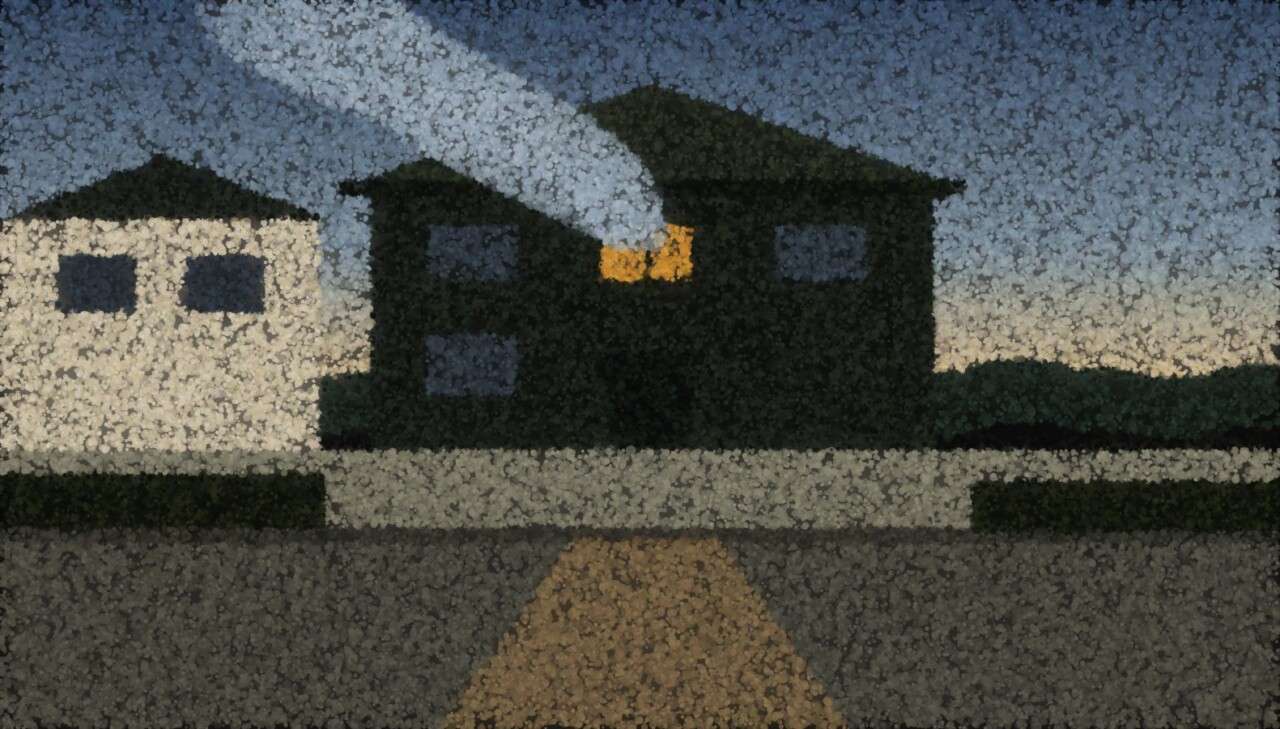
The mental picture almost everyone carries of a house burning in a wildfire is wrong, and the wrongness is expensive. The picture is a wall of flame arriving through the trees and consuming the building. What actually happens, in most losses, is that a shower of burning fragments arrives miles ahead of the fire, lands in a gutter or against a plastic bin or under a deck, and smoulders there until something catches.
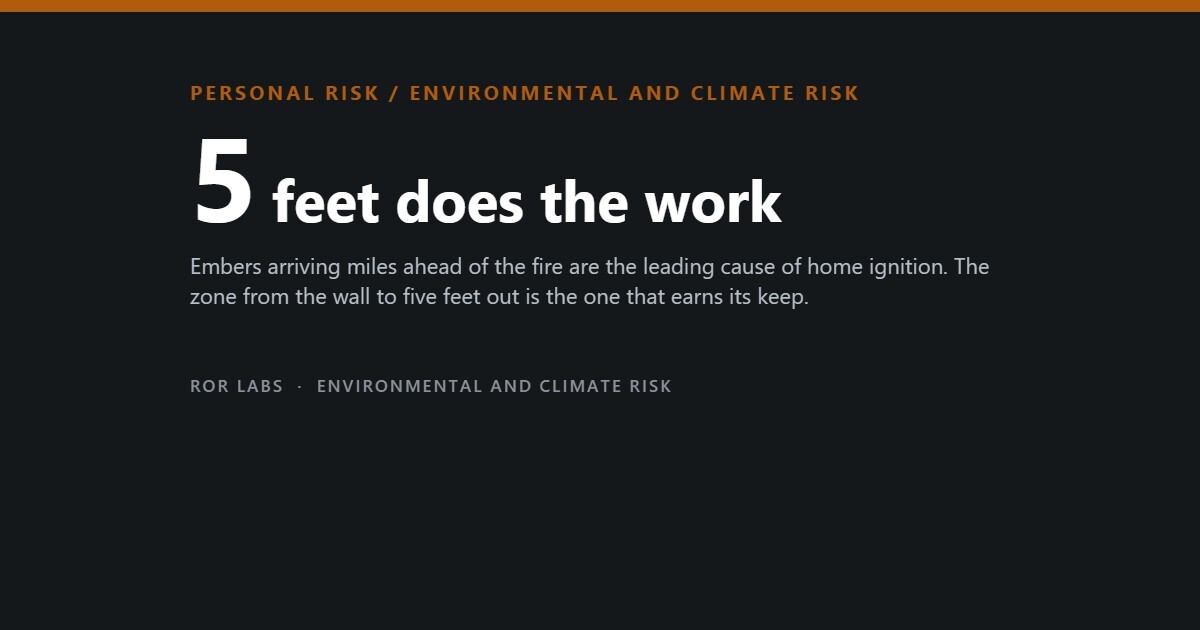
The Insurance Institute for Business and Home Safety, which burns full-size houses in a laboratory large enough to hold them, describes embers as the leading cause of home ignition in wildfire. That single reframing changes what is worth doing, because embers are not stopped by distance from the treeline. They are stopped by what is in the first five feet around your walls.
This article covers what the ignition research found, why the most valuable zone is the one people use for decorative bark and firewood stacks, and which of the available measures have evidence behind them.
Embers, not the flame front
An ember, or firebrand, is a burning piece of bark, leaf or structure lofted by the fire’s own convection column and carried on the wind. They arrive in enormous numbers, they arrive early, and they arrive at houses that are nowhere near the fire.
What a five-foot noncombustible zone buys
Research from the Insurance Institute for Business and Home Safety.
Sources: Insurance Institute for Business & Home Safety (IBHS), Near-Building Noncombustible Zone research and Wildfire Prepared Home programme; IBHS and ZestyAI, 2021.
The reason the first five feet dominate is mechanical. Embers do not fly into walls; they fall, drift and collect. Wind eddies around a building deposit them in the same places every time: against the base of the wall, in the re-entrant corners, in the gutter, on the deck, under the eaves.
Where embers actually collect
The recurring ignition points in post-fire investigations.
Sources: IBHS Wildfire Prepared Home; NFPA Firewise USA, Immediate (Noncombustible) Zone fact sheet.
The three zones, and which one earns its keep

Defensible space is usually taught as concentric rings. That framing is correct and it obscures the priority, because the rings are not equally valuable and the smallest one does most of the work.
What each zone is for
The first zone defends against embers. The outer zones defend against the flame front and give firefighters somewhere to stand.
| Zone | Distance | What it is actually doing |
|---|---|---|
| Immediate | 0–5 feet | Denying embers anything to ignite against the building. Noncombustible surfaces only: gravel, pavers, bare soil. No mulch, no bins, no firewood, no plants under windows. |
| Intermediate | 5–30 feet | Breaking the continuity of fuel so a ground fire cannot run up to the house. Spacing between shrubs, trees limbed up, lawn kept short. |
| Extended | 30–100 feet | Slowing and lowering the flame front before it arrives, and creating room for crews to work. Thinning rather than clearing. |
Sources: NFPA Firewise USA; IBHS Wildfire Prepared Home standard.
The building itself matters as much as the ground around it, and here the evidence points at a small number of specific details rather than at the house as a whole.
The details that decide whether a house survives
Components tested in the IBHS Wildfire Prepared Home standard.
Source: Insurance Institute for Business & Home Safety, Wildfire Prepared Home programme requirements and live burn demonstrations.
What actually helps, in order
Ranked by how much ignition risk each one removes
The first five cost nothing but an afternoon.
Sources: IBHS Wildfire Prepared Home; NFPA Firewise USA; CAL FIRE defensible space guidance.
The equipment that has evidence behind it (paid link)
All of it addresses embers, which is the mechanism that causes most losses.
Browse on Amazon →
Browse on Amazon →
Browse on Amazon →
Browse on Amazon →
Three things we are deliberately not linking. Exterior home sprinkler and gel systems. They are heavily marketed and their evidence base is thin: they depend on water pressure and power at the exact moment a fire event takes both away, they are typically applied too early or too late to help, and no independent standard rates them. Fire-retardant sprays sold to homeowners. The products used by agencies are applied by trained crews at specific times; the consumer versions weather off and give a durable sense of protection they cannot support. “Fireproof” document safes as the answer to your papers. Ratings are for a defined temperature and duration in a house fire, not a prolonged wildfire, and a scanned copy in cloud storage survives everything a safe does and also survives the safe. Buy the safe if you like; scan the documents first.
The decision, and the fifteen minutes before it
All of the preparation above is designed to work while the house is empty, and that is deliberate. The reason it matters is that the most dangerous phase of a wildfire for people, as opposed to buildings, is not the fire reaching the house. It is the movement of large numbers of people onto a small number of roads, late, at the same time.
Late evacuation is repeatedly identified in post-fire reviews as the circumstance in which people die: in vehicles, on routes that are already involved, in low visibility, behind other vehicles that have stopped. The countermeasure is not a better car. It is deciding earlier, and having decided in advance what “earlier” means.
Decide these in March, not on the day
Every item is a decision that becomes much harder to make well under time pressure and smoke.
Sources: CAL FIRE evacuation guidance; NFPA Firewise USA; IBHS Wildfire Prepared Home.
One detail worth knowing because it surprises people: leaving the exterior lights on is standard advice not for your benefit but for the crews, who may be looking for structures in daytime smoke thick enough to need headlights. Leaving gates unlocked is the same logic. A house that firefighters can find and reach is a house they can defend, and defensible space in the technical sense means space in which it is safe for them to stand.
Questions people ask
Do I have to remove my trees?
Usually not, and the instinct to clear-cut is often the wrong response. What matters is continuity — whether fire can climb from the ground into the canopy and travel from crown to crown to your roof. Spacing, limbing up the lower branches and removing the ladder fuels underneath achieves that while keeping the trees, and mature trees can even catch embers that would otherwise reach the house.
What if my neighbour does nothing?
In dense neighbourhoods a burning house is itself a major ember source and a radiant heat source for the ones beside it, so your neighbour’s five feet genuinely affects you. This is why the Firewise programme organises at the street level rather than the household level, and why the most effective version of this work is a conversation rather than a purchase.
Does any of this affect my insurance?
Increasingly, yes. Insurers in high-risk areas are using property-level wildfire risk scores, and several now recognise certification programmes such as Wildfire Prepared Home. Worth asking your insurer directly what they recognise before you spend, because the answer differs by company and by state, and separately worth checking what your policy actually covers — the gap between assumed and actual cover is its own risk, which we wrote about in our piece on what home insurance does not cover.
Should I stay and defend the house?
In the United States the guidance is unambiguous: leave early when told to. The preparation described here is designed to let a house survive without anyone in it, which is the entire point — it works while you are somewhere safe. People who die in these fires are very often people who left late, in a vehicle, on a road that was already involved.
What about the smoke, if the fire is far away?
That is the version of wildfire risk that reaches the most people by a wide margin, and it is a different problem with different answers — filtration, sealing the house, and knowing when the outside air is better than the inside air. We covered the evidence on fine particles and what actually reduces exposure in our piece on PM2.5 and what actually helps.
The short version
- Embers, not the flame front, are the leading cause of home ignition in wildfire.
- They travel miles ahead of the fire and collect against the building.
- An ember-resistant buffer around the house halves the risk of ignition.
- Clearing perimeter vegetation nearly doubles a structure’s likelihood of surviving.
- The first five feet matter more than the next ninety-five. No mulch, bins, firewood or plants against the wall.
- Gutters, vents, decks and the base of the wall are where ignitions start.
- A Class A roof and ember-resistant vents are the two structural changes worth most.
- Thin, do not clear. Continuity of fuel is the problem, not the existence of trees.
- Preparation is designed to work with nobody home. Leave early.
- Exterior sprinkler systems and consumer retardant sprays have thin evidence. The five feet do not.
This article summarises wildfire ignition research. It is not a substitute for local fire authority guidance, which reflects your own terrain, vegetation and building codes, and it is not advice about whether to evacuate — that decision belongs to the authorities issuing the order, and the correct response to one is to go.
On the links above: some are affiliate links, marked (paid link). If you buy through one we may earn a commission at no additional cost to you. As an Amazon Associate I earn from qualifying purchases. We link to product searches rather than specific items so that recommendations do not break as models change, and we say plainly when we are choosing not to link something. Full policy: Affiliate Disclosure.
Sources
- Insurance Institute for Business & Home Safety. “IBHS research shows creating an ember-resistant buffer around a home cuts its risk of igniting from a wildfire in half.” (Embers as the leading cause of home ignition; five-foot noncombustible zone; 2021 IBHS and ZestyAI study on perimeter vegetation.)
- Insurance Institute for Business & Home Safety. Near-Building Noncombustible Zone research report, December 2018, and Wildfire Prepared Home programme requirements and live burn demonstrations.
- National Fire Protection Association, Firewise USA. Immediate (Noncombustible) Zone wildfire research fact sheet.
- CAL FIRE. Defensible space zone guidance.