Your Home Insurance Almost Certainly Does Not Cover Flooding
In This Series: Personal Finance & Investing
- Why Most Stock Investors Lose Money: What the Evidence Actually Shows
- Options and Futures: Where Retail Money Actually Goes
- Two Retirees, the Same Returns, Only One Runs Out. The Difference Is the Order.
- Deposit Insurance Stops at $250,000. Since 2008, Uninsured Depositors Have Actually Lost Money in Six Per Cent of Failures.
- Courts Resolve More Than Seventy Per Cent of Debt Suits Without a Defence. Fewer Than One Defendant in Ten Has a Lawyer.
- The Median Forfeiture Is $1,678. A Lawyer to Contest It Costs About Twice That.
Key takeaways · 7 min read
- Most homeowners insurance excludes flood damage entirely. It is bought separately or not at all.
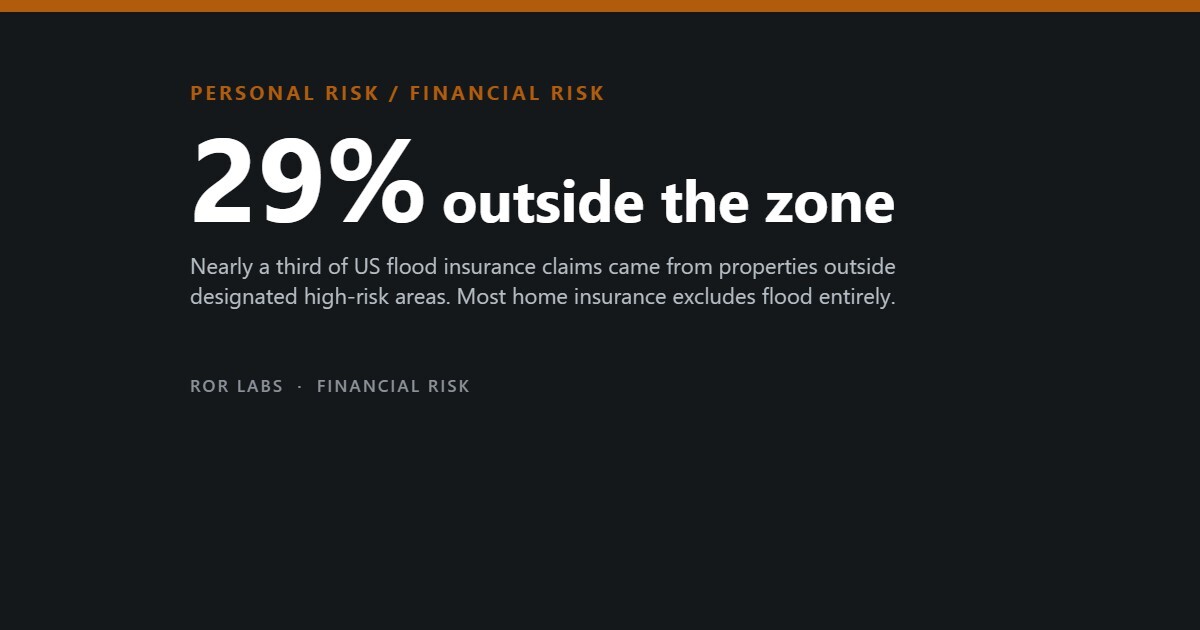
- 29% of NFIP flood claims between 2014 and 2024 came from outside designated high-risk areas.
- 99% of U.S. counties have had a flood event in the past twenty years. A flood map is a regulatory boundary, not a safety guarantee.
- Flood cover has a waiting period — commonly 30 days. You cannot buy it once the forecast turns.
There is a particular kind of bad day that arrives twice: once when the water comes in, and again three weeks later when someone explains that the policy you have been paying for does not cover this.
Flood is the largest of these gaps and the least understood. Most homeowners insurance excludes flood damage entirely. Not limits it — excludes it. And the people most likely to be caught out are precisely the ones who were told they did not need to worry.

The zone map is not a risk map
Where the flood claims actually came from
National Flood Insurance Program claims, 2014–2024.
Source: FEMA, National Flood Insurance Program, “What is my flood risk” (floodsmart.gov), claims data 2014–2024.
And the context for that number: 99% of U.S. counties have experienced a flood event in the past twenty years. Flood maps describe where flooding is likely enough to regulate. They were never a list of the only places it happens, and treating a low-risk designation as an all-clear is the most common way people end up uninsured for the thing that actually hits them.
The gaps that recur

Flood is the biggest, and it is not the only one. These are the exclusions and limits that people discover at the worst possible moment. Policies vary enormously by insurer and by country, so treat this as a list of questions rather than a description of your cover.
Six things worth checking before you need to
Each is a common source of denied or reduced claims.
Sources: FEMA/NFIP flood insurance guidance; National Association of Insurance Commissioners consumer information on flood insurance.
Water damage: which pot does it come from?
The same puddle on the same floor, three different answers.
Sources: NFIP definitions of flood; NAIC consumer guidance on water damage coverage.
The two-hour job worth doing once
What actually improves your position
None of this costs anything except the premium decisions at the end.
Sources: FEMA flood insurance guidance including waiting periods; NAIC consumer guidance on home inventories and claims.
The waiting period deserves emphasis, because it is the detail that most reliably catches people. Flood cover bought while a storm is forecast will not respond to that storm. It is a decision that has to be made on an ordinary day, about a day that has not happened yet — which is the hardest kind of decision to make, and the reason so many people are uninsured for it.
Questions people ask
Is flood insurance worth it if I am not near water?
That depends on your circumstances and we are not going to tell you what to buy. What the data supports is that the question is worth asking rather than assuming: 29% of claims came from outside high-risk areas, and premiums outside those areas are correspondingly lower because the assessed risk is lower. The mistake is not declining it — it is never having considered it because a map said low risk.
Does renters insurance cover flooding?
Generally the same exclusion applies to your belongings. Renters can buy contents-only flood cover, which is considerably cheaper than a building policy because you are not insuring the structure. Ground-floor and basement flats are exactly where this matters, and exactly where people assume the landlord’s policy covers their possessions. It does not.
Will claiming raise my premium?
Often yes, which is a real consideration for small claims near your excess. For a significant loss it is not a close call — that is what the policy is for. What is worth avoiding is a pattern of small claims, since frequency affects pricing and renewal more than a single large event does.
My claim was denied. Is that the end?
No. Ask for the denial in writing with the specific policy wording relied on — that alone resolves some disputes, because it forces the reasoning to be stated. Insurers have internal complaints processes, and most countries have an independent ombudsman or regulator that reviews disputes free of charge. Denials are sometimes wrong, and they are sometimes based on a factual misunderstanding you can correct.
The short version
- Most homeowners insurance excludes flood damage entirely. It is bought separately or not at all.
- 29% of NFIP flood claims between 2014 and 2024 came from outside designated high-risk areas.
- 99% of U.S. counties have had a flood event in the past twenty years. A flood map is a regulatory boundary, not a safety guarantee.
- Flood cover has a waiting period — commonly 30 days. You cannot buy it once the forecast turns.
- Water from above is usually covered; from the drains needs an endorsement; from the ground needs flood cover.
- Check whether you are on replacement cost or actual cash value — it is the largest single difference in what you receive.
- Recheck your rebuild figure against current construction costs, not what you paid.
- Do the fifteen-minute video inventory and store it off-site. It is free and it decides contents claims.
This article describes how these policies are commonly structured and is not financial or insurance advice. Cover varies enormously between insurers and countries, and the only description of your position that counts is your own policy wording. We are not licensed advisers and this is not a recommendation to buy or decline any product.
Further reading: California Against the Sea — Rosanna Xia (Heyday, 2023). A Los Angeles Times reporter on sea-level rise and the policy fights it is already causing on one coastline — narrower geographically than Goodell’s global account, but closer to the ground and to who actually pays. Find it on Amazon (paid link)
On the links above: some are affiliate links, marked (paid link). If you buy through one we may earn a commission at no additional cost to you. As an Amazon Associate I earn from qualifying purchases. We link to product searches rather than specific items so that recommendations do not break as models change, and we say plainly when we are choosing not to link something. Full policy: Affiliate Disclosure.
Sources
- Federal Emergency Management Agency, National Flood Insurance Program. “What is My Flood Risk” (floodsmart.gov), claims data 2014–2024.
- Federal Emergency Management Agency. Flood Insurance programme guidance, including policy waiting periods.
- National Association of Insurance Commissioners. Consumer information on flood insurance and water damage coverage.