Solvents in Drinking Water: What Camp Lejeune Shows
Key takeaways · 13 min read
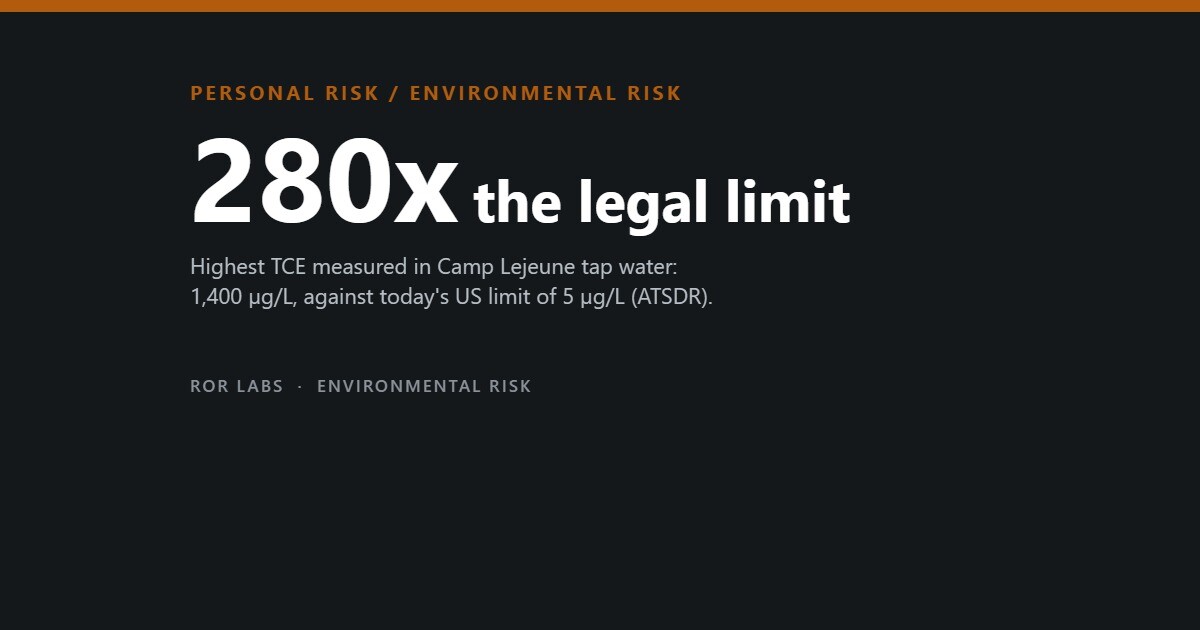
- From the 1950s to 1985, two water systems at Camp Lejeune, a Marine base in North Carolina, carried industrial solvents. The highest TCE reading was 280 times today’s US limit.
- Compared with Marines at uncontaminated Camp Pendleton, Camp Lejeune personnel had modestly higher rates of several cancers and 70% higher odds of Parkinson’s disease.
- Most raised risks are small and imprecise. Exposure was rebuilt by computer models, since almost nobody tested before 1980, and there were no smoking data.
- TCE is a known human carcinogen, most clearly for kidney cancer. The US banned it in December 2024, but parts of the rule are on hold during a court challenge.
Trichloroethylene (TCE) was long the standard degreaser for engine parts. Its cousin perchloroethylene (PCE) still cleans clothes in some dry cleaners. Both sink through soil, last for decades in groundwater and turn up in wells, and at the levels that matter nobody can taste them.
Camp Lejeune is where that problem has been studied hardest. For about three decades, Marines, families and civilian staff at the North Carolina base drank and showered in contaminated water. This article looks at what government scientists found, what they could not, and what the case means for anyone on a town supply or a private well. A separate article covers PFAS in drinking water.
The answer is uncomfortable in both directions. The chemicals cause some cancers, and the base studies point the same way. But the raised risks are mostly modest, the exposures come from models, and the hundreds of thousands now seeking compensation are not, one by one, proven cases.
What happened at Camp Lejeune
The base runs on groundwater, and two treatment plants were affected. Tarawa Terrace, a housing area of about 1,850 homes, drew on wells polluted with PCE from an off-base dry cleaner. Hadnot Point, serving barracks, workplaces and more housing, drew on wells polluted with TCE from leaking tanks, spills and waste sites on the base.
Nobody sampled the tap water for these compounds before 1980. When they did, the highest TCE reading at Hadnot Point was 1,400 micrograms per litre (µg/L). Benzene from fuel and vinyl chloride, a breakdown product of TCE and PCE, were found too. The worst wells were shut in February 1985.
Measured and modelled levels against today’s limit
Camp Lejeune drinking water, micrograms per litre (µg/L). The US limit for TCE and PCE is 5 µg/L.
Source: Bove et al., Environmental Health Perspectives (2024), citing ATSDR models. Modelled figures are reconstructions.
The law and the Department of Veterans Affairs (VA) use a wider window, August 1953 to December 1987. Federal health officials estimate that 500,000 to one million people may have been exposed over that span.
Two families who made it public
Jerry Ensminger served 24 years in the Marine Corps, retiring as a master sergeant. In testimony to a House of Representatives committee, he said his daughter Janey was conceived while the family lived in base housing and was diagnosed with acute lymphocytic leukaemia at six. She died in 1985, aged nine. He did not learn about the contaminated water until 1997.

Mike Partain was born in the base hospital in 1968. At 39 he was diagnosed with breast cancer, a disease rare in men. He joined Ensminger in 2007, and the two went on to gather a list of more than 125 men with the same diagnosis who had links to the base. Ensminger campaigned for the 2012 law on VA care for Camp Lejeune veterans and families; its working title carried Janey’s name.
Their stories are why the studies exist, but they do not show that the water caused either illness. A government study of 71 Marines with male breast cancer found only a small, imprecise excess for Camp Lejeune (odds ratio 1.14); a larger registry study later found a clearer signal in the full Marine cohort. Neither design can settle what happened to one person.
Rebuilding the exposure
With so few measurements, the Agency for Toxic Substances and Disease Registry (ATSDR) rebuilt the past. Its engineers linked groundwater and contaminant-transport models to models of mixing at the plants and flow through the pipes, producing monthly estimates for each housing area back to the 1950s. The modellers did not know who later fell ill.
The few real samples offer a check. At Tarawa Terrace the highest simulated monthly PCE average was 183 µg/L, against a measured maximum of 215. A fair match, but still a reconstruction: every exposure figure in the studies below is modelled.
People were also classed by where their unit was based, not by what they drank, though many trained away or lived off base. That tends to blur a true effect towards zero and leaves its size uncertain.
What the adult studies found
ATSDR compared Camp Lejeune with Camp Pendleton in California, a similar Marine base with clean water; Marines against Marines avoids the ‘healthy soldier’ bias. The first mortality study, led by Frank Bove in 2014, followed about 155,000 people from each base who began service in 1975–85, through 2008. Camp Lejeune had a 10% higher death rate from all cancers. Several specific cancers were higher still, but the confidence intervals were wide, and by the end of follow-up fewer than 6% of the cohort had died.
Early mortality signals, with wide margins
Hazard ratio for death, Camp Lejeune v. Camp Pendleton personnel, 1979–2008. All intervals include or touch 1.
Source: Bove et al., Environmental Health (2014); 154,932 and 154,969 personnel, 8,964 and 9,365 deaths.
In 2024 the team used cancer diagnoses from 54 registries between 1996 and 2017 instead of death certificates. Among about 155,000 Camp Lejeune and 163,000 Camp Pendleton personnel, the overall cancer rate was 5% higher at Camp Lejeune, and a handful of cancers stood out.
Cancer diagnoses, 1996–2017
Adjusted hazard ratio for a cancer diagnosis, Camp Lejeune v. Camp Pendleton, Marines and Navy personnel who began service in 1975–85.
Source: Bove et al., Environmental Health Perspectives (2024), table 3. No smoking data. Grey bars: interval includes 1.
Kidney cancer, the one most firmly tied to TCE, was barely raised, but over three quarters of the cohort were still under 60. A companion 2024 mortality study, with deaths to 2018, did find kidney, oesophageal and female breast cancer deaths raised by at least 20%.
Smoking is the obvious worry: 53% of Marines smoked in 1980, and there were no individual data. As a check, the team used smoking-related diseases not linked to solvents. Chronic lung disease deaths differed little, implying a smoking gap of 4–6 percentage points; correcting for it would trim the lung and larynx results by under 10%. It is an indirect test.
The clearest number concerns Parkinson’s disease. A team led by Samuel Goldman, using VA and Medicare records, found 279 cases among 172,128 Camp Lejeune veterans and 151 among 168,361 from Camp Pendleton, an odds ratio of 1.70 after adjustment. In absolute terms, that is 0.33% against 0.21%.
Pregnancy and children
ATSDR’s first questions were about babies, and the answers are the patchiest. Among 11,896 births to mothers in base housing in 1968–85, the highest modelled TCE exposure went with more babies small for their gestational age, and the highest PCE exposure with more preterm births. The effects were modest and did not always rise with dose.
Birth outcomes at the highest modelled exposure
Odds ratios against births with unexposed water, Camp Lejeune, 1968–85.
Sources: Ruckart et al., Environmental Health (2014 and 2013). Grey bars: interval includes or touches 1.
A parent survey checked against medical records looked for rarer conditions. Of 106 reported cases, only 15 neural tube defects, 24 oral clefts and 13 childhood blood cancers were confirmed. TCE above today’s limit in early pregnancy went with more than twice the odds of a neural tube defect, but the interval ran from 0.6 to 9.6. The childhood cancers showed no clear dose pattern.
For families like the Ensmingers, that is hard to read. A study of 13 children cannot rule a link in or out; the evidence on childhood leukaemia at the base is simply too thin to carry much weight either way.
What TCE and PCE do to the body
The case against TCE does not rest on Camp Lejeune. In 2012 the International Agency for Research on Cancer (IARC) classed it as carcinogenic to humans, its top category; PCE is rated probably carcinogenic.
The US Environmental Protection Agency (EPA) finished its own TCE review in 2011. Its meta-analyses of worker studies found convincing evidence for kidney cancer and weaker signals for liver cancer and non-Hodgkin lymphoma. Lung cancer was not raised, which argues against smoking as the explanation.
TCE in worker studies
Summary relative risk for any occupational TCE exposure, random-effects meta-analyses by the US EPA.
Source: Chiu et al., Environmental Health Perspectives (2013), summarising the EPA review. Worker exposures were often higher than residential ones.
ATSDR’s own review judged the evidence sufficient for TCE causing kidney cancer and non-Hodgkin lymphoma, PCE causing bladder cancer, benzene causing leukaemias and vinyl chloride causing liver cancer. Outside cancer, EPA’s safe-dose values for TCE rest partly on heart defects in animals exposed in the womb, so even short exposure in pregnancy is taken seriously.
Most of these risk ratios come from workers who breathed vapour daily, so applying them to a town supply is a stretch. But tap water is not only drunk: a Marine in training was estimated to drink up to six litres a day, and breathing vapour and skin contact in the shower may add more than drinking.
The law, the claims and the ban
Since 2017 the VA has presumed a service link for eight conditions in veterans with at least 30 days at the base in 1953–87, including kidney, liver and bladder cancer, adult leukaemia and Parkinson’s disease. The Camp Lejeune Justice Act, signed in August 2022 as part of the PACT Act, let people sue the government directly.
More than 408,000 claims have reached the Navy. A fast-track ‘Elective Option’ pays $100,000 to $550,000 for nine conditions. By 18 September 2026 the Justice Department had offered over $1.1 billion and paid over $879 million, yet only about 1% of claimants had settled. Partain reckons that at the Navy’s pace the backlog would take 429 years.
Mousser alleges that base water in the 1980s caused the cancer diagnosed in 2020; the government disputes it, and the judge will rule on causation and damages. His is the first of four kidney cancer ‘bellwether’ trials meant to guide everyone else’s claims. Until then it is an allegation, not a finding.
In December 2024 EPA banned TCE, most uses within a year, and set a ten-year phase-out of PCE in dry cleaning. EPA now intends to reconsider both. Challenges to the TCE rule are before the Third Circuit Court of Appeals, and in May 2026 EPA postponed conditions on its exemptions until the case ends. Neither rule touches solvent already in the ground.
What it means for your water
US public water systems must keep these chemicals below federal limits: 5 µg/L for TCE, PCE and benzene, and 2 µg/L for vinyl chloride. Your utility’s annual water quality report lists them. Breaches happen, but the system is built to catch them, which Camp Lejeune’s was not before 1980.
Private wells are another matter: the owner tests, or nobody does. A US Geological Survey study of 1,926 rural private wells sampled in 1986–99 found at least one volatile organic compound in 12% of samples and 1.4% above a federal standard or health guideline, with PCE among the most common. It remains the best national figure, and it is over 20 years old.
EPA advises yearly tests for bacteria, nitrates and a few basics, adding volatile organic compounds if the well is near a dry cleaner, fuel station, buried tank, landfill or factory, or the water smells of fuel. Use a certified drinking-water laboratory; some health departments test wells free.
Solvents can also arrive through the air. Vapour from a plume can rise through cracks in a slab or gaps around pipes; this is vapour intrusion. The usual fix is sub-slab depressurisation, a fan system like those used for radon. If you live over a known plume, ask your state environment agency whether indoor air has been tested, especially if anyone at home is pregnant.
What to do
Steps sorted by when they matter. Each one says how strong the evidence is: Measured Official advice Untested
Before
- If you use a private well, test it every year for bacteria and nitrates, and add volatile organic compounds if it is near a dry cleaner, fuel station, buried tank, landfill or factory. Official advice see Sources
- Use a laboratory certified for drinking-water testing, or ask your local health department, which may test wells for free. Official advice see Sources
- On public water, read your utility’s annual water quality report for TCE, PCE, benzene and vinyl chloride results. Untested see Sources
- If you live over a known solvent plume, ask your state environment agency whether indoor air has been tested for vapour intrusion. Untested see Sources
If it happens
- If a test finds solvents, use another water source for drinking and cooking until the cause is fixed. Untested see Sources
- Do not rely on boiling: it drives volatile compounds into the air of your kitchen. Untested see Sources
- If you choose a filter, pick one certified for the specific chemical and change cartridges on schedule. Untested see Sources
- If vapour intrusion is confirmed, ask about sub-slab depressurisation, a fan system similar to those used for radon. Official advice see Sources
Afterwards
- If you lived or served at Camp Lejeune between 1953 and 1987, tell your doctor where and when, so it can be weighed with your other risks. Untested see Sources
- Veterans with at least 30 days at the base in that period can check the VA’s list of eight presumptive conditions. Official advice see Sources
- For questions about Camp Lejeune Justice Act claims, ask the Navy claims office or a qualified attorney before deciding on any offer. Untested see Sources
What not to do
- Do not assume a past exposure caused a particular illness; the studies show group risks, not individual causes. Measured see Sources
- Do not assume a private well is safe because it tastes fine: these solvents cannot be tasted at the levels that matter. Untested see Sources
- Do not treat a solvent ban as a clean-up: the 2024 rules do not remove solvent already in the ground. Measured see Sources
Not medical or legal advice. If you lived or worked at an affected site, tell your doctor and keep records of your service or residence.
Questions people ask
Does a home water filter remove TCE and PCE?
Activated carbon filters can reduce volatile organic compounds, but products vary. Look for certification for the specific chemical and change cartridges on schedule. Test first, so you know what you are filtering for.
I lived at Camp Lejeune as a child. Should I be screened for cancer?
Tell your doctor where and when you lived, so they can weigh it with your other risks. Veterans and family members may be eligible for VA health care; check the VA’s Camp Lejeune pages.
Can I still file a claim under the Camp Lejeune Justice Act?
The law set a filing deadline that has passed for most people, and the court is still shaping the process. Ask the Navy’s claims office or an attorney. VA disability claims are a separate route.
Does boiling water get rid of solvents?
Boiling drives volatile compounds into the air, and so into your kitchen. If a test shows solvents, use another source for drinking and cooking until the cause is fixed.
Is Camp Lejeune water safe now?
The worst wells closed in 1985 and the Tarawa Terrace plant in 1987. The base supply must now meet federal limits like any public system.
The short version
- From the 1950s to 1985, two water systems at Camp Lejeune, a Marine base in North Carolina, carried industrial solvents. The highest TCE reading was 280 times today’s US limit.
- Compared with Marines at uncontaminated Camp Pendleton, Camp Lejeune personnel had modestly higher rates of several cancers and 70% higher odds of Parkinson’s disease.
- Most raised risks are small and imprecise. Exposure was rebuilt by computer models, since almost nobody tested before 1980, and there were no smoking data.
- TCE is a known human carcinogen, most clearly for kidney cancer. The US banned it in December 2024, but parts of the rule are on hold during a court challenge.
- More than 408,000 claims have been filed under a 2022 law. About 1% of claimants had settled by autumn 2026; the first trial still awaited a ruling in November.
- Public water must meet solvent limits; a private well is tested only if you test it. Check for volatile organic compounds near dry cleaners, fuel stations, landfills or factories.
This article summarises research, government documents and news reports for general information. It is not medical or legal advice. If you are worried about past exposure, talk to your doctor; for claims, ask the VA, the Navy or a qualified attorney.
Further reading: Bove et al., Environmental Health Perspectives (2024), for the cancer-registry comparison of Camp Lejeune and Camp Pendleton. Goldman et al., JAMA Neurology (2023), for Parkinson’s disease. Chiu et al., Environmental Health Perspectives (2013), for how EPA weighed the TCE evidence.
Sources
- Weston A. Federal scientist challenges Justice Department’s kidney cancer defense in Camp Lejeune litigation. Public Radio East / WUNC (9 November 2026).
- Weston A. First Camp Lejeune Justice Act trial ends as deadline for global settlement framework approaches. Public Radio East / WFAE (29 October 2026).
- Weston A. Advocates for Camp Lejeune water contamination victims contest DOJ claims. Public Radio East / WFAE (16 March 2026).
- Bove FJ, Greek A, Gatiba R, et al. Cancer incidence among Marines and Navy personnel and civilian workers exposed to industrial solvents in drinking water at US Marine Corps Base Camp Lejeune: a cohort study. Environ Health Perspect 132(10):107008 (2024), doi:10.1289/EHP14966.
- Bove FJ, Greek A, Gatiba R, Boehm RC, Mohnsen MM. Evaluation of mortality among Marines, Navy personnel, and civilian workers exposed to contaminated drinking water at USMC base Camp Lejeune: a cohort study. Environ Health (2024), doi:10.1186/s12940-024-01099-7.
- Bove FJ, Ruckart PZ, Maslia M, Larson TC. Evaluation of mortality among marines and navy personnel exposed to contaminated drinking water at USMC base Camp Lejeune: a retrospective cohort study. Environ Health 13:10 (2014), doi:10.1186/1476-069X-13-10.
- Ruckart PZ, Bove FJ, Shanley E, Maslia M. Evaluation of contaminated drinking water and male breast cancer at Marine Corps Base Camp Lejeune, North Carolina: a case control study. Environ Health (2015).
- Ruckart PZ, Bove FJ, Maslia M. Evaluation of contaminated drinking water and preterm birth, small for gestational age, and birth weight at Marine Corps Base Camp Lejeune, North Carolina: a cross-sectional study. Environ Health 13:99 (2014), doi:10.1186/1476-069X-13-99.
- Ruckart PZ, Bove FJ, Maslia M. Evaluation of exposure to contaminated drinking water and specific birth defects and childhood cancers at Marine Corps Base Camp Lejeune, North Carolina: a case-control study. Environ Health 12:104 (2013), doi:10.1186/1476-069X-12-104.
- Maslia ML, Aral MM, Ruckart PZ, Bove FJ. Reconstructing historical VOC concentrations in drinking water for epidemiological studies at a U.S. military base: summary of results. Water 8(10):449 (2016).
- Goldman SM, Weaver FM, Stroupe KT, et al. Risk of Parkinson disease among service members at Marine Corps Base Camp Lejeune. JAMA Neurol (2023), doi:10.1001/jamaneurol.2023.1168.
- Chiu WA, Jinot J, Scott CS, et al. Human health effects of trichloroethylene: key findings and scientific issues. Environ Health Perspect (2013), doi:10.1289/ehp.1205879.
- International Agency for Research on Cancer Monograph Working Group. Carcinogenicity of trichloroethylene, tetrachloroethylene, some other chlorinated solvents, and their metabolites. Lancet Oncol 13(12):1192–1193 (2012).
- Moran MJ, Lapham WW, Rowe BL, Zogorski JS. Volatile organic compounds in ground water from rural private wells, 1986 to 1999. J Am Water Resour Assoc 40(5):1141–1157 (2004).
- Ensminger J. Written testimony to the US House of Representatives Committee on Science (hearing document, science.house.gov).
- US Department of Veterans Affairs. Diseases associated with exposure to contaminants in the water supply at Camp Lejeune. 38 CFR Part 3, effective 14 March 2017.
- US Environmental Protection Agency. Trichloroethylene (TCE); regulation under the Toxic Substances Control Act. Federal Register 89 FR 102568 (17 December 2024); extension of postponement of effectiveness, Federal Register document 2026-08750 (5 May 2026).
- US Environmental Protection Agency. Risk management for perchloroethylene (PCE), web page (accessed November 2026).
- US Environmental Protection Agency. Protect your home’s water (private wells), web page (accessed November 2026).
- US Environmental Protection Agency. A citizen’s guide to vapor intrusion mitigation. EPA 542-F-12-021 (September 2012).