Two of the 14 Dementia Risk Factors Are Your Ears and Your Eyes
In This Series: Healthy Ageing & Everyday Myths
- The Wrong Cuff Turns 125 Into 144. Most People Have Never Had This Measured Properly.
- Every 3 Decibels Halves the Time. That Is the Whole Rule, and Almost Nobody Knows It.
- Sleep Regularity Beat Sleep Duration: What the Mortality Data Shows
- Sitting Is Not the New Smoking. The Standing Desk Did Not Help Either.
- Falls at Home: The Fixes With Evidence, and the One That Was Withdrawn
- Loneliness Raises the Risk of Dying by Fourteen Per Cent. The Fifteen-Cigarettes Line Came From Somewhere Else.
Disclosure: this article contains affiliate links, marked (paid link). If you buy through one we may earn a commission, at no extra cost to you. As an Amazon Associate I earn from qualifying purchases. It costs you nothing and it does not change what we recommend.
Key takeaways · 7 min read
- The 2024 Lancet Commission identified 14 modifiable risk factors covering an estimated 45% of dementia cases at population level.
- Two were newly added: high midlife LDL cholesterol (7%) and untreated vision loss in later life (2%).
- Hearing loss remains one of the largest single contributors.
- Many of the fourteen are cardiovascular. What protects the heart protects the brain.
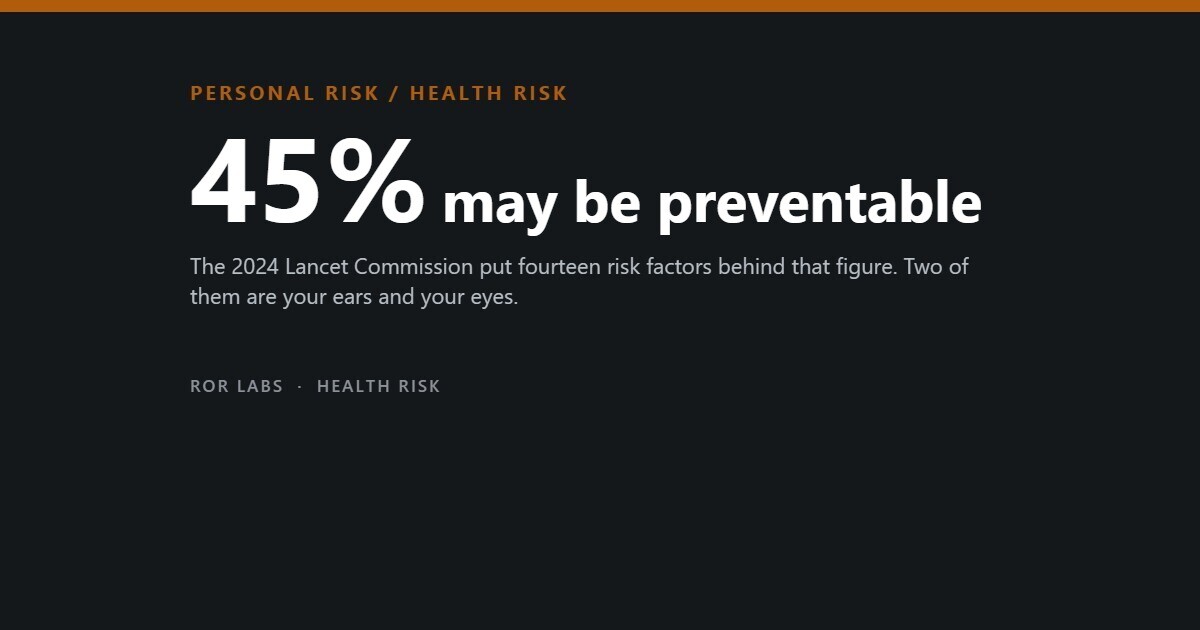
Dementia is widely understood as something that happens to you — genetic, unlucky, unavoidable. The 2024 Lancet Commission put a number against that assumption. Around 45% of dementia cases could potentially be prevented by addressing fourteen risk factors, none of which is a drug.
That is a population figure, not a personal guarantee, and the distinction matters. But two of the fourteen are things most people would never connect to their brain at all, and one of them is treated in an afternoon.

The fourteen, by life stage
What the Commission identified
Grouped by when in life the exposure matters most. Two were added in the 2024 update.
| Life stage | Risk factors |
|---|---|
| Early life | Less education |
| Midlife | Hearing loss, high LDL cholesterol (new), depression, traumatic brain injury, physical inactivity, diabetes, smoking, hypertension, obesity, excessive alcohol |
| Later life | Social isolation, air pollution, untreated vision loss (new) |
Source: Livingston G, et al. “Dementia prevention, intervention, and care: 2024 report of the Lancet standing Commission.” The Lancet, 2024.
The two additions, and what they carry
Share of dementia cases attributable to each, at population level.
Source: 2024 Lancet Commission on dementia prevention, intervention and care.
Hearing and vision are the surprising ones
Hearing loss has been on this list for years and remains among the largest single contributors. Vision loss joined it in 2024. Both are sensory, both are ordinary, and both are usually treated as quality-of-life issues rather than brain-health ones.
The proposed mechanisms are plausible and not fully settled: a degraded signal makes the brain work harder to interpret it, sensory loss withdraws people from conversation and social contact, and less stimulation may accelerate decline. Causation is not established — early dementia can also cause someone to stop engaging, which looks like sensory withdrawal.
But the practical position is unusually comfortable. Treating hearing and vision loss is worth doing on its own merits, carries almost no downside, and may carry this benefit as well. That is a rare shape for a health decision.
Things worth booking, not buying
Each of these is a specific appointment that maps onto a factor above.
Source: 2024 Lancet Commission risk factor list.
What 45% does and does not mean
This number is quoted constantly and misunderstood almost as often, so it is worth being precise.
Reading the figure honestly
Both columns are true at once.
Source: 2024 Lancet Commission, population attributable fraction methodology.
We make the same point about the modelled figures in our articles on gas stoves and falls, and it applies here with particular force, because dementia attracts more supplement marketing than almost any other condition. A population attributable fraction is a policy tool. It tells governments where to spend. It does not license anyone to sell you a 45% reduction in a bottle.
The small amount that is worth buying (paid link)
Nearly everything on the Commission’s list is an appointment rather than a purchase. These two map onto actual factors.
Browse on Amazon →
Browse on Amazon →
We are not linking brain supplements, nootropics or “memory” formulas. No supplement appears anywhere on the Commission’s list of fourteen factors, and the largest trials of the popular candidates have not shown a benefit for cognition. We are also not linking brain-training subscriptions: they reliably make you better at the games, and the transfer to everyday memory has not held up. Hearing aids and glasses would be the honest recommendations here, and both need a professional fitting rather than a link.

Questions people ask
Is it too late at 60?
No. The Commission organises factors by life stage precisely because different ones matter at different points — social isolation, air pollution and vision loss are later-life factors, which means they are live now for someone in their sixties. Hearing loss and blood pressure remain worth treating at any age. The framing that helps is that you are always in some stage of this list.
My parent had dementia. Does the list still matter?
More, if anything. Family history raises baseline risk, and modifiable factors act on top of that baseline rather than being cancelled by it. Genetic risk and lifestyle risk are largely additive in the cohort data. If you carry more of the first, the second is where the room to move is.
Does social isolation really belong on a medical list?
It is on the Commission’s later-life list, and it is also the hardest one to interpret — withdrawal can be an early symptom rather than a cause. But it interacts with the sensory factors in a way that is worth noticing: hearing loss makes conversation exhausting, exhausting conversation gets avoided, and avoidance produces isolation. Treating the hearing may be the most effective way to treat the isolation.
What about the new Alzheimer’s drugs?
They are treatments for people who already have the disease, not prevention, and their benefits so far are modest and come with real side effects and monitoring requirements. They do not change anything in this article. Prevention and treatment are separate questions, and this one is about prevention.
The short version
- The 2024 Lancet Commission identified 14 modifiable risk factors covering an estimated 45% of dementia cases at population level.
- Two were newly added: high midlife LDL cholesterol (7%) and untreated vision loss in later life (2%).
- Hearing loss remains one of the largest single contributors.
- Many of the fourteen are cardiovascular. What protects the heart protects the brain.
- 45% is a population estimate from observational data, not a personal guarantee — age and genetics still dominate.
- Most of the list is appointments, not purchases: hearing test, eye test, blood pressure, cholesterol, diabetes, depression.
- No supplement appears anywhere on the list.
- Later-life factors mean it is never too late to act on part of it.
This summarises published population research and is not medical advice. If you are worried about your own or a relative’s memory, a doctor can assess it properly — and several treatable conditions, including thyroid problems, vitamin deficiency and depression, can mimic early dementia.
On the links above: some are affiliate links, marked (paid link). If you buy through one we may earn a commission at no additional cost to you. As an Amazon Associate I earn from qualifying purchases. We link to product searches rather than specific items so recommendations do not break as models change, and we say plainly when we are choosing not to link something. Full policy: Affiliate Disclosure.
Sources
- Livingston G, Huntley J, Liu KY, et al. “Dementia prevention, intervention, and care: 2024 report of the Lancet standing Commission.” The Lancet, 2024.
- Alzheimer Europe. Summary of the 2024 Lancet Commission on dementia risk reduction.
- Dementias Platform UK. Analysis of newly added modifiable risk factors in the 2024 Lancet report.