Every 3 Decibels Halves the Time. That Is the Whole Rule, and Almost Nobody Knows It.
In This Series: Healthy Ageing & Everyday Myths
- Two of the 14 Dementia Risk Factors Are Your Ears and Your Eyes
- The Wrong Cuff Turns 125 Into 144. Most People Have Never Had This Measured Properly.
- Sleep Regularity Beat Sleep Duration: What the Mortality Data Shows
- Sitting Is Not the New Smoking. The Standing Desk Did Not Help Either.
- Falls at Home: The Fixes With Evidence, and the One That Was Withdrawn
- Loneliness Raises the Risk of Dying by Fourteen Per Cent. The Fifteen-Cigarettes Line Came From Somewhere Else.
Disclosure: this article contains affiliate links, marked (paid link). If you buy through one we may earn a commission, at no extra cost to you. As an Amazon Associate I earn from qualifying purchases. It costs you nothing and it does not change what we recommend.
Key takeaways · 12 min read
- Hair cells do not grow back. Every loss is permanent and cumulative.
- Below 70 dBA there is essentially no risk, at any duration.
- The limit is 85 dBA for 8 hours, and every 3 dB louder halves the safe time.
- At 100 dBA — earbuds near maximum — the daily allowance is 15 minutes.
There is one fact about hearing that decides everything else, and most people have never been told it plainly: the cells that do the hearing do not grow back. The hair cells in the human cochlea are formed before birth and are never replaced. Birds regrow theirs. Fish regrow theirs. We do not. Every one you destroy is subtracted from a fixed budget you were issued once.
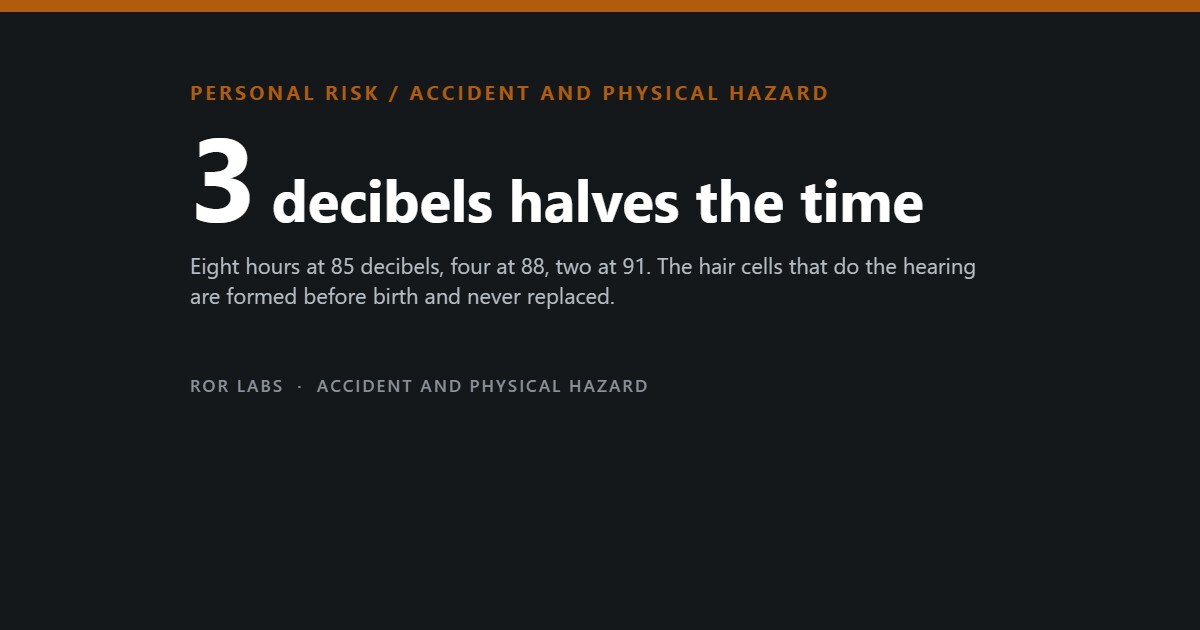
The second fact is the one that turns the first into something you can act on. Loudness does not add up the way the numbers look. The decibel scale is logarithmic, and the exposure limits move on a three-decibel exchange rate: every three decibels louder halves the time you can safely be there. Eight hours at 85 decibels and fifteen minutes at 100 decibels are, as far as your cochlea is concerned, roughly the same event.
Almost nobody knows that table. It is the single most useful thing in occupational health that never made it into ordinary life, and it explains why a two-hour concert can cost you more than a career in a moderately noisy office. Here is what the evidence says, what the numbers actually are, and which protection is worth buying.
What is actually being destroyed
Sound arrives at the inner ear as a travelling wave, and rows of hair cells convert that motion into nerve signals. Loud sound damages them mechanically and metabolically. As the U.S. National Institute on Deafness and Other Communication Disorders puts it, human hair cells do not grow back: they are gone for good.
The ringing that goes away is not proof that nothing happened
Two different things get confused constantly, and only one of them recovers.
Source: National Institute on Deafness and Other Communication Disorders (NIDCD), “Noise-Induced Hearing Loss.”
There is a floor below which none of this matters. Sounds at or below 70 A-weighted decibels are unlikely to cause hearing loss no matter how long you are exposed. Ordinary conversation sits at 60 to 70 dBA. A quiet office, a supermarket, a car at cruising speed — all below the line. The problem starts at 85 and gets steep very quickly after that.
Where everyday sounds actually sit
A-weighted decibels. The 70 dBA line is where risk begins to exist at all; 85 dBA is where the clock starts running.
Source: NIDCD, “Noise-Induced Hearing Loss,” common sound levels.
The table nobody shows you
The U.S. National Institute for Occupational Safety and Health sets its recommended exposure limit at 85 dBA averaged over an eight-hour day. The part that matters for ordinary life is the rule attached to it: for every three-decibel increase, NIOSH recommends halving the exposure time.
Three decibels sounds like nothing. It is a doubling of sound energy. Follow it up the scale and the durations collapse.
How long you can safely be there
NIOSH recommended exposure limits, using the 3 dB exchange rate. These are daily totals, not per-event allowances.
| Sound level | Safe daily exposure | What that sounds like |
|---|---|---|
| 85 dBA | 8 hours | Heavy city traffic, a busy restaurant |
| 88 dBA | 4 hours | A noisy bar |
| 91 dBA | 2 hours | A subway platform as the train arrives |
| 94 dBA | 1 hour | A hairdryer at close range |
| 97 dBA | 30 minutes | A power drill |
| 100 dBA | 15 minutes | Earbuds near maximum volume |
| 103 dBA | 7 minutes 30 seconds | A petrol lawnmower |
| 106 dBA | 3 minutes 45 seconds | A nightclub dance floor |
| 109 dBA | Under 2 minutes | A rock concert near the stage |
| 112 dBA | About 1 minute | A chainsaw |
| 115 dBA | About 30 seconds | A siren beside you |
Source: National Institute for Occupational Safety and Health (NIOSH), Occupational Noise Exposure: Criteria for a Recommended Standard; CDC/NIOSH, “Noise-Induced Hearing Loss.”
One honest caveat. These are occupational limits, built for a working lifetime of daily exposure and set at a level that still allows a meaningful minority of exposed workers to develop hearing loss over a career. They are not a bright line between safe and dangerous for a single evening, and nobody has run a trial in which one group went to concerts for thirty years. Treat the table as a dosing guide with real uncertainty around it — but note that the uncertainty runs in both directions, and the World Health Organization’s recommended limit for recreational listening is stricter, not looser: 80 dB for adults and 75 dB for children, over a week.
Where the exposure actually comes from now
For most of the twentieth century this was an industrial problem. It is no longer only that. A systematic review published in BMJ Global Health in 2022 pooled 33 studies covering 19,046 people aged 12 to 34 and estimated how many young people are exposed to unsafe listening levels.
Between 0.67 and 1.35 billion young people
Prevalence of unsafe listening among 12- to 34-year-olds, pooled across 33 studies.
Source: Dillard, L.K. et al., “Prevalence and global estimates of unsafe listening practices in adolescents and young adults,” BMJ Global Health, November 2022. World Health Organization safe listening standards.
The damage is already visible in the population data. A CDC analysis found that somewhere between 10 and 40 million American adults under 70 show audiometric signs of noise-related hearing damage, and roughly 17% of teenagers aged 12 to 19 show evidence of noise-induced hearing loss. That second number is the one worth sitting with: a sixth of teenagers already have measurable damage they will carry for another seventy years.
The reason this matters more than it used to
Hearing loss used to be filed as an inconvenience of ageing. The 2024 Lancet Commission on dementia prevention put it somewhere else entirely: hearing loss is one of the fourteen modifiable risk factors that together account for a large share of dementia cases worldwide, and by the Commission’s accounting it carries one of the biggest single population-attributable fractions on the list.
What the connection is, and what it is not
This is the part that gets overstated in headlines, so it is worth being precise.
Source: Livingston, G. et al., “Dementia prevention, intervention, and care: 2024 report of the Lancet standing Commission,” The Lancet, 2024.
What actually helps, in order
Everything below is distance, time, or a barrier. There is nothing else — no supplement, no exercise, no recovery protocol that restores a hair cell.
Ranked by how much exposure each one removes
The first four are free.
Sources: NIOSH; NIDCD; World Health Organization, Make Listening Safe.
The protection worth owning (paid link)
Look for a stated noise reduction rating. A plug without one is a piece of foam with a claim attached.
Browse on Amazon →
Browse on Amazon →
Browse on Amazon →
Browse on Amazon →
Two things we are deliberately not linking. The first is supplements marketed for hearing or tinnitus — ginkgo, zinc, magnesium, proprietary blends. Hair cells do not regenerate in humans, and no supplement has been shown to restore hearing or reliably prevent noise damage; the category exists because tinnitus is distressing and untreatable, which makes it a good market rather than a good treatment. The second is paid sound-level meter apps. NIOSH publishes one free, developed and laboratory-validated by the agency that wrote the exposure limits. There is no reason to buy one. Separately, worth knowing: noise-cancelling headphones are a genuine safety tool, not because they are quiet but because they remove the background you were competing with — most people turn the volume down once the aircraft or train noise is gone.
Questions people ask
Are earbuds worse than over-ear headphones?
Not inherently — what matters is the level reaching the eardrum and how long it lasts. In practice earbuds tend to be used in noisier places, which pushes people to raise the volume, and they are worn for longer stretches. The style of the device is a weak predictor; the volume setting and the hours are the whole story.
Is 60% volume for 60 minutes a real rule?
It is a rule of thumb, not a measurement, and it is a reasonable one. Its weakness is that 60% of maximum means different absolute levels on different devices and with different headphones. If you want the real answer rather than the approximation, use your phone’s built-in headphone exposure reporting, which measures what actually reached your ear.
My ears ring after concerts but it always goes away. Am I fine?
The ringing going away means the temporary threshold shift resolved. It does not mean nothing was damaged — research indicates residual long-term damage can remain after hearing appears to recover. Repeated temporary shifts are the mechanism by which permanent loss accumulates, so treat each one as a bill rather than a near miss.
Do noise-cancelling headphones protect my hearing?
Indirectly, and usefully. They do not block the sound you are playing, and at high volume they are as capable of damage as anything else. What they do is remove the ambient noise you were trying to overcome, and most people respond by turning the volume down. That second-order effect is real and it is the reason they are worth having on a commute.
I already have some hearing loss. Is there any point?
Yes, and more than before. The damage you have is permanent, but the hair cells you still have are the ones worth defending, and the exposure table applies to them exactly as it did at twenty. If loss is affecting conversation, an audiologist is the right person to see — untreated hearing loss is the version that appears in the dementia literature, and treatment is the modifiable part.
The short version
- Hair cells do not grow back. Every loss is permanent and cumulative.
- Below 70 dBA there is essentially no risk, at any duration.
- The limit is 85 dBA for 8 hours, and every 3 dB louder halves the safe time.
- At 100 dBA — earbuds near maximum — the daily allowance is 15 minutes.
- Entertainment venues average 104 to 112 dB, where the allowance is one to four minutes.
- 24% of young people listen unsafely on headphones; 48% are exposed at venues. Up to 1.35 billion people at risk.
- About 17% of teenagers already show measurable noise-induced hearing loss.
- Ringing that fades is a temporary threshold shift, not an all-clear.
- Hearing loss is on the Lancet list of modifiable dementia risk factors — an association, not a proven causal chain, but a cheap one to act on.
- There is no supplement that regrows a hair cell. Distance, time and a barrier are the whole toolkit.
This article is about noise exposure, not medical diagnosis. Sudden hearing loss in one ear is a medical emergency and should be seen the same day; persistent tinnitus, and any hearing change that affects conversation, is a reason to see an audiologist or a doctor rather than to self-manage.
On the links above: some are affiliate links, marked (paid link). If you buy through one we may earn a commission at no additional cost to you. As an Amazon Associate I earn from qualifying purchases. We link to product searches rather than specific items so that recommendations do not break as models change, and we say plainly when we are choosing not to link something. Full policy: Affiliate Disclosure.
Sources
- National Institute for Occupational Safety and Health (NIOSH). Occupational Noise Exposure: Criteria for a Recommended Standard. Recommended exposure limit of 85 dBA over 8 hours with a 3 dB exchange rate.
- Centers for Disease Control and Prevention / NIOSH. “Noise-Induced Hearing Loss.” cdc.gov/niosh/noise.
- National Institute on Deafness and Other Communication Disorders (NIDCD). “Noise-Induced Hearing Loss.” (Hair cell permanence; 70 dBA threshold; common sound levels; temporary threshold shift; prevalence estimates of 10–40 million U.S. adults under 70 and approximately 17% of 12- to 19-year-olds.)
- Dillard, L.K., Arunda, M.O., Lopez-Perez, L., et al. “Prevalence and global estimates of unsafe listening practices in adolescents and young adults: a systematic review and meta-analysis.” BMJ Global Health, November 2022. (33 studies, 19,046 participants aged 12–34; 24% unsafe personal listening device use; 48% unsafe venue exposure; 0.67–1.35 billion at risk.)
- World Health Organization. Make Listening Safe initiative and safe listening standards (80 dB for adults, 75 dB for children).
- Livingston, G. et al. “Dementia prevention, intervention, and care: 2024 report of the Lancet standing Commission.” The Lancet, 2024.