Child Heatstroke in Hot Cars: What the Evidence Shows
Key takeaways · 14 min read
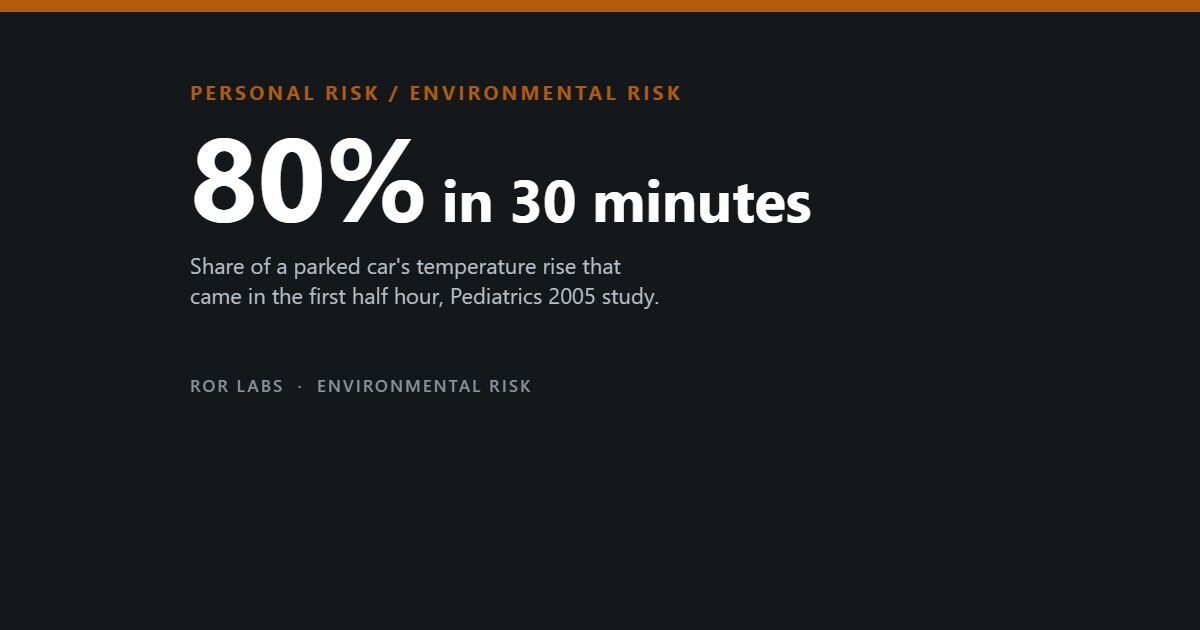
- In a 2005 study, 80% of a parked car’s temperature rise came in the first 30 minutes, and cracking the windows made almost no difference.
- About 37 children a year have died of heatstroke in US vehicles since 1998; just over half were forgotten by a caregiver.
- Memory researchers describe the forgetting as a failure of prospective memory, made more likely by a change in routine, stress and lack of sleep, not by a lack of love.
- Congress ordered a federal rule on child-detection technology by November 2023; by June 2026 no rule had even been proposed.
Every summer in the United States, children die after being left in, or climbing into, a parked car. The numbers are small next to road deaths, about three dozen a year, but each case is devastating, and most share a pattern that surprises people: the adult did not choose to leave the child. They forgot the child was there.
That fact sits awkwardly with the usual response, which is to say it could never happen to a careful parent. Research on car heating, child physiology and human memory points the other way. Cars heat faster than most people expect, small children heat faster than adults, and the memory failure behind most cases is one that ordinary, loving and attentive people make.
This article sets out what the studies have measured, how the deaths are counted and why counts differ, what memory science says about forgetting a child, what reminder technology can and cannot do, and why a federal safety rule ordered in 2021 has still not appeared. It does not describe individual cases.
How fast a parked car heats
The most cited measurement study was published in Pediatrics in 2005 by Catherine McLaren, Jan Null and James Quinn. They tracked the inside of a dark sedan for an hour on 16 clear days with outside temperatures from 72°F to 96°F (22°C to 36°C). Whatever the weather, the cabin warmed at a similar rate, about 3.2°F every five minutes, and rose by an average of 40°F within the hour.
Two details matter most. First, 80% of the rise came in the first 30 minutes, so a short errand is not a safe window. Second, even on the coolest day the inside of the car reached 117°F (47°C). Opening the windows by an inch and a half barely changed anything: the cabin still heated at 3.1°F per five minutes, against 3.4°F with them closed, and reached the same peak.
Cracked windows barely slow the heat
Rate of temperature rise inside a parked dark sedan, °F per five minutes, on clear days.
Source: McLaren C, Null J, Quinn J, Pediatrics 116(1):e109–e112 (2005), doi:10.1542/peds.2004-2368. Outside temperatures ranged from 72°F to 96°F; the window test was run on two of the days.
Other studies agree. In Austin, Texas, researchers measured a parked car one day a month through 2012. The cabin reached 105°F (41°C) or more in every month except January and December, peaked at 137°F (58°C), and hit dangerous levels on a day when it was only 68°F (20°C) outside. An Australian study in 1981 found that a car in the Brisbane sun reached 67°C within 15 minutes, and that windows had to be half open to keep it near outside temperature.
Why children overheat faster
Small children have more surface area for their weight, sweat less effectively and cannot get themselves out. The US National Highway Traffic Safety Administration says a child’s body temperature rises three to five times faster than an adult’s. Heatstroke begins at a core temperature of about 104°F (40°C), and a core temperature of about 107°F (42°C) can be fatal.
How quickly a child reaches those thresholds has been modelled rather than measured, for obvious reasons. Using a heat-balance model of an infant in full sun, Andrew Grundstein and colleagues estimated that a baby could stop being able to shed heat within five minutes and reach heatstroke in 15 to 55 minutes, depending on how hot the car was at the start. These are worst-case modelled figures, not observations.
Sun or shade: shade helps, but not enough
Six parked vehicles in Tempe, Arizona, and a modelled two-year-old inside, °C.
| Measure | In shade | In sun |
|---|---|---|
| Average cabin air temperature, steady state | 39.5 | 47.6 |
| Modelled child core temperature after 60 minutes | 38.2 | 39.1 |
| Average rise in modelled core temperature per minute | 0.028 | 0.038 |
Source: Vanos JK, Middel A, Poletti MN, Selover NJ, Temperature (2018), doi:10.1080/23328940.2018.1468205. Child temperatures are modelled for a hypothetical two-year-old; normal core temperature is about 37°C.
Parking in shade is not a safeguard. A 2018 Arizona study by Jennifer Vanos and colleagues measured six vehicles in sun and full shade and modelled a two-year-old inside. Shaded cabins averaged 39.5°C, which is already above body temperature, against 47.6°C in the sun. The modelled child’s core temperature rose in both, faster in the sun, and the authors estimated heat injury within about two hours in a sunlit car.
How many children die
The best-known count comes from Jan Null, a meteorologist now associated with San Jose State University, whose NoHeatStroke.org site has tracked cases since 1998 from news reports and other sources. By the end of September 2026 it listed 1,070 deaths, an average of 37 a year, with 25 so far in 2026. The worst years were 2018 and 2019, with 53 deaths each.
One problem, several counts
US child deaths from vehicular heatstroke, by year and by who is counting.
Sources: NHTSA heatstroke campaign page (accessed October 2026); NoHeatStroke.org (accessed October 2026); Medical Daily, 6 August 2026, citing NHTSA and the National Safety Council.
Different trackers give different totals for the same year: 31, 34 and 35 for 2025. There is no single federal register of these deaths, so the counts rest largely on media reports. When researchers used child death review records for 2005 to 2019, they found 296 cases, roughly half the 597 to 604 counted by advocacy trackers, partly because only some states report to that system. The direction is clear; the exact number is not.
How it happens
NoHeatStroke.org classifies each death by circumstance. Since 1998, 52.9% of children were forgotten by a caregiver, 23.8% got into an unattended car on their own, and 21.9% were knowingly left in the car by an adult. More than half of the children who died were under two years old.
How children come to be in hot cars
Share of US child vehicular heatstroke deaths since 1998, by circumstance.
Source: Null J, NoHeatStroke.org, Department of Meteorology and Climate Science, San Jose State University (accessed October 2026). Based on 1,070 deaths.
The death review study adds detail. Of children unknowingly left in vehicles, where the place was known, 40.8% died at home and 28.5% at the adult’s workplace, which fits a parent who meant to drop a child at childcare and drove to work instead. Most deaths happened on weekdays. The adult responsible was a parent in 71.6% of cases, with grandparents (9.1%) and childcare workers or babysitters (5.7%) among the others.
How a loving parent forgets
The neuroscientist David Diamond concluded, in a 2019 paper in Medicine, Science and the Law, that most cases of a forgotten child are failures of prospective memory: remembering to carry out a plan in the future, such as stopping at childcare on the way to work. Prospective memory is fragile. It competes with the brain’s habit system, which runs familiar routes on autopilot. When the habit wins, the driver can arrive at work believing the stop was made.
Diamond and others identify the conditions that make the habit more likely to win: a change in routine, such as a different parent doing the drop-off, stress, distraction and lack of sleep, all common in families with young children. A sleeping or quiet baby in the back seat gives no reminder. None of this requires carelessness, drink or a medical condition, and in Diamond’s analysis it can happen to loving, attentive parents.
A 2025 study of US media reports covering 164 incidents went further, finding cases in which drivers appeared to have a false memory of dropping the child off. The authors suggest the brain fills the gap with the usual version of the journey. The study relied on press accounts and its authors called the pattern tentative. It does not explain every case, and knowingly leaving a child is a different situation.
What the memory research says
Factors linked to forgetting a child in a car, and what the research does not claim.
A change in routine, such as a different drop-off
Stress, distraction and lack of sleep
A quiet or sleeping child, often in a rear-facing seat
Not evidence of neglect or lack of love
Not limited to any type of parent
Knowingly leaving a child, or a child climbing in, are separate scenarios
Sources: Diamond DM, Medicine, Science and the Law (2019), doi:10.1177/0025802419831529, as summarised in Chandler MD et al., Traffic Injury Prevention (2024), doi:10.1080/15389588.2023.2290454; Pluck GC et al. (2025).
Reminder technology
If memory fails, technology is the obvious backstop. Early aftermarket gadgets did poorly: a 2012 evaluation for NHTSA by the Children’s Hospital of Philadelphia found seat-sensor devices inconsistent and unreliable, often needing the child to be repositioned, and prone to losing their connection. A later NHTSA test of nine systems in 2020 found that all worked as designed, but that they handled real-world situations differently.
Carmakers moved on their own. In 2019, manufacturers representing nearly all US light-vehicle sales pledged to fit rear-seat reminders, with sound and visual alerts after the engine is switched off, as standard by model year 2025. Many of these systems rely on door logic: they alert if a rear door was opened before the trip. They cannot know whether a child is actually there, and they do nothing for a child who climbs into a parked car.
Not all reminders are equal
Types of technology meant to prevent children being left in cars, and their limits.
| Approach | What it does | Evidence or limit |
|---|---|---|
| Aftermarket seat sensors | Alert a phone or fob if the driver walks away | Inconsistent and unreliable in a 2012 evaluation |
| Rear-door logic reminders | Alert after the engine is off if a rear door was used | Cannot detect a child; industry pledge for model year 2025 |
| Direct detection (radar or camera) | Senses a person left inside the cabin | Only type scored by Euro NCAP from 2025 |
Sources: Arbogast KB et al., NHTSA report (2012); Prasad A, Wetli A, NHTSA (2022), doi:10.21949/1530246; automakers’ voluntary commitment (September 2019); Euro NCAP child presence detection protocol, as described in Euro NCAP’s ESV 27 paper.
Europe has gone further. The European New Car Assessment Programme began awarding safety-rating points for child presence detection in 2023, accepting both reminder-style and sensing systems, and from 2025 it rewards only systems that directly detect a child in the cabin. That pushes manufacturers towards technology that also covers children who get in on their own. Whether it reduces deaths has not yet been shown.
The Hot Cars Act and the missing rule
In November 2021 Congress included the HOT CARS Act in the Infrastructure Investment and Jobs Act, as Section 24222. It required NHTSA to issue a motor vehicle safety standard requiring new vehicles to alert drivers to check the rear seat after the engine is switched off, with a final rule due by 15 November 2023. As of June 2026, according to Senator Richard Blumenthal, the agency had not even issued a proposed rule.
The delay matters less for new cars than it might, because the industry pledge already covers basic reminders in new models. It matters more for the kind of system required. A rule could settle for door logic, or it could require detection that works when a child is not expected to be there. States have filled some gaps: according to Kids and Car Safety, 21 states make it illegal to leave a child unattended in a vehicle and 25 protect bystanders who break in to rescue one.
What helps
Because the main risk is a memory failure, the advice from safety agencies and child safety groups focuses on habits that do not depend on remembering. NHTSA and child safety groups suggest opening the rear door every time you park, putting something you need, such as a bag or phone, on the back seat, and asking your childcare provider to call you if your child does not arrive. Those habits are recommended for everyone, not only people who think they might forget.
Where the deaths come from, and what targets them
Matching common prevention advice to the circumstances it addresses.
Sources: share of deaths, NoHeatStroke.org (accessed October 2026); advice, NHTSA heatstroke campaign. The advice has not been tested in trials; it is matched here to the scenario it is meant to prevent.
Nearly a quarter of deaths involve children who get into cars by themselves, often at home. Keeping vehicles locked, keys and fobs out of reach, and checking cars and boots first when a child goes missing target that scenario. If you see a child alone in a hot car, the advice from safety agencies is to call the emergency services immediately. None of these measures has been tested in a trial, but each targets a known pattern.
What the evidence suggests
The physics is settled: parked cars heat fast, most of the rise comes in the first half hour, and cracked windows and shade do little. Children heat faster than adults and cannot escape. The counts are less precise than they look, but they consistently show that just over half of deaths involve a child forgotten by a caregiver, through a memory failure that research describes as ordinary rather than negligent. Technology can catch that failure, but the strongest form, direct detection, is not yet required in the United States.
What to do
Steps sorted by when they matter. Each one says how strong the evidence is: Measured Official advice Untested
Before
- Open the rear door every time you park, and put something you need, such as a bag or phone, on the back seat. Official advice see Sources
- Ask your childcare provider to call you if your child does not arrive. Official advice see Sources
- Keep cars locked and keys and fobs out of reach. Nearly a quarter of deaths involve children who got into a car alone. Measured see Sources
- If a child goes missing, check cars and boots first. Official advice see Sources
What not to do
- Do not leave a child in a car, even briefly. Official advice see Sources
These habits are recommended for everyone, not only people who think they might forget. None has been tested in a trial; each targets a known pattern.
Questions people ask
How hot does a car get on a mild day?
In the 2005 Pediatrics study, a car in sun reached 117°F (47°C) even on a 72°F (22°C) day, and rose by an average of 40°F within an hour.
Does leaving a window open help?
Very little. Windows open an inch and a half did not meaningfully slow heating or lower the peak temperature.
Can this really happen to a good parent?
Memory research suggests it can. Forgetting a child usually reflects a prospective memory failure linked to routine changes, stress and tiredness, not a lack of care.
Do new cars have rear-seat reminders?
Most do, under a voluntary industry pledge for model year 2025. Many rely on rear-door use and cannot detect a child directly.
What should I do if I see a child alone in a hot car?
Call the emergency services straight away and follow their instructions. Many US states protect bystanders who act to rescue a child.
The short version
- In a 2005 study, 80% of a parked car’s temperature rise came in the first 30 minutes, and cracking the windows made almost no difference.
- About 37 children a year have died of heatstroke in US vehicles since 1998; just over half were forgotten by a caregiver.
- Memory researchers describe the forgetting as a failure of prospective memory, made more likely by a change in routine, stress and lack of sleep, not by a lack of love.
- Congress ordered a federal rule on child-detection technology by November 2023; by June 2026 no rule had even been proposed.
- Trackers disagree on the exact toll, 31 to 35 deaths in 2025, because there is no single official register.
This article summarises published research and agency information for general information. It is not medical or legal advice. If you see a child alone in a vehicle, or a child who has been in a hot car seems unwell, call your local emergency number at once (911 in the US, 999 or 112 in the UK, 112 in the EU). If you have been affected by a loss like this and are struggling, please contact a doctor, a mental-health professional or a local crisis line.
Further reading: McLaren et al., Pediatrics 116(1) (2005), for how fast parked cars heat. Diamond, Medicine, Science and the Law (2019), for the memory science behind forgotten children. Chandler et al., Traffic Injury Prevention (2024), for what child death reviews show about these cases.
- Remember, Lisa Genova (2021). A neuroscientist explains how memory works and why everyday forgetting is normal. Clear on prospective memory and habit; it is a general guide, not a study of hot-car cases.
- The Heat Will Kill You First, Jeff Goodell (2023). A reporter on what extreme heat does to bodies and societies. Vivid on heat physiology; vehicles are a small part, and the tone leans towards alarm.
- Stolen Focus, Johann Hari (2022). An argument that modern life erodes attention. Readable on distraction and sleep loss; some of its claims are contested by researchers.
Sources
McLaren C, Null J, Quinn J. Pediatrics 116(1):e109–e112 (2005), doi:10.1542/peds.2004-2368. — Stanford University School of Medicine. Parked cars get dangerously hot even on cool days (news release, July 2005). — Duzinski SV et al. Threat of paediatric hyperthermia in an enclosed vehicle: a year-round study. Inj Prev 20(4):220 (2014). — King K, Negus K, Vance JC. Pediatrics 68(4):579 (1981), doi:10.1542/peds.68.4.579. — Grundstein AJ, Duzinski SV, Null J. Theor Appl Climatol (2015), doi:10.1007/s00704-015-1636-2. — Vanos JK, Middel A, Poletti MN, Selover NJ. Temperature (2018), doi:10.1080/23328940.2018.1468205. — Chandler MD, Schnitzer PG, Dykstra HK, MacKay JM. Traffic Inj Prev (2024), doi:10.1080/15389588.2023.2290454. — Diamond DM. Med Sci Law (2019), doi:10.1177/0025802419831529. — Pluck GC, Kittikamron P, Cerone A, Garcés MS. False memories in pediatric vehicular heatstroke (2025), mdpi.com/2813-9844/7/4/90. — Arbogast KB, Belwadi A, Allison M. Reducing the potential for heat stroke to children in parked motor vehicles: evaluation of reminder technology. NHTSA (2012). — Prasad A, Wetli A. Testing of unattended child reminder systems. NHTSA (2022), doi:10.21949/1530246. — Null J. NoHeatStroke.org, San Jose State University (accessed October 2026). — NHTSA. Heatstroke campaign (accessed October 2026). — Kids and Car Safety. 2026 child hot car deaths (accessed October 2026). — Office of Senator Richard Blumenthal, press release, 8 June 2026. — Alliance of Automobile Manufacturers and Association of Global Automakers, voluntary commitment on rear seat reminder systems (September 2019). — Palao et al. Euro NCAP’s current and future in-cabin monitoring systems assessment, ESV 27. — Medical Daily, 6 August 2026.