Tornado Deaths and Mobile Homes: What the Evidence Shows
Key takeaways · 15 min read
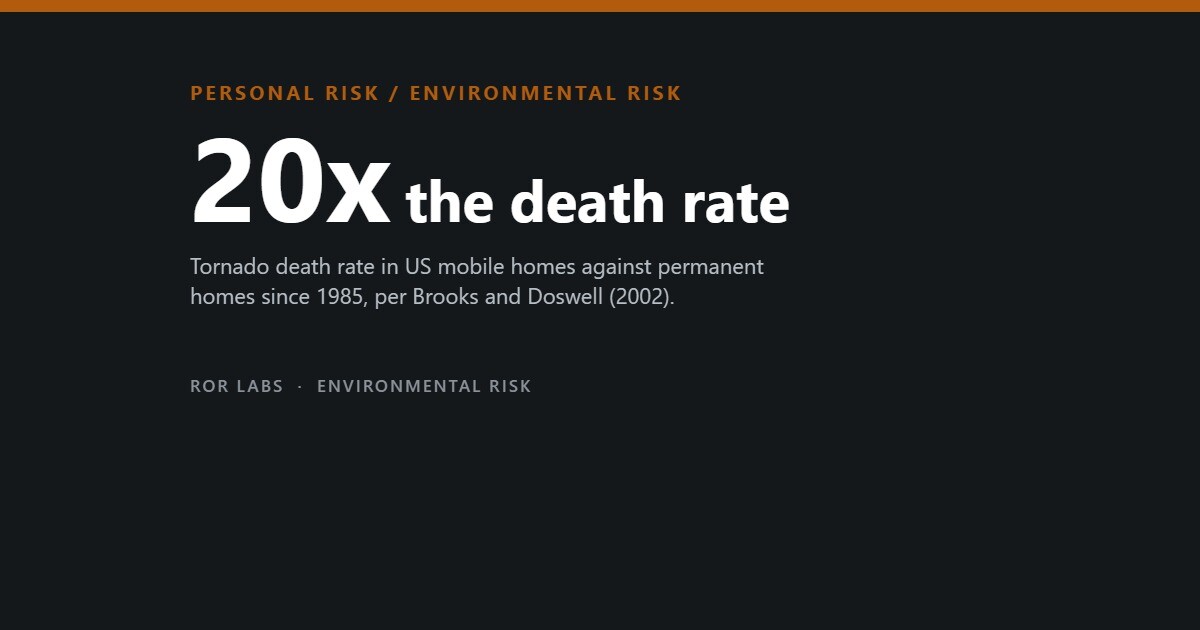
- Since 1985 the tornado death rate for people in US mobile homes has been about 20 times that for people in permanent homes.
- The mobile-home share of US tornado deaths rose from 24% in 1976–80 to 50% in 1996–2000, while mobile homes were about 7% of housing.
- Overnight tornadoes are 2.5 times as likely to kill as daytime ones, and night is when warnings are least likely to be heard.
- Warnings have improved, but advice to leave a mobile home only works if there is somewhere sturdy to go; more than half of residents surveyed in Alabama and Mississippi thought their home was a safe place to shelter.
Tornadoes kill far fewer Americans than they once did. In the 1910s to 1930s the country averaged around 260 tornado deaths a year; by the end of the century it was nearer 54, in a much larger population. Forecasting, radar, warnings, television and better buildings all played a part. One group, though, has been left behind by that progress: the people who live in mobile, or manufactured, homes.
The pattern showed up again in the first five months of 2026, a quiet tornado season by recent standards. Of the 12 people killed, nine were in manufactured homes. That is a small number, and small numbers swing, but it fits a long record in which mobile homes account for a share of tornado deaths many times their share of the housing stock.
This article sets out what researchers have found about who dies in tornadoes and where, why lightweight homes fail, why night-time tornadoes are so dangerous, how good warnings really are, and the uncomfortable part: a warning tells people to leave, but many have nowhere sturdier to go.
Where tornado deaths happen
The National Weather Service began recording whether tornado victims died in mobile homes in 1975. Using those records, Harold Brooks and Charles Doswell of the National Severe Storms Laboratory found that the mobile-home share of all US tornado deaths rose from 24% in 1976–80 to 34% in 1986–90 and 50% in 1996–2000. Over the same decades, mobile homes grew from 0.7% of US housing units in 1950 to 7.2% in 1990.
A growing share of the dead
Percentage of US tornado deaths that occurred in mobile homes, by period and measure.
Sources: Brooks HE, Doswell CA, Weather and Forecasting 17(3) (2002), using NWS and Census Bureau data; Associated Press analysis of NWS data, 28 July 2023. The AP figures count only people killed at home, a different denominator.
Brooks and Doswell then estimated death rates per resident. Since 1985, they found, the tornado death rate for people in mobile homes has been roughly 20 times that for people in permanent homes, and close to the rate for the whole US population before 1925. The rising share of deaths was not because mobile homes got worse. It was because far more people came to live in them.
The record since then points the same way. An Associated Press analysis in 2023 found that 53% of people killed at home by tornadoes since 1996 died in mobile homes, although they make up less than 6% of housing units. In 2023, at least 45 of 74 tornado deaths were in manufactured housing. Most of these deaths are in the Southeast, in the lower Mississippi, Tennessee and Arkansas valleys rather than the classic Great Plains tornado alley.
Why a mobile home fails
A mobile home is light and sits on piers rather than a foundation. Unless it is well anchored, strong wind can roll it or lift it, and then the whole structure, with its occupants, is moving. Permanent houses fail too, but usually piece by piece: a roof lifts, a wall falls, and an interior room on the lowest floor often stays standing. That difference shows up clearly in case-control studies of real tornadoes.
After the F5 tornado that struck the Oklahoma City area on 3 May 1999, state health researchers compared people who died with people in the damage path who survived. Being in a mobile home raised the odds of death about 35-fold compared with a permanently anchored house; being outdoors raised them about 141-fold. Being in a car was not riskier than being in a house in that event, though the confidence intervals were very wide.
Where people were when the F5 tornado hit
Odds of death compared with people in permanently anchored houses, Oklahoma, 3 May 1999.
| Location | Odds ratio of death | 95% interval |
|---|---|---|
| Permanently anchored house | 1 (reference) | – |
| Mobile home | 35.3 | 7.8 to 175.6 |
| Outdoors | 141.2 | 15.9 to 6,379.8 |
| Motor vehicle | Not higher than a house | 0.0 to 9.9 |
Source: Daley WR et al., American Journal of Epidemiology 161(12):1144 (2005), doi:10.1093/aje/kwi142. Based on 40 direct deaths; the very wide intervals reflect small numbers.
Mobile homes are also killed by weaker storms. Daniel Sutter and Kevin Simmons found that mobile-home deaths were significantly more likely in lower-rated tornadoes than permanent-home deaths. The AP analysis put it starkly: 79% of at-home deaths in the three weakest tornado categories, with winds up to 135 mph, were in mobile homes. A tornado that strips shingles from a brick house can destroy a trailer next door.
The night problem
Tornadoes at night are hard to see, and they arrive when people are asleep, often in the least protective kind of home. Walker Ashley and colleagues looked at US tornadoes from 1950 to 2005. Only 27.3% happened between sunset and sunrise, yet those night-time tornadoes caused 39.3% of deaths and 42.1% of killer tornado events. Tornadoes between local midnight and sunrise were 2.5 times as likely to kill as those in daylight.
A 2022 update by Stephen Strader and colleagues found the gap has not closed: nocturnal tornadoes remain nearly twice as deadly as daytime ones, despite better detection. Surveys suggest why. In a national study by Makenzie Krocak and colleagues, adults were least confident they would receive a tornado warning between midnight and 4 a.m., and the Southeast gets the most tornadoes in exactly that window. That is also where mobile homes are most common, so the risks stack.
Night tornadoes punch above their weight
Share of US tornadoes, deaths and killer events that occurred between sunset and sunrise, 1950–2005.
Source: Ashley WS, Krmenec AJ, Schwantes R, Weather and Forecasting 23(5) (2008), doi:10.1175/2008WAF2222132.1.
How good are tornado warnings?
Warnings are much better than they were, but they are not as precise as many people assume. Between 1986 and 2007 the National Weather Service sharply increased the number of warnings it issued, and the share of tornadoes warned in advance rose from about 0.4 to over 0.75. The price was a false alarm ratio that stayed near 0.75: roughly three of every four tornado warnings were not followed by a tornado in the warned area.
In 2012 the service shortened default warning durations and put more emphasis on cutting false alarms, and lead time, detection and false alarms all fell together, according to Brooks and James Correia. Lead time also depends on the setting. A study of storm-based warnings found an average of 5.5 minutes for warnings issued outside any tornado watch, against 15.1 minutes inside the most serious type of watch.
Minutes of warning
Average lead time of US tornado warnings, by measure and period.
Sources: Krocak MJ, Brooks HE, Weather and Forecasting 36(5) (2021); Simmons KM, Sutter D, Economic and Societal Impacts of Tornadoes (2011), doi:10.1007/978-1-935704-02-7_4; Gibbs JG, Bowers BR, Journal of Operational Meteorology (2019), doi:10.15191/nwajom.2019.0709. Periods and definitions differ.
Do the minutes matter? Kevin Simmons and Daniel Sutter studied US tornadoes from 1986 to 2002. A warning reduced injuries consistently, by more than 40% at some lead times. For deaths the picture was mixed: lead times up to about 15 minutes reduced fatalities, but longer lead times were linked to more deaths, a result the authors say rests on five killer tornadoes and is not robust. More minutes help only if people use them.
Do false alarms cost lives?
Forecasters have long worried that too many false alarms train people to ignore the next warning. Simmons and Sutter tested this by comparing places with different false alarm ratios between 1986 and 2004. Holding other factors constant, tornadoes in areas with a higher false alarm ratio killed and injured more people. A one-standard-deviation rise in the false alarm ratio was linked to 12% to 29% more expected deaths.
They estimated that the national fall in false alarms over that period cut tornado deaths by 4% to 11%, an effect about as large as that of longer lead times. This is a statistical association across places, not proof of how individuals behave, and survey work on whether false alarms make people complacent has been mixed. But it suggests that warning more often is not free, and that warning accuracy is a safety issue in itself.
Nowhere to go
The official advice is clear. The National Weather Service says a mobile home is not a safe place in a tornado and that occupants should get to a sturdy building. The difficulty is practical. With a lead time of ten or fifteen minutes, often at night and in heavy rain, a family has to wake, decide, find shoes and keys, and reach a building that is open and close enough. In many rural parks there is no such building.
Surveys show the gap. In a study of 257 mobile and manufactured home residents in Alabama and Mississippi, Kevin Ash and colleagues found that more than half believed their home was a safe place to shelter. Separate surveys led by Brooke Liu found that nearly half of mobile home residents in the Southeast did not know where to go. After the 2008 Super Tuesday outbreak in Tennessee, mobile home residents were less prepared than other residents on every measure studied.
The advice and the reality
What official guidance asks of mobile home residents, and what surveys of residents found.
Believe their home is a safe shelter: more than half (257 surveyed, Alabama and Mississippi)
Do not know where to shelter: nearly half (Southeast surveys)
Least confident of hearing a warning between midnight and 4 a.m.
Leave for a sturdy building or shelter before the tornado arrives
Shelters cost effective for mobile home residents; about $30 million per life saved in permanent homes
Homes built to post-1994 wind rules were 79% less likely to be levelled than pre-1976 homes
Sources: Ash KD et al., Weather, Climate, and Society 12(3) (2020); Liu BF et al., Weather, Climate, and Society 11(3) (2019); Krocak MJ et al., Weather and Forecasting (2021); Merrell D et al., Land Economics 81(1) (2005); Simmons KM, Sutter D, Natural Hazards (2008); NWS tornado safety guidance.
Shelters are where the economics changes. Economists David Merrell, Simmons and Sutter estimated that a tornado shelter in a permanent home in Oklahoma costs around $30 million per life saved, too much to justify on safety grounds alone. For mobile home residents, whose risk is many times higher, the same analysis found shelters cost effective. Some counties now open churches and public buildings during warnings, but the AP found other places with no shelters at all.
Building codes and wind zones
Since 1976, manufactured homes in the United States have been built to a federal standard set by the Department of Housing and Urban Development, not to local building codes. The standard divides the country into three wind zones. Zones II and III, with design wind speeds of 100 and 110 mph, cover coastal counties exposed to hurricanes. Almost everywhere else, including the tornado-prone interior, is Zone I, with lower design loads.
Three wind zones, drawn for hurricanes
HUD design wind requirements for manufactured homes.
| Zone | Design requirement | Where it applies |
|---|---|---|
| Zone I | 15 psf horizontal load, 9 psf uplift | Most of the country, including the tornado-prone Plains and inland Southeast |
| Zone II | 100 mph design wind speed | Listed coastal counties from Texas to Maine |
| Zone III | 110 mph design wind speed | Hawaii, coastal Alaska, territories, parts of the Florida, Louisiana and North Carolina coasts |
Source: Manufactured Home Construction and Safety Standards, 24 CFR 3280.305 (2021 edition). Zone II and III wind loads apply to the whole home structure.
Stronger rules do make a difference. After Hurricane Andrew, HUD and Florida tightened wind load and tie-down requirements. When three tornadoes struck central Florida on 2 February 2007, all 21 deaths in Lake County were in manufactured homes. Homes built to the post-Andrew rules were 79% less likely to be levelled than homes built before 1976, and the authors estimated that full compliance could have cut deaths by 70%.
That finding has limits. It comes from one county and one set of tornadoes, and a well-anchored home is still no match for a violent tornado. Anchoring raises the wind speed a home can survive, which matters because so many mobile-home deaths happen in weaker storms. It does not turn a mobile home into a shelter, which is why researchers keep returning to safe rooms and community shelters.
Counting the dead
The numbers in this article come with caveats. The National Weather Service counts direct deaths, from debris or being thrown, and not indirect ones such as heart attacks or fires after the power fails. Location data for mobile homes only begin in 1975, and for other locations in 1985. Different analyses also use different denominators: all tornado deaths, deaths at home, or deaths per resident, and they can give quite different percentages.
The exposure is also shifting. A 2024 study by Strader, Victor Gensini, Ashley and Amanda Wagner found that the share of homes that are manufactured rose by 12.3% between 1980 and 2020, more than any other vulnerability measure they examined. In the Mid-South, rising tornado activity and growing development together tripled the modelled number of homes likely to be hit each year. Annual totals, like the low count of early 2026, mostly reflect the weather that year.
What the evidence suggests
The evidence is unusually consistent. Across decades, data sources and methods, people in mobile homes are many times more likely to die in tornadoes than people in permanent homes, and the risk is worst at night and in the Southeast. Warnings have improved and do reduce injuries, but a warning that says leave assumes there is somewhere to go. As Brooks and Doswell argued in 2002, the remaining problem is mostly not meteorological. It is about anchoring, building rules, shelters close to where people live, and reaching them while they sleep.
What to do
Steps sorted by when they matter. Each one says how strong the evidence is: Measured Official advice Untested
Before
- If you live in a mobile home, know now which sturdy building or shelter you will go to. Nearly half of Southeast residents did not know where to go. Measured see Sources
- Make sure a warning can wake you between midnight and 4 a.m. Residents were least confident of hearing one then. Measured see Sources
- Have the home properly anchored. Homes built to post-1994 wind rules were 79% less likely to be levelled, though anchoring does not make it a shelter. Measured see Sources
If it happens
- Leave for the sturdy building before the tornado arrives. The National Weather Service says a mobile home is not a safe place in a tornado. Official advice see Sources
What not to do
- Do not assume your mobile home is safe to shelter in. More than half of surveyed residents believed it was. Measured see Sources
Questions people ask
Is a tied-down mobile home safe in a tornado?
No. Anchoring helps a home survive weaker winds, but the National Weather Service says mobile homes are not safe in tornadoes and occupants should get to a sturdy building.
How much more dangerous is a mobile home?
Brooks and Doswell estimated a death rate about 20 times that in permanent homes since 1985. In the 1999 Oklahoma tornado, the odds of death were about 35 times higher.
Why are night-time tornadoes so deadly?
They are hard to see, people are asleep and less likely to hear warnings, and many are at home in weaker buildings. Overnight tornadoes are 2.5 times as likely to kill.
How much warning do people usually get?
It varies. Recent averages for significant tornadoes are around 16 minutes, but warnings issued outside a tornado watch averaged 5.5 minutes, and some tornadoes are not warned at all.
Where do mobile home tornado deaths mostly happen?
Mostly in the southeastern United States, especially the lower Mississippi, Tennessee and Arkansas valleys, where mobile homes are common and night-time tornadoes are frequent.
The short version
- Since 1985 the tornado death rate for people in US mobile homes has been about 20 times that for people in permanent homes.
- The mobile-home share of US tornado deaths rose from 24% in 1976–80 to 50% in 1996–2000, while mobile homes were about 7% of housing.
- Overnight tornadoes are 2.5 times as likely to kill as daytime ones, and night is when warnings are least likely to be heard.
- Warnings have improved, but advice to leave a mobile home only works if there is somewhere sturdy to go; more than half of residents surveyed in Alabama and Mississippi thought their home was a safe place to shelter.
- Stronger anchoring rules cut the chance of a home being levelled, but shelters close to where people live are what turn a warning into safety.
This article summarises published research and agency guidance for general information. It is not safety or engineering advice for any particular home. When severe weather threatens, follow official warnings from the National Weather Service and your local emergency management agency, and make a plan in advance for where you will shelter, especially if you live in a mobile or manufactured home.
Further reading: Brooks and Doswell, Weather and Forecasting 17(3) (2002), for the long-term record of tornado deaths and the mobile home problem. Ashley, Krmenec and Schwantes, Weather and Forecasting 23(5) (2008), on nocturnal tornadoes. Ash et al., Weather, Climate, and Society 12(3) (2020), on how residents themselves see the risk.
- The Weather Machine, Andrew Blum (2019). A journalist’s tour of how modern forecasts are made, from satellites to supercomputers. Clear on the forecasting side; it says little about what happens after a warning is issued.
- Disasterology, Samantha Montano (2021). An emergency management researcher on why disasters fall hardest on some communities. Strong on systems and inequality; it covers many hazards, so tornadoes get limited space.
- Poverty, by America, Matthew Desmond (2023). A sociologist on why poverty persists in a rich country, including the cost of housing. Useful background on who lives where and why; it is not about weather risk.
Sources
Brooks HE, Doswell CA. Deaths in the 3 May 1999 Oklahoma City tornado from a historical perspective. Weather and Forecasting 17(3):354–361 (2002). — Associated Press. Mobile homes turn deadly when tornadoes hit, AP analysis finds (28 July 2023). — Ashley WS. Weather and Forecasting 22(6) (2007), doi:10.1175/2007WAF2007004.1. — Daley WR et al. Am J Epidemiol 161(12):1144 (2005), doi:10.1093/aje/kwi142. — Sutter D, Simmons KM. Tornado fatalities and mobile homes in the United States. Natural Hazards, doi:10.1007/s11069-009-9416-x. — Ashley WS, Krmenec AJ, Schwantes R. Weather and Forecasting 23(5) (2008), doi:10.1175/2008WAF2222132.1. — Strader SM et al. Weather, Climate, and Society (2022), doi:10.1175/WCAS-D-22-0020.1. — Krocak MJ et al. Weather and Forecasting (2021), doi:10.1175/WAF-D-20-0207.1. — Sills D, Elliott L. Atmosphere-Ocean (2023), doi:10.1080/07055900.2023.2257163. — Brooks HE, Correia J. Weather and Forecasting 33(6) (2018), doi:10.1175/WAF-D-18-0120.1. — Krocak MJ, Brooks HE. Weather and Forecasting 36(5) (2021), doi:10.1175/WAF-D-21-0052.1. — Simmons KM, Sutter D. Economic and Societal Impacts of Tornadoes (2011), doi:10.1007/978-1-935704-02-7_4. — Gibbs JG, Bowers BR. Journal of Operational Meteorology (2019), doi:10.15191/nwajom.2019.0709. — Simmons KM, Sutter D. Weather and Forecasting 23(2) (2008), doi:10.1175/2007WAF2006027.1. — Simmons KM, Sutter D. Weather, Climate, and Society 1(1) (2009), doi:10.1175/2009WCAS1005.1. — Ash KD et al. Weather, Climate, and Society 12(3) (2020), doi:10.1175/WCAS-D-19-0088.1. — Liu BF, Egnoto MJ, Lim JR. Weather, Climate, and Society 11(3) (2019), doi:10.1175/WCAS-D-17-0080.1. — Chaney PL, Weaver GS. Weather, Climate, and Society (2010), doi:10.1175/2010WCAS1042.1. — Merrell D, Simmons KM, Sutter D. Land Economics 81(1):87 (2005), doi:10.3368/le.81.1.87. — Simmons KM, Sutter D. Natural Hazards (2008), doi:10.1007/s11069-007-9192-4. — Strader SM, Gensini VA, Ashley WS, Wagner AN. npj Natural Hazards (2024), doi:10.1038/s44304-024-00019-6. — US Department of Housing and Urban Development. 24 CFR 3280.305, wind zones (2021 edition). — National Weather Service. Tornado safety: during (accessed October 2026). — FOX Weather, 3 June 2026.