The Six-Foot Rule Was Wrong, and Handwashing Was Never the Main Defence
Further reading: The Premonition — Michael Lewis (W. W. Norton, 2021). A narrative account of the public-health officials who saw a pandemic coming and were sidelined. Lewis’s hero-narrative structure simplifies a messier institutional story, and some epidemiologists have pushed back on parts of his framing. Find it on Amazon (paid link)
Disclosure: this article contains affiliate links, marked (paid link). If you buy through one we may earn a commission, at no extra cost to you. As an Amazon Associate I earn from qualifying purchases. It costs you nothing and it does not change what we recommend.
Key takeaways · 7 min read
- In 2024 the WHO dropped the droplet-versus-airborne distinction that underpinned decades of advice.
- Exhaled particles behave like smoke, not like falling cannonballs. The six-foot rule was never a boundary.
- Covid-19, influenza and measles all spread this way.
- The variables that matter: ventilation, time in the room, crowding and what people are doing — then distance.
For most of the twentieth century, public health taught that respiratory viruses spread in two ways: large droplets that fall to the ground within about six feet, and a small special category of genuinely airborne diseases. Almost everything you were taught about catching a cold rests on that division.
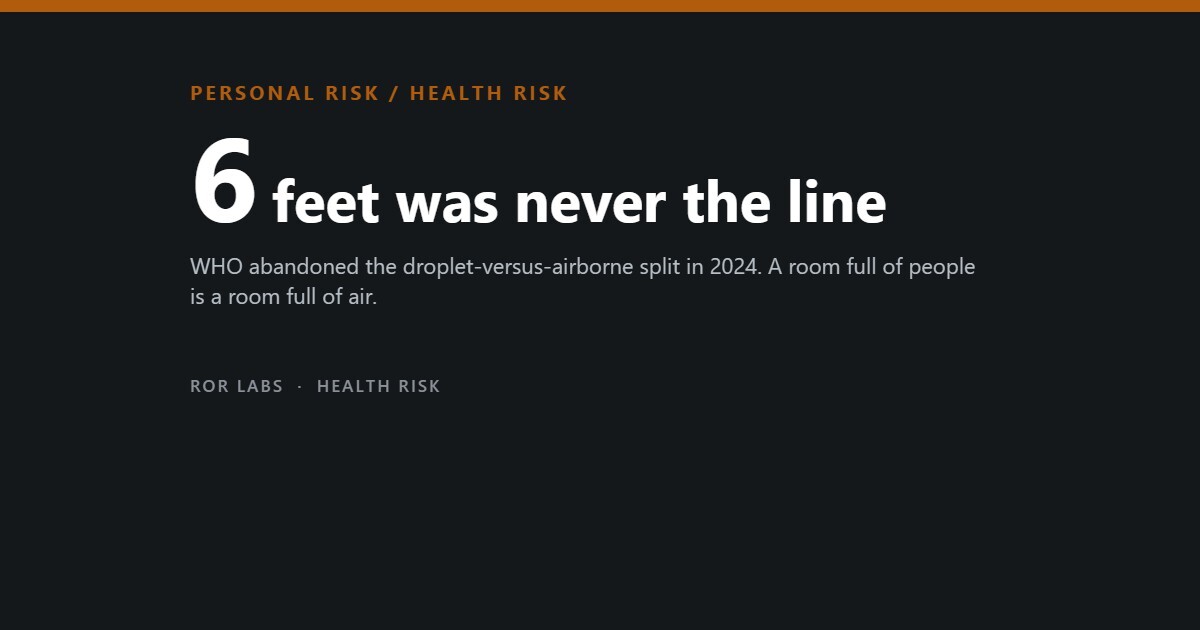
In 2024 the World Health Organization abandoned it. The droplet-versus-airborne split, and the distance rule built on top of it, turned out not to describe how the physics works.

What the six-foot rule got wrong
The old model imagined virus-laden droplets flying out, travelling a fixed distance, and dropping. Stay beyond that arc and you were outside the danger zone. The trouble is that exhaled particles do not behave like tiny cannonballs. They behave like smoke.
Two mental models of the same room
Only one of them matches the measurements.
Source: World Health Organization revised terminology on pathogens transmitted through the air (2024), as reported by KFF Health News.
The WHO dropped the droplet-versus-airborne categories entirely, describing transmission instead as people exhaling pathogens that remain suspended in the air and are inhaled by others. One expert quoted at the time put it plainly: the distance-based categories were totally artificial. Covid-19, influenza and measles all spread this way.
Why this reorders the advice
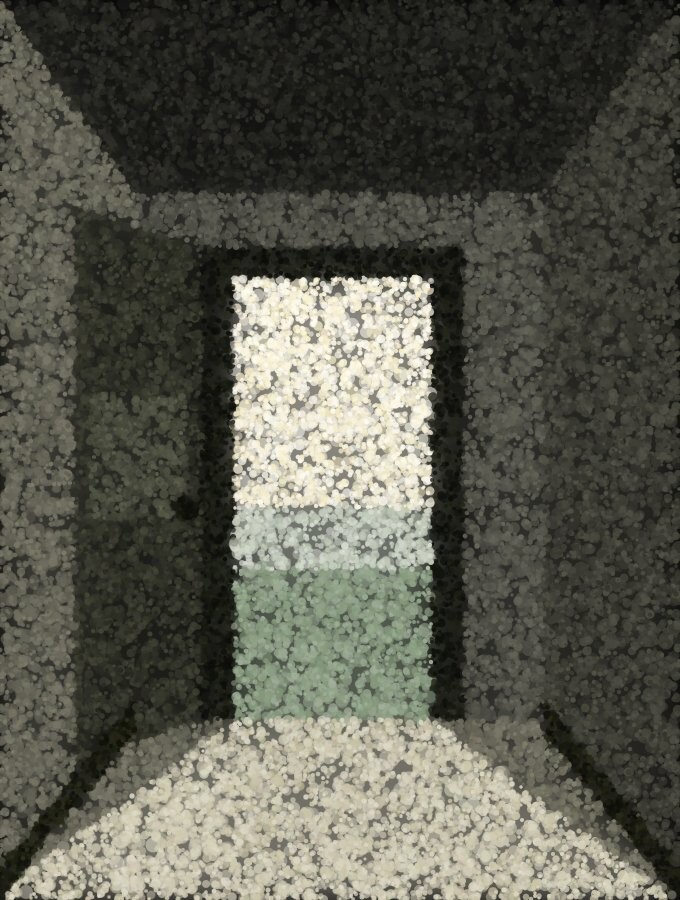
If exhaled particles behave like smoke, then the useful question is not “how close did I get” but “how much of that room’s air did I breathe.” And that reshuffles the ranking most people carry in their heads.
The variables that actually govern your exposure
Think of it as smoke: would the room smell of cigarettes an hour later?
Sources: WHO 2024 terminology revision on airborne pathogens; U.S. EPA guidance on ventilation and respiratory viruses.
So was handwashing pointless?
No — and this is where the correction gets over-corrected. Hand hygiene remains firmly in CDC guidance for respiratory viruses, and it does a great deal for the things that genuinely spread by contact: norovirus, many gut infections, and a real if smaller share of respiratory transmission.
What changed is the ranking. For airborne respiratory viruses, handwashing went from being presented as the primary defence to being one useful measure alongside a larger one that was barely mentioned for decades: the air in the room.
What each measure is actually for
Matching the intervention to the route.
| Measure | Works against | Does little for |
|---|---|---|
| Handwashing | Norovirus, gut infections, contact spread | Air you have already inhaled |
| Surface disinfection | Norovirus, C. difficile, contaminated shared objects | Airborne respiratory viruses — the “hygiene theatre” of 2020 |
| Ventilation / opening a window | All airborne respiratory viruses | Anything transmitted by touch |
| Well-fitted respirator | Inhaled particles, if it seals | Anything, if it gapes at the sides |
| Air filtration (HEPA) | Particles including virus-carrying ones, in that room | Gases; and it is no substitute for fresh air |
Sources: CDC hygiene guidance for respiratory viruses; EPA ventilation and respiratory viruses guidance; WHO 2024 terminology revision.
What to actually do, ranked
The first three cost nothing.
Sources: CDC respiratory virus prevention guidance; EPA indoor air guidance.
The two things worth owning (paid link)
Both address the air rather than the surfaces.
Browse on Amazon →
Browse on Amazon →
We are not linking antibacterial surface sprays, UV sanitising wands or “immune support” supplements. Surface disinfection is aimed at a route that carries little of this transmission; consumer UV wands are largely unproven and some emit UV-C, which damages eyes and skin; and immune supplements have not shown meaningful reductions in respiratory infection in large trials. A window costs nothing and does more than all three.
Questions people ask
Does cold weather cause colds?
Not directly, and the airborne model explains the seasonality better than folklore does. Winter moves everyone indoors with the windows shut, which is precisely the condition that lets exhaled particles accumulate. There is also some evidence that cold, dry air impairs the nose’s own defences — but the dominant factor is the closed room, not the temperature outside.
What CO2 reading should worry me?
Outdoor air sits around 420 ppm. Well-ventilated indoor spaces stay under about 800. Above roughly 1,000 you are breathing a meaningful share of other people’s exhaled air. It is a proxy for ventilation, not a virus measurement — an empty room can read high, and a crowded well-ventilated one can read low. That is the point of it.
Is six feet now meaningless?
No — distance still reduces exposure, because concentration is highest near the person exhaling. What is meaningless is treating it as a boundary between safe and unsafe. Six feet away for three hours in a sealed room is worse than three feet away for two minutes outdoors.
Should I run an air purifier when someone is ill at home?
It is reasonable, particularly in a room you cannot ventilate. A HEPA unit removes particles from the air of that room, and virus-carrying particles are particles. Size it to the room, and treat it as a supplement to opening a window rather than a replacement — fresh air removes everything, filtration only removes what passes through the machine.
The short version
- In 2024 the WHO dropped the droplet-versus-airborne distinction that underpinned decades of advice.
- Exhaled particles behave like smoke, not like falling cannonballs. The six-foot rule was never a boundary.
- Covid-19, influenza and measles all spread this way.
- The variables that matter: ventilation, time in the room, crowding and what people are doing — then distance.
- Handwashing still matters, especially for norovirus and contact spread. It just is not the main defence against airborne viruses.
- Surface disinfection against respiratory viruses was largely misdirected effort.
- The highest-value free action indoors is opening a window — wide, briefly, beats narrow and constant.
- If you mask, fit beats filter rating.
This summarises published guidance and is not medical advice. Difficulty breathing, chest pain, confusion or a high fever that will not come down are reasons to seek medical care rather than to manage at home.
On the links above: some are affiliate links, marked (paid link). If you buy through one we may earn a commission at no additional cost to you. As an Amazon Associate I earn from qualifying purchases. We link to product searches rather than specific items so recommendations do not break as models change, and we say plainly when we are choosing not to link something. Full policy: Affiliate Disclosure.
Sources
- World Health Organization. Global technical consultation report on proposed terminology for pathogens that transmit through the air (2024).
- KFF Health News. “WHO Overturns Dogma on Airborne Disease Spread. The CDC Might Not Act on It.” 1 May 2024.
- U.S. Environmental Protection Agency. “Ventilation and Respiratory Viruses” and indoor air quality guidance.
- U.S. Centers for Disease Control and Prevention. Hygiene and respiratory virus prevention guidance.