Economic Abuse and Coerced Debt: What the Evidence Shows
Key takeaways · 13 min read
- Economic abuse means controlling, exploiting or sabotaging a partner’s money and work. Coerced debt, credit taken out in someone’s name by fraud or pressure, is one of its most lasting forms.
- National surveys put it at roughly one in six or seven women, and fewer men. Among people seeking help from services, 76% to 99% report it.
- Of 1,823 women who called a US domestic violence hotline, 52% reported coerced debt. Among 187 recently divorced women, 62% had it, a median of $22,000 each.
- In UK bank records, women who disclosed abuse ended up with credit scores 109 points lower than similar customers, after years of falling savings and rising debt.
Some abuse never leaves a bruise. It shows up as a card you never applied for, a loan you were pressured to sign, or a credit file that blocks you from renting a flat years after you left. Researchers call this economic abuse, and its best-documented form, debt taken out in a partner’s name, is called coerced debt.
Sources include validated survey scales, national surveys in four countries, US studies of hotline callers and divorce records, UK charity polling and a new study of bank records, plus three cases on the public record and the laws passed since 2019. An earlier article here covered coercive control more broadly.
Economic abuse is common, often hidden even from its target, and slow to undo because banks and courts treat debts as freely chosen. The evidence is strongest among people seeking help; for the general population, figures depend on how many questions a survey asks.
What economic abuse is
The first validated measure, the Scale of Economic Abuse, was published in 2008 by Adrienne Adams and colleagues. Of 103 women using domestic violence services, 99% reported at least one economically abusive act since the relationship began. A shorter 12-item version, the SEA-12, tested with 120 survivors, later grouped the behaviours into three kinds: economic control, economic exploitation and employment sabotage (Postmus et al., 2016).
Control means restricting: hiding the household finances, handing out an allowance, refusing someone their own account. Exploitation is using up a partner’s resources by spending their savings, stealing their money or identity, or running up debts in their name; sabotage is stopping someone from earning.
A 2022 scoping review by Laura Johnson and colleagues points out that physical violence needs proximity, whereas economic abuse can continue from anywhere, including after separation, through joint accounts, child maintenance and shared debts. A survivor may not realise what has happened until the debt appears.

How common it is
Population surveys vary, mainly because they ask different questions. Jozica Kutin and colleagues analysed Australia’s 2012 Personal Safety Survey of 17,050 people, which asked five items about cohabiting partners. Lifetime prevalence was 15.7% for women and 7.1% for men, peaking for women in their 40s at 20.9%. Women with a disability, high financial stress or less education had higher odds.
One in six or seven women, by these measures
Share reporting economic abuse in national surveys. Items, time frames and abusers counted differ between countries.
Sources: Kutin et al., Aust N Z J Public Health (2017); Mellar et al., J Interpers Violence (2024); Bruno et al., Violence Against Women (2024); ONS, Crime Survey for England and Wales, year ending March 2025.
In a Swedish national survey of 6,611 women in 2021, 13% reported economic abuse, 8% by a current partner and 25% by a former one. Only 11.5% of them had experienced economic abuse alone; the rest had also faced physical or sexual violence. In New Zealand, 15% of 1,431 ever-partnered women had experienced it, and they had 4.72 times the odds of food insecurity.
New questions were added to the Crime Survey for England and Wales in 2024. In the year to March 2025, 2.7% of adults reported economic abuse by a partner or relative in the past year, and 11.0% since age 16, while US and UK service samples report 76% to 99%.
Coerced debt in a partner’s name
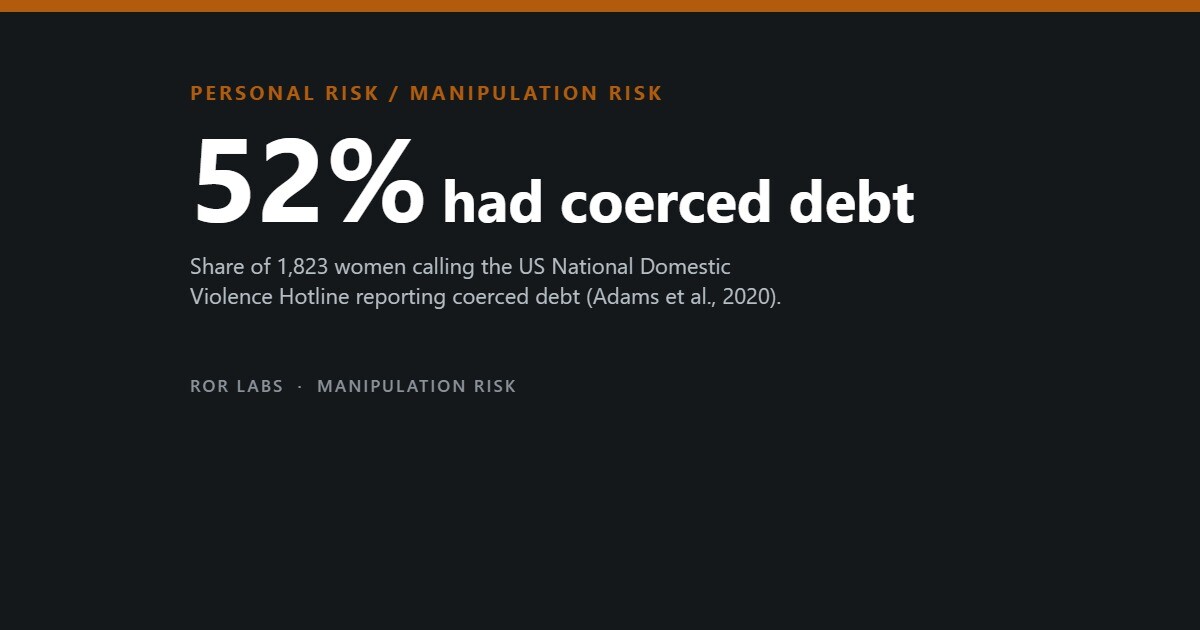
Coerced debt is credit taken out in someone’s name through fraud, pressure or manipulation. The law professor Angela Littwin first described it in detail in 2012. With Adrienne Adams she then surveyed 1,823 women who called the US National Domestic Violence Hotline: 52% reported coerced debt, and women whose partners hid financial information were 3.6 times as likely to have it.
What hotline callers reported
Women who called the US National Domestic Violence Hotline (n = 1,823), share reporting each experience.
Source: Adams, Littwin and Javorka, Violence Against Women (2020), as reported by the authors’ university. A convenience sample of help-seekers, not the general population.
Women with coerced debt were six times as likely to report credit damage and 2.5 times as likely to report financial dependence on the abuser. The team’s newest study, published in December 2025, sampled 187 women recently divorced from an abusive husband in one county of a southern US state, and examined their 2,833 credit accounts.
In that study, 116 women (62%) had coerced debt, a mean of 4.4 debts each and up to 24, totalling more than $12.5 million. The median per woman was $22,000. Pressure was the commonest route, and many women described more than one. The authors note the limits: one county, a mostly White, college-educated sample, and some amounts taken from memory.
How the debts were created
187 women recently divorced from an abusive husband, one county in a southern US state, 2020–2021. A woman could report more than one route.
Source: Adams, Littwin, Kennedy and Beeble, J Interpers Violence (2025). Funded by the US National Science Foundation.
What it costs survivors
The clearest harm is to credit, which follows a person into every tenancy check and phone contract. In the UK, a 2024 survey of 2,849 women commissioned by the charity Surviving Economic Abuse and run by Ipsos estimated that 15% of women, about 4.1 million, had experienced economic abuse from a partner or ex-partner in the past year.
The UK picture, from a charity survey
Women aged 18+ in the UK, online panel survey, October–November 2024 (n = 2,849). Past 12 months, current or former partner.
Source: Surviving Economic Abuse, Counting the Cost (July 2025), fieldwork by Ipsos UK. Charity data: self-reported, women only, one snapshot, not peer-reviewed.
Of those women, 23% said the abuse had stopped them leaving and 11% that they had become homeless as a result. Economic abuse was more common among disabled women (23%, against 13%) and Black women (28%, against 11% of White women). These are a campaigning charity’s self-reported online figures, so they estimate the scale rather than give a precise count.
The Lloyds study in Nature (September 2026) compared 5,428 women who had disclosed abuse to the bank with 15,602 matched customers across 373 measures, giving an independent view from bank records. Their savings fell and debts rose over the years before disclosure, ending in missed payments and credit scores 109 points lower. They also changed address, reset passwords and reported lost cards more often.
Three cases on the record
Ruth Dodsworth, an ITV Wales weather presenter, has described in interviews how her then husband took over her money until she had to ask him for cash for food. Jonathan Wignall pleaded guilty to controlling or coercive behaviour and stalking and was jailed for three years at Cardiff Crown Court in April 2021. She later told the Observer that he had taken out credit cards and loans in her name.

In the United States, Katie Stager told The 19th in 2021 that her husband managed the household money. She believed her wages as an office manager were paying the utility bills. After the relationship ended she found thousands of dollars of unpaid bills and a credit card opened in her name carrying about $20,000 of debt. She divorced him in 2012 and spent years paying it off.
In November 2025, at Newport Crown Court, Antonio Villafane, 67, was jailed for eight years after a jury convicted him of six offences, including controlling or coercive behaviour and fraud. The CPS said he had persuaded his partner to transfer £250,000 into his bank account, promising land in their joint names, and bought it in his name only.
What the law now says
The UK’s Domestic Abuse Act 2021 names economic abuse in its statutory definition of domestic abuse. It means ‘any behaviour that has a substantial adverse effect on B’s ability to acquire, use or maintain money or other property, or obtain goods or services’. Cases are usually prosecuted as controlling or coercive behaviour, an offence in England and Wales since 2015.
Surviving Economic Abuse studied 810 successful prosecutions reported in the media between December 2015 and December 2022. Nearly two-thirds mentioned economic abuse, but only 2% of those cases ended with a compensation order. The sample comes from news coverage, so it may over-represent severe or unusual cases.
Prosecuted, but rarely repaid
810 successful controlling or coercive behaviour prosecutions reported in the media, England and Wales, December 2015 to December 2022.
Source: Surviving Economic Abuse, Seen yet sidelined (September 2023). Charity analysis of news reports; cannot be generalised to all cases.
Banks have a voluntary Financial Abuse Code, launched by UK Finance in 2018 and revised in 2021. By January 2026, 33 firms had signed it, covering almost 90% of UK mortgage lending, and a third version aligned with the regulator’s Consumer Duty was published on 9 November 2026. UK Finance says 25 banks and building societies have also committed to accepting a single Economic Abuse Evidence Form.
In the United States, the federal Fair Credit Reporting Act lets identity-theft victims block fraudulent debts but does not cover debt obtained by pressure. The Consumer Financial Protection Bureau asked for comment on changing that in December 2024; its autumn 2025 agenda listed the issue only as something it ‘intends to explore’.
Some states have moved faster. Maine’s 2019 law makes debt collectors stop, and credit agencies reinvestigate, debts shown to stem from economic abuse; a federal appeals court upheld it in 2022. California’s 2022 law, SB 975, lets survivors ask a court to declare a debt coerced and hold the abuser liable. Texas added coerced debt to its identity-theft law in June 2025.

Practical steps and safety
Safety comes first, and an abuser who monitors accounts or devices may notice sudden changes, so specialist services advise planning with a domestic abuse adviser before closing joint accounts, changing passwords or contacting lenders. If you are in danger, call the police. In the UK the free National Domestic Abuse Helpline is 0808 2000 247; in the US the National Domestic Violence Hotline is 1-800-799-7233.
When it is safe, check your credit file with each credit reference agency for accounts you do not recognise, and keep copies of statements, messages and letters. Tell your bank: many UK banks have specialist teams, and Lloyds says its team helps customers separate finances and deal with coerced debt. In the 2023 Observer report, Natalie Curtis said that with help from Surviving Economic Abuse, Lloyds had returned most of the loans to her account.
In the Texas divorce study, only one of about 100 women with coerced debt active at divorce saw her ex-husband ordered to pay it off, and creditor law helped with fewer than 10% of debts, so legal routes are slow. A debt adviser, a specialist lawyer or a charity can help find the right remedy.
Where the evidence is weak
Measurement is the biggest problem: Kutin’s team found 11.5% in Australia with five items, and noted that a UK panel survey with 31 indicators found 35%. A 2020 review by Judy Postmus and colleagues of 46 studies from six continents found no agreed index, and the Johnson review found that half of 35 studies used no validated measure.
Most data come from people who sought help, at one point in time, and from women abused by men. That suits describing harm but cannot count the population or prove cause. Much of the UK data comes from Surviving Economic Abuse, a campaigning charity, and the bank study covers one lender’s customers who chose to disclose.
What the evidence supports is narrower but solid: economic abuse is common among survivors, overlaps with violence and leaves debts that outlast the relationship. I found no published evaluation of whether the new laws or bank codes reduce that harm.
What to do
Steps sorted by when they matter. Each one says how strong the evidence is: Measured Official advice Untested
Before
- Know the warning signs: being denied information about household money, needing permission to spend, being pressured to sign for credit or being stopped from working. Measured see Sources
- Keep at least one account and your own login details that only you control, if it is safe to do so. Untested see Sources
- Do not sign loans, guarantees or joint credit under pressure; ask for time and independent advice first. Untested see Sources
If it happens
- If you are in danger, call the police; in the UK the National Domestic Abuse Helpline is 0808 2000 247, in the US the National Domestic Violence Hotline is 1-800-799-7233. Official advice see Sources
- Plan any change to joint accounts, passwords or lenders with a domestic abuse adviser, because an abuser who monitors accounts may notice. Official advice see Sources
- When it is safe, keep copies of statements, messages and letters about debts in your name. Untested see Sources
Afterwards
- Check your credit file with each credit reference agency for accounts you do not recognise. Untested see Sources
- Tell your bank: firms that signed the UK Financial Abuse Code are expected to help, and many accept the Economic Abuse Evidence Form so you need not repeat your story. Official advice see Sources
- Report accounts opened without your knowledge as identity fraud; in Maine, California and Texas, ask about state remedies for coerced debt. Official advice see Sources
- Get help from a debt adviser or specialist lawyer: divorce alone rarely moves the debt, as only one of about 100 women in a Texas study saw her ex-husband ordered to pay. Measured see Sources
What not to do
- Do not assume that ending the relationship ends the abuse; Swedish women reported economic abuse by former partners about three times as often as by current ones. Measured see Sources
- Do not blame yourself for debts taken out by fraud or pressure; nearly three in four hotline callers with coerced debt stayed longer because of money worries. Measured see Sources
- Do not close joint accounts or confront the abuser about money without a safety plan. Official advice see Sources
Not legal or financial advice. If you are in danger, call 999 or 911. A domestic-abuse adviser can help you plan before you change accounts.
Questions people ask
Is it abuse if my partner just manages the money?
Not necessarily. Many couples agree that one person handles the bills. Researchers draw the line at control without consent: being denied information or access to money, needing permission to spend, being pressured into credit or stopped from working.
Can I be made to pay a debt my partner took out in my name?
Often, yes, because lenders treat the named person as liable. An account opened without your knowledge may be identity fraud, which you can report. Debt taken under pressure is harder, though Maine, California and Texas now offer remedies and UK firms following the industry code may review it.
Does economic abuse stop when the relationship ends?
Often not. Swedish women reported it from former partners about three times as often as from current ones, and joint debts, mortgages and child maintenance can keep the link open.
Do men experience economic abuse?
Yes. In Australia’s survey 7.1% of men reported it, against 15.7% of women, and the Johnson review cites a study in which 38% of male survivors did. Far less is known about men and same-sex couples.
Will a bank believe me?
Banks that have signed the UK code are expected to have trained staff and a process for disclosures, and many accept the Economic Abuse Evidence Form, completed by a qualified adviser so you need not repeat your story. Outside the UK, practice varies.
The short version
- Economic abuse means controlling, exploiting or sabotaging a partner’s money and work. Coerced debt, credit taken out in someone’s name by fraud or pressure, is one of its most lasting forms.
- National surveys put it at roughly one in six or seven women, and fewer men. Among people seeking help from services, 76% to 99% report it.
- Of 1,823 women who called a US domestic violence hotline, 52% reported coerced debt. Among 187 recently divorced women, 62% had it, a median of $22,000 each.
- In UK bank records, women who disclosed abuse ended up with credit scores 109 points lower than similar customers, after years of falling savings and rising debt.
- The UK named economic abuse in law in 2021, and some US states let survivors challenge coerced debts. Courts rarely order abusers to repay, and no remedy has been formally evaluated.
- Most evidence comes from help-seekers at one point in time. Plan changes to shared accounts with a domestic abuse adviser, and call the police if you are in danger.
This article summarises research, official statistics, charity reports and news for general information. It is not legal, financial or professional advice. If you fear for your safety, contact a domestic abuse helpline or, in an emergency, the police; for debts, speak to a free debt adviser or a lawyer.
Further reading: Adams, Littwin and Javorka, Violence Against Women (2020), for the hotline study. Johnson et al., BMC Public Health (2022), for what 35 studies found. Surviving Economic Abuse, Counting the Cost (2025), for the UK survey and its methods.
Sources
- Trendl A, Sharp-Jeffs N, Perrier K, et al. Banking records reveal characteristics of financial abuse. Nature (2026), doi:10.1038/s41586-026-11049-7. Reported by The Herald Business (6 October 2026).
- Adams AE, Sullivan CM, Bybee D, et al. Development of the Scale of Economic Abuse. Violence Against Women 14(5) (2008), doi:10.1177/1077801208315529.
- Postmus JL, Plummer SB, Stylianou AM. Measuring economic abuse in the lives of survivors. Violence Against Women (2016), doi:10.1177/1077801215610012.
- Johnson L, Chen Y, Stylianou A, et al. Examining the impact of economic abuse on survivors of intimate partner violence: a scoping review. BMC Public Health (2022), doi:10.1186/s12889-022-13297-4.
- Postmus JL, Hoge GL, Breckenridge J, et al. Economic abuse as an invisible form of domestic violence: a multicountry review. Trauma Violence Abuse (2020), doi:10.1177/1524838018764160.
- Kutin J, Russell R, Reid M. Economic abuse between intimate partners in Australia: prevalence, health status, disability and financial stress. Aust N Z J Public Health (2017).
- Mellar BM, Fanslow JL, Gulliver PJ, et al. Economic abuse by an intimate partner and its associations with women’s socioeconomic status and mental health. J Interpers Violence (2024), doi:10.1177/08862605241235140.
- Bruno L, Strid S, Ekbrand H. Men’s economic abuse toward women in Sweden: findings from a national survey. Violence Against Women (2024), doi:10.1177/10778012241257248.
- Office for National Statistics. Domestic abuse prevalence and trends, England and Wales: year ending March 2025 (26 November 2025).
- Littwin A. Coerced debt: the role of consumer credit in domestic violence. California Law Review 100(4) (2012).
- Adams AE, Littwin AK, Javorka M. The frequency, nature, and effects of coerced debt among a national sample of women seeking help for intimate partner violence. Violence Against Women (2020), doi:10.1177/1077801219841445.
- Adams AE, Littwin AK, Kennedy AC, et al. Describing coerced debt created in abusive marriages. J Interpers Violence (2025), doi:10.1177/08862605251398461.
- Surviving Economic Abuse. Counting the Cost (July 2025); fieldwork by Ipsos UK.
- Surviving Economic Abuse. Seen yet sidelined (September 2023).
- The Observer. ‘He took every penny’: the women left with a debt mountain by coercive partners (September 2023).
- ITV News Wales. Abusive ex-husband of ITV Wales presenter Ruth Dodsworth jailed (14 April 2021).
- Lee J. Domestic violence can also take the form of economic abuse. The 19th, republished by PBS NewsHour (11 August 2021).
- CPS Cymru-Wales. Man who lived ‘off-grid’ jailed for controlling and coercive behaviour (26 November 2025).
- Domestic Abuse Act 2021, section 1. legislation.gov.uk.
- UK Finance. Financial Abuse Code (third version, 9 November 2026); press release on new signatories (21 January 2026).
- Consumer Financial Protection Bureau. Identity theft and coerced debt, advance notice of proposed rulemaking (December 2024); Fall 2025 agenda statement.
- Maine LD 748, An Act To Provide Relief to Survivors of Economic Abuse (2019); Maine House Democrats on the First Circuit ruling (15 August 2022).
- California Senate Bill 975 (Stats. 2022, ch. 989), Civil Code section 1798.97.3.
- University of Texas School of Law. Shining a light on coerced debt (13 November 2025), on Texas House Bill 4238 (2025).