Dying Alone at Home: What the Evidence Shows
Key takeaways · 13 min read
- Japan’s police handled 76,941 people in 2025 who had died alone at home. About 22,200 of them were found eight days or more after death, and 208 after more than a year.
- South Korea counted 3,924 lonely deaths in 2024, up 7.2% on 2023. More than four in five were men, and about 60% were in their 50s or 60s.
- The strongest risk markers in Korean and Japanese studies are being male, unmarried, poor, out of work or retired, and having alcohol problems or long-term illness. Living alone sets the scene; on its own it explains little.
- Most people who die alone at home are found within days. In Japanese police data for early 2024, four in ten were found within a day, and the long delays cluster among people with little regular contact.
Every few months a story appears of someone found at home long after they died, with post piled behind the door and rent unpaid. Japan calls it kodokushi; South Korea, godoksa. Both now count these deaths, and both have passed laws partly in response.
This article is about the most extreme result of social isolation: how often people die alone at home and are not found for days or weeks, who is most affected, and what has been tried. An earlier article covered loneliness and mortality; this one is about the death itself and the days after it.
A couple of warnings before the numbers. Definitions differ from country to country, so the figures rarely line up. And dying alone does not by itself mean a life went badly; most of these statistics really record how long it took anyone to notice.
What counts as a lonely death
Japan’s National Police Agency (NPA) counts people who lived alone and died at home, where the police handled the body. That includes someone found within hours. The Cabinet Office then treats those found eight days or more after death as ‘isolated deaths’ (koritsushi), a narrower group it first estimated for 2024.
South Korea’s Lonely Death Prevention and Management Act, passed in 2020 and in force since April 2021, defines a lonely death by social isolation from family and others, not by a number of days. A 2024 amendment widened it from people living alone to anyone living in social isolation. The figures come from police death-scene records reviewed by experts.
Researchers use other cut-offs: three days or more between death and discovery in Yokohama, more than a week in Kyoto. A scoping review of 16 studies found the terms varied, but all described a death with nobody present, in social isolation (Cho et al., 2025).
How many people in Japan
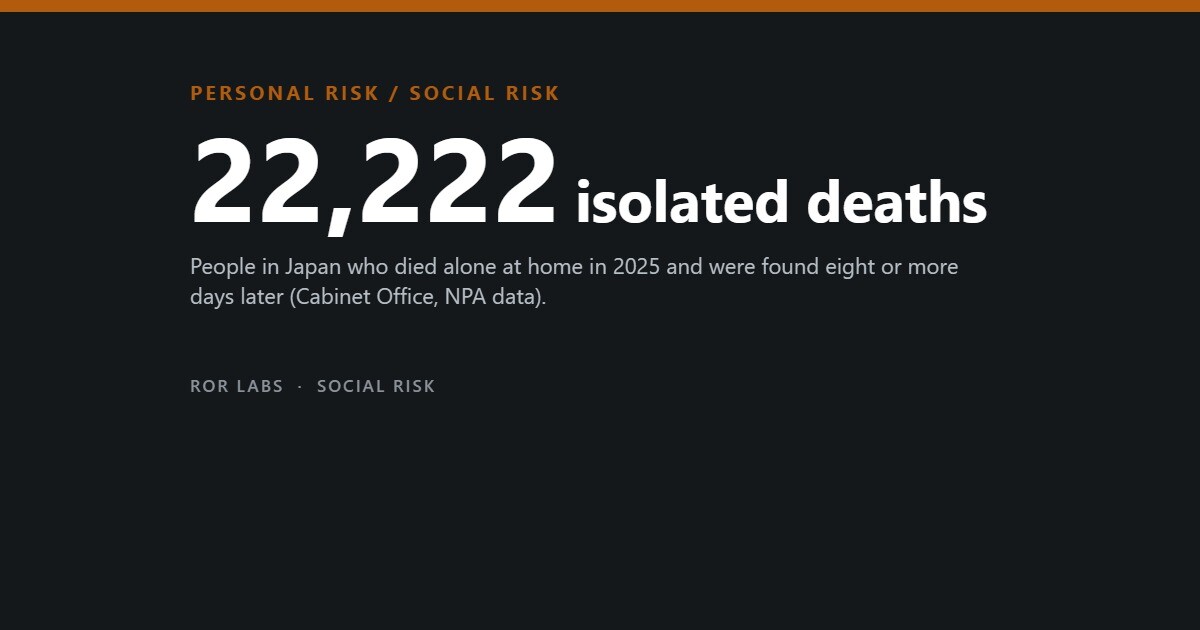
The NPA’s 2025 total was 76,941, up from 76,020 in 2024; 58,919 were aged 65 or over. Of these, 22,222 were found eight days or more after death, 366 more than in 2024, and 208 after more than a year. About eight in ten of the isolated deaths were men.
Japan, 2025: people who lived alone and died at home
Bodies handled by police. Each later row is a subset of the one above it.
Sources: National Police Agency data via Nippon.com (7 May 2026); Cabinet Office estimate of isolated deaths via Kyodo (April 2026) and Nippon.com (August 2026).
The total hides how quickly most people are found. The NPA’s preliminary figures for January to June 2024 had 39.7% of 37,227 people found within a day and 19.8% within two to three days. Fewer than three in ten lay undiscovered for eight days or more.
Most are found quickly
Time from death to discovery for people who lived alone and died at home, Japan, January to June 2024 (preliminary). Share of 37,227.
Source: National Police Agency, Criminal Investigation Bureau, provisional figures, August 2024 (Cabinet Office working-group papers). Percentages calculated by us from the published counts.
Local studies show the same shape. Records from the Tokyo Medical Examiner’s Office for 2016 to 2023 identified 46,313 solitary deaths in the 23 wards by the authors’ definition; 69.8% were men. The crude rate for men rose from 69.3 to 102.5 per 100,000, and the interval to discovery was longer for men (five days v. three) (Ninomiya et al., 2026).
South Korea and elsewhere
South Korea’s 2024 welfare ministry survey counted 3,924 lonely deaths, up from 3,661: 1.09 in every 100 deaths. Men made up 81.7%, and men in their 60s (27.8%) and 50s (26.2%) were the largest groups. Suicide accounted for 13.4%, and 39.1% had received basic livelihood benefits in the year before death.
Using police data for 2017 to 2023, Agnus Kim and Doojin Ryu found the rate rose from 4.7 to 7.2 per 100,000. Unlike suicide, which rises with age, it peaked in people’s 50s and 60s. In 2023 only a quarter were found by family.
Who found them
People who died a lonely death in South Korea in 2024, by who discovered the body.
Source: Ministry of Health and Welfare and Korea Social Security Information Service, 2024 lonely death survey, as reported by Hankook Ilbo (27 November 2025).
We found no national count for the UK or the US. A 12-week San Francisco study in 1996 recorded 387 cases of people found helpless or dead at home; 23% were dead, and the rate peaked in men aged 85 and over living alone (Gurley et al.). In South Australia, decomposed home deaths of over-60s rose from 1.6% to 9.6% of autopsies (Byard, 2024).
South Australia: two five-year periods
Deaths at home of people aged 60 and over with moderate or marked decomposition, Forensic Science SA.
Source: Byard, Journal of Forensic and Legal Medicine (2024). Cases rose from 27 to 67 while total autopsies fell from 1,673 to 696, so part of the rise in share reflects the smaller denominator.
Who is most at risk
The largest study compared all 3,122 Korean lonely deaths in 2021 that could be linked to health insurance records with 9,493 people of the same age and sex. Most cases (57.3%) were aged 45 to 64. After adjustment, being in the lowest income group or on medical aid carried odds about 14 times higher than the top income group (Koo et al., 2025).
Health and income markers in Korea
Adjusted odds ratio for lonely death, 3,122 cases in 2021 v. 9,493 age- and sex-matched controls.
Source: Koo et al., Journal of Korean Medical Science (2025). Funded by the Korean Ministry of Health and Welfare. Odds ratios from administrative data, not causes.
Two Japanese studies point the same way. In Yokohama, among 1,503 home deaths examined by medical examiners in 2013, being unmarried (odds ratio 3.05), male (1.80) and dying of liver disease (2.48) predicted a delay of three days or more; age did not (Kakiuchi et al., 2019). In 235 Kyoto forensic cases of people living alone, 61.8% of those with alcohol abuse lay undiscovered for over a week, against 38.9% of others (adjusted ratio 1.50; Miyamori et al., 2022).
A 2026 study of 420 forensic autopsies found longer delays in men, older and single people, those out of work, drinkers and people without long-term care certification (Yamasaki et al.). For 47 people who lived alone yet were found within a day, the authors point to regular visits from relatives. Regular contact seems to count for more than who you live with.
These studies have clear limits. They are records of the dead, so they show markers rather than causes. The Korean study had no data on household type or friendships, and the Kyoto cases were those sent for forensic investigation. The Korean authors also note that 40% of 2021 cases were known to neither medical aid nor the welfare screening programme.
Four people, and what was missed
Joyce Vincent was 38 when she died in her bedsit in Wood Green, north London. Housing association staff repossessing the flat over rent arrears found her on 25 January 2006; she had probably died in 2003, more than two years earlier. She had worked at an accountancy firm, loved music and had four sisters. Carol Morley’s 2011 film Dreams of a Life tried to work out who she had been.
Sheila Seleoane, 58, was found in her flat in Nunhead, south-east London, in February 2022, about two and a half years after she died. A 2022 inquest heard that neighbours had raised concerns, her rent went unpaid and her gas supply was cut off. The housing association’s staff had not, in its own words, joined the dots. It later began welfare checks on tenants whose gas is turned off.
Laura Winham was found in her Woking flat in May 2021 by her brother, more than three years after the last entry on her calendar, in November 2017. She had long struggled with her mental health. In February 2025 the coroner found lost opportunities by council and benefit services, though not ones shown to have caused her death; the cause could not be established.
Not every case involves living alone. In August 2026 a man in his 20s in Jungnang-gu, Seoul, was found two to three days after he died, when his younger brother reported he was not moving. All three in the household had severe intellectual disabilities, and police believe the others could not tell. So isolation is not only a matter of living alone.
Is dying alone a bad death?
Not necessarily. When Glenys Caswell and Mórna O’Connor interviewed 11 older people living alone in the UK, dying alone worried them less than needing care and losing independence. Seven hospice-at-home nurses had seen patients seem to arrange to be alone at the end. The authors suggest dying alone may be more a problem for survivors.
The sociologist Allan Kellehear argues that older people who die alone are routinely cast as victims when some are exercising choice. In Japan, Mika Toyota found that post-death cleaners’ accounts have begun to shift kodokushi from shame towards something with specific causes that can be prepared for.
What is worth preventing is narrower: someone who collapses and could have been helped, a body left for weeks, a family that finds out too late. All three come down to contact, which is something policy can reach.
What has been tried
Japan’s Act on the Advancement of Measures to Address Loneliness and Isolation came into force on 1 April 2024. It set up a Cabinet Office headquarters to draw up a priority plan and asks local governments to try to form councils of support organisations. It is a framework law; whether it changes outcomes will take years to show.
South Korea published its first master plan against lonely deaths in 2023, and its welfare ministry says a system to spot people at risk starts in 2026, with job support and self-help groups for people in their 50s and 60s. None has been evaluated yet.
AI phone calls are the most visible tool. Naver’s CLOVA CareCall reaches about 50,000 older people through some 150 institutions. A March 2026 report by Naver and a Yonsei University centre claimed lonely-death rates 44.2% lower where it is used, but it was co-written by the developer and gave no baseline rates or adjustment.
A Seoul National University randomised trial (ISRCTN11098754) tested twice-weekly AI calls for 12 weeks in older people on low incomes; it measures loneliness, not deaths, and should report by March 2027. Sensor-based checks remain prototypes: one 2024 study proposed spotting unusual stillness from occupancy data.
Utility and payment records are the cheapest warning system on offer. In the Seleoane case, unpaid rent and a cut-off gas supply sat in separate departments. In Korea, landlords and building staff already find more bodies than families.
What individuals and neighbours can do
If you live alone, set up one regular contact that someone would notice missing: a daily message, a weekly call, a standing visit. Make sure a friend or relative knows how to reach your landlord or a spare key. In Japan, regular visits from relatives were linked with quick discovery, and in Korea health and welfare workers found 7.7% of cases.
For families, the Winham inquest shows that stepping back at someone’s request can be right and still leave a gap. Agree a light-touch arrangement, such as a text every few days, and what happens if it stops. Ask about local watch-over or care-call services.
For neighbours and landlords, the signs are mundane: post piling up, curtains unchanged for days, rent or bills unpaid. If you are worried, knock, then call the landlord or the police non-emergency line and ask for a welfare check. Being wrong costs very little.
What to do
Steps sorted by when they matter. Each one says how strong the evidence is: Measured Official advice Untested
Before
- If you live alone, set up one regular contact that someone would notice missing, such as a daily message or a weekly call. Measured see Sources
- Make sure a friend or relative knows how to reach your landlord, or where a spare key is kept. Untested see Sources
- If an older relative lives alone, arrange regular visits; in Japanese studies, regular visits from relatives went with faster discovery. Measured see Sources
- Ask your local council or welfare office whether a watch-over or care-call service is available. Untested see Sources
If it happens
- If a neighbour’s post piles up or curtains stay unchanged for days, knock, then call the landlord or the police non-emergency line for a welfare check. Untested see Sources
- If you see or hear signs that someone is in distress, call the emergency number straight away. Untested see Sources
- Landlords and housing staff: treat unpaid rent together with a cut-off gas or power supply as a reason for a welfare check. Official advice see Sources
Afterwards
- If a regular check-in stops, follow up the same day rather than waiting for the next scheduled contact. Untested see Sources
- If you are worried about a relative who has asked for distance, agree a light-touch arrangement and what happens if it stops. Untested see Sources
What not to do
- Do not assume living alone is the danger in itself; most people who die alone at home are found within days. Measured see Sources
- Do not rely on an AI call service as proof of safety; its effect on deaths has not been shown. Measured see Sources
- Do not blame families or the person who died; the documented cases show signals spread across many services. Untested see Sources
If you are worried about someone who has not been seen, call the police non-emergency line or, if urgent, 999 or 911.
Questions people ask
Is living alone itself dangerous?
Most people who live alone and die at home are found quickly. The strongest markers in these studies are poverty, being unmarried or out of work, alcohol problems and serious illness, with little regular contact.
Why are middle-aged men so affected in Korea?
Korean studies point to low income, job loss, alcohol-related illness and weak social ties. The welfare ministry is aiming job support and self-help groups at this age group; these have not been evaluated.
Are lonely deaths rising?
The counts have risen in Japan and Korea, partly because populations are ageing and more people live alone. Better recording since Korea’s 2021 law may also play a part.
Do AI check-in calls prevent deaths?
Not proven. The 44.2% figure comes from a developer-linked report with no published method, and the first randomised trial measures loneliness, not deaths.
What should I do if I think a neighbour has not been seen for days?
Contact the landlord or the police non-emergency number and ask for a welfare check. If you see or hear signs of someone in distress, call the emergency number straight away.
The short version
- Japan’s police handled 76,941 people in 2025 who had died alone at home. About 22,200 of them were found eight days or more after death, and 208 after more than a year.
- South Korea counted 3,924 lonely deaths in 2024, up 7.2% on 2023. More than four in five were men, and about 60% were in their 50s or 60s.
- The strongest risk markers in Korean and Japanese studies are being male, unmarried, poor, out of work or retired, and having alcohol problems or long-term illness. Living alone sets the scene; on its own it explains little.
- Most people who die alone at home are found within days. In Japanese police data for early 2024, four in ten were found within a day, and the long delays cluster among people with little regular contact.
- Watch-over schemes, AI phone calls and new laws in Japan and Korea are spreading faster than the evidence. The one large claim for AI calls comes from a report the developer co-wrote; a randomised trial is still to report.
- The most practical protection is ordinary: regular contact someone would notice missing, an agreed check-in, and neighbours, landlords and services who act on small signs such as uncollected post or unpaid rent.
This article summarises research, official statistics and news reports for general information. It is not legal, medical or social-care advice. If you are worried about someone’s safety, contact local emergency services; if you are struggling with loneliness or low mood yourself, talk to a doctor or a local support service.
Further reading: Koo et al., Journal of Korean Medical Science (2025), for the largest comparison of lonely deaths with matched controls. Kakiuchi et al., Environmental Health and Preventive Medicine (2019), for how time to discovery is measured. Caswell and O’Connor, Mortality (2019), for what older people living alone think about dying alone.
Sources
- Nippon.com. Living alone and dying unseen in Japan (7 May 2026).
- Nippon.com. Surge in solitary deaths reflects changes in Japan’s family structure (24 August 2026).
- Kyodo News, via Akita Sakigake Shimpo. ‘Koritsushi’ 22,000 in 2025, government estimate (14 April 2026).
- National Police Agency. Persons living alone who died at home, January–June 2024, provisional (August 2024), Cabinet Office working-group papers.
- Hankook Ilbo, on the Ministry of Health and Welfare 2024 lonely death survey (27 November 2025).
- Koo HY, Bai H, Lee JR, Kang MJ, Jun YH, Yun J, et al. Potential risk factors for lonely death: a nationwide case-control study in Korea. J Korean Med Sci 40(50):e335 (2025), doi:10.3346/jkms.2025.40.e335.
- Kim AM, Ryu D. Lonely deaths in Korea, 2017–2023: records of social disconnection. Behav Med (2026), doi:10.1080/08964289.2026.2716214.
- Kakiuchi Y, Nagao R, Ochiai E, Kakimoto Y, Osawa M. A descriptive study of solitary death in Yokohama City. Environ Health Prev Med (2019), doi:10.1186/s12199-019-0766-z.
- Miyamori D, Kamitani T, Ogawa Y, Idota N, Ikegaya H, Ito M. Alcohol abuse as a potential risk factor of solitary death among people living alone: a cross-sectional study in Kyoto, Japan. BMC Public Health (2022), doi:10.1186/s12889-022-12965-9.
- Yamasaki Y, Tamiya N, Yamamoto H, et al. Factors that delay discovery in cases of death at home in Japan. Leg Med (2026), doi:10.1016/j.legalmed.2026.102895.
- Ninomiya H, Ae R, Suzuki H. Descriptive epidemiology of solitary death (kodokushi) in Tokyo’s 23 wards, Japan, 2016–2023. J Epidemiol (advance publication, 2026).
- Cho CM, Moon HJ, Yoo JH. Understanding of solitary death in people living in the community: a scoping review. Glob Public Health (2025), doi:10.1080/17441692.2025.2597627.
- Byard RW. The forensic implications of lonely deaths (Kodokushi): a South Australian study. J Forensic Leg Med (2024), doi:10.1016/j.jflm.2024.102799.
- Gurley RJ, Lum N, Sande M, Lo B, Katz MH. Persons found in their homes helpless or dead. N Engl J Med (1996), doi:10.1056/NEJM199606273342606.
- Caswell G, O’Connor M. ‘I’ve no fear of dying alone’: exploring perspectives on living and dying alone. Mortality (2019), doi:10.1080/13576275.2017.1413542.
- Kellehear A. Dying old: and preferably alone? Agency, resistance and dissent at the end of life. Int J Ageing Later Life (2009).
- Toyota M. From dreadful shame to manageable incident: how post-mortem cleaning workers’ narratives change the feeling rules about ‘lonely deaths’ in Japan (2024), doi:10.1017/ssh.2024.32.
- Health and Social Welfare Review (KIHASA) 44(3):111 (2024), on the amended legal definition.
- Cabinet Office, Japan. Outline of the Act on the Advancement of Measures to Address Loneliness and Isolation (Act No. 45 of 2023).
- Seoul Economic Daily. Naver AI call service cuts lonely deaths by 44% (19 March 2026).
- ISRCTN11098754. Effectiveness of an LLM-based AI care call service in reducing loneliness among lower-income seniors (registered 2025).
- Noh SH, Moon HJ. A non-intrusive method for lonely death prevention using occupancy detection and an anomaly detection model. Buildings 14(5):1392 (2024), doi:10.3390/buildings14051392.
- Morley C. How could a young woman lie dead and undiscovered for three years? Irish Examiner (14 January 2012).
- Southwark News. Deceased Nunhead woman lay undiscovered for two years, inquest hears (21 July 2022).
- ITV News London. Woman found dead in flat after three years had been ‘left to fend for herself’ (25 February 2025).
- The Korea Herald. Man’s death goes unnoticed for days in family (14 September 2026).