Overdraft Fees: What the Evidence Shows
Key takeaways · 11 min read
- Large US banks collected almost $12 billion in overdraft and NSF fees in 2019, and about $5.8 billion in 2023.
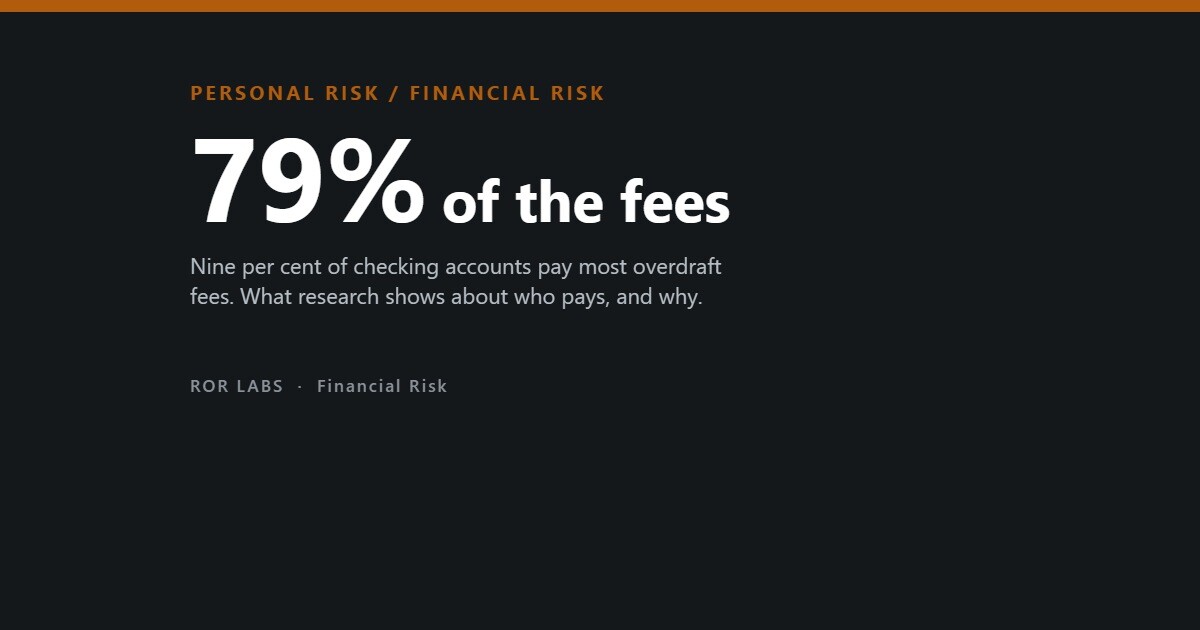
- 9% of accounts pay 79% of the fees, mostly people with low balances and poor credit.
- Text alerts cut the most expensive UK overdraft charges by 17 to 19%, but capture less than half of avoidable costs.
- Nudges can move fees rather than remove them: a Brazilian reminder cut late fees but raised overdraft fees.
An overdraft fee is one of the few prices most people pay without ever deciding to. A card payment goes through, the balance dips below zero, and a day or two later the bank adds a charge of around $35. Sometimes the purchase that triggered it cost less than the fee.
For a long time overdraft fees were among the largest sources of fee income for American banks. In 2019, the largest banks collected almost $12 billion from overdraft and insufficient-funds charges. By 2023 that had fallen by half, and in December 2024 the Consumer Financial Protection Bureau finalised a rule that would have cut it further. Congress repealed that rule five months later.
This article looks at what research shows about who pays overdraft fees, why they pay them, what kinds of intervention reduce them, and why the policy argument keeps swinging back and forth. The number that frames almost everything else comes from the CFPB: 9% of accounts pay 79% of the fees.
How an accident became a business
Overdraft coverage started as a courtesy. If a customer’s cheque would bounce by a small amount, a bank might pay it anyway and charge a fee, rather than return it and embarrass both parties. In 1969 the Federal Reserve decided that this kind of occasional coverage was not credit, and so did not fall under lending law. That exemption lasted more than fifty years.
Debit cards changed the scale. Once most small everyday purchases were made by card, a single day could produce several overdrafts, each with its own fee. A coffee, a bus fare and a grocery top-up could together cost more than $100 in fees.
In 2010 the Federal Reserve responded with an opt-in rule under Regulation E. Banks could no longer charge overdraft fees on one-off debit card and ATM transactions unless the customer had actively agreed to the service. Cheques, direct debits and recurring payments were not covered.
The CFPB, created the following year, began publishing data on how the market actually worked. Its figures for the largest banks, those with more than $1 billion in assets, show how much money was involved. In 2019, overdraft and insufficient-funds revenue was $11.96 billion. By 2023 it had fallen to $5.83 billion, a decline of 51%, after many large banks cut or dropped the fees.
Overdraft and NSF fee revenue, large US banks
Banks with more than $1 billion in assets.
Consumer Financial Protection Bureau, Data Spotlight: Overdraft/NSF revenue in 2023, April 2024.
Who actually pays
The most important fact about overdraft fees is how concentrated they are. In a 2017 data point, the CFPB defined frequent overdrafters as accounts with more than ten overdraft or insufficient-funds charges a year. They made up 9% of accounts but paid 79% of all such fees. Very frequent overdrafters, with more than twenty charges a year, were 4.9% of accounts and paid 63% of the fees.
Those accounts looked different from the rest. The median credit score of very frequent overdrafters was 563, against 747 for people who never overdrew. Only about half had a general-purpose credit card, and those who did had a few hundred dollars of available credit, against about $14,100 for non-overdrafters. Their median end-of-day balance was $276, compared with $1,585.
The opt-in rule mattered for this group. Frequent overdrafters who had opted in to debit card coverage had only 22% more overdrafts than those who had not, but paid far more in fees. Assuming a fee of $34, the CFPB estimated the difference at about $442 a year.
That pattern is the core of the policy debate. For most customers, overdraft fees are an occasional nuisance. For a small group with little money and little access to other credit, they are a regular and substantial cost.
A small share of accounts pays most of the fees
Share of checking accounts compared with share of overdraft and NSF fees paid.
Consumer Financial Protection Bureau, Data Point: Frequent Overdrafters, August 2017. Frequent means more than 10 charges a year; very frequent, more than 20.

Inattention or empty pockets?
There are two broad explanations for why people keep paying overdraft fees, and they point to very different fixes.
The first is inattention. People do not track their balance closely, forget a direct debit is due, or underestimate how many small card payments are pending. If that is the main problem, reminders and better information should help a lot.
The second is that people simply do not have the money, and overdraft is the most readily available form of short-term credit. If that is the main problem, reminders will do little, and removing the fee without offering an alternative could push people towards something worse.

The best recent evidence suggests that both are true, in different proportions. Michael Grubb and colleagues, in a 2025 paper in the Journal of Finance, used data from UK banks to estimate how much of overdraft use could have been avoided. They found that over half of overdraft charges could have been avoided if customers had moved money from savings or used cheaper credit they already had. That is the inattention part.
But in the United States, a 2025 analysis by economists at the Federal Reserve Bank of New York, drawing on a survey of about a thousand households, found that nearly 80% of households had not overdrawn at all in the previous year. Among the rest, once other factors were taken into account, the reliable predictor was a low credit score. People with scores below 620 were more than 50% more likely to have overdrawn than those above 760, while income, race and education were no longer significant. That is the empty-pockets part. People with poor credit have fewer places to turn, and the overdraft is the one already attached to their account.
What nudges can and cannot do
Because some overdrafts are avoidable, regulators have tested whether nudges help. The results are consistent in one respect: they help, but less than hoped, and sometimes they move costs somewhere else.
In the UK, the Financial Conduct Authority worked with banks to automatically enrol customers in text alerts warning them when their balance was low. Grubb and colleagues found that automatic enrolment reduced unarranged overdraft charges, the most expensive kind, by 17 to 19%, and arranged overdraft charges by 4 to 8%. Scaled to the market, they estimated savings of £170 to £240 million a year. But alerts captured less than half of the savings that would have been possible if every avoidable overdraft had been avoided.
In Turkey, Sule Alan, Mehmet Cemalcılar, Dean Karlan and Jonathan Zinman ran an experiment with a large bank that sent text messages to about 108,000 customers. Messages that mentioned a discount on the overdraft interest rate reduced overdraft use. Messages that simply mentioned that an overdraft was available, without the price, increased it. Neither effect persisted once the messages stopped.
In Brazil, Paolina Medina studied reminders to pay credit card bills on time. The reminders cut late payment fees by 14%. But overdraft fees rose by 9%, because some customers paid the card bill on time from a checking account that could not cover it. The fee had moved rather than disappeared.
What happened when banks sent messages
Randomised or quasi-randomised studies of reminders and alerts.
| Study | Setting | Main finding |
|---|---|---|
| Grubb and colleagues, 2025 | UK, text alerts | Unarranged overdraft charges cut 17–19% |
| Alan and colleagues, 2018 | Turkey, 108,000 customers | Price messages cut use; availability messages raised it |
| Medina, 2021 | Brazil, card reminders | Late fees down 14%, overdraft fees up 9% |
Journal of Finance, 2025 and 2018; Review of Financial Studies, 2021.
Did the opt-in rule work?
The 2010 opt-in rule was built on the idea that people would choose not to pay for overdraft coverage on debit cards if asked. It had some effect, but it was smaller than supporters expected.
Many customers opted in, often after being told at account opening that the service would protect them from declined transactions. Claire Greene and Mi Luo, in a Federal Reserve Bank of Boston working paper, compared consumer survey data from 2009 and 2014. Fewer people overdrew and fewer paid fees after the rule, but the changes were small, and the authors could not separate the rule’s effect from other economic changes. And because the rule did not cover cheques or direct debits, much of the fee income simply shifted to those channels.
The CFPB’s own data showed the consequence. Frequent overdrafters who had opted in paid substantially more than those who had not, even though they overdrew only slightly more often. Letting people choose did not, on its own, protect the people most exposed.
The cap that never arrived
In December 2024, the CFPB finalised a rule that would have treated overdraft coverage at large banks, those with more than $10 billion in assets, much like other lending. Banks would have had three options: charge a flat fee of $5, charge a fee that covered only their actual costs and losses, or offer overdraft as a credit product with standard lending disclosures.
The bureau estimated that the rule would save consumers about $5 billion a year, or around $225 for each household that paid overdraft fees. It was due to take effect on 1 October 2025.
It never did. In spring 2025 both houses of Congress voted to overturn the rule under the Congressional Review Act, and President Trump signed the resolution on 9 May 2025. The Act also stops the agency from issuing a substantially similar rule unless Congress authorises it.
Meanwhile, the market had already changed. Several of the largest banks had cut fees sharply under public and regulatory pressure. By 2023, compared with 2019, Capital One had eliminated overdraft fee revenue altogether, Citibank had cut it by about 98%, and Bank of America by 91%. JPMorgan Chase and Wells Fargo cut theirs by less than half.
How far large banks cut overdraft revenue
Change in overdraft and NSF fee revenue, 2019 to 2023.
Consumer Financial Protection Bureau, Data Spotlight, April 2024.
The case for overdraft fees
Critics of the CFPB rule, including banks and many members of Congress, argued that overdraft coverage is a service people value. A declined card at a pharmacy or a returned rent payment can cost more, in fees and in consequences, than an overdraft charge.
The research on payday lending gives this argument some support. When Oregon capped payday loans in 2007, Jonathan Zinman found that former payday borrowers moved partly into bank overdrafts and late bill payments. The reverse is also plausible: if overdraft becomes less available, some customers could move towards payday loans, pawnshops or other expensive credit. The evidence on this is thinner than on either product alone.
There is also a concern about access. If overdraft becomes less profitable, banks may raise monthly account fees or be less willing to open accounts for customers with low balances. The large cuts since 2019 have not, so far, produced a clear rise in the number of unbanked households, but the rule was repealed before its effects could be observed.
The honest summary is that overdraft fees are expensive credit that falls mostly on people with few alternatives. Whether removing them helps depends on what replaces them.
Who the frequent overdrafters are
CFPB comparison of account holders by overdraft frequency.
| Measure | Never overdrew | Very frequent |
|---|---|---|
| Median credit score | 747 | 563 |
| Median end-of-day balance | $1,585 | $276 |
| Available credit on cards | about $14,100 | a few hundred dollars |
Consumer Financial Protection Bureau, Data Point: Frequent Overdrafters, August 2017.
What the evidence does not show
It does not show that most people who pay overdraft fees are careless. Some overdrafts are avoidable, but the heaviest users are mostly people with low balances and little access to other credit.
It does not show that reminders solve the problem. Text alerts reduce the most expensive charges, but by less than a fifth, and in some settings they move costs to other fees.
It does not show what would have happened under the CFPB’s $5 rule. It was repealed before taking effect, so its predicted savings and its critics’ predicted harms were never tested.
And much of the detailed account-level data is from the 2010s. The market has changed since, with many large banks cutting fees and new products such as early wage access and small-dollar bank loans appearing.
Questions people ask
How much is a typical overdraft fee?
Many large US banks still charge up to about $35 per overdraft, though several have cut or eliminated the fee since 2021.
Who pays most overdraft fees?
A small group. The CFPB found that 9% of accounts, those with more than ten overdrafts a year, paid 79% of all overdraft and insufficient-funds fees.
Do low-balance alerts help?
Yes, modestly. In a UK study, automatic text alerts cut the most expensive overdraft charges by 17 to 19%.
What happened to the CFPB overdraft rule?
It was finalised in December 2024 and would have capped fees at large banks at $5 or at cost. Congress overturned it and the President signed the repeal on 9 May 2025.
Is opting out of overdraft coverage a good idea?
It depends on your circumstances. Opting out means card payments are declined rather than covered. The research suggests the people who pay most in fees are those who opt in and have little buffer, but this is not personal advice.
The short version
- Large US banks collected almost $12 billion in overdraft and NSF fees in 2019, and about $5.8 billion in 2023.
- 9% of accounts pay 79% of the fees, mostly people with low balances and poor credit.
- Text alerts cut the most expensive UK overdraft charges by 17 to 19%, but capture less than half of avoidable costs.
- Nudges can move fees rather than remove them: a Brazilian reminder cut late fees but raised overdraft fees.
- A CFPB rule capping overdraft fees at large banks was repealed in May 2025 before it took effect.
This article summarises published research and public data on overdraft fees. It is not financial or legal advice, and it does not recommend any bank, account or credit product. If overdraft fees are a regular cost for you, a non-profit credit counselling service can help you look at your options.
Further reading. Grubb, Kelly, Nieboer, Osborne and Shaw, ‘Sending Out an SMS’, Journal of Finance, 2025, is the most careful recent study of what alerts can achieve. The CFPB’s 2017 data point on frequent overdrafters remains the clearest picture of who pays.
- Nudge: The Final Edition, Richard Thaler and Cass Sunstein (2021). The revised edition of the book behind many of the alert and default experiments described here.
- The Psychology of Money, Morgan Housel (2020). Short essays on how people actually behave with money, including why a small buffer matters more than a clever plan.
- Poverty, by America, Matthew Desmond (2023). A sociologist on the costs of being poor in the United States, including overdraft fees and high-cost credit.
Sources
- Consumer Financial Protection Bureau. Data Point: Checking account overdraft. July 2014.
- Consumer Financial Protection Bureau. Data Point: Frequent overdrafters. August 2017.
- Consumer Financial Protection Bureau. Data Spotlight: Overdraft/NSF revenue in 2023 down more than 50% versus pre-pandemic levels. April 2024.
- Consumer Financial Protection Bureau. CFPB closes overdraft loophole to save Americans billions in fees. Press release, December 2024.
- Grubb MD, Kelly D, Nieboer J, Osborne M, Shaw J. Sending out an SMS: automatic enrollment experiments for overdraft alerts. Journal of Finance, 2025;80(1):467–514. doi:10.1111/jofi.13404.
- Alan S, Cemalcılar M, Karlan D, Zinman J. Unshrouding: evidence from bank overdrafts in Turkey. Journal of Finance, 2018;73(2):481–522. doi:10.1111/jofi.12593.
- Medina PC. Side effects of nudging: evidence from a randomized intervention in the credit card market. Review of Financial Studies, 2021;34(5):2580–2607. doi:10.1093/rfs/hhaa108.
- Leonard G, Morgan DP, van der Klaauw W. Who’s paying those overdraft fees? Federal Reserve Bank of New York, Liberty Street Economics, May 2025.
- Greene C, Luo M. Consumers’ use of overdraft protection. Federal Reserve Bank of Boston, Research Data Report 15-8, 2015.
- Zinman J. Restricting consumer credit access: household survey evidence on effects around the Oregon rate cap. Journal of Banking and Finance, 2010.
- Holland & Knight. CFPB overdraft and digital payment rules repealed. May 2025.
- Consumer Finance Monitor (Ballard Spahr). Trump signs resolution nullifying CFPB overdraft rule. 12 May 2025.