Listeria in Food: What the Evidence Shows
Key takeaways · 13 min read
- Listeriosis is rare: the CDC estimates about 1,250 infections a year in the US, and about 1 in 25,000 pregnant women is infected each year.
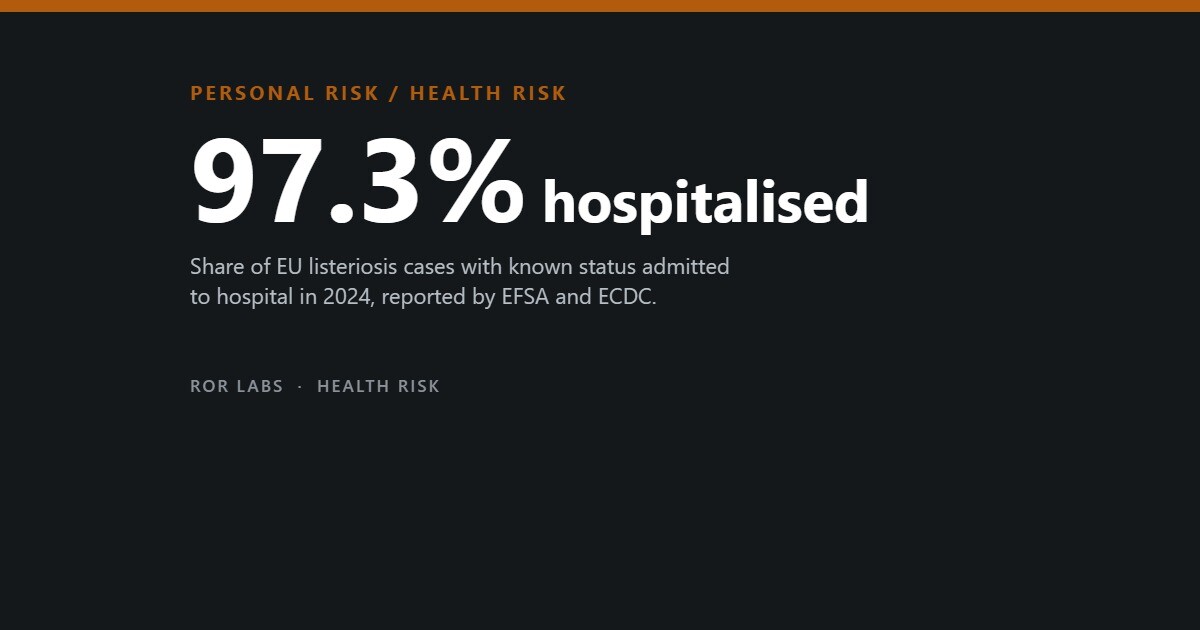
- It is severe when it strikes: in the EU in 2024, 97.3% of cases with a known status were hospitalised and 15.6% of those with a known outcome died.
- Risk is concentrated: US rates were about four times the average in over-65s and ten times in pregnant women, and most other patients under 65 had a weakened immune system.
- In pregnancy the mother usually recovers but the baby may not: in a French cohort of 107 cases, 24% ended in fetal loss and only 5% had an uneventful outcome.
In this article
Most food poisoning announces itself within a day or two. Listeria is different. It keeps growing in a cold fridge, it rarely makes healthy adults more than briefly unwell, and when it does cause serious illness the meal responsible may have been eaten weeks earlier. For a small group of people, though, it is among the most dangerous things that can arrive on a plate.
This article looks at what surveillance systems, cohort studies and outbreak investigations show about listeriosis: who gets it, how often, how often it kills, which foods have carried it, and why outbreaks take so long to trace. It draws on US and European surveillance, a French national cohort, and studies of what pregnant women know and eat.
The balance is uncomfortable. For most people the absolute risk is tiny; for a few, the case-fatality is high. And much of the standard advice comes from outbreak data rather than trials. Every number below is tied to the source that reported it.

What listeria is, and why the fridge does not stop it
Listeria monocytogenes is a bacterium found widely in soil, water and food-processing plants. Unlike most food-poisoning bacteria, it can multiply at refrigerator temperatures. The CDC’s 2013 review of US cases notes that it grows in moist environments even when chilled, which is why ready-to-eat foods that sit in the fridge for days or weeks keep turning up in outbreaks.
Two illnesses share the name. In healthy people it can cause a short bout of fever and diarrhoea; in outbreaks of this kind the median time from meal to symptoms was about 24 hours. The serious form, invasive listeriosis, reaches the blood, the brain or, in pregnancy, the placenta. Surveillance mostly counts this invasive form, which is why the figures that follow look so severe.
The numbers are small. The CDC estimates that about 1,250 people in the US are infected each year and about 172 die. The EU recorded 3,041 confirmed cases in 2024. The European Food Safety Authority (EFSA) and the European Centre for Disease Prevention and Control (ECDC) called listeriosis the most severe zoonosis they track, with the highest share of hospitalisations and the highest case-fatality.
Who is at risk
Risk is concentrated in four groups: pregnant women and their unborn or newborn babies, older adults, and people whose immune system is weakened by disease or treatment. The CDC’s Vital Signs review of 1,651 US cases reported in 2009–2011 found that 58% were in adults aged 65 or over and 14% were associated with pregnancy.
Who gets listeriosis
Incidence compared with the whole population, US FoodNet surveillance sites, 2009–2011.
Source: CDC, Vital Signs: Listeria illnesses, deaths, and outbreaks, United States 2009–2011 (MMWR, 2013).
Among non-pregnant patients under 65, 74% had an underlying condition, most often immunosuppressive therapy such as steroids or chemotherapy, followed by cancer and diabetes. The French MONALISA cohort, which followed 818 patients, found a similar pattern: 43% of those with blood or brain infection had received corticosteroids or other immunosuppressive drugs in the previous five years.
The higher rate among pregnant Hispanic women in the US has been linked to fresh Mexican-style cheeses such as queso fresco. A 2004–2007 analysis found pregnant patients were more likely than other patients to report eating them (odds ratio 2.6). The pattern reflects what is sold and how it is made, not anything the women did wrong.
How rare, and how deadly
The two halves of the risk point in opposite directions. For any one person, infection is unusual. The CDC says about 1 in 25,000 pregnant women in the US is infected each year, and average incidence at US surveillance sites in 2009–2011 was 0.29 cases per 100,000 people. Even in the highest-risk group in that study, pregnant Hispanic women, the rate was 7 per 100,000.
When it is invasive, it is serious
Hospitalisation and death among reported cases of invasive listeriosis.
Sources: EFSA and ECDC, EU One Health 2024 Zoonoses Report (2025); Charlier et al., Lancet Infectious Diseases (2017); CDC, MMWR Vital Signs (2013).
The spread in fatality figures comes mostly from the denominator. The EU counts deaths among cases whose outcome was reported; the US figure includes fetal losses; MONALISA followed patients for three months and counted only blood and brain infections, in people who were older and often already ill. In that cohort, 12% of three-month deaths after bacteraemia came after discharge and were attributed to pre-existing disease.
So the honest summary is that listeriosis is very unlikely for any individual, but among the people it does reach, who are mostly vulnerable already, it kills roughly one in six to one in five. That combination is what makes targeted advice for high-risk groups reasonable, and also what makes it easy to overstate the danger for everyone else.
Pregnancy and newborns
Pregnancy changes the picture because the bacterium can cross the placenta. The mother may have little more than a fever; the baby bears most of the harm. In MONALISA, every one of the 107 women with maternal-neonatal listeriosis recovered, but only five had a normal delivery and a normal recovery after birth.
Outcomes of listeriosis in pregnancy
107 maternal-neonatal cases, MONALISA national prospective cohort, France, 2009–2013.
Source: Charlier et al., Lancet Infectious Diseases (2017).
France’s longer series tells the same story. Of 606 pregnancy-related cases reported in 1999–2011, 27% ended in fetal loss and 58% were live-born babies with listeriosis, most of them preterm. In the US, 20% of the 128 pregnancy-associated cases reported in 2004–2007 ended in fetal loss.
There is better news in the same French data. Among infected newborns, the case-fatality ratio fell from 33% in 1970–1975 to 4% in 1999–2011, probably because of progress in neonatal care, the authors say. These studies count only laboratory-confirmed cases, so early miscarriages that were never tested for listeria are likely to be missing from them.
The foods involved
Listeria does best in foods that are eaten without further cooking and kept chilled for days or weeks. US outbreaks and case-control studies have implicated deli meats, hot dogs, soft cheeses, pâté, smoked seafood, melon, sprouts and ice cream. The CDC’s 2013 review found cheese behind half of 12 US outbreaks in 2009–2011, mostly soft cheeses labelled as made from pasteurised milk.
The largest recent US outbreak came from deli counters. In 2024, meats sliced at delis, including one producer’s liverwurst, made 61 people ill in 19 states; 60 were hospitalised and 10 died. The company, Boar’s Head, recalled more than 7 million pounds of ready-to-eat products. The CDC opened its investigation on 19 July 2024 and declared the outbreak over in November.
Other outbreaks show how varied the vehicles are. Whole cantaloupes from one Colorado farm caused 147 illnesses and 33 deaths in 2011. Enoki mushrooms caused 36 illnesses, four deaths and two fetal losses in an outbreak reported in 2020. Ice cream from a Florida creamery made 28 people ill in 2022, with one death and one fetal loss. Ready-to-eat pasta meals caused 28 illnesses and seven deaths in an outbreak that closed in February 2026.
Pasteurisation kills listeria, but contamination can happen afterwards, which is why pasteurised soft cheeses and ice cream still appear on the list. Raw milk raises the stakes: the FDA and Health Canada estimated that, per serving, soft-ripened cheese made from unpasteurised milk carries 50 to 160 times the risk of the same cheese made from pasteurised milk.
Why tracing takes so long
The textbook incubation range for listeriosis, 3 to 70 days, comes from a large outbreak described in 1987. When Véronique Goulet and colleagues pooled 37 invasive cases with a single known exposure, the median was 8 days overall, but it varied sharply by form: 2 days for bacteraemia, 9 days for brain infection and 27.5 days for pregnancy-associated cases, which ranged from 17 to 67 days.
Time from meal to illness
Median incubation by form of listeriosis: 37 invasive cases with one known exposure, plus nine outbreaks of listeria gastroenteritis.
Source: Goulet et al., BMC Infectious Diseases (2013).
A later US analysis of outbreak cases found a median of 11 days, with 90% of cases within 28 days. That long, variable gap is the core problem for investigators. People struggle to recall what they ate a month earlier: in the 2011 cantaloupe outbreak, most pregnant women surveyed in Colorado could not remember which brand of melon they had eaten. Goulet’s team suggested asking pregnant patients about the six weeks before symptoms.
Genome sequencing now links scattered cases over long periods. The enoki outbreak connected specimens collected from November 2016 to December 2019. The 2026 requesón outbreak linked illnesses from March 2023 to July 2026 before a cheese maker was identified. Each case on its own looked sporadic, and most cases still do: only 14% of US cases in 2009–2011 were part of a recognised outbreak.

Does the advice to pregnant women work?
Agencies advise people at higher risk to avoid or heat certain foods. The CDC’s list includes heating deli meats and hot dogs until steaming hot (165°F, about 74°C), avoiding unheated queso fresco-type cheeses, refrigerated smoked fish and raw sprouts, eating cut melon soon after cutting, and never eating enoki mushrooms raw. The question is whether such advice reaches people and changes what they eat.
Advice versus what people eat
Surveys of pregnant women and recent mothers, and of French mothers with listeriosis.
Sources: Wong et al. (2013); Xu et al., Food Control (2017); Girard et al., Eurosurveillance (2014); Ogunmodede et al. (2005).
Knowledge does not translate neatly into behaviour. In an Irish survey of mothers who had just given birth, 82% knew they should avoid certain foods, but 55% said they had eaten high-risk foods anyway, and only 13.5% recalled being told about listeria by a midwife or doctor. In Louisiana, women who knew more about listeria ate fewer high-risk foods, but 71% still ate at least one.
Whether advice prevents infections is harder to show, because cases are too rare for a trial. A 2018 systematic review found 11 relevant studies, all but one case-control, with odds ratios for implicated foods from 1.6 to 20.5. Yet one Australian study found no link between pregnancy listeriosis and any food it asked about. MONALISA’s authors add that no clinical trial of listeriosis treatment had been done.
The strongest population evidence points to the factory more than the fridge. In France, pregnancy-related listeriosis fell from 60 to 5 cases per 100,000 live births between 1984 and 2011, and the authors credit control measures in food production. Regions where more women hear dietary advice through monthly toxoplasmosis screening had fewer cases, a hint rather than proof that advice helps.
Who is at risk, and what to avoid
The US Centers for Disease Control and Prevention (CDC) estimates about 1,250 listeria illnesses and about 172 deaths a year in the US, making listeriosis the fourth leading cause of foodborne-illness death. Most healthy people rarely become seriously ill.
| Group | Note |
|---|---|
| Pregnant women | About 1 in 25,000 pregnant women are infected each year |
| Newborns | Named as higher risk |
| Adults 65 and over | More than half of infections |
| People with weakened immune systems | About 75% of cases |
Symptoms. In pregnancy: fever and flu-like symptoms such as muscle aches and tiredness. In others: fever, headache, stiff neck, confusion, loss of balance or seizures. Serious illness usually starts within two weeks of eating contaminated food, and intestinal symptoms usually within 24 hours.
| Food | Advice |
|---|---|
| Soft cheeses such as queso fresco, raw-milk cheese | Avoid unless heated to 165°F or steaming hot; choose pasteurised alternatives |
| Deli meat, cold cuts, hot dogs, dry sausages | Avoid unless heated to 165°F or steaming hot |
| Premade deli salads | Avoid; make your own |
| Refrigerated paté or meat spreads, smoked fish | Avoid; choose shelf-stable or cooked versions |
| Raw sprouts, raw enoki mushrooms | Eat only cooked until steaming hot |
| Cut melon | Avoid if left out over 2 hours (1 hour above 90°F) or refrigerated over a week |
| Raw milk, yogurt, ice cream | Avoid |
What we could not confirm. The CDC pages we read give no “times more likely” multipliers. A CDC clinician page says the risk after exposure is very low, citing an estimate of about 1 case per 10,000 pregnant women who ate the implicated cantaloupe in a 2011 outbreak. The case counts carry no year.
The limits of the evidence
Three caveats run through this evidence. First, the denominators are small and uncertain. A Colorado study of the 2011 cantaloupe outbreak estimated about one case per 10,000 exposed pregnant women, but that rested on a single case; one more would have doubled it, the authors note, and early miscarriages are rarely tested for listeria.

Second, surveillance sees only part of the picture. The best figures come from countries with mandatory reporting and laboratory confirmation; France’s system was estimated to capture 85–87% of cases in 2008–2013. Food attributions come from what patients remember and from outbreak foods, and sporadic cases, which are most cases, rarely have a confirmed source. Much of the food list is therefore built on outbreaks.
Third, fear has costs too. During the 2011 outbreak, 81% of pregnant women surveyed in Colorado had heard about it, and many had eaten foods on the risk lists, including turkey deli meat (54%) and soft cheese (39%). The feared surge in pregnancy cases did not come. None of this argues against the advice; it argues for proportion, and for keeping pressure on producers, where the largest gains were made.
What to do
Steps sorted by when they matter. Each one says how strong the evidence is: Measured Official advice Untested
Before
- If you are pregnant, over 65 or on immune-suppressing treatment, heat deli meats and hot dogs until steaming hot (165°F, about 74°C) before eating them. Official advice see Sources
- In those groups, avoid unheated queso fresco-type soft cheeses, refrigerated smoked fish and raw sprouts. Official advice see Sources
- Eat cut melon soon after it is cut, and never eat enoki mushrooms raw. Official advice see Sources
- Ask your midwife or doctor which foods to avoid or heat; in an Irish survey only 13.5% of new mothers recalled being told about listeria. Measured see Sources
If it happens
- If you are pregnant and get a fever after eating a recalled product, contact your midwife or doctor promptly. Untested see Sources
- If a food you have at home is named in a recall, stop eating it and check the recall notice. Untested see Sources
- If you are pregnant and ate a recalled product, tell your midwife or doctor about it even if you feel well. Untested see Sources
Afterwards
- Keep watching for fever for weeks, not days: in pregnancy the median gap between meal and illness in documented cases was 27.5 days, and up to 67. Measured see Sources
- If health officials ask what you ate, think back several weeks; researchers suggest a six-week window for pregnancy-related cases. Measured see Sources
What not to do
- Do not assume pasteurised means safe: pasteurised soft cheeses and ice cream have caused outbreaks. Measured see Sources
- Do not rely on the fridge alone: listeria can grow at refrigerator temperatures. Measured see Sources
- Do not panic over a single exposure: in the 2011 cantaloupe outbreak the estimated risk was about one case per 10,000 exposed pregnant women. Measured see Sources
- Do not decide on treatment yourself; see a doctor or midwife. Untested see Sources
Not medical advice. If you are pregnant, ask your midwife or doctor.
Questions people ask
Is listeria dangerous for healthy adults?
Rarely. The CDC says people outside the higher-risk groups rarely become seriously ill. Most invasive cases are in pregnant women, adults over 65 and people with weakened immunity.
How long after eating contaminated food do symptoms appear?
For blood and brain infections, usually within days to two weeks. In pregnancy, the median in documented cases was 27.5 days and the longest 67 days.
I am pregnant and ate a recalled product. What should I do?
Tell your midwife or doctor about the exposure, and contact them promptly if you develop a fever or feel unwell in the weeks that follow.
Which foods carry the most risk?
Chilled ready-to-eat foods: unheated deli meats and hot dogs, soft cheeses including queso fresco-type cheeses, refrigerated smoked fish, cut melon left standing, raw sprouts and raw enoki mushrooms.
Does cooking kill listeria?
Yes. CDC advice for higher-risk people is to heat deli meats, hot dogs and soft cheeses until steaming hot, and to eat sprouts and enoki only when cooked.
Is listeriosis becoming more common?
In the EU, cases showed a significant increasing trend over 2020–2024. In the US, the CDC’s 2013 review found no progress in reducing incidence over the previous decade.
The short version
- Listeriosis is rare: the CDC estimates about 1,250 infections a year in the US, and about 1 in 25,000 pregnant women is infected each year.
- It is severe when it strikes: in the EU in 2024, 97.3% of cases with a known status were hospitalised and 15.6% of those with a known outcome died.
- Risk is concentrated: US rates were about four times the average in over-65s and ten times in pregnant women, and most other patients under 65 had a weakened immune system.
- In pregnancy the mother usually recovers but the baby may not: in a French cohort of 107 cases, 24% ended in fetal loss and only 5% had an uneventful outcome.
- The gap between meal and illness is long in pregnancy, a median of about four weeks and up to 67 days in documented cases, which makes the food hard to trace.
- Avoidance advice rests on outbreak and case-control data, not trials; many pregnant women still eat higher-risk foods, and France’s large fall in cases followed controls in food production.
This article summarises research and official data for general information. It is not medical advice. If you are pregnant, ask your midwife or doctor which foods to avoid or heat, and see a doctor promptly if you feel unwell after eating a recalled product. For stomach upsets abroad, see our separate article on travellers’ diarrhoea.
Further reading: Charlier et al., Lancet Infectious Diseases (2017), doi:10.1016/S1473-3099(16)30521-7, the MONALISA cohort. Goulet et al., BMC Infectious Diseases 13:11 (2013), on incubation periods. Girard et al., Eurosurveillance 19(38) (2014), on France’s fall in pregnancy-related cases.
Sources
- Centers for Disease Control and Prevention. About Listeria infection; People at increased risk for Listeria infection; Preventing Listeria infection (accessed October 2026).
- Centers for Disease Control and Prevention. Vital Signs: Listeria illnesses, deaths, and outbreaks — United States, 2009–2011. MMWR (2013), PMID 23739339.
- European Food Safety Authority, European Centre for Disease Prevention and Control. The European Union One Health 2024 Zoonoses Report. EFSA J 23(12):e9759 (2025), doi:10.2903/j.efsa.2025.9759.
- Charlier C, Perrodeau É, Leclercq A, et al. Clinical features and prognostic factors of listeriosis: the MONALISA national prospective cohort study. Lancet Infect Dis (2017), doi:10.1016/S1473-3099(16)30521-7.
- Girard D, Leclercq A, Laurent E, Lecuit M, de Valk H, Goulet V. Pregnancy-related listeriosis in France, 1984 to 2011. Euro Surveill 19(38) (2014), doi:10.2807/1560-7917.ES2014.19.38.20909.
- Jackson KA, Iwamoto M, Swerdlow D. Pregnancy-associated listeriosis. Epidemiol Infect (2010), doi:10.1017/S0950268810000294.
- Goulet V, King LA, Vaillant V, de Valk H. What is the incubation period for listeriosis? BMC Infect Dis 13:11 (2013), doi:10.1186/1471-2334-13-11.
- Angelo KM, Jackson KA, Wong KK, Hoekstra RM, Jackson BR. Assessment of the incubation period for invasive listeriosis. Clin Infect Dis (2016), doi:10.1093/cid/ciw569.
- Imanishi M, Routh JA, Klaber M, et al. Estimating the attack rate of pregnancy-associated listeriosis during a large outbreak. Infect Dis Obstet Gynecol (2015), doi:10.1155/2015/201479.
- Moran LJ, Verwiel Y, Bahri Khomami M, Roseboom TJ, Painter RC. Nutrition and listeriosis during pregnancy: a systematic review. J Nutr Sci (2018), doi:10.1017/jns.2018.16.
- Wong LFA, Ismail KI, Fahy U. Listeria awareness among recently delivered mothers. J Obstet Gynaecol (2013), doi:10.3109/01443615.2013.830091.
- Xu W, Cater M, Gaitan A, et al. Awareness of Listeria and high-risk food consumption behavior among pregnant women in Louisiana. Food Control (2017), doi:10.1016/j.foodcont.2017.01.009.
- Ogunmodede F, Jones JL, Scheftel J, et al. Listeriosis prevention knowledge among pregnant women in the USA (2005), PMID 16040322.
- Centers for Disease Control and Prevention. Listeria outbreak linked to meats sliced at delis (2024; updated 31 January 2025); Meat+Poultry, CDC issues final update on Boar’s Head Listeria outbreak (November 2024).
- Centers for Disease Control and Prevention. 2020 outbreak of Listeria infections linked to enoki mushrooms (final update 9 June 2020).
- US Food and Drug Administration. Outbreak investigation of Listeria monocytogenes: ice cream (July 2022).
- US Food and Drug Administration. Outbreak investigation of Listeria monocytogenes: prepared pasta meals (June 2025; updated 12 February 2026).
- Associated Press via CBS News Colorado. 33 listeria deaths is final tally tied to Jensen Farms (28 August 2012).
- Centers for Disease Control and Prevention. Listeria outbreak, June 2026 (soft cheese): investigation update (26 August 2026).
- CDC. About listeria infection (2 August 2024). cdc.gov.
- CDC. People at increased risk for listeria infection (24 September 2025). cdc.gov.
- CDC. Symptoms of listeria infection (3 February 2025). cdc.gov.
- CDC. Preventing listeria infection (31 January 2025). cdc.gov.
- CDC. Caring for patients with listeriosis (12 August 2024). cdc.gov.