Cycling past car doors and lorries, and the 4% of London traffic in 63% of cyclist deaths
Key takeaways · 10 min read
- Car doors cause roughly 3% to 18% of recorded cyclist crashes, depending on the city and the data. Most injuries are minor; deaths come when a rider is thrown into traffic.
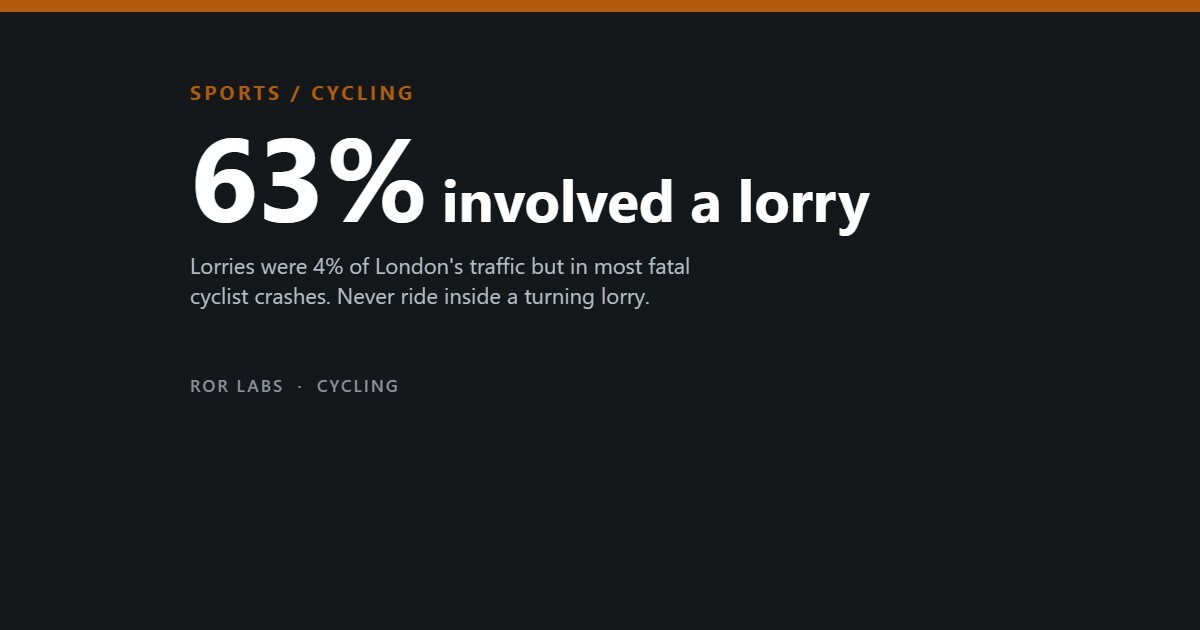
- In London, lorries made up 4% of miles driven but were involved in 63% of fatal collisions with cyclists in 2015 to 2017, usually while turning left at low speed.
- Painted lanes beside parked cars often sit inside the door zone. In one European study the open door reached into the lane in 92.5% of combinations.
- Side guards, separated lanes and London’s lorry vision rules have measured benefits; the Dutch reach is sensible but has little outcome evidence.
Just after 6.30 on the evening of 27 October 2025, a 26-year-old man was riding a Citi Bike north on 108th Street in Corona, Queens, when the driver of a parked BMW opened his door. The impact threw him into the roadway with severe head injuries, and he was pronounced dead at Elmhurst Hospital a short time later. Two days on, police had made no arrests and were still investigating.
The other danger on a city street is bigger and slower. Between 2015 and 2017, heavy goods vehicles made up 4% of the miles driven in London but were involved in 63% of the fatal collisions involving cyclists, according to the Mayor’s office. The typical crash happens at walking pace: a lorry turns left across a cyclist going straight on, and the driver never sees the bike.
This article covers how often doorings and turning-lorry crashes happen and how badly people are hurt, why painted lanes beside parked cars sit inside the door zone, what has been measured to work, from side guards to London’s lorry vision rules, and how thin the evidence is for the “Dutch reach”. The answer is not to stop riding. It is to ride carefully, out of the door zone and never on the inside of a turning lorry.
What happens in a dooring and a turning-lorry crash
Doorings are common enough to show up in every city that counts them. In a study of 683 injured adult cyclists treated in Toronto and Vancouver emergency departments, collisions with vehicle doors made up 9.2% of all crashes and 27% of collisions with motor vehicles. In Victoria, Australia, they were 8.4% of police-reported cyclist crashes but 3.1% of hospital presentations. In Chicago, the state transport department logged 302 doorings in 2015, about 17.5% of all bicycle crashes.
How often the crash is a car door
Collisions with an opening vehicle door as a share of recorded cyclist crashes. The denominators differ: police records miss many minor crashes, hospital records miss many uninjured ones.
Sources: Illinois Department of Transportation data as reported by WTTW (2017); Teschke et al., BMC Public Health (2014); Johnson et al., Safety Science (2013); Chao et al., PLOS ONE (2025), 6,363 door crashes of 127,637 on road segments, 1991 to 2020.
Most doorings bruise and break rather than kill. A ten-year review of every dooring seen at the main trauma centre in Bern, Switzerland, found injuries mostly to the head and limbs, treated mostly as outpatients, with an average Injury Severity Score of 3.5; one patient needed emergency surgery. The deaths come from the second impact. In 2018 a London professor of genetics swerved or was clipped by a van door opened without a look and fell under the wheels of an overtaking taxi.
Lorry crashes run the other way: rare, slow and severe. In European in-depth crash data, lorries turning across a cyclist were moving at about 13 km/h on average, and the impact came within two metres of the front, around the passenger door. The driver had a problem seeing the cyclist in 72% of cases. In Japanese data the risk of death was 6% even at impact speeds of 10 km/h or less for the heaviest trucks; for cars it stayed at or below 5% up to 40 km/h.
Chance an injured cyclist is killed or seriously injured
Share of cyclist casualties recorded by Spanish police that were deaths or serious injuries, by the other vehicle involved.
Source: Aldred et al., International Journal of Environmental Research and Public Health 17(1):96 (2020), observational analysis of Spanish police injury data.
Where the risk concentrates
The door zone is the strip a door sweeps when it swings open. Britain’s Highway Code tells cyclists to leave “a door’s width or 1 metre” when passing parked cars, but many lanes are painted closer than that. A 2026 study measured the doors of the 50 best-selling cars in Europe and compared them with cycle-lane guidance from 24 EU countries and the UK. In 92.5% of the combinations the open door reached into the cycle lane, and in 10% by more than half a metre. The average new car had also grown 9 cm wider in 20 years.
Riders in a lane like that pass a great many doors. A Melbourne study that fitted cameras to the bikes of 25 commuters counted 1,166 parked cars an hour and 2.3 door obstructions an hour, and in eight of the nine obstructions an occupant had opened the door into the rider’s path. In the Toronto and Vancouver data, doorings clustered on major streets with parked cars, including those with painted bike lanes or shared-lane markings, and none occurred on routes separated from traffic.
Where door crashes cluster in Britain
Door crashes as a share of police-recorded cyclist crashes away from junctions, by setting and by the vehicle involved, 1991 to 2020.
Source: Chao et al., PLOS ONE (2025), STATS19; after adjustment, urban 20 to 30 mph roads carried 16.2 times the odds of a door crash and taxis 1.61 times. Police data miss many non-fatal crashes.
Lorry deaths concentrate in a different place: the junction. An in-depth review of police files on 53 fatal cyclist crashes in London between 2007 and 2011 found 27 involved a lorry and three a bus. The commonest pattern was a lorry turning left across a cyclist going straight ahead, with the cyclist not visible to the driver, a road that narrowed, or a rider positioned beside the cab. In 2011, seven of the nine London cyclist deaths involving a lorry involved construction vehicles.
London lorries: share of traffic and of deaths
Heavy goods vehicles in London, 2015 to 2017. Shares of fatal collisions involving each group, against the lorries’ share of miles driven.
Source: Mayor of London press release on the Direct Vision Standard, 29 October 2019; see also Talbot et al., Traffic Injury Prevention (2017).
The same pattern holds beyond London. Lorries turning across cyclists are blamed for about 40% of the most serious cyclist injuries and deaths in Britain, according to Cambridge engineers who reconstructed such crashes, and in 2021 trucks were involved in the deaths of 199 cyclists across the EU. Women appear over-represented in British lorry deaths, a pattern a survey of 4,596 British cyclists linked to how riders judge passing on the inside.
What has been measured to work
The surest measure is distance. In the Toronto and Vancouver study, no crash involving a car door happened on a route separated from traffic, which is why the researchers argue that protected lanes remove whole classes of crash. For lorries, the oldest evidence is for side guards, the rails that stop a cyclist falling between the wheels. After Britain required them in the 1980s, the fatality rate for cyclists hitting the side of a truck fell by 61% and for pedestrians by 20%, according to a review by the US Volpe Center.
London went further in 2019 with its Direct Vision Standard, which rates lorries over 12 tonnes from zero to five stars by how much the driver can see through the cab windows. Since October 2024 a lorry needs three stars or an approved package of mirrors, cameras and sensors to enter the city, with a penalty of up to £550. Transport for London says deaths in collisions between lorries and people walking, cycling or riding motorcycles fell from 17 a year to 11.
London after its lorry vision rules
People walking, cycling or motorcycling killed or seriously injured in collisions with heavy goods vehicles, per year. Before-and-after figures without a comparison city.
Source: Transport for London press release, 17 November 2025. The Direct Vision Standard and HGV Safety Permit took effect in 2019, with enforcement from 2020.
Electronic help is promising but mostly modelled. A 2024 simulation of real crashes estimated that a blind-spot detection system could prevent between 26% and 66% of lorry-cyclist crashes, and a Cambridge reconstruction suggested automatic braking might have prevented 18 of 19 left-turn deaths. Since 7 July 2024, every new truck and bus sold in the EU must carry systems that detect people in its blind spots.
For doors, the remedy is behaviour. Since 29 January 2022 Rule 239 of the Highway Code has told drivers and passengers to open a door with the hand on the opposite side, so they turn and look over their shoulder: the Dutch reach. The same rule says you must not hit anyone when opening a door, and the offence carries a fine of up to £1,000. By 2017, 41 US states had a dooring law, and Massachusetts had put the Dutch reach in its driver’s manual.
The evidence behind both measures is weaker than the confidence with which they are promoted. A 2018 Nottingham conference paper that set out to test the Dutch reach noted that there was no scientific evidence for it. The only experiment we found, a 2022 Taiwanese study of 51 drivers by an inventor testing his own patented mirror, found that drivers using a version of the reach accepted the shortest gap to an approaching rider: about 13 metres, against 15 with his mirror. A German randomised trial registered in 2026 studies only whether the habit can be learned. London’s figures are before-and-after counts with no comparison city, and TfL’s count for 2023 rose from six deaths in its 2024 release to 11 in its 2025 one.
Why the answer is not to stop riding

Cycling’s balance sheet still comes out ahead, as we set out in our article on cycling injuries and helmets, and both of these crashes respond to where you ride. Stay out of the door zone: the Highway Code’s door’s width or one metre is a minimum, and on a narrow street with parking that means riding in the middle of the lane. Rule 72 now says cyclists may ride in the centre of the lane on quiet roads, in slow traffic and approaching junctions, to be clearly visible. Look through rear windows for heads and watch for brake lights and taxis stopping.
With lorries, the rule is simple: never ride up the inside of a lorry or bus that is turning, signalling or slowing near a junction. If one pulls alongside at the lights, hang back behind it rather than sitting by the cab, where the driver may not see you. Drivers can do their part: use the far hand on the door, check mirrors before turning, and in a lorry, use the cameras and look twice. Choose protected routes where you can, and ride carefully rather than not at all.
What to do
Steps sorted by when they matter. Each one says how strong the evidence is: Measured Official advice Untested
Before
- Choose protected or separated routes where you can. In the Toronto and Vancouver study, no door crash happened on a route separated from traffic. Measured see Sources
- Plan routes that avoid narrow painted lanes beside parked cars. In one European study the open door reached into the lane in 92.5% of car and lane combinations. Measured see Sources
If it happens
- Ride at least a door’s width or one metre from parked cars, and take the middle of the lane where the street is narrow. Official advice see Sources
- Look through rear windows for heads, and watch for brake lights and taxis stopping. Taxis carried 1.61 times the odds of a door crash in British data. Measured see Sources
- Never ride up the inside of a lorry or bus that is turning, signalling or slowing near a junction. Lorries were 4% of London’s traffic but in 63% of fatal cyclist crashes. Measured see Sources
- At the lights, wait behind a lorry, not beside the cab. If you cannot see the driver’s face in a mirror, the driver probably cannot see you. Official advice see Sources
Afterwards
- After a crash, see a doctor or physiotherapist even if you feel fine at first, and report the collision to the police. Official advice see Sources
What not to do
- As a driver or passenger, do not open a door without looking. Use the far hand (the Dutch reach) so you turn and check behind; it is sensible, though outcome evidence is thin. Untested see Sources
Questions people ask
Is it illegal to open a car door into a cyclist?
In Great Britain, yes: opening a door so as to injure someone is an offence with a maximum fine of £1,000, and Rule 239 says you must not hit anyone. Most US states have a similar law, though about nine had none in 2017.
What is the Dutch reach?
Opening a car door with the hand farthest from it, so your body turns and you look behind. Britain’s Highway Code has recommended it since 2022. It makes sense, but there is little outcome evidence that it prevents crashes.
How far from parked cars should I ride?
At least a door’s width or one metre, says the Highway Code. European cars have been getting wider, so more is better, and on a narrow street that means taking the middle of the lane.
What should I do when a lorry is turning?
Stay behind it. Do not pass on the side it is turning towards, and do not wait beside the cab at junctions. If you cannot see the driver’s face in a mirror, the driver probably cannot see you.
The short version
- Car doors cause roughly 3% to 18% of recorded cyclist crashes, depending on the city and the data. Most injuries are minor; deaths come when a rider is thrown into traffic.
- In London, lorries made up 4% of miles driven but were involved in 63% of fatal collisions with cyclists in 2015 to 2017, usually while turning left at low speed.
- Painted lanes beside parked cars often sit inside the door zone. In one European study the open door reached into the lane in 92.5% of combinations.
- Side guards, separated lanes and London’s lorry vision rules have measured benefits; the Dutch reach is sensible but has little outcome evidence.
- Ride a door’s width or more from parked cars, take the lane where it is narrow, and never ride up the inside of a turning lorry.
This is a summary of published research and reporting, not medical or legal advice. If you have been injured in a crash, see a doctor or physiotherapist, even if you feel fine at first, and report the collision to the police.
Further reading: Teschke et al., BMC Public Health (2014), for where doorings happen and where they do not. Talbot et al., Traffic Injury Prevention (2017), for how London lorry crashes unfold. Janoška et al., Journal of Safety Research (2026), for door zones against lane guidance.
- There Are No Accidents, Jessie Singer (2022). A journalist on why we call preventable crashes accidents, and how road design and blame shape who gets hurt. A good companion to the dooring and lorry evidence here.
- Killed by a Traffic Engineer, Wes Marshall (2024). A civil engineering professor takes apart the rules of thumb behind street design, including bike lanes squeezed beside parked cars.
- Curbing Traffic, Chris and Melissa Bruntlett (2021). A family that moved to Delft describes everyday life on Dutch streets built so that cyclists rarely meet doors or lorries at close range.
Sources
- College Point cyclist killed after being doored by BMW driver in Corona. QNS, 29 October 2025.
- Mayor launches world-leading lorry safety scheme. Mayor of London press release, 29 October 2019.
- Teschke K, Frendo T, Shen H, et al. Bicycling crash circumstances vary by route type: a cross-sectional analysis. BMC Public Health 14:1205 (2014), doi:10.1186/1471-2458-14-1205.
- Johnson M, Newstead S, Oxley J, Charlton J. Cyclists and open vehicle doors: crash characteristics and risk factors. Safety Science (2013), doi:10.1016/j.ssci.2013.04.010.
- Chicago ‘dooring’ reports saw steep increase in 2015, data shows. WTTW News, 21 April 2017 (Illinois Department of Transportation data).
- Chao CC, Ma HP, Wei L, et al. Risk factors for overtaking, rear-end, and door crashes involving bicycles in the United Kingdom: revisited and reanalysed. PLOS ONE (2025), doi:10.1371/journal.pone.0315692.
- Braun C, Hetmank C, Exadaktylos AK, Klukowska-Rötzler J. Dooring-Fahrradunfälle mit schweren Verletzungsmustern: 10-Jahres-Studie eines Level-1-Traumazentrums. Praxis (2022), doi:10.1024/1661-8157/a003928.
- Professor killed after van driver opened door without looking. road.cc, 8 August 2019 (inquest report).
- Schindler R, Jänsch M, Bálint A, Johannsen H. Exploring European heavy goods vehicle crashes using a three-level analysis of crash data. International Journal of Environmental Research and Public Health 19(2):663 (2022).
- Matsui Y, Oikawa S, Sorimachi K, et al. Association of impact velocity with serious-injury and fatality risks to cyclists in commercial truck-cyclist accidents. Stapp Car Crash Journal (2017), doi:10.4271/2017-22-0013.
- Aldred R, García-Herrero S, Anaya-Boig E, et al. Cyclist injury severity in Spain: a Bayesian analysis of police road injury data focusing on involved vehicles and route environment. International Journal of Environmental Research and Public Health 17(1):96 (2020).
- Department for Transport. The Highway Code, Rules 67, 72, 74 and 239 (gov.uk); Highway Code changes set to take effect this weekend, gov.uk news story, 26 January 2022.
- Janoška Z, Bílová M, Daňek P, Bíl M. The dooring risk in Europe: cycling infrastructure guidelines often underestimate the car door zone. Journal of Safety Research (2026), doi:10.1016/j.jsr.2026.09.010.
- Lawrence BM, Oxley JA, Logan DB, Stevenson MR. Cyclist exposure to the risk of car door collisions in mixed function activity centers: a study in Melbourne, Australia. Traffic Injury Prevention 19(sup1):S164–S168 (2018), doi:10.1080/15389588.2017.1380306.
- Talbot R, Reed S, Christie N, Barnes J, Thomas P. Fatal and serious collisions involving pedal cyclists and trucks in London between 2007 and 2011. Traffic Injury Prevention (2017).
- Delmonte E, White H. Construction Logistics and Cyclist Safety (CLOCS): from research to practice. Transport Research Laboratory (2014).
- Jia Y, Cebon D. A strategy for avoiding collisions between heavy goods vehicles and cyclists. University of Cambridge (2018), modelled reconstruction of 19 fatal crashes.
- Tomasch E, Hoschopf H, Ausserer K, Rieß J. Required field of view of a sensor for an advanced driving assistance system to prevent heavy-goods-vehicle to bicycle accidents. Vehicles 6(4):94 (2024).
- Frings D, Rose A, Ridley AM. Bicyclist fatalities involving heavy goods vehicles: gender differences in risk perception, behavioral choices, and training. Traffic Injury Prevention (2012), doi:10.1080/15389588.2012.664796.
- Epstein AK, Peirce S, Breck A, et al. Truck sideguards for Vision Zero: review and technical recommendations. Volpe National Transportation Systems Center, US DOT (2014).
- World-leading Direct Vision Standard for HGVs strengthened in the capital. Transport for London press release, 28 October 2024.
- Pedestrian, cyclist and motorcyclist deaths and serious injuries in collisions with HGVs fall 50 per cent under Mayor’s lorry safety scheme. Transport for London press release, 17 November 2025.
- European Commission. Mandatory drivers assistance systems expected to help save over 25,000 lives by 2038. European Road Safety Charter (2024).
- Bike Law U: Dooring (13 January 2015) and Does your state do the “Dutch Reach”? (6 June 2017). League of American Bicyclists.
- Large D, Choo MC, Houghton R. Validating ‘Dutch Reach’: a preliminary evaluation of far-hand door opening and its impact on car drivers’ head movements. 7th International Cycling Safety Conference, Barcelona (2018).
- Huang CY. Research into the safe distance for opening a car door in order to avoid approaching motorcycles from the rear. Applied Sciences 12(2):606 (2022).
- Zimmermann A, Wilhelm LO, Fleig L, Warner LM, Keller J. Habit formation of the far-hand door opening among drivers: a randomized controlled trial. OSF registration (2026), osf.io/8unsb.