The Loyalty Penalty on Savings: What the Evidence Shows
Key takeaways · 13 min read
- Between January 2022 and May 2023, the nine largest UK savings providers passed on about 28% of Bank Rate rises to easy-access accounts, against 51% for fixed-term and notice accounts.
- Long-standing customers often earn less: FCA figures put easy-access savers in accounts opened more than five years earlier 0.42 points below new customers.
- Inertia is strong: in Norway, a household was still over 50 points more likely to bank with the same deposit-taker 14 years on, and inaction cost up to 2 points of interest a year.
- In October 2026 the FDIC’s national average savings rate was 0.38%, while US consumer prices were 3.7% higher than a year before, so the average balance lost buying power.
Money left in a bank feels like the one thing that cannot go wrong. It does not crash like a share price, and in most countries a public scheme stands behind it up to a limit. But a balance that sits still can quietly fall behind, both against prices and against what the same bank pays its newest customers.
This article looks at what regulators, central banks and economists have found about that gap: the ‘loyalty penalty’ on long-held savings accounts, the slow pass-through of rate rises to deposits, and the inertia that keeps most people where they are. It draws on the UK Financial Conduct Authority’s studies, research on deposit pricing in the US, Norway and the Netherlands, and the latest official rate data.
It does not recommend any bank, account or product, and no rate here is an offer. What a deposit guarantee does and does not cover is explained in a separate article on deposit insurance. Every number below is tied to the source that reported it.

What the loyalty penalty is
The term describes a simple pattern. Banks compete for new money with attractive rates, then let the rate on older accounts drift down, often by closing the product to new customers and keeping existing savers on it. The UK regulator’s 2015 cash savings market study found about 350 easy-access products on sale and just over 1,000 closed to new customers.
The same study, based on data from 21 firms holding about £700 billion, found that around a third of easy-access balances sat in accounts opened more than five years earlier. Some £160 billion of easy-access savings earned a rate at or below the 0.5% Bank Rate in 2013. The four largest current-account providers paid materially lower rates on easy-access accounts than others.
Old accounts, unchecked rates
UK easy-access savings in the FCA’s 2015 market study (much of the data from 2013).
Source: Financial Conduct Authority, Cash savings market study: final findings (January 2015).
When the FCA later put a figure on the penalty, it found that easy-access savers whose accounts were more than five years old earned 0.42 percentage points less than new customers, and 0.55 points less in easy-access cash ISAs. In its 2023 review it found several large firms paying 0.5 to 1 point more on products still on sale than on closed ones.
How slowly rate rises reach savers
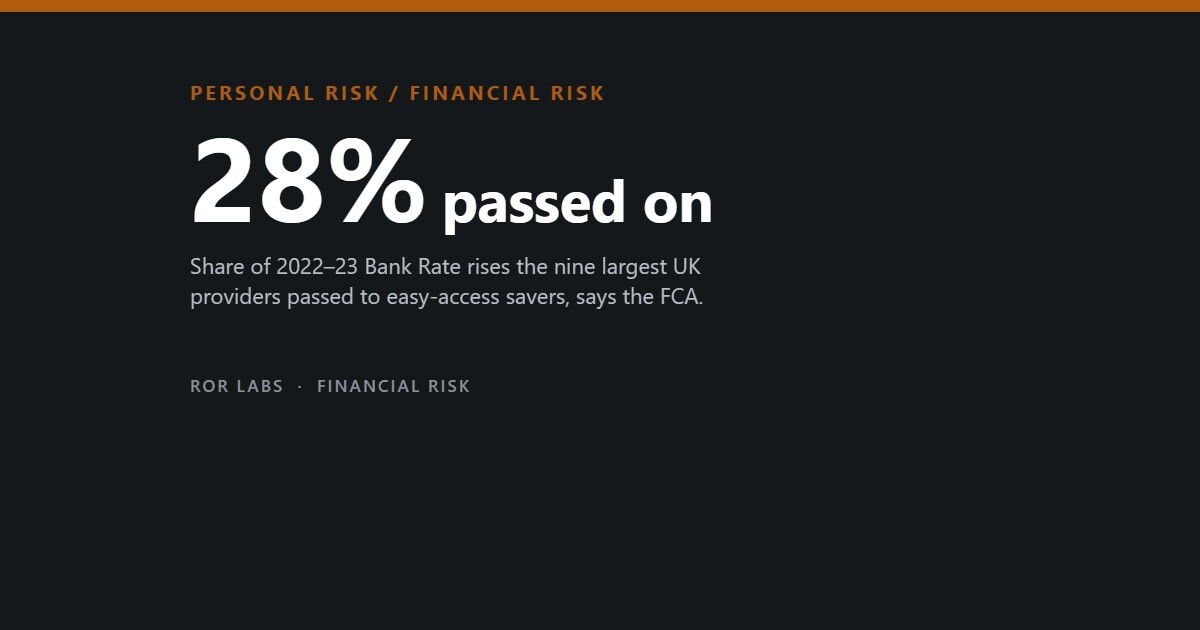
The penalty grows when rates rise. Between January 2022 and May 2023, Bank Rate went up by 4.25 percentage points. The FCA’s 2023 review of the nine largest providers found they passed on about 28% of that to easy-access accounts on average, with individual firms ranging from 15% to 61%. Fixed-term and notice accounts saw 51%.
Rate rises reached easy-access savers last
Share of UK Bank Rate rises passed on to savers by the nine largest providers.
Source: Financial Conduct Authority, Cash Savings Market Review 2023 (July 2023).
The lag was sharpest at the start. In the first eight months of the cycle, easy-access pass-through was only 14%; from August 2022 to May 2023 it rose to 35%. The FCA noted that pass-through on easy-access accounts had averaged 80% in 2004–2009, so the sluggishness was not a law of nature. Average easy-access rates at the nine firms rose from 0.07% to only 1.25%.
The United States shows the same pattern. Federal Reserve economists John Driscoll and Ruth Judson tracked eleven deposit rates weekly at over 2,500 branches of about 900 institutions for ten years. Rates fell quickly when market rates fell and rose slowly when they rose. Without that stickiness, they estimated, depositors would have received as much as $100 billion more in interest a year in rising-rate periods.
In the most recent cycle, New York Fed economists found that the share of Federal Reserve rate rises passed to interest-bearing deposits, the ‘deposit beta’, reached almost 0.4 by late 2022. That matched the peak of the 2015–19 cycle, but took about a year instead of three. Offered rates rose most on 12-month certificates of deposit and least on checking accounts.
Why banks can pay less
The gap between large and smaller providers
UK easy-access savings rates in 2023, by type of provider.
Source: Financial Conduct Authority, Cash Savings Market Review 2023 (July 2023).
Economists explain the gap with market power. In an influential 2017 paper, Itamar Drechsler, Alexi Savov and Philipp Schnabl showed that when the US Federal Reserve raised rates, banks widened the spread between market rates and what they paid on deposits, and money flowed out of the banking system. Spreads widened more in concentrated local markets, even comparing branches of the same bank.
That finding echoed older work. In 1992 David Neumark and Steven Sharpe reported that banks in concentrated markets were slower to raise deposit rates when market rates rose and faster to cut them when rates fell. Drechsler and colleagues argued that this ‘deposits channel’ could account for the entire transmission of monetary policy through bank balance sheets.
A 2026 paper by Xu Lu and Lingxuan Wu, which won a European prize for systemic-risk research, adds attention. Using transaction data on millions of US depositors, they found that irregular income stayed in low-rate accounts much longer than regular pay. Banks serving more inattentive customers set lower rates and passed on less of each rate change. In their account, inattention is itself a source of market power.
How few people switch
Switching is rare almost everywhere it has been measured. The FCA’s 2015 study found that 80% of easy-access accounts had not been switched in the previous three years. Survey respondents could not guess the interest rate on half of their easy-access accounts, and 63% did not know whether their own provider offered the same product at a different rate.

The most detailed picture comes from Norway, where Christoph Basten and Ragnar Juelsrud used records covering every household deposit and loan relationship from 2004 to 2018. A year after a household was first seen with deposits at a bank, it was a bit over 90 percentage points more likely to still be there than at a comparable bank nearby. After 14 years the gap still exceeded 50 points.
They estimated that this inaction cost households up to 2 percentage points of deposit interest a year. Losses varied: households headed by someone under 30 lost 28 basis points less in rate terms, and parents 15 less. Retirees and wealthier households gave up less in rate but more in money, because they held larger balances. The chance of switching banks when taking out a new loan fell by about 5 points for each extra year with a bank.
Once a saver arrives, they tend to stay
Norway, all household bank relationships 2004–2018: extra likelihood of still holding deposits at the same bank, and the cost.
Source: Basten and Juelsrud, Review of Financial Studies (2023). Points are percentage points.
In the Netherlands, Dirk Gerritsen and Jacob Bikker studied annual savings data from 2004 to 2014. Depositors moved only 3–6% of their savings for each percentage point of difference in interest rates. A Dutch survey by Carin van der Cruijsen and Maaike Diepstraten found that people stayed mainly because of a good relationship with their bank, practical barriers and a sense that switching would not gain much.
Why information rarely moves people
If people do not know their rate, telling them seems an obvious fix. A large test of that idea ran in the UK. Paul Adams, Stefan Hunt, Christopher Palmer and Redis Zaliauskas ran randomised trials with about 124,000 savings-account holders at five UK deposit-takers, showing them varying amounts of information about better accounts, including one at their own provider that was better in every respect.
Switching took roughly 15 minutes, and the average potential gain was about $190 a year. Yet switching stayed rare across every design. The authors concluded that pessimistic beliefs, an expectation that any alternative would not be much better, led people to ignore the information. Better disclosure alone, they found, could not explain away deposit stickiness.
A wider review points the same way. Zita Vasas collected over 400 estimates from 35 studies of nudges in retail finance and found that they raised search and switching by 2–3 percentage points on average. Nudges that changed the choice itself did better than those that only provided or highlighted information. In its 2015 study the FCA reported that reminders raised switching by at least 8% compared with no reminder.

The real return on idle cash
The second cost is inflation. In the US, the Federal Deposit Insurance Corporation publishes a national average savings rate, weighted by each institution’s share of deposits. In October 2026 it stood at 0.38%. The FDIC’s benchmark market yield for savings deposits was 3.88%, and the Bureau of Labor Statistics reported that consumer prices in September were 3.7% higher than a year before.
An average savings balance lost ground to prices
United States, latest official figures, autumn 2026.
Sources: FDIC National Rates and Rate Caps via FRED (series SNDR, STY); US Bureau of Labor Statistics, CPI release of 14 October 2026.
Put simply, a balance earning the national average lost more than 3% of its buying power over the year. That is an average across all institutions, so some savers earn far more and many earn less. The euro area tells a similar story: households earned 0.29% on overnight deposits in August 2026, while new deposits fixed for up to a year paid 2.13%.
Non-interest-bearing balances lose the most. The FCA’s 2023 review found about £250 billion in UK deposits earning no interest at all, and about £260 billion of easy-access balances, roughly 40% of the total, in accounts paying 1% or less. Some of that money is needed for everyday payments; how much of it could earn more is not known. The costs of the account itself, such as overdraft fees, are another matter.
What regulators have tried
The UK has tried most of the obvious remedies. From December 2015 the FCA published the lowest rates large firms paid on easy-access accounts, and firms agreed to complete most cash ISA transfers within seven working days. In January 2020 it proposed a single easy-access rate, which would have required each firm to pay one rate on all its easy-access accounts after any introductory period. It estimated savers would gain about £260 million a year.
In November 2020 the regulator dropped the idea, citing the pandemic and very low rates, which had narrowed the gap between new and long-standing customers. When rates rose, it turned to its new Consumer Duty. In July 2023 it published a 14-point plan, asking the lowest-paying firms to justify their rates and asking firms to prompt customers in low-paying accounts.
By September 2024 the FCA reported that the average easy-access rate at the nine largest firms had risen from 1.66% in July 2023 to 2.11%, and estimated that savers were about £4 billion a year better off. It also noted that the largest firms still generally paid below the market average for standard easy-access accounts.
The limits of the evidence
The ‘loss’ figures compare actual rates with the best rate available, and that benchmark flatters the gap. Basten and Juelsrud call their own estimate a rough approximation, because the top rate in an area is often restricted to accounts with limited eligibility. The best-paying accounts may have balance caps, withdrawal limits or conditions an average saver would not meet.
Staying is not always irrational. A bank that holds a current account, a mortgage and savings in one place saves time, and the Norwegian study found that existing depositors were about 20 points more likely to borrow from the same bank later. Some people value the relationship, or simply have too little in savings for a switch to be worth the effort.
Much of the evidence is also old or local. The FCA’s 2015 figures describe 2013, when Bank Rate was 0.5%. The Norwegian and Dutch data end in 2018 and 2014. The trials were run in the UK, and the strongest US work uses data from before the 2022 rate cycle. The 2026 inattention paper is a working paper that has not yet been through journal review.
What to do
Steps sorted by when they matter. Each one says how strong the evidence is: Measured Official advice Untested
Before
- Find out the interest rate your savings and current-account balances actually earn; in an FCA survey, savers could not guess the rate on half of their easy-access accounts. Measured see Sources
- Check whether your own bank pays more on a newer version of the same account; the FCA found several large firms paying 0.5–1 point more on products still on sale than on closed ones. Measured see Sources
- Before moving money, check the deposit protection scheme that covers it; limits and rules differ by country. Untested see Sources
If it happens
- When the central bank raises rates, check whether your easy-access rate has moved; in 2022–23 the largest UK providers passed on about 28% of rises. Measured see Sources
- Compare your rate with a published average or benchmark, such as the FDIC national savings rate in the US, rather than assuming it is fair. Measured see Sources
Afterwards
- Recheck the rate after any introductory bonus ends; the FCA found the rate on long-held easy-access accounts was 0.42 points below new customers’. Measured see Sources
- If your bank prompts you that your account pays a low rate, read it; the FCA asked firms to send such prompts under its 2023 plan. Official advice see Sources
What not to do
- Do not assume loyalty earns a better rate; in Norway, staying put cost households up to 2 points of interest a year. Measured see Sources
- Do not leave large balances in non-interest-bearing accounts without checking what they earn; about £250 billion of UK deposits earned nothing in 2023. Measured see Sources
- Do not judge an account by its headline rate alone; the best-paying accounts may have balance caps, withdrawal limits or conditions. Untested see Sources
General information, not financial advice. Deposit protection rules differ by country.
Questions people ask
What is the loyalty penalty on savings?
It is the gap between the rate a bank pays long-standing customers and what it offers new ones on similar accounts. UK regulator figures put it at 0.42 points for easy-access accounts more than five years old.
Why do banks raise savings rates more slowly than loan rates?
Research links it to market power and customer inertia: banks in concentrated markets and those whose customers pay less attention raise deposit rates more slowly when market rates rise.
How many people switch savings accounts?
Few. In the FCA’s 2015 study, 80% of easy-access accounts had not been switched in three years. In 2023 about 23% of UK savers surveyed said they had switched in the previous six months for a better rate.
Is my money losing value in a savings account?
If the interest rate is below inflation, its buying power falls. In autumn 2026 the US average savings rate was 0.38%, against inflation of 3.7%.
Do reminders from my bank help?
A little. Trials and reviews find that disclosure and reminders raise switching by a few percentage points, and pessimism about alternatives limits their effect.
The short version
- Between January 2022 and May 2023, the nine largest UK savings providers passed on about 28% of Bank Rate rises to easy-access accounts, against 51% for fixed-term and notice accounts.
- Long-standing customers often earn less: FCA figures put easy-access savers in accounts opened more than five years earlier 0.42 points below new customers.
- Inertia is strong: in Norway, a household was still over 50 points more likely to bank with the same deposit-taker 14 years on, and inaction cost up to 2 points of interest a year.
- In October 2026 the FDIC’s national average savings rate was 0.38%, while US consumer prices were 3.7% higher than a year before, so the average balance lost buying power.
- Disclosure and reminders help a little: a review of over 400 estimates found nudges raise search and switching by 2–3 points on average.
- Staying put is not always a mistake; convenience, links to other products and limits on the best-paying accounts all matter, and the measured losses are averages.
This article summarises research and official data for general information. It is not financial advice and does not recommend any bank, account or product. Deposit protection limits and rules differ by country; check the scheme that covers your money before you move it.
Further reading: Drechsler, Savov and Schnabl, Quarterly Journal of Economics 132(4) (2017), for the deposits channel. Adams, Hunt, Palmer and Zaliauskas, Journal of Financial Economics 141(1) (2021), for why disclosure rarely moves savers. The FCA’s Cash Savings Market Review 2023, for pass-through during the latest rate cycle.
Sources
- Financial Conduct Authority. Cash savings market study: Part I and II, final findings (January 2015).
- Financial Conduct Authority. Cash Savings Market Review 2023 (31 July 2023).
- Financial Conduct Authority. FCA update on cash savings (18 September 2024).
- Financial Conduct Authority. CP20/1: Introducing a Single Easy Access Rate for cash savings (January 2020); Reuters report via LSE.co.uk (9 January 2020).
- MoneyExpert. FCA drops plans to end loyalty penalty in savings accounts (18 November 2020).
- Drechsler I, Savov A, Schnabl P. Q J Econ 132(4):1819–1876 (2017), doi:10.1093/qje/qjx019.
- Neumark D, Sharpe SA. Q J Econ (1992), doi:10.2307/2118485.
- Driscoll JC, Judson R. Sticky deposit rates. Finance and Economics Discussion Series 2013-80, Federal Reserve Board (2013), doi:10.17016/feds.2013.80.
- Kang-Landsberg A, Luck S, Plosser M. Deposit betas: up, up, and away? Liberty Street Economics, Federal Reserve Bank of New York (11 April 2023).
- Lu X, Wu L. Banking on inattention. NBER Working Paper 34783 (2026), doi:10.3386/w34783.
- Banque de France. Award of the 2026 Ieke van den Burg Prize for research on systemic risk (8 June 2026).
- Basten C, Juelsrud R. Rev Financ Stud (2023), doi:10.1093/rfs/hhad062.
- Gerritsen DF, Bikker JA. J Financ Serv Res (2018), doi:10.1007/s10693-018-0305-x.
- van der Cruijsen C, Diepstraten M. J Financ Serv Res (2017), doi:10.1007/s10693-017-0276-3.
- Adams PD, Hunt S, Palmer C, Zaliauskas R. J Financ Econ 141(1):122–147 (2021), doi:10.1016/j.jfineco.2020.05.009.
- Vasas Z. Behavioural Public Policy (2022), doi:10.1017/bpp.2022.23.
- Federal Deposit Insurance Corporation. National Rates and Rate Caps: National Rate, Savings, and Treasury Yield, Savings, via FRED (series SNDR and STY, October 2026).
- US Bureau of Labor Statistics. Consumer Price Index, September 2026 (14 October 2026).
- European Central Bank. Euro area bank interest rate statistics: August 2026 (1 October 2026).
- Banco de España. ECB raises rates by 25 basis points in June (11 June 2026).