Deposit Insurance Stops at $250,000. Since 2008, Uninsured Depositors Have Actually Lost Money in Six Per Cent of Failures.
In This Series: Personal Finance & Investing
- Why Most Stock Investors Lose Money: What the Evidence Actually Shows
- Options and Futures: Where Retail Money Actually Goes
- Two Retirees, the Same Returns, Only One Runs Out. The Difference Is the Order.
- Courts Resolve More Than Seventy Per Cent of Debt Suits Without a Defence. Fewer Than One Defendant in Ten Has a Lawyer.
- Your Home Insurance Almost Certainly Does Not Cover Flooding
- The Median Forfeiture Is $1,678. A Lawyer to Contest It Costs About Twice That.
Key takeaways · 14 min read
- $250,000 is per depositor, per insured bank, per ownership category. Multiple accounts of the same category at one bank share one limit; different categories each get their own.
- It covers deposits against the failure of an insured bank. It does not cover investments, annuities, crypto, fraud, or the collapse of a non-bank intermediary.
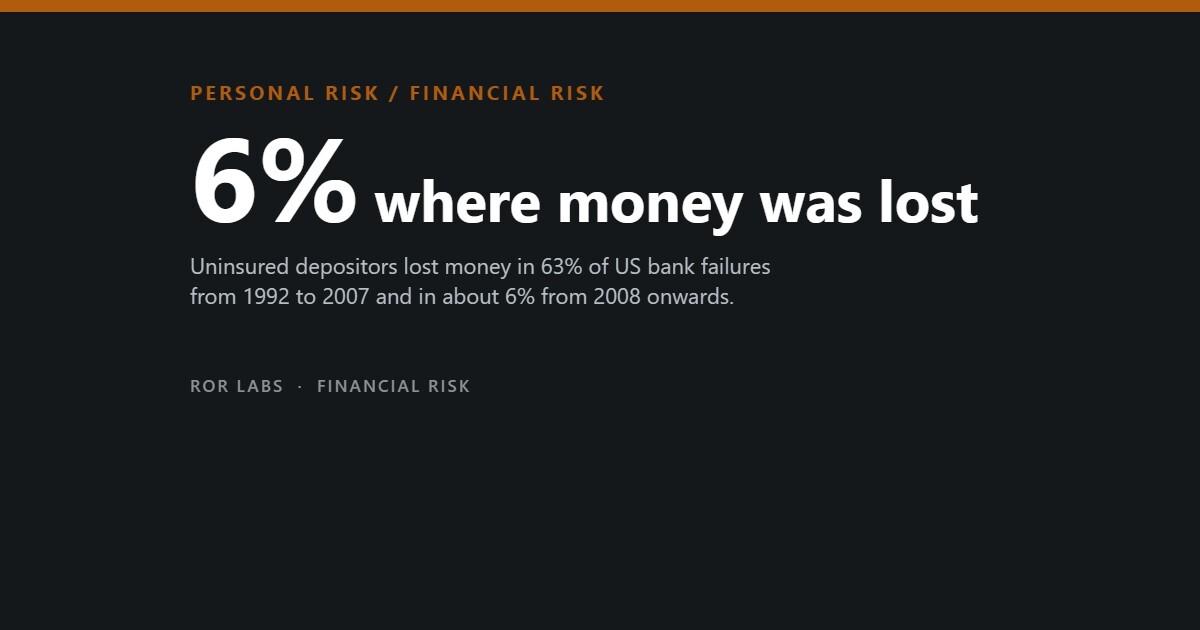
- Uninsured depositors lost money in 63% of US bank failures from 1992 to 2007 and in about 6% from 2008 onwards, while average resolution costs rose from 10% to 18.2% of failed-bank assets.
- That shift is estimated to have cost at least $45 billion in extra resolution expenses over fifteen years, and it is a change in practice, not in law.
In this article
- What the $250,000 actually is
- What has actually happened to people above the limit
- Why six per cent is not a promise
- Why the composition of a bank’s deposits decides its fate
- The case for leaving the limit where it is
- The failure mode that actually reaches ordinary savers
- What follows
- Questions people ask
- The short version
- Sources
In May 2024, 85,000 people who saved money through an American app called Yotta found they could not get at it. Yotta was not a bank. It never claimed to be. It moved its customers’ money into deposit accounts at real, federally insured banks through an intermediary called Synapse, and it told its customers, accurately, that the money sat in FDIC-insured institutions. Then Synapse went bankrupt.
Yotta believed it had roughly $112 million on behalf of those customers. When the partner bank reconciled its own books, it reported holding a small fraction of that, leaving nearly $109 million unaccounted for. Across the whole Synapse ecosystem about $265 million was frozen, and the gap between what the various ledgers said ran to somewhere between $65 million and $95 million. Four FDIC-insured banks had held the money. Every one of them was solvent. None of them failed. Federal deposit insurance, which pays out when an insured bank fails, was therefore never triggered, and the customers had no claim under it at all.
That is the shape of the problem this article is about. Deposit insurance is one of the most successful pieces of financial plumbing ever built, and almost everything most people believe about it is slightly wrong in ways that matter only on the day it matters. What follows is what it actually covers, what has actually happened to people above the limit, and why the reassuring answer to the second question is not a promise about the future.

What the $250,000 actually is
The standard maximum deposit insurance amount in the United States is $250,000. It is not per account, not per person, and not per bank in the way most people picture. The formula is per depositor, per insured bank, per ownership category — and the third term is where nearly all of the misunderstanding lives.
What the limit multiplies across, and what it does not touch
| Covered | Not covered | |
|---|---|---|
| Products | Chequing and savings accounts, money market deposit accounts, certificates of deposit, cashier’s cheques and official items | Stocks, bonds, mutual funds, money market mutual funds, annuities, life insurance, municipal securities, crypto assets, safe deposit box contents |
| Coverage multiplies by | Ownership category — single, joint, certain retirement accounts, revocable and irrevocable trusts, employee benefit plans, corporate, government — and separately by each insured bank | Number of accounts of the same category at the same bank. Three single-name savings accounts at one bank share one $250,000 limit. |
| Trigger | The failure of the insured bank. Insured funds are typically available within a business day or two. | Anything that is not a bank failure: fraud, the collapse of a non-bank intermediary, an app going under, a dispute over who owns what. |
Federal Deposit Insurance Corporation. The $250,000 figure was set by the Emergency Economic Stabilization Act of 2008, which raised it from $100,000, and was made permanent thereafter. It has not moved since.
A married couple at one bank can hold $250,000 each in single accounts and $500,000 jointly — $1 million at one institution, all insured, with no special product required. The same couple with $600,000 in one person’s name has $350,000 uninsured. Nothing about the second arrangement is riskier in any economic sense. It is simply outside the categories.
The last row is the one the Yotta customers hit. Deposit insurance is triggered by the failure of an insured bank and by nothing else. When the intermediary fails and the banks do not, the insurance has no work to do, however truthfully the app described where the money was.
What has actually happened to people above the limit
The legal position is that above $250,000 you are an unsecured creditor of a failed bank, entitled to a share of whatever the receiver recovers, paid out over years. The practical position, for the last decade and a half, has been almost the opposite. Michael Ohlrogge of NYU assembled the record.
How often uninsured depositors actually lost money
Share of US bank failures in which uninsured depositors took a loss, and the average cost of resolving those failures.
Ohlrogge, M., “Why Have Uninsured Depositors Become De Facto Insured?”, 2023. The author attributes at least $45 billion in additional resolution expenses over the fifteen years to the shift towards rescuing uninsured depositors.
Two things flipped at once, and they are connected. Before 2008, most failures were resolved in a way that imposed losses above the insurance limit; after 2008, almost none were. Over the same period the average cost of resolving a failed bank, as a share of its assets, went up by more than half. Protecting uninsured depositors is not free. It shows up as a larger hole in the Deposit Insurance Fund, refilled by assessments on every other bank, which is to say by their customers.
Ohlrogge’s explanation is institutional rather than conspiratorial. The FDIC has a statutory obligation to resolve failures at least cost, and it has drifted from it, in part because purchase-and-assumption deals covering all deposits were, in the agency’s own description, often the only structure acquirers would offer. He notes that Congress has twice before — in 1951 and again in 1991 — legislated specifically to rein in what it saw as excessive depositor rescues.
Why six per cent is not a promise
March 2023 is the clearest illustration of both halves. When Silicon Valley Bank failed, all of its depositors were made whole, including well above $250,000, under the systemic risk exception — a mechanism requiring a supermajority of the FDIC board, a supermajority of the Federal Reserve board and the agreement of the Treasury Secretary in consultation with the President. It is deliberately hard to invoke, and it is invoked when the alternative is judged worse than the precedent it sets.
The bill arrived in November 2023 as a special assessment of $16.3 billion, levied on large banks to recover the portion of the loss attributable to protecting uninsured deposits at Silicon Valley Bank and Signature Bank. That number is the price of one decision, on one weekend, about two banks.
Four things that were all true in March 2023
So the honest summary of the last fifteen years is that uninsured depositors have almost always been rescued, that this has been expensive, that the agency doing the rescuing is under a statutory duty not to do it as a matter of course, and that the mechanism used for the largest case is one nobody can invoke on your behalf in advance. A pattern of behaviour is not a guarantee, and the people whose job it is to maintain the pattern keep saying so.
Why the composition of a bank’s deposits decides its fate
It is worth understanding why the mix of insured and uninsured money matters at all, because it is the mechanism that turns an accounting problem into a failure.

Erica Jiang, Gregor Matvos, Tomasz Piskorski and Amit Seru published an analysis in March 2023, effectively in real time, of what rising interest rates had done to US bank balance sheets. Marking loan and securities portfolios to market rather than book, they put the US banking system’s asset value $2.2 trillion below its reported value — an average decline of about 10 per cent across all banks, and about 20 per cent at the worst-affected fifth percentile. Most of that exposure was not hedged with interest rate derivatives.
Their point was that unrealised losses on their own do not fail a bank. What matters is uninsured leverage: the ratio of uninsured deposits to assets. Insured depositors have no reason to run, because their money is coming back either way. Uninsured depositors do, because being early is worth something and being late is not. A bank with large paper losses and few uninsured deposits can sit on them until the bonds mature. The same bank funded by uninsured depositors who can all leave by phone in an afternoon cannot.
Depositors behave exactly as the incentive predicts
Jordan, Federal Reserve Bank of Boston, 2000; Iyer, Jensen, Johannesen and Sheridan, 2016; Davenport and McDill, 2006.
The case for leaving the limit where it is
The obvious reform is to raise the limit, or abolish it. There is a reasonable literature arguing that the current arrangement is the worst of the three available options, and it does not point where you might expect.
Oz Shy, Rune Stenbacka and Vladimir Yankov, in a Federal Reserve working paper, compare three regimes: no deposit insurance, unlimited deposit insurance, and the limited kind almost every country actually has. Their finding is that limited coverage weakens competition between banks and reduces total welfare relative to either extreme. The mechanism is that depositors respond to a cap by spreading money across several banks to manufacture full coverage, which softens the competitive pressure any single bank feels for a customer’s balance.
The Danish evidence points the other way, and just as awkwardly. When Denmark limited coverage, above-limit money did not become disciplined; it relocated to the banks that depositors assumed were too systemic to fail. A limit that everyone expects to be overridden in a crisis does not create market discipline. It creates a subsidy for size.
And the experimental work on moral hazard is less alarming than the theory. In a laboratory experiment run with real bankers, coverage-limit treatments had no effect on the deposit rates offered; a high coverage limit induced more risk-taking only among smaller banks. That is a real effect and a narrow one, which is roughly where the empirical literature on deposit insurance and moral hazard tends to land.
Ohlrogge’s own proposal is not to raise the limit but to make it bite: audits of the FDIC’s compliance with least-cost resolution, blind bidding for failed banks so that acquirers cannot count on all-deposit structures, and giving insured deposits explicit priority over uninsured ones. Whether that is right is a policy argument. What it makes clear is that the person best placed to say the current settlement is unstable is the same person who documented that uninsured depositors are, in practice, protected.
The failure mode that actually reaches ordinary savers
For almost everyone reading this, the $250,000 line is not the binding constraint. The Synapse case is, and it is worth being precise about the mechanism, because the marketing language is technically accurate throughout.
An app takes your money and places it in a pooled account at a partner bank, held for the benefit of many customers at once. Deposit insurance can pass through that structure to the individual customer — but only if the records showing who owns what are accurate and can be reconstructed. In the Synapse model, funds were shuffled between four partner banks and, in effect, only the intermediary knew whose money was where. When it collapsed, the ledgers did not agree with each other by somewhere between $65 million and $95 million, and there was no independent record to fall back on.
Three sentences that can all be true at once
In October 2024 the FDIC proposed a recordkeeping rule for custodial accounts, which would require insured banks to maintain the customer-level ledgers that make pass-through coverage actually reconstructable. As of writing it has not been finalised. Whether it is, and in what form, is the single most consequential open question for anyone banking through an app.
Reporting on the Synapse bankruptcy and its aftermath, 2024–2025; FDIC proposed rule on Recordkeeping for Custodial Accounts, October 2024.
What follows
There is no product to buy here and no clever structure that beats the plain reading of the rules. The levers are ordinary and there are only about four of them.
- Use the ownership categories before you use extra banks. A couple can insure $1 million at a single bank with nothing more exotic than a joint account. The FDIC publishes a free calculator, EDIE, that works through the categories for a specific set of accounts.
- Check whether the thing holding your money is a bank. If it is an app, find out which insured institution actually holds the deposit and in what kind of account. “FDIC-insured” describes the bank, not the app, and the distinction only shows up when something breaks.
- Treat balances above the limit as a decision, not an accident. Most large uninsured balances are the residue of a house sale or an inheritance sitting where it landed. The evidence says such balances have almost always been made whole; the law says they need not be.
- Remember what the insurance is for. It covers the failure of an insured bank. Fraud, an intermediary’s collapse, a bad investment sold at a bank, or a dispute about who owns a pooled balance are all outside it, and no amount of staying under $250,000 changes that.

Questions people ask
Is $250,000 per account or per person?
Neither, exactly. It is per depositor, per insured bank, per ownership category. Three savings accounts in your sole name at one bank share a single $250,000 limit. The same $750,000 split between your single account, a joint account with your spouse and a qualifying retirement account is fully insured at the same bank.
If uninsured depositors almost always get their money back, why worry?
Because the pattern is discretionary and expensive. Uninsured depositors lost money in 63 per cent of US bank failures between 1992 and 2007 and in about 6 per cent from 2008 onwards. That change was a change in resolution practice, not in law, it is estimated to have cost $45 billion extra over fifteen years, and Congress has twice legislated to stop exactly this drift. The FDIC’s statutory duty is still least-cost resolution.
Did the limit go up after Silicon Valley Bank?
No. All depositors at Silicon Valley Bank and Signature Bank were covered under the systemic risk exception, and a $16.3 billion special assessment on large banks recovered the cost. The general limit remains $250,000, where it has been since 2008.
Is money in a banking app insured?
The bank holding it is insured. Whether coverage reaches you depends on whether the ownership of the pooled account can be reconstructed at customer level. That is the gap the Synapse collapse exposed, and it is the subject of an FDIC rule proposed in October 2024 that has not been finalised.
What about investments bought at my bank?
Not covered, and this is the most common misunderstanding after the ownership categories. Stocks, bonds, mutual funds, money market mutual funds, annuities, life insurance and crypto assets are outside deposit insurance entirely, including when they are sold to you on bank premises by someone in a bank uniform.
The short version
- $250,000 is per depositor, per insured bank, per ownership category. Multiple accounts of the same category at one bank share one limit; different categories each get their own.
- It covers deposits against the failure of an insured bank. It does not cover investments, annuities, crypto, fraud, or the collapse of a non-bank intermediary.
- Uninsured depositors lost money in 63% of US bank failures from 1992 to 2007 and in about 6% from 2008 onwards, while average resolution costs rose from 10% to 18.2% of failed-bank assets.
- That shift is estimated to have cost at least $45 billion in extra resolution expenses over fifteen years, and it is a change in practice, not in law.
- In March 2023 all depositors at Silicon Valley Bank and Signature Bank were made whole under the systemic risk exception; a $16.3 billion special assessment on large banks recovered the cost. The limit did not change.
- Uninsured leverage, not paper losses, is what turns a weakened bank into a failed one. US banks’ marked-to-market assets were estimated $2.2 trillion below book value in early 2023, mostly unhedged.
- A limit everyone expects to be overridden does not produce market discipline. When Denmark capped coverage, above-limit money moved to the banks assumed to be too systemic to fail.
- The failure mode that reached ordinary savers was not a bank failure at all. In the Synapse collapse, 85,000 Yotta customers were locked out, roughly $265 million was frozen, ledgers disagreed by $65–95 million, and no insured bank failed, so no insurance was triggered.
This article describes how deposit insurance works and what the research on bank failures has found. It is not financial advice, it is not a recommendation about any bank, product or account, and nobody writing it knows anything about your circumstances. Coverage rules differ by country; if you bank outside the United States, your own scheme’s limits and categories are what apply to you.
Further reading: the FDIC publishes its deposit insurance rules and a free coverage calculator called EDIE at fdic.gov, and both are more authoritative than any summary of them, this one included. Michael Ohlrogge’s paper on why uninsured depositors became de facto insured is freely available and is the source of the central figures here.
- The Psychology of Money, Morgan Housel (2020). On how people actually behave around money and risk — including the panic a bank run represents.
- Chaos Kings, Scott Patterson (2023). On tail-risk trading and the crises that create it, including bank failures.
- The Data Detective, Tim Harford (2020). Ten rules for reading numbers in the news skeptically.
Sources
- Ohlrogge, M., “Why Have Uninsured Depositors Become De Facto Insured?”, New York University School of Law, 2023, summarised in the Harvard Law School Forum on Corporate Governance, 1 December 2023. (1992–2007: uninsured depositors experienced losses in 63% of bank failures, average resolution cost 10% of failed banks’ assets. 2008 onwards: losses in 6% of failures, average resolution cost 18.2% of assets. At least $45 billion in additional resolution expenses attributed to the shift over fifteen years. Congress intervened in 1951 and 1991 to restrain excessive depositor rescues. Proposed reforms: GAO audits of FDIC compliance with least-cost resolution, blind bidding, and priority for insured over uninsured deposits.)
- Jiang, E.X., Matvos, G., Piskorski, T. and Seru, A., “Monetary Tightening and U.S. Bank Fragility in 2023: Mark-to-Market Losses and Uninsured Depositor Runs?”, NBER Working Paper 31048, March 2023. (US banking system market value of assets $2.2 trillion lower than book value accounting for held-to-maturity loan portfolios; average decline of 10% across all banks, 20% at the bottom fifth percentile; most declines unhedged by interest rate derivatives. The paper identifies uninsured leverage — uninsured debt over assets — as the key determinant of whether such losses produce insolvency.)
- Federal Deposit Insurance Corporation, final rule on Special Assessment Pursuant to Systemic Risk Determination, adopted November 2023 and published in the Federal Register on 29 November 2023. ($16.3 billion special assessment on large banks to recover the loss to the Deposit Insurance Fund attributable to protecting uninsured depositors at Silicon Valley Bank and Signature Bank, following the systemic risk determination of March 2023. The initial May 2023 proposal was $15.8 billion.)
- Jordan, J.S., “Depositor discipline at failing banks”, New England Economic Review, Federal Reserve Bank of Boston, March 2000. (Failing New England banks experienced a 70% decline in uninsured deposits over their final two years of operation in the early 1990s; many offset much of the shortfall by increasing their use of insured deposits, diminishing the discipline uninsured funding is intended to impose.)
- Iyer, R., Jensen, T.L., Johannesen, N. and Sheridan, A., “The Run for Safety: Financial Fragility and Deposit Insurance”, EPRU Working Paper, 2016. (Danish reform limiting deposit insurance coverage; account-level data for all individual accounts in Danish banks. The reform caused a 50% decrease in deposits above the insurance limit at non-systemic banks, but a much smaller decrease at systemic banks, which saw fewer withdrawals from uninsured accounts and more openings of new uninsured accounts.)
- Davenport, A. and McDill, K., “The Depositor Behind the Discipline: A Micro-Level Case Study of Hamilton Bank”, 2006. (Account-level administrative data at a failed US institution. Uninsured deposits exited at a greater rate than insured deposits, but the vast majority of deposits withdrawn were fully insured. Uninsured business account owners were highly sensitive to the bank’s deteriorating condition; owners of uninsured individual retirement accounts effectively exerted no market discipline.)
- Shy, O., Stenbacka, R. and Yankov, V., “Limited deposit insurance coverage and bank competition”, Federal Reserve Board Finance and Economics Discussion Series 2014-99. (Comparison of three regimes — no deposit insurance, unlimited deposit insurance, and limited deposit insurance. Under a limit, some consumers open accounts at several banks to achieve full coverage; the authors show that limited deposit insurance weakens competition among banks and reduces total welfare relative to either no insurance or unlimited insurance.)
- Sahadewo, G.A., Purwanto, B.M. and Pradiptyo, R., “Does a deposit insurance scheme induce moral hazard among bankers? Evidence from an experiment with bankers”, Gadjah Mada International Journal of Business, 2018. (Laboratory experiment with real bankers as participants. Coverage limit treatments had no effect on the deposit rates offered. A high coverage limit induced smaller banks to hold a higher share of risky projects — evidence of moral hazard concentrated among small banks.)
- Johari, E., Chronopoulos, D.K., Scholtens, B., Sobiech, A. and Wilson, J.O.S., “Deposit insurance and bank dividend policy”, 2020. (Uses the US Emergency Economic Stabilization Act of 2008, which increased the maximum limit of deposit insurance coverage, as an identification strategy; the source here for the date at which the $250,000 figure was set.)
- Reporting on the Synapse Financial Technologies bankruptcy and its aftermath, CNBC, Banking Dive and others, May 2024 to March 2025, and the FDIC’s proposed rule on Recordkeeping for Custodial Accounts, October 2024. (85,000 Yotta customer accounts locked; approximately $112 million expected on their behalf, of which nearly $109 million was unaccounted for when the partner bank reconciled its books; approximately $265 million frozen across the Synapse ecosystem; a discrepancy of roughly $65–95 million between the ledgers of Synapse, the partner banks and the fintechs. Four FDIC-insured institutions held customer deposits: Evolve Bank and Trust, Lineage Bank, AMG National Trust and American Bank. No insured bank failed, so no deposit insurance claim arose. The October 2024 proposed rule would require insured banks to maintain customer-level ledgers for custodial accounts; it had not been finalised as of writing.)