Badminton injuries, the Achilles at 36 and the shuttle in the eye
Key takeaways · 9 min read
- Badminton injury rates run at about 1 to 4 per 1,000 hours, mostly overuse and leg injuries.
- Achilles ruptures are the signature serious injury: recreational players, mid-thirties, late in a game.
- Eye injuries cluster in doubles, often from a partner’s shot, and most happen without eye protection.
- One youth trial found a structured warm-up cut injuries by 70%, but adult evidence is lacking.
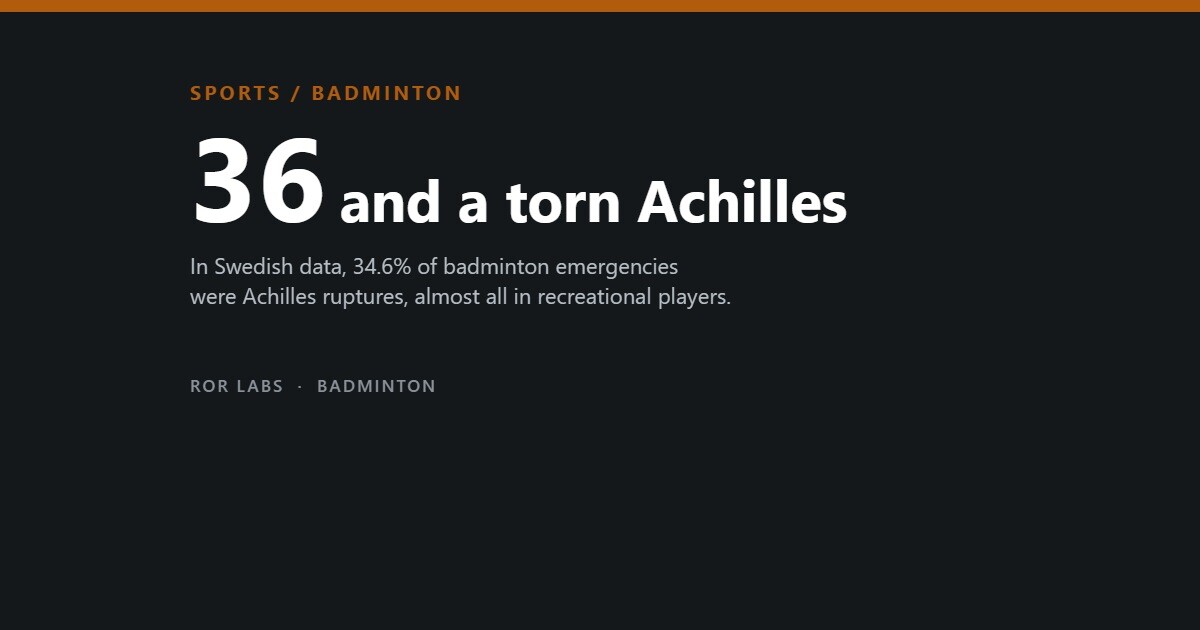
A Swedish hospital study of badminton injuries in the early 1990s found that more than a third of them, 34.6%, were ruptured Achilles tendons. Almost all the patients were recreational players or beginners, not athletes. A companion study put the typical patient at 36 years old, and found 94% of the ruptures happened in the middle or at the end of a game. At follow-up, 39.5% of those injured had not gone back to badminton.
That is the injury badminton is known for among doctors, and the second one is the eye. A shuttlecock is light, but eye specialists have catalogued hundreds of injuries caused by it. Both injuries follow patterns that are well described. Neither is a reason to give up one of the most followed sports in the world, with about 709 million fans by the Badminton World Federation’s count.
This article follows the series format: what badminton players actually injure, where the risk concentrates, what has been measured to reduce it, and why the answer is not to put the racket away.
What actually gets injured
Overall, badminton is a moderate-risk sport. A 2025 systematic review of 19 studies of players aged 10 to 50 found typical injury rates of 1 to 4 per 1,000 hours of play, with studies of elite players at the upper end. The lower body accounted for between 41% and 92% of injuries, and overuse problems for a quarter to three quarters. Eye injuries made up 2% to 7% across studies, most of them caused by the shuttle.
The classic prospective study, from Denmark in the 1980s, followed 375 randomly chosen elite and recreational players and recorded 2.9 injuries per 1,000 hours. Three quarters were overuse injuries, and 92% of injured players kept playing while hurt. A study of French national-team players found 3.4 injuries per 1,000 hours overall, but 11.6 in matches against 2.08 in training. The lunge was the commonest cause of leg injuries and the smash of arm injuries.
Badminton injury rates
Injuries per 1,000 hours of badminton in prospective studies.
Source: Guermont et al., Clinical Journal of Sport Medicine (2019); Yung et al., Research in Sports Medicine (2007); Jørgensen and Winge, International Journal of Sports Medicine (1987).
In a 2025 study of 711 elite young players in China and Japan, aged 7 to 22, 60.3% had been injured at least once, at 2.91 injuries per 1,000 training hours. The knee was the commonest site, followed by the ankle and the lower back. A 2024 meta-analysis of 28 studies found sprains the most common injury type and the ankle the most common single site. In a survey of recreational players in Malaysia, with an average of almost 18 years in the sport, shoulder pain and stiffness led the list.
Where young elite players get hurt
Share of injuries by site in 711 elite youth players in China and Japan.
Source: Zhou et al., Scientific Reports 15:2889 (2025).
When the risk concentrates
The Achilles tendon is the clearest example. In the Swedish emergency data, 90.7% of those injured were recreational players or beginners, and 92.3% of injuries were to the legs. Achilles ruptures and ankle sprains or fractures together made up almost two thirds. A separate study from Malmö found that almost two thirds of Achilles ruptures in the city were caused by sport, “notably badminton”. The pattern in the case reports is consistent: a man in his mid-thirties, playing recreationally, pushing off suddenly at the back of the court, often late in a game and despite having warmed up.
The knee shows a similar profile. A Danish study of 539 badminton players with a torn anterior cruciate ligament found two thirds were recreational players, 30% were aged 40 to 49 and another 20% were in their thirties. The commonest movements at the moment of injury were a jumping scissor-kick landing in the back court, at 19%, and lunges, at 26% combined. Almost half of the ruptures, 45%, happened in the rear court, with the front and middle of the court at 22% each. A 1990 review summed up the sport’s risk profile in a way that still holds: exposure for exposure, recreational players and men carry more risk than elite players and women, and Achilles rupture is an injury of older recreational players.
The recreational player’s injury
Findings from Swedish and Danish studies of badminton tendon and ligament injuries.
Source: Fahlström et al., American Journal of Sports Medicine (1998) and Scandinavian Journal of Medicine & Science in Sports (1998); Kaldau et al., Asia-Pacific Journal of Sports Medicine, Arthroscopy, Rehabilitation and Technology 38:22–28 (2024).
Eye injuries concentrate in doubles. In a Chinese series of 85 badminton eye injuries, 73 happened in doubles and 10 in singles, and 52 were caused by the injured player’s own partner. Seventy per cent of the injured, and 82% of the players who hit the shuttle, had never had a lesson. The injuries were serious: 58 involved bleeding inside the eye, 36 led to raised eye pressure, 26 needed surgery and one eye was left blind. A systematic review of 378 badminton eye injuries from 12 countries found 85% were caused by the shuttle and 97% were closed-globe injuries, which can still damage vision permanently. Doubles play and not wearing eye protection were the risk factors.
What has been measured to work
There is only one randomised trial of injury prevention in badminton. PreventiBad, published in 2025, randomised youth clubs with 273 players, average age 13.8, to a structured warm-up or their usual routine for eight weeks. The warm-up group had 6 injuries in 4,865 hours of play against 14 in 3,440 hours, an injury risk ratio of 0.30. The authors call the result preliminary, and it is: the trial was short, small and in young players. There are no trials in adults or recreational players, and none aimed at the Achilles tendon.
Two kinds of evidence
The only prevention trial, and a laboratory study of landing technique.
Usual routine: 4.07 injuries per 1,000 h
Structured warm-up: 1.23 per 1,000 h
Risk ratio 0.30 (0.12–0.75)
Eight weeks; called preliminary
Recreational players, habitual landing: 68 N/kg
Same players, scissor-kick landing: 50 N/kg
About 25% less peak Achilles force
Biomechanics, not an injury trial
Source: Phomsoupha, Tran and Guermont, Journal of Sports Sciences (2025); Kaldau et al., Journal of Sports Science and Medicine 21(2):224–232 (2022).
A laboratory study offers a clue about the Achilles tendon. When recreational players landed with their habitual technique, peak force on the tendon was about 25% higher than when they used the scissor-kick landing elite players are taught. That is a biomechanics finding, not proof that coaching prevents ruptures, but it points in the same direction as the case reports: the injury belongs to players who have learned the game informally. For eyes, no badminton trial exists. In a systematic review of racket sports, a median 93% of eye injuries happened when no eyewear was worn, and ordinary glasses did not protect. Eye protection standards written for racket sports, however, do not currently name badminton, so players have to choose eyewear rated for squash or similar sports. An older piece of advice for doubles has stood the test of time: the player at the net keeps the racket up in front of the face.
Why the answer is not to stop
Racket sports are among the activities most strongly associated with long life. In a British cohort of 80,306 adults, racket sport players had a 47% lower risk of death from any cause than non-players. In a US cohort of 13,204 people followed for a median of 25 years, racket sports were linked to a 25% lower risk of cardiovascular disease. Both are observational, so they show association, not proof.
What badminton does for fitness
Results from training studies and cohorts. Hazard ratio below 1.00 means lower risk.
Source: Patterson et al., Journal of Sports Sciences (2017); Porter et al., Journal of Physical Activity and Health (2019); Oja et al., British Journal of Sports Medicine 51(10):812–817 (2017).
The training studies are smaller but more direct. Previously untrained women who played recreational badminton for eight weeks raised their maximal oxygen uptake by 16%, slightly more than a comparison group that ran, and lowered their blood pressure and resting heart rate. In the United Arab Emirates, adults aged 40 to 70 who played three times a week for two months improved on cardiovascular and muscular measures, with the largest gains in those who had a chronic disease. Neither study was a full randomised trial, but both show a sport that older beginners can take up and benefit from. Even at the top level, injury is part of the game rather than a reason to quit: in January 2025 the Malaysian world number six, Lee Zii Jia, withdrew from his home Malaysia Open with an ankle ligament injury.
The injury pattern gives the practical advice. Build up playing time, especially after a long break, and respect fatigue late in a session, when most Achilles ruptures happen. Take lessons: technique matters for landing, and untrained doubles partners cause most eye injuries. In doubles, the net player keeps the racket up, and anyone who wants to be safe should wear eyewear designed for racket sports. None of this is about playing less. It is about playing like someone who has been taught.
Questions people ask
What is the most common badminton injury?
Sprains and overuse injuries of the leg, especially the ankle and knee. Achilles tendon rupture is the most characteristic serious injury in recreational players.
Why do badminton players rupture their Achilles tendon?
Ruptures typically happen in recreational players in their thirties, during a sudden push-off at the back of the court, usually in the middle or late part of a game.
Can a shuttlecock damage your eye?
Yes. Most injuries are closed-globe but can include bleeding inside the eye and raised eye pressure, and some cause permanent vision loss. Most happen in doubles.
Should I wear eye protection for badminton?
Most racket-sport eye injuries happen without eyewear, and ordinary glasses do not protect. Eyewear rated for racket sports is the sensible choice, especially in doubles.
Is badminton good exercise for older adults?
Yes. Short training studies found fitness gains in adults aged 40 to 70, and racket sports are associated with lower mortality. Build up gradually.
The short version
- Badminton injury rates run at about 1 to 4 per 1,000 hours, mostly overuse and leg injuries.
- Achilles ruptures are the signature serious injury: recreational players, mid-thirties, late in a game.
- Eye injuries cluster in doubles, often from a partner’s shot, and most happen without eye protection.
- One youth trial found a structured warm-up cut injuries by 70%, but adult evidence is lacking.
- Racket sports are linked to lower mortality; take lessons, build up gradually and protect your eyes.
This is a summary of published research, not medical advice. A sudden pain or snap at the back of the ankle, or any eye injury with blurred vision or pain, needs prompt medical assessment.
Further reading: Stepper et al., BMJ Open Sport & Exercise Medicine 11(1):e002127 (2025), for the systematic review of badminton injuries. Hoskin, Watson and Kamalden, Injury Prevention (2023), for badminton eye injuries. Our article on pickleball injuries covers another racket sport with many older beginners.
- The Joy of Movement, Kelly McGonigal (2019). A health psychologist on why exercise lifts mood and builds connection, with a good chapter on the social side of playing together.
- Ageless, Andrew Steele (2020). A computational biologist’s clear account of the science of ageing, and of what is and is not known about slowing it.
- Lifespan, David Sinclair and Matthew LaPlante (2019). An optimistic book about the biology of ageing. Read it alongside more cautious accounts; some of its claims remain contested.
Sources
Fahlström M, Björnstig U, Lorentzon R. Scandinavian Journal of Medicine & Science in Sports (1998). — Fahlström M, et al. American Journal of Sports Medicine (1998), doi:10.1177/03635465980260032201. — Kaalund S, et al. British Journal of Sports Medicine 23(2):102 (1989). — Stepper L, et al. BMJ Open Sport & Exercise Medicine 11(1):e002127 (2025), doi:10.1136/bmjsem-2024-002127. — Jørgensen U, Winge S. International Journal of Sports Medicine (1987), doi:10.1055/s-2008-1025689. — Guermont H, et al. Clinical Journal of Sport Medicine (2019), doi:10.1097/JSM.0000000000000848. — Yung PS, et al. Research in Sports Medicine (2007), doi:10.1080/15438620701405263. — Zhou X, et al. Scientific Reports 15:2889 (2025). — Marchena-Rodríguez A, et al. Systematic review and meta-analysis of badminton injuries (2024). — Abdul Muttalib A, et al. Malaysian Orthopaedic Journal (2009), doi:10.5704/moj.0911.002. — Møller A, Åström M, Westlin N. Acta Orthopaedica Scandinavica (1996), doi:10.3109/17453679608996672. — Kaldau NC, et al. Asia-Pacific Journal of Sports Medicine, Arthroscopy, Rehabilitation and Technology 38:22–28 (2024), doi:10.1016/j.asmart.2024.09.005. — Jørgensen U, Winge S. Sports Medicine (1990), doi:10.2165/00007256-199010010-00006. — Yu J, et al. British Journal of Sports Medicine (2019), doi:10.1136/bjsports-2018-099496. — Hoskin AK, Watson SL, Kamalden TA. Injury Prevention (2023), doi:10.1136/ip-2022-044564. — Phomsoupha M, Tran J, Guermont H. Journal of Sports Sciences (2025), doi:10.1080/02640414.2025.2461931. — Kaldau NC, et al. Journal of Sports Science and Medicine 21(2):224–232 (2022), doi:10.52082/jssm.2022.224. — Mazarelo JFD, Winter SL, Fong DTP. The Physician and Sportsmedicine (2023), doi:10.1080/00913847.2023.2196934. — ASTM F3164-24 (2024). — Kelly SP. British Journal of Ophthalmology 71(10):746 (1987). — Oja P, et al. British Journal of Sports Medicine 51(10):812–817 (2017). — Porter AK, et al. Journal of Physical Activity and Health (2019), doi:10.1123/jpah.2018-0671. — Patterson S, et al. Journal of Sports Sciences (2017). — Hazari A, Jalgoum M, Kandakurti PK. F1000Research (2023), doi:10.12688/f1000research.142339.1. — Malay Mail, 4 January 2025. — Badminton World Federation, 2022 Global Fan Study, 14 January 2023.