Boxing injuries, headguards and the fights that add up
Key takeaways · 10 min read
- Boxing injuries are mostly bruises, cuts and hand injuries; concussion is about one in eight.
- Brain effects rise with the number of fights and knockouts, with no safe threshold found.
- Removing headguards tripled Olympic injury rates and increased cuts, but headguards do not prevent concussion.
- Rapid weight cutting before weigh-in is almost universal among professionals and linked to injury.
On 2 August 2025, two Japanese boxers fought on the same card at Korakuen Hall in Tokyo. Shigetoshi Kotari, 28, boxed twelve rounds to a draw in a regional title fight. Hiromasa Urakawa, also 28, was knocked out. Both underwent surgery for bleeding on the brain, and both died within a week. Japan’s boxing commission responded by cutting regional title fights from twelve rounds to ten.
Deaths like these are why boxing is the sport people point to when they talk about brain injury, and the concern is justified. But most people who box never step into a ring. In a 2025 survey of 583 Portuguese boxers, 70.5% had never competed. The risk in boxing is not spread evenly across everyone who wraps their hands. It rises with the number of fights, with knockouts, and with how a fighter prepares for the scales, and those are things the sport can measure and change.
This article follows the series format: what boxers actually injure, where the risk concentrates, what has been measured to reduce it, and why the answer is not simply to walk away from the gym.
What actually gets injured
A 2023 meta-analysis of studies from this century, covering 733,113 participants and 10,567 injuries, estimated 223.9 injuries per 1,000 boxers overall, 270.8 among amateurs and 399.8 among professionals. Bruises were the commonest type at 30.2%, followed by cuts and skin injuries at 21.4%, sprains and strains, concussion at 12.3% and fractures at 11.4%. The authors found that amateur injury rates had fallen over the previous decade while professional rates stayed high, with more concussion in the professional ranks.
What boxing injuries are
Share of injuries by type, pooled from 14 studies of 21st-century boxing.
Source: Mao et al., Orthopaedic Journal of Sports Medicine (2023).
Professional fight records show the same picture from ringside. In 524 professional bouts in Nevada from 2001 to 2003, there were 17.1 injuries per 100 boxer-matches; half were cuts to the face, 17% hand injuries and 14% eye injuries. The hand matters more in training than in the ring. In Britain’s elite amateur squad from 2005 to 2009, the hand was the most injured body part and more injuries happened in training than in competition. In US emergency departments from 1990 to 2008, the hand accounted for a third of boxing injuries, and punching bags caused 36.8% of them — the injury many recreational boxers are most likely to meet.
Comparisons between combat sports depend on how you count. At three Olympic Games from 2008 to 2016, boxing recorded 76.6 injuries per 1,000 athlete-exposures, against 46.4 for taekwondo, 34.0 for judo and 22.7 for wrestling. Measured per minute of actual fighting, judo came out slightly ahead of boxing, 9.6 against 9.2, and the difference was not significant. Neither ranking is wrong; they answer different questions.
When the risk concentrates
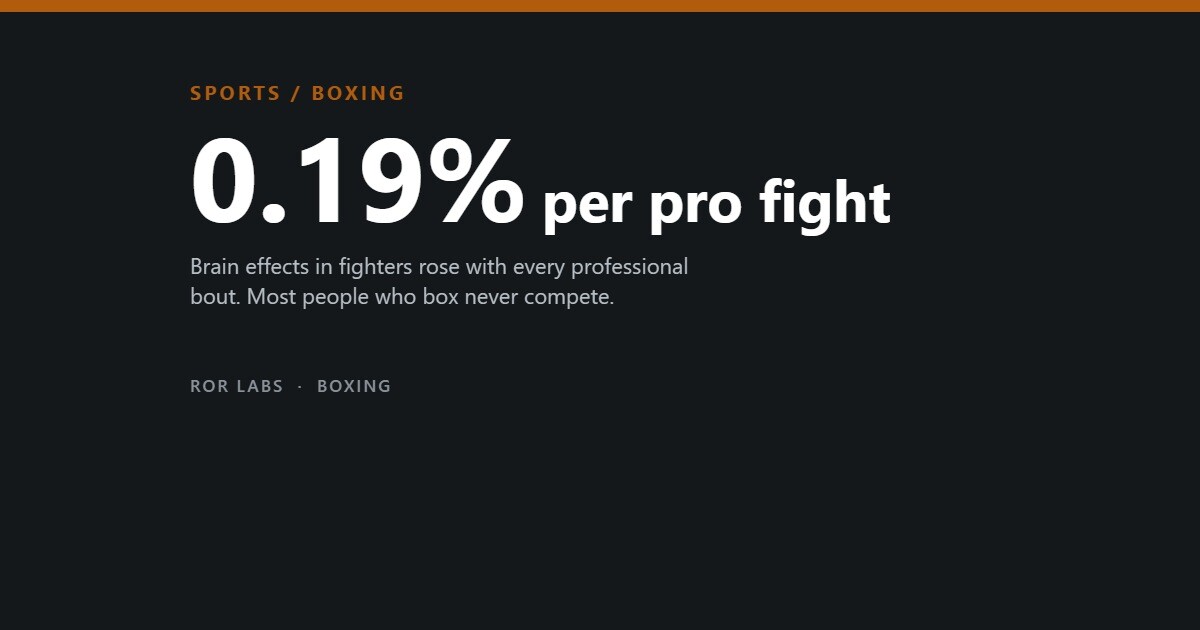
The clearest evidence on the brain comes from the Professional Fighters Brain Health Study, run at the Cleveland Clinic, which has followed hundreds of professional boxers and mixed martial artists with scans and cognitive tests. In its 2015 analysis of 224 fighters, each additional professional fight was linked to 0.19% slower processing speed, and each step up a combined fight-exposure score to smaller volumes in deep brain structures. Fighters at the top of that score processed information 8.8% more slowly than those at the bottom, and about one in four had impaired verbal memory, against about one in ten. Boxers fared worse than mixed martial artists on both scans and tests.
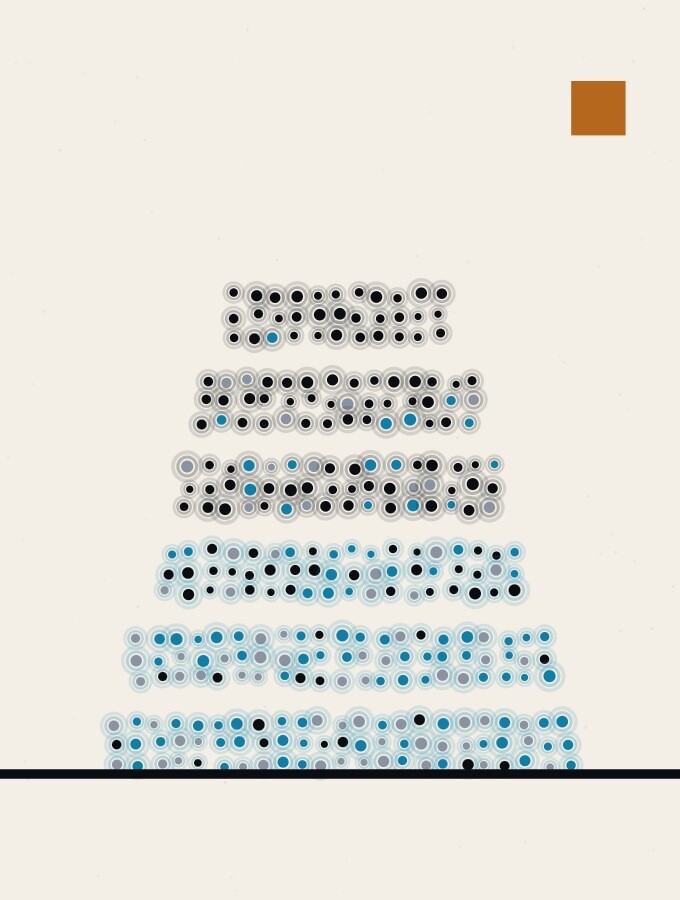
There was no threshold below which the fights did not count. The relationship was a slope, and it started with the first fights. Later analyses from the same study found that starting to fight younger was linked to smaller volumes in memory-related regions, and that heavyweights lost more function per year. A separate study of 104 elite mixed martial artists found that fighters with three or more previous knockout losses were concussed in 65% of their most recent fights. The brain that has been knocked out before is more easily knocked out again. The same slope shows up in ordinary injuries: in a prospective German study, competitive boxers who fought more than three bouts a year were injured more often. Commissions rarely see this curve. What they see is the rare fight in which it ends.
The fights add up
Findings from the Professional Fighters Brain Health Study, 224 fighters, 2015.
Source: Bernick et al., British Journal of Sports Medicine 49(15):1007 (2015).
Preparation for the scales is the other concentration of risk. Nearly all professional combat athletes lose weight deliberately before weigh-in and regain it before the fight. In a study of 399 professional boxers in California, 97.5% gained weight between weigh-in and fight, 7.2% of body weight on average, and one in five gained 10% or more. In a study of 155 combat athletes, men who lost more weight in the 24 hours before weigh-in had higher odds of reporting an injury. Rapid weight loss is a health risk in its own right, and anyone doing it should be supervised by a doctor and a registered dietitian rather than following gym folklore.
What has been measured to work
Headguards are the most argued-over piece of equipment in the sport, because the evidence cuts two ways. In 2013 amateur boxing removed headguards for elite men. Across the Olympic Games before and after, the overall injury rate per minute of fighting for male boxers tripled, a rate ratio of 3.00. A study of 28,802 rounds found that without headguards, cuts rose sharply while stoppages from blows to the head fell. The Association of Ringside Physicians concluded in 2023 that headguards are highly effective against cuts and should be used, especially in sparring, but that they should not be relied on to prevent concussion, and that riskier behaviour while wearing them may cancel out part of their benefit.
Headguards: what changed when they came off
Elite men’s amateur boxing, before and after headguards were removed in 2013.
Injury rate per minute of fighting
After removal: 3.00 times the rate
(95% CI 2.07–4.36)
Lystad et al., 2020
Cuts: rose sharply
Stoppages from head blows: fell
Concussion benefit of headguards: unproven
Loosemore et al., 2017
Source: Lystad et al., British Journal of Sports Medicine (2020); Loosemore et al., Clinical Journal of Sport Medicine (2017); Association of Ringside Physicians position statement (2023).
Rules have been used more directly. After the South Korean boxer Duk Koo Kim died following a world title fight, the World Boxing Association cut championship bouts from fifteen rounds to twelve in 1987; Japan’s move to ten-round regional title fights in 2025 follows the same logic. Olympic-style boxing today uses three rounds of three minutes for adults and two-minute rounds for under-17s. World Boxing’s rules require boxers to make weight on the morning of each competition day, which limits how much can be lost and regained. That matters because weigh-in timing changes behaviour: British combat athletes weighed in 24 hours or more before competing cut more weight than those weighed in on the day, 9.7% against 5.2% of body weight.
The weight swing before a fight
Deliberate weight loss before weigh-in and regain before the bout, in professional and elite combat athletes.
Source: Murugappan et al., The Physician and Sportsmedicine (2021); Campbell et al. (2025).
Medical suspensions address the knockout curve. Under the International Boxing Association’s rules, a boxer knocked out by blows to the head is suspended for at least 30 days and must complete a graded return-to-play protocol, and a third such knockout within twelve months brings a year out of the ring. None of these measures has been tested in a trial, and several are recent, but they target the right variables: the number of rounds, the number of knockouts, and the weight swing before a fight. The measure with the strongest evidence is simpler still. The brain study found damage rose with exposure, so the most effective protection is fewer head blows — less hard sparring, fewer fights, and longer breaks after a knockout.
Why the answer is not to stop
Most boxing does not involve being hit in the head. The Portuguese survey found seven in ten boxers had never competed, and sparring caused about a third of their injuries. A growing share of people take boxing classes that involve bags, pads and conditioning but no contact at all. For them the risks are the hand, the wrist and the shoulder, and a punching bag is the likeliest cause of an emergency visit. US emergency data from 2000 to 2023 estimated 362,869 boxing injuries, with fractures at 24.6% and concussion or closed head injury at 6.9%, though the head injuries were four times as likely to lead to admission.
Most boxers never fight
Selected findings on recreational boxing.
Source: SottoMayor et al. (2025); Potter, Snyder and Smith, American Journal of Preventive Medicine (2011).
Boxing-based exercise has also been tried for Parkinson’s disease, and the story there is honest rather than inspiring. Programmes such as Rock Steady Boxing have reported improvements in balance and mobility in small studies without control groups. But a 2024 meta-analysis of 13 studies found no significant pooled effect on mobility, balance, motor symptoms or fitness, and a double-blind randomised trial of 40 patients found a sensory-focused exercise programme did better than boxing training. Boxing training may help people with Parkinson’s as one form of exercise among several; it has not been shown to be special.
What the evidence supports is a clear separation between two activities that share a name. Non-contact boxing training is vigorous exercise with the injury profile of other gym work: wrap your hands, build up bag work gradually and treat a sore wrist early. Competitive boxing and hard sparring carry a dose-dependent risk to the brain that no equipment removes. For anyone who chooses them, the levers are known: keep hard sparring rare, wear a headguard in training to avoid cuts without assuming it prevents concussion, take knockouts seriously and rest for longer afterwards, make weight gradually under medical supervision, and keep count of the fights. The two deaths in Tokyo were not random. They sit at the far end of a slope that can be walked back.
Questions people ask
How dangerous is boxing?
A 2023 meta-analysis estimated about 224 injuries per 1,000 boxers, higher in professionals. Most are bruises and cuts; concussion was about 12% of injuries.
Is boxing bad for your brain?
For fighters who take head blows, yes, in proportion to exposure: each professional fight was linked to slightly slower processing speed, with no safe threshold identified.
Do boxing headguards prevent concussion?
They greatly reduce cuts but have not been shown to prevent concussion. Ringside physicians recommend them for sparring on that basis.
Is non-contact boxing safe?
It has the injury profile of other vigorous gym exercise, mainly hand, wrist and shoulder problems. The brain risk comes from being hit.
Does boxing help Parkinson’s disease?
Small studies report benefits, but a 2024 meta-analysis found no significant pooled effect. It is one reasonable form of exercise, not a proven treatment.
The short version
- Boxing injuries are mostly bruises, cuts and hand injuries; concussion is about one in eight.
- Brain effects rise with the number of fights and knockouts, with no safe threshold found.
- Removing headguards tripled Olympic injury rates and increased cuts, but headguards do not prevent concussion.
- Rapid weight cutting before weigh-in is almost universal among professionals and linked to injury.
- Most people who box never compete; non-contact training carries far lower risk.
This is a summary of published research, not medical advice. Anyone knocked out or showing signs of concussion needs medical assessment and should not return to sparring or competition until cleared. Rapid weight loss can be dangerous; if weight is a concern, work with a doctor and a registered dietitian.
Further reading: Bernick et al., British Journal of Sports Medicine 49(15):1007 (2015), for the dose-response brain findings. Association of Ringside Physicians, The Physician and Sportsmedicine (2023), on headguards. Our article on wrestling and weight cutting covers a rule change that reduced it.
- Damage, Tris Dixon (2021). A boxing writer’s history of brain trauma in the sport, drawing on fighters, families and doctors. Unflinching but not sensational.
- Ending Parkinson’s Disease, Ray Dorsey, Todd Sherer, Michael Okun and Bastiaan Bloem (2020). Four specialists on the disease and on exercise, including where the evidence is strong and where it is not.
- The Idea of the Brain, Matthew Cobb (2020). A zoologist’s history of how we have tried to understand the brain, and a useful corrective to overconfident claims about it.
Sources
Al Jazeera, 10 August 2025, on the deaths of Shigetoshi Kotari and Hiromasa Urakawa. — SottoMayor R, et al. Portuguese boxing injury survey (2025). — Mao Y, Zhao D, Li JH, Fu W. Orthopaedic Journal of Sports Medicine (2023), doi:10.1177/23259671221127669. — Bledsoe GH, Li G, Levy F. Southern Medical Journal (2005), doi:10.1097/01.smj.0000182498.19288.e2. — Loosemore M, et al. British Journal of Sports Medicine (2015), doi:10.1136/bjsports-2015-094755. — Potter MR, Snyder AJ, Smith GA. American Journal of Preventive Medicine (2011), doi:10.1016/j.amepre.2010.12.018. — Lystad RP, et al. British Journal of Sports Medicine (2020), doi:10.1136/bjsports-2020-102958. — Bernick C, Banks SJ, Shin W, et al. British Journal of Sports Medicine 49(15):1007 (2015). — Bryant BR, et al. International Review of Psychiatry (2020), doi:10.1080/09540261.2019.1665501. — Bray MJC, et al. Neurotrauma Reports (2021), doi:10.1089/neur.2020.0057. — Hada S, et al. Journal of Physical Fitness and Sports Medicine 11(4):255 (2022). — Murugappan KR, et al. The Physician and Sportsmedicine (2021), doi:10.1080/00913847.2021.1960780. — Hillier M, et al. International Journal of Sport Nutrition and Exercise Metabolism (2019), doi:10.1123/ijsnem.2018-0393. — Doherty CS, Barley OR, Fortington LV. Journal of Science and Medicine in Sport (2025). — Loosemore MP, et al. Clinical Journal of Sport Medicine (2017), doi:10.1097/JSM.0000000000000322. — deWeber K, et al. Association of Ringside Physicians position statement. The Physician and Sportsmedicine (2023), doi:10.1080/00913847.2023.2242415. — Donnelly RR, et al. Clinical Journal of Sport Medicine 33(6) (2023). — World Boxing Competition Rules (November 2024). — International Boxing Association Technical & Competition Rules (March 2024). — Campbell P, et al. (2025), doi:10.1016/j.peh.2025.100395. — Tsuzaki J, et al. The Physician and Sportsmedicine (2026), doi:10.1080/00913847.2026.2661569. — González-Devesa D, et al. Revista de Neurología (2024). — Sangarapillai K, Norman BM, Almeida QJ. Neurorehabilitation and Neural Repair (2021), doi:10.1177/15459683211023197. — Dawson RA, et al. Topics in Geriatric Rehabilitation (2020).