Hiking with bears and snakes, and the spray that stopped nine charges in ten
Key takeaways · 10 min read
- Bears injured 238 people in Japan in the year to March 2026 and killed 13, both records; most attacks were in Tohoku in autumn, many near homes.
- Worldwide, almost half of brown bear attacks involved a mother with cubs, while most fatal black bear attacks in North America involved a predatory bear.
- In Alaskan case series, bear spray stopped aggressive bears about 90% of the time; firearms 76% to 84%. Storing food away from bears cut Yosemite incidents by 99%.
- About 7,000 to 8,000 venomous snakebites happen in the US each year and about five people die. Do not cut, suck, ice or tourniquet a bite.
Between April 2025 and March 2026, bears injured 238 people in Japan and killed 13 of them. Both numbers were records, according to preliminary figures from the Ministry of the Environment; the previous worst year, 2023, had 219 victims and six deaths. October alone brought 89 victims. Most were attacked by Asiatic black bears in the northern Tohoku region. In Akita, the worst-hit prefecture, many victims were not hikers at all but people walking, commuting or farming close to home.
North America has its own slow rise. Recorded bear attacks in Alaska averaged 2.6 a year from 1880 to 2015 but 7.6 a year in the 2010s. Snakes are the other trail animal people fear: the CDC estimates that 7,000 to 8,000 people in the United States are bitten by venomous snakes each year, and that about five of them die.
This article covers what actually happens in bear and snake encounters, where the risk concentrates, what has been measured to work, from bear spray and food canisters to snakebite first aid, and why the sensible response is to hike carefully rather than stay at home.
What actually happens in a bear or snake encounter
The widest view of brown bear attacks comes from a 2019 study that gathered 664 attacks between 2000 and 2015 across North America, Europe, Russia, Iran and Turkey. Most, 85.7%, ended in injury and 14.3% in death. Half of the victims were doing something for pleasure, such as hiking, berry picking or camping, and 63% were alone. The most common trigger was a mother with cubs.
What set off brown bear attacks
Main scenario in brown bear attacks on people worldwide, 2000–2015, where the circumstances were known. Some attacks had more than one trigger.
Source: Bombieri et al., Scientific Reports (2019), compiled from datasets, reports and news.
Black bears behave differently. Of 210 agency-confirmed non-fatal black bear attacks in the lower 48 US states from 2000 to 2017, 52% were defensive, 33% food-motivated and 15% predatory. Fatal attacks are another matter: a review of 63 deaths from 1900 to 2009 judged that 88% involved a bear behaving as a predator, and 92% of those predatory bears were males. A defensive mother and a hunting male call for opposite responses.
Snakebites are smaller events with a longer tail. More than 95% of venomous bites in the United States come from pit vipers: rattlesnakes, copperheads and cottonmouths. Their venom damages tissue around the bite and can disturb blood clotting. National data put deaths at an average of six a year from 2001 to 2017, ranging from two to twelve, while emergency departments treated about 9,192 non-fatal snakebites of all kinds a year.
Where the risk concentrates

Japan’s record year was concentrated in place and season. The six Tohoku prefectures accounted for 158 of the 238 victims. Akita had the most, 67, followed by Iwate with 40 and Fukushima with 24, and Iwate had the most deaths, five. September to November brought 161 victims, and cases fell sharply in December, when bears den. Sightings outside Hokkaido and Kyushu reached a record 50,359 by the end of February.
The danger did not sit mainly on mountain trails. A ministry briefing counted 19 bear incidents inside national parks in the 2025 fiscal year, as of mid-December, a small share of the national total. In Akita, a local newspaper survey of victims found that encounters in everyday surroundings stood out, and that many victims carried neither bells nor spray. For a hiker, the lesson is that autumn in bear country deserves extra attention.
People injured by bears in Japan
Victims of bear attacks by fiscal year (April to March), with deaths in brackets. The 2025 figure is preliminary.
Sources: Ministry of the Environment, Japan, briefing on bear damage in national parks (data to 15 December 2025); preliminary fiscal 2025 figures reported by Kyodo, 7 April 2026.
In North America the risk tracks group size and visibility. In 682 Alaskan conflicts since 1880, grizzlies were involved in 88%, and groups of two or more were less likely to be confronted; poor visibility made close encounters more likely. Of eight fatal attacks in Yellowstone from 1872 to 2018, 75% involved men, 88% small parties and 75% remote backcountry.
Snakebites concentrate on feet and hands. The North American Snakebite Registry logged 450 bites at 14 sites from 2013 to 2015. Rattlesnakes caused most of them, and more than a quarter of the people bitten on the leg were not wearing shoes. Reported copperhead bites in children rose 137% at US poison centres between 2000 and 2013, a reminder that many bites happen around homes and gardens, not deep in the hills.
Who gets bitten, and where
Characteristics of 450 snakebites entered in the North American Snakebite Registry, 2013–2015.
Source: Ruha et al., Journal of Medical Toxicology (2017), ToxIC Snakebite Study Group.
These registry cases come from toxicology services at hospitals, so they lean towards bites serious enough to need a specialist. Even so, the pattern of bare feet, hands reaching into cover and bites close to home matches what poison centres report. On a trail, boots and watching where hands and feet go remove much of the risk.
What has been measured to work
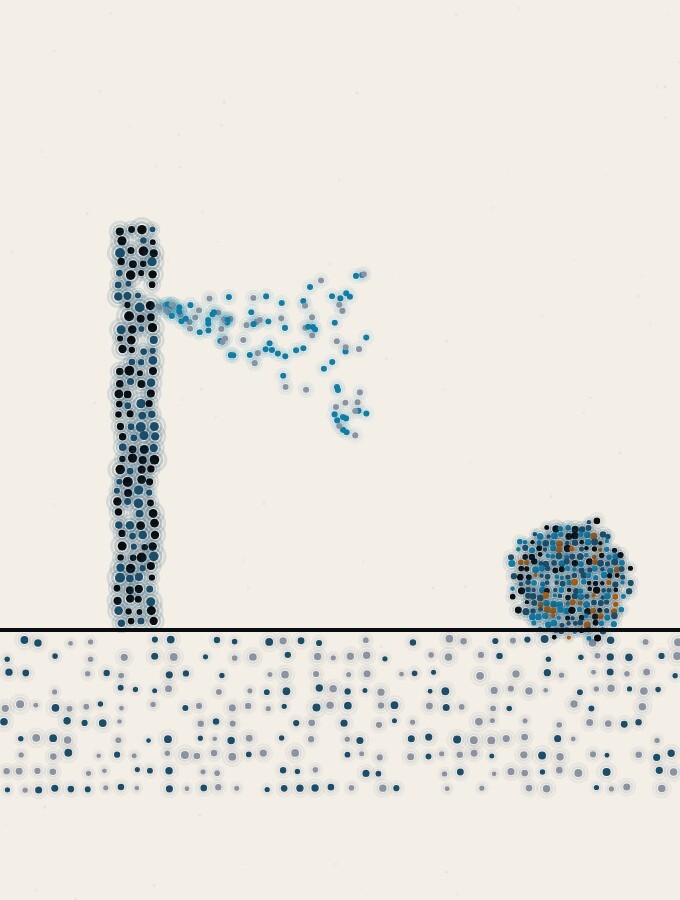
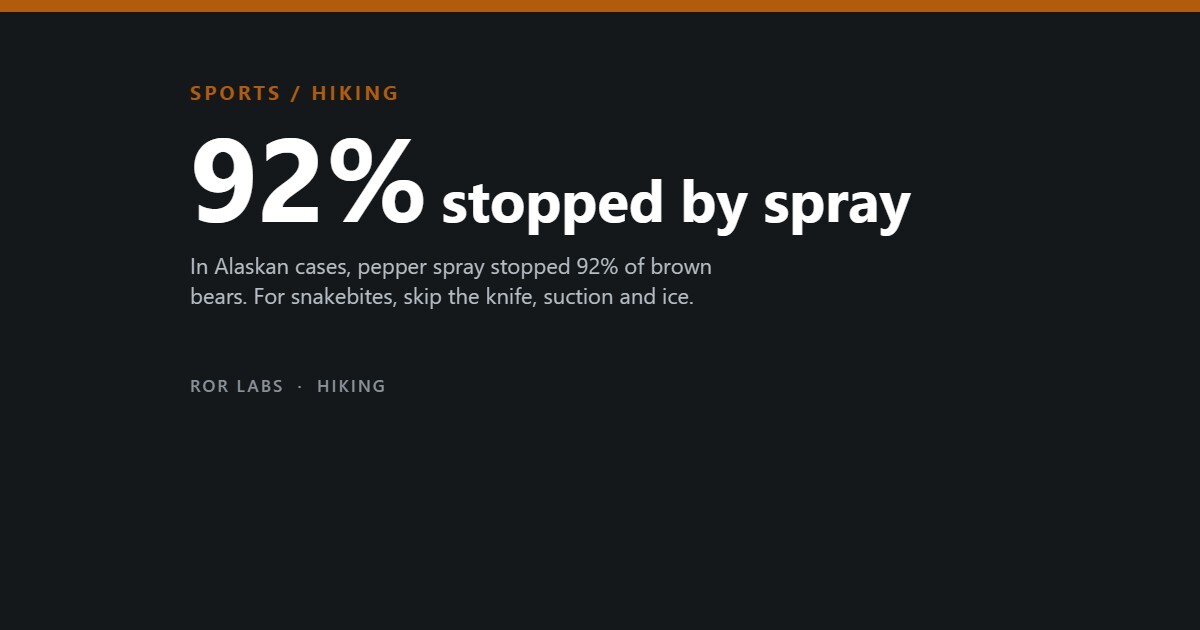
The best-known number in bear safety comes from Alaska. Researchers reviewed 83 bear spray incidents from 1985 to 2006, 72 of them cases where people sprayed a bear to defend themselves. Red pepper spray stopped the bear’s unwanted behaviour 92% of the time with brown bears and 90% with black bears. Of everyone carrying spray in close encounters, 98% were not injured, and the three injuries recorded were minor, none needing hospital care.
Spray has drawbacks. Wind interfered in 7% of incidents, though the spray still reached the bear, and 14% of users felt its effects themselves, from minor irritation to near incapacitation. A companion study looked at 269 bear incidents involving firearms in Alaska from 1883 to 2009. Handguns stopped the bear in 84% of cases and long guns in 76%, but people with firearms were injured at the same rate whether they fired or not, and 61% of the bears died.
Stopping an aggressive bear in Alaska
Share of incidents in which the bear’s aggressive behaviour stopped, and share of spray carriers uninjured. Two separate case series, not a head-to-head trial.
Sources: Smith et al., Journal of Wildlife Management (2008 and 2012).
These figures need a caveat that rarely travels with them. Both studies are collections of reported incidents, gathered over different decades, not trials. People who carry spray may hike differently from people who carry rifles, and hunters with guns were often near meat or fish that drew bears in. The global attack study was built partly from news reports, and its authors say Russia and the east are probably undercounted. Spray looks better; the margin is uncertain.
Keeping food from bears has the clearest record. Human–bear incidents in Yosemite peaked at 1,584 in 1998. After the park received funding for more staff, more rubbish collection and better bear-resistant food storage, incidents fell to 114 in 2011 and to 22 by late November 2018, a 99% drop. Since 2004 backpackers have had to carry approved canisters in much of the park’s wilderness.
Human–bear incidents in Yosemite
Recorded human–bear incidents per year. The 2018 figure runs only to the end of November.
Source: Mazur et al., Human–Wildlife Interactions 12(3), article 8 (2018), Yosemite National Park staff.
For encounters, the US National Park Service advises talking calmly so the bear knows you are human, never running, and hiking in groups. If a grizzly or brown bear attacks, leave your pack on and play dead, lying on your stomach with hands behind your neck. If a black bear attacks, do not play dead; fight back, aiming at the face. Any bear that stalks you or attacks a tent should be fought, whatever the species. Advice for Japan’s Asiatic black bears differs: Niigata Prefecture tells people who are attacked to lie face down and protect the head, neck and abdomen, citing an Akita University study in which nobody who took that defensive posture was seriously injured.
Snakebite first aid is mostly about what not to do. The CDC, the American Red Cross and the WHO agree: no tourniquet, no cutting, no sucking out venom, no ice and no electric shock. Call emergency services, keep the person still and calm, remove rings and watches before swelling starts, and get to hospital, because antivenom is the only specific treatment. The Red Cross adds that pressure bandaging should not be used after a pit viper bite.
Australia does the opposite, because its dangerous snakes are elapids, whose venom mainly attacks nerves, blood and muscle rather than the bite site. Its standard is pressure immobilisation: a firm elastic bandage over the whole limb, a splint, and keeping the person lying still. The WHO recommends it only for neurotoxic snakes that do not cause local swelling. Yet a doctor in Cairns has argued there is limited good evidence of benefit, after two patients were harmed by bandages left on for hours.
Why the answer is not to stop hiking
Yellowstone recorded eight fatal bear attacks between 1872 and 2018, seven of them by grizzlies. That works out at one death for every 26.2 million park visits. The frequency of fatal attacks has risen recently, but visits have risen faster, so the risk for each visitor has fallen. The study’s author recommended groups of three or more, staying on trails, never running from a bear and carrying bear spray.
Snakes follow the same arithmetic. Roughly five deaths a year among all the Americans who hike, camp and garden is a small number, and most serious bites involve a hand reaching where it cannot see or a bare foot. As our article on hiking and mountaineering deaths showed, falls, heat and drowning loom far larger in trail deaths than animals. Boots, a torch after dark and a step back from a snake on the path deal with most of the snake risk.
The habits that protect against bears are cheap: make noise in thick cover, travel together, carry spray where it is recommended and know how to use it, store food in canisters or lockers and keep dogs on a lead. In Japan in autumn, check local bear warnings before setting out. None of this asks anyone to give up the hills, only to hike carefully in them.
What to do
Steps sorted by when they matter. Each one says how strong the evidence is: Measured Official advice Untested
Before
- Carry bear spray where it is recommended and learn how to use it. In Alaskan cases it stopped 92% of brown bears and 90% of black bears. Measured see Sources
- Store food in approved canisters or lockers. Better food storage cut human–bear incidents in Yosemite by 99%. Measured see Sources
- In Japan in autumn, check local bear warnings before setting out. Official advice see Sources
If it happens
- Hike in a group, make noise in thick cover and keep dogs on a lead. Official advice see Sources
- Wear boots and watch where you put your hands and feet; 27% of people bitten on the leg in a US registry had no shoes on. Measured see Sources
- If a bear approaches, talk calmly and never run. Official advice see Sources
- If an Asiatic black bear attacks in Japan, lie face down and protect your head, neck and abdomen, as Niigata Prefecture advises. Official advice see Sources
Afterwards
- Seek medical care after any bear injury, however slight; bites and claw wounds can be deeper than they look. Official advice see Sources
What not to do
- Outside Australia, do not put a pressure bandage on a pit viper bite. Official advice see Sources
Not medical advice. For any snakebite, call emergency services straight away.
Questions people ask
Is bear spray better than a gun?
In Alaskan case series, spray stopped aggressive bears about 90% of the time and 98% of carriers were uninjured; firearms stopped bears 76% to 84% of the time. The studies were not head-to-head, but spray is easier to use well and rarely kills the bear.
Should I play dead or fight back?
The US National Park Service says to play dead if a grizzly or brown bear attacks defensively, and to fight back against a black bear. Fight any bear that stalks you or enters your tent.
What should I do if a snake bites me?
Call emergency services, stay as still and calm as possible, remove rings and watches, and get to hospital. Do not cut, suck, use ice or apply a tourniquet. In Australia, apply a pressure bandage and splint the limb.
Do bear bells work?
One 1984 study of hikers in Glacier National Park found bells reduced the likelihood of charges, but its authors called the result tentative. Talking and travelling in groups are the methods official agencies recommend.
The short version
- Bears injured 238 people in Japan in the year to March 2026 and killed 13, both records; most attacks were in Tohoku in autumn, many near homes.
- Worldwide, almost half of brown bear attacks involved a mother with cubs, while most fatal black bear attacks in North America involved a predatory bear.
- In Alaskan case series, bear spray stopped aggressive bears about 90% of the time; firearms 76% to 84%. Storing food away from bears cut Yosemite incidents by 99%.
- About 7,000 to 8,000 venomous snakebites happen in the US each year and about five people die. Do not cut, suck, ice or tourniquet a bite.
- Per visit, the risk is tiny: one death per 26.2 million visits to Yellowstone. Hike in groups, wear boots, carry spray and store food properly.
This is a summary of published research and official guidance, not medical advice. For any snakebite, call emergency services straight away. Anyone injured by a bear, however slightly, should seek medical care, as bites and claw wounds can be deeper than they look and can become infected. Ask your doctor or physiotherapist about recovery afterwards.
Further reading: Bombieri et al., Scientific Reports (2019), for brown bear attacks worldwide. Smith et al., Journal of Wildlife Management (2008), for bear spray. US National Park Service, “Staying safe around bears”. WHO, snakebite envenoming treatment guidance.
Sources
- Ministry of the Environment, Japan. 国立公園におけるクマ被害対策について (bear damage countermeasures in national parks), briefing document, data to 15 December 2025.
- Kyodo News. クマ被害、最多の238人 25年度、死亡は13人, via Akita Sakigake Shimpo, 7 April 2026.
- Akita Sakigake Shimpo. Survey of bear attack victims in Akita, 25 April 2026.
- Smith TS, Herrero S. Human–bear conflict in Alaska: 1880–2015. Wildlife Society Bulletin (2018), doi:10.1002/wsb.870.
- Centers for Disease Control and Prevention, NIOSH. Venomous snakes (outdoor workers), web page.
- Bombieri G, Naves J, Penteriani V, et al. Brown bear attacks on humans: a worldwide perspective. Scientific Reports (2019), doi:10.1038/s41598-019-44341-w.
- Scharhag JM, Sartini C, Crimmins SM, et al. Characteristics of non-fatal attacks by black bears: conterminous United States, 2000–2017. Human–Wildlife Interactions 15(1), article 23 (2021).
- Herrero S, Higgins A, Cardoza JE, et al. Fatal attacks by American black bear on people: 1900–2009. Journal of Wildlife Management (2011), doi:10.1002/jwmg.72; ScienceDaily report, 11 May 2011.
- Capito KC, Dhadvai S, Steiner MJ, Mills W. Snakebite. Pediatrics in Review (2026), doi:10.1542/pir.2025-006806.
- Langley RL, Haskell MG, Hareza DA, King KM. Fatal and nonfatal snakebite injuries reported in the United States. Southern Medical Journal (2020), doi:10.14423/smj.0000000000001156.
- Gunther KA. Bear-caused human fatalities in Yellowstone National Park: characteristics and trends. Human–Wildlife Interactions 16(3), article 8 (2023).
- Ruha AM, Kleinschmidt KC, Greene S, et al. The epidemiology, clinical course, and management of snakebites in the North American Snakebite Registry. Journal of Medical Toxicology (2017), doi:10.1007/s13181-017-0633-5.
- Schulte J, Domanski K, Smith EA, et al. Childhood victims of snakebites: 2000–2013. Pediatrics (2016), doi:10.1542/peds.2016-0491.
- Smith TS, Herrero S, DeBruyn TD, Wilder JM. Efficacy of bear deterrent spray in Alaska. Journal of Wildlife Management (2008), doi:10.2193/2006-452.
- Smith TS, Herrero S, Layton CS, et al. Efficacy of firearms for bear deterrence in Alaska. Journal of Wildlife Management (2012), doi:10.1002/jwmg.342.
- Mazur RL, Leahy RM, Lee-Roney CJ, Patrick KE. Using Global Positioning System technology to manage human–black bear incidents at Yosemite National Park. Human–Wildlife Interactions 12(3), article 8 (2018), doi:10.26077/vm5g-7q38.
- Martin SR, McCurdy K. Wilderness food storage in Yosemite. Human Dimensions of Wildlife (2009), doi:10.1080/10871200902858993.
- US National Park Service. Staying safe around bears; Bear attacks (updated 2 April 2025), web pages.
- American Red Cross. Venomous snake bites, first aid web page.
- World Health Organization. Snakebite envenoming: treatment and rehabilitation; Snakebite envenoming questions and answers, web pages.
- Australian Venom Research Unit, University of Melbourne. Pressure immobilisation first aid, web page.
- Little M. Harm due to the use of pressure bandage immobilisation in patients bitten by snakes in Australia. Clinical Toxicology (2023), doi:10.1080/15563650.2023.2252586.
- Jope KL, Shelby B. Hiker behavior and the outcome of interactions with grizzly bears. (1984), doi:10.1080/01490408409513035.
- Niigata Prefecture. クマ注意! (bear warning notice), prefectural web document.