A Child Physically Cannot See a Car Coming at 30 mph. Start There.
In This Series: Road, Transit & Child Safety
- Nobody Skips the Car Seat. The Deaths Are in the Exceptions.
- Half of the People Who Die in Crashes Were Not Wearing a Belt
- Three Quarters of Pedestrian Deaths Happen After Dark. Your Reflective Vest Is in the Wrong Place.
- Sixty-Four Per Cent of Seriously Injured British Bus Passengers Were Never in a Crash. And the Bus Is Still About Four Times Safer Than the Car.
Disclosure: this article contains affiliate links, marked (paid link). If you buy through one we may earn a commission, at no extra cost to you. As an Amazon Associate I earn from qualifying purchases. It costs you nothing and it does not change what we recommend.
Key takeaways · 12 min read
- Children cannot reliably detect a car approaching above 20 mph. It is a developmental limit, not carelessness.
- That makes road speed the variable that decides whether a child’s own judgement can function.
- Safe Routes to School engineering cut child pedestrian injury 44% during commute hours in New York, with no fall in untreated areas.
- The school bus is roughly 70 times safer than the car trip.
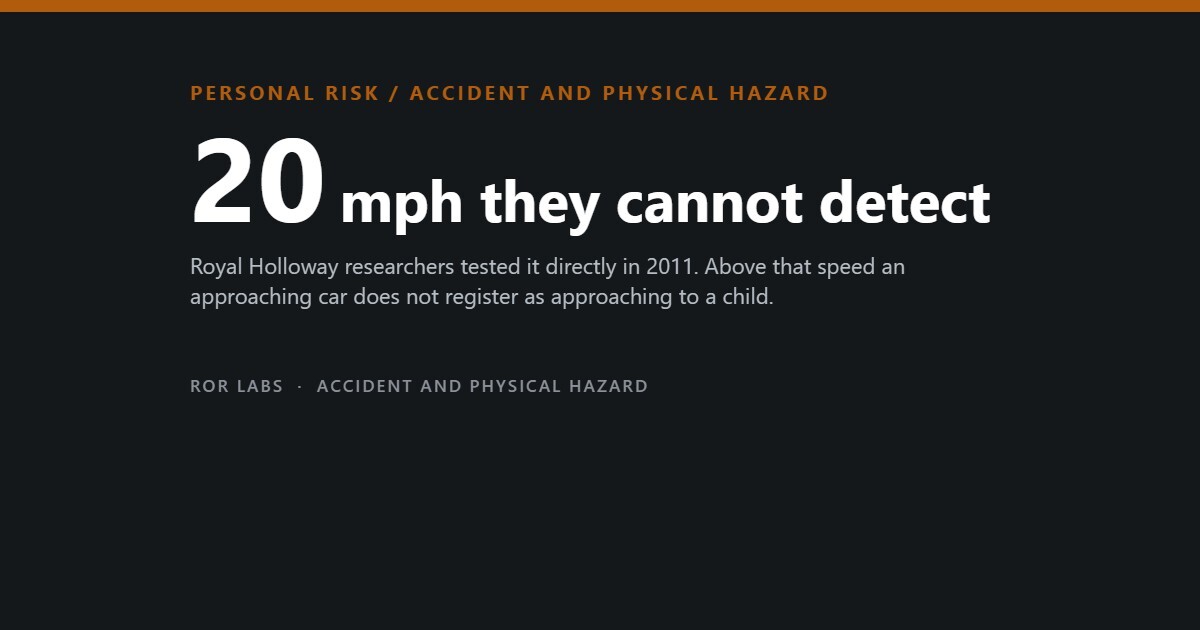
Almost every piece of advice about walking children to school assumes the child is capable of doing the thing being asked of them: look, judge whether the car is far enough away, decide. In 2011 a group of vision researchers at Royal Holloway, University of London tested that assumption directly, and found it does not hold.
Children could not reliably detect a car approaching at speeds above 20 miles per hour. Not “did not bother to look” — could not detect. The neural machinery that reads looming, the rate at which an object grows in your visual field as it comes at you, is still developing, and above that speed the approaching car simply does not register as approaching.
That single finding reorganises the whole subject. It means road speed is not one factor among many in child pedestrian safety — it is the factor that determines whether the child’s own judgement can work at all. And it means the school run splits neatly into things that work (the route, the speed, the bus) and things that mostly make adults feel better. Here is the evidence on both.
The perceptual limit
Above 20 mph, a child cannot see the car coming
Detection of an approaching vehicle by visual looming, compared across ages.
and belowChildren can reliably perceive that the vehicle is approaching, and their crossing judgement has something real to work with.
20 mphDetection becomes unreliable. The researchers describe a perceptual illusion in which faster cars read as not approaching at all — the faster the vehicle, the worse the error.
Source: Wann, J.P., Poulter, D.R., Purcell, C. “Reduced Sensitivity to Visual Looming Inflates the Risk Posed by Speeding Vehicles When Children Try to Cross the Road.” Psychological Science, 2011.
Two other developmental facts stack on top of it. Children are shorter, so a parked van or a tall vehicle bonnet blocks their sightline and blocks the driver’s sightline to them — a problem that has worsened as vehicle front ends have grown, which we covered in our piece on pedestrian deaths after dark. And children are worse at dividing attention, so a child holding a conversation while crossing is doing meaningfully less looking than an adult doing the same.
The intervention that has a number attached
Most road safety measures are hard to evaluate because you cannot randomise a city. The Safe Routes to School programme in New York is a rare exception: it was rolled out in some neighbourhoods and not others, over a decade, in a city that records every crash injury.
A 44% fall in child pedestrian injury, during school-commute hours only
New York City, 2001–2010, 169,000 pedestrian injuries analysed. Ages 5 to 19.
Source: DiMaggio, C. & Li, G. “Effectiveness of a Safe Routes to School Program in Preventing School-Aged Pedestrian Injury.” Pediatrics, 2013.
Read the two findings together and the shape of the answer appears. The child’s perception is the constraint you cannot change. The road is the variable you can. Everything that lowers vehicle speed or shortens the exposure — a crossing where children actually cross, a hump before the school gate, a route that avoids the arterial — is working on the side of the equation that responds.
The bus is the safest thing in this article
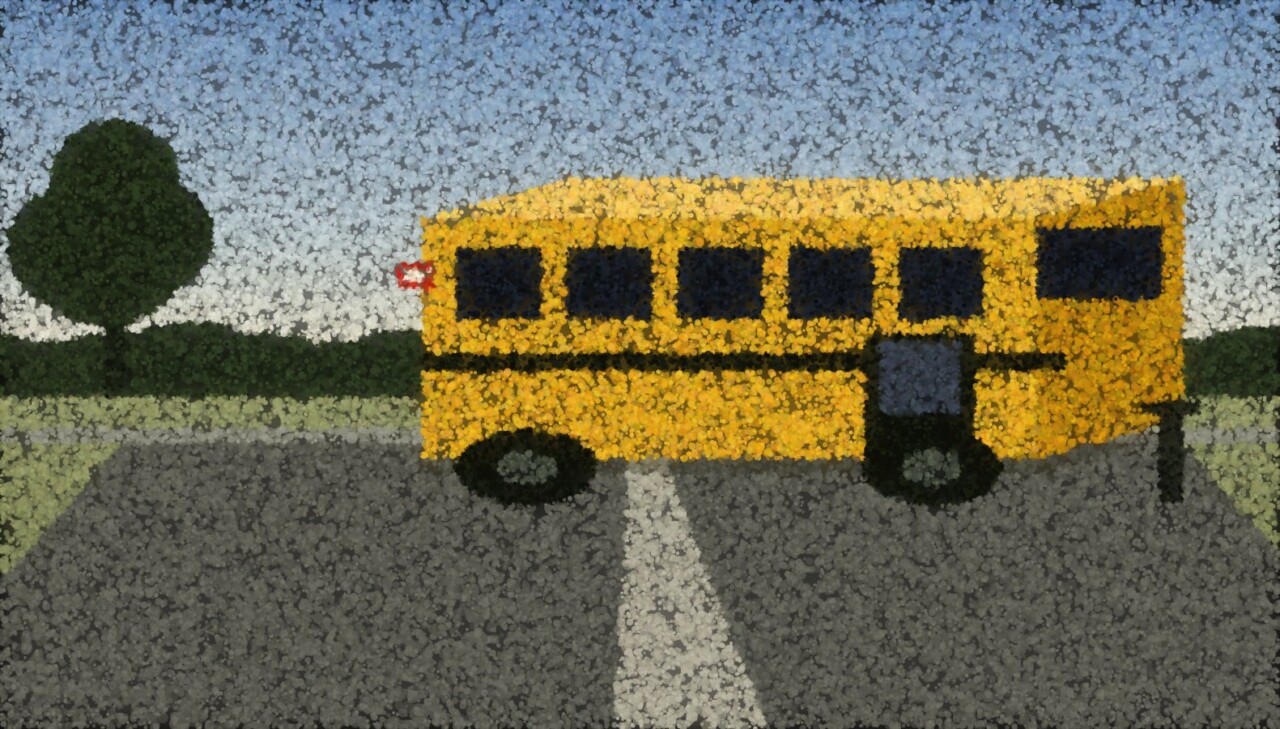
If you can put a child on a school bus, the argument is essentially over. About 25 million American students ride one every school day, and by the National Safety Council’s figures a child is roughly 70 times more likely to get to school safely by bus than by car. Large buses are built to a crash standard that private cars are not, and the compartmentalised seating works without anyone having to buckle anything.
And then there is the part that surprises every parent who hears it. Nearly two thirds of school-bus-related deaths of school-age children happen outside the bus, in the ten feet around it, in the minute before boarding and the minute after getting off.
The danger zone is the bus stop, not the journey
National School Bus Loading and Unloading Survey, over 51 years of records. What struck the child, in fatal loading-zone incidents.
Source: National School Bus Loading and Unloading Survey, Kansas State Department of Education, 51-year cumulative totals; 2020–21 school year data.
That is why the standard instruction is a specific distance rather than a general caution: cross at least ten feet in front of the bus — five giant steps — far enough forward that the driver can see you over the bonnet, and make eye contact before stepping out. In the 2020–21 survey, four children died in loading zones: two struck by the bus, two by other vehicles. All four were six or seven years old.
Where a child vanishes from view
The blind areas around a stopped school bus. The dangerous ones are the places a child naturally stands.
Sources: National Safety Council school bus guidance; NHTSA school bus safety; state pupil transportation danger-zone materials.
The school gate is its own hazard
There is an awkward feedback loop in the modern school run. Parents drive because the roads feel unsafe for walking; the driving concentrates several hundred vehicles into a fifteen-minute window at a single gate; and that concentration is itself one of the more dangerous environments a child encounters. Reversing, three-point turns, double parking and doors opening into the road all happen at once, in the exact place where children are densest.
It is worth naming plainly because the individual decision that feels safest — drive to the gate — makes the collective situation worse, and the family two streets away then has to walk through it.
What actually helps, in order
Ranked by how much risk each one removes
The first five are free.
Sources: DiMaggio & Li, Pediatrics (2013); Wann et al., Psychological Science (2011); National Safety Council; NHTSA school bus safety.
What is worth buying for the school run (paid link)
A short list, because most of what works is a decision rather than a purchase.
Browse on Amazon →
Browse on Amazon →
Browse on Amazon →
What we are deliberately not linking. Child GPS trackers marketed as school-run safety. They are genuinely useful for a different problem — knowing where a child is when plans change — and they do nothing about the risk this article is about. A tracker does not slow a car down or move a crossing, and it will not tell you anything useful in the seconds that matter. Buy one if you want the reassurance of knowing where your child is; do not buy one believing it makes the walk safer. Rucksack rain covers sold as high-visibility. A bright colour helps in daylight and does almost nothing at night, when the risk actually concentrates — only retroreflective material returns headlight beams. And a note on helmets: they are worth having and they protect against falls, not against being hit by a car at speed. Nothing worn on a child’s head substitutes for the road being slower.
Questions people ask
At what age can a child walk to school alone?
There is no age that answers it, because the honest variable is the route rather than the child. A confident nine-year-old on a route with one signalised crossing on 20 mph streets is in a different situation from the same child crossing a four-lane arterial. The perception research says reliable judgement of approaching traffic arrives later than most parents assume, so the sequence that makes sense is: walk it together many times, then walk it behind them, then let them go — and choose the route so that the number of real judgements required is close to zero.
Is driving them actually safer?
Safer than walking on a dangerous road, yes. Safer than the bus, no — by a wide margin. And the aggregate effect of everyone driving is a worse environment at the gate for the children who are walking, including sometimes your own on the days you do not drive.
Do high-visibility vests work for children?
In daylight a bright colour helps a little. At night, which is when the risk concentrates, a plain bright vest performs surprisingly poorly compared with retroreflective material placed on the limbs — the effect is large and it is about placement, not quantity. If you buy one thing for winter, make it ankle bands rather than a tabard.
What about the walk home rather than the walk there?
It is the riskier half. The morning trip is supervised, hurried and uniform; the afternoon is unsupervised, social, distracted and in winter it is dark. Child pedestrian injuries cluster in the after-school hours, and that is the trip worth planning most carefully.
Our school has no crossing. What can I actually do?
This is the one place where collective action beats individual caution by a measurable margin. Safe Routes to School style changes — a crossing point, a hump, a guard, a timed street closure — produced a 44% fall in injuries in the New York evaluation. They are decided by the school and the local authority, they respond to organised parent pressure, and they are the only intervention on this page with a number that large attached to it.
The short version
- Children cannot reliably detect a car approaching above 20 mph. It is a developmental limit, not carelessness.
- That makes road speed the variable that decides whether a child’s own judgement can function.
- Safe Routes to School engineering cut child pedestrian injury 44% during commute hours in New York, with no fall in untreated areas.
- The school bus is roughly 70 times safer than the car trip.
- But nearly two thirds of school-bus-related child deaths happen outside the bus.
- Across 51 years of loading-zone records, 56.4% of those deaths involved the bus itself and 39.3% another vehicle.
- Cross ten feet in front — five giant steps — and make eye contact with the driver.
- The walk home is the riskier half: unsupervised, distracted and dark in winter.
- Reflective material belongs on the ankles, not the chest.
- A GPS tracker tells you where a child is. It does not make the road safer.
This article summarises injury research and transport statistics. Rules on child pedestrian supervision, school transport and speed limits differ by country and by district; where a specific decision about your own child is concerned, local guidance and your own knowledge of the route matter more than any national figure.
On the links above: some are affiliate links, marked (paid link). If you buy through one we may earn a commission at no additional cost to you. As an Amazon Associate I earn from qualifying purchases. We link to product searches rather than specific items so that recommendations do not break as models change, and we say plainly when we are choosing not to link something. Full policy: Affiliate Disclosure.
Sources
- Wann, J.P., Poulter, D.R., Purcell, C. “Reduced Sensitivity to Visual Looming Inflates the Risk Posed by Speeding Vehicles When Children Try to Cross the Road.” Psychological Science, 22(4), 2011.
- DiMaggio, C. & Li, G. “Effectiveness of a Safe Routes to School Program in Preventing School-Aged Pedestrian Injury.” Pediatrics, 2013. (New York City, 2001–2010; 169,000 pedestrian injuries; 44% reduction during school-commute hours in intervention areas, no reduction in comparison areas.)
- National Safety Council. “Buses Safest Transportation for School Children.” (Approximately 25 million students daily; about 70 times more likely to arrive safely by bus than by car; nearly two thirds of school-bus-related deaths of school-age children occur outside the bus; ten-foot crossing rule.)
- National School Bus Loading and Unloading Survey, Kansas State Department of Education. (51-year cumulative totals: 56.4% of loading-zone fatalities involved the school bus, 39.3% other vehicles; 2020–21 school year: four student fatalities and at least 13 children injured by illegally passing vehicles.)
- National Highway Traffic Safety Administration. School Bus Safety and Reducing the Illegal Passing of School Buses.