Romance Scams and Pig-Butchering: What the Evidence Shows
Key takeaways · 13 min read
- Americans reported $929 million lost to romance scams in 2025 and $7.2 billion to cryptocurrency investment fraud, a category that includes the romance-plus-investment pattern known as pig butchering.
- These are complaint figures. Most victims never report, so the real losses are larger by an unknown margin.
- The script is patient: weeks or months of daily contact, a move to a private messaging app, then a fake trading platform that shows invented profits until the victim tries to withdraw.
- Many of the people typing the messages are themselves trafficked workers held in scam compounds in Southeast Asia, according to the UN.
A romance scam works by turning something good into a weapon. A stranger becomes a friend, then a partner, then the person you talk to before sleep. Months later the money is gone, and so is the relationship. Researchers call it a double hit: a financial loss and a bereavement for someone who never existed.
In recent years the script has changed. Instead of asking for help with a medical bill, the new partner offers to help you invest, usually in cryptocurrency. The Chinese name for this, sha zhu pan, translates as pig butchering: fatten the victim with trust, then take everything. What follows covers the losses, who is targeted, how the script runs, real cases from court records and the press, and what the evidence says helps.
Nearly every number here comes from complaints that victims chose to make, so the true scale is bigger and the profile of victims is skewed, and the studies of who is vulnerable are small and recruit people who were willing to talk. Earlier articles covered government and bank impersonation scams and AI voice cloning.
How big the losses are
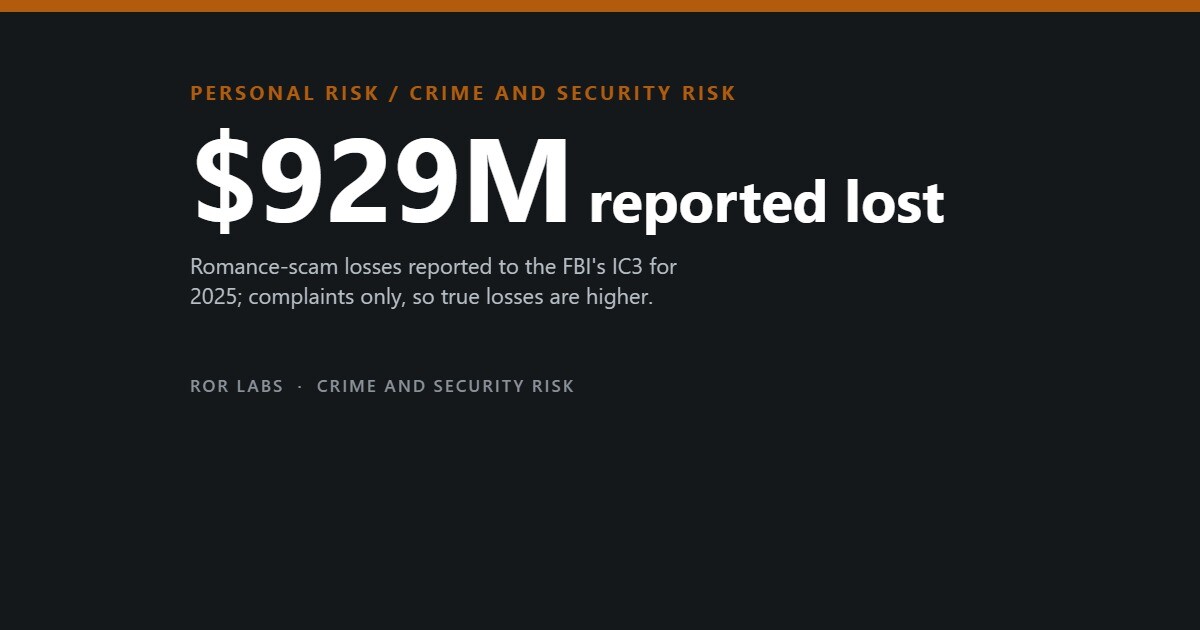
The FBI’s Internet Crime Complaint Center (IC3) published its 2025 report in April 2026. Confidence and romance fraud drew 23,159 complaints and $929 million in reported losses, up from $672 million in 2024. Investment fraud was far larger at $8.6 billion, and cryptocurrency investment fraud alone accounted for $7.2 billion across 61,559 complaints.
Romance losses are dwarfed by the investment category
Losses reported to the FBI’s Internet Crime Complaint Center, United States, 2025 unless stated.
Source: FBI, 2025 Internet Crime Report (April 2026). Complaint data only; categories overlap in practice.
Cassandra Cross, a criminologist in Australia, pointed out in 2023 that a romance ending in a fake investment is usually filed as investment fraud, so romance figures can look flat while the romance-led share of investment losses grows unseen. The US Federal Trade Commission adds that nearly 60% of people who lost money to a romance scam in 2025 said it began on social media.

Who gets targeted
The popular picture is a lonely widow, but the research is more mixed. In a UK panel study of 11,780 adults published in 2018, Monica Whitty found 200 romance scam victims; 63% were middle-aged (35 to 54), 60% were women, and they were better educated than non-victims. They also scored higher on impulsive urgency, sensation seeking and an addictive disposition.
Victims are not only the oldest
Age of romance scam victims in a UK online panel, set against the share of US romance losses reported by people over 60.
Sources: Whitty, Cyberpsychology, Behavior, and Social Networking (2018), 200 victims among 11,780 panel members; FBI IC3 2025 report ($584m of $929m). Different measures: share of victims v. share of money.
Both pictures can be true: middle-aged people use dating sites more, and older people hold more savings, so they may lose more per case. UK police data for 2025 found people aged 55 to 74 accounted for nearly half of all romance losses. An earlier study by Tom Buchanan and Whitty linked victimisation to idealised beliefs about romance, while loneliness was linked to distress among those who had not lost money.
Pig butchering may reach a different group. In 26 interviews by Rajvardhan Oak and Zubair Shafiq, 81% of victims were men, the mean age was 48 and most had degrees. A study of two US state scam trackers also found crypto scam victims mostly male. None of these samples is random, so none tells us who is most at risk in the population.
How the script works
Oak and Shafiq break the scam into stages. It opens with a lure: a dating-app match, a social media follow or a ‘wrong number’ text. The bond phase lasted 3 to 11 months in their sample, with daily messages, mirrored opinions and photos, sometimes even audio or video calls. Then the investment appears, framed as a hobby or a shared future.
Inside 26 pig-butchering cases
Share of interviewed victims who reported each feature of the scam.
Source: Oak and Shafiq, SOUPS 2025. Victims recruited through social media and Reddit; not a representative sample.
Every participant opened an account on a fake trading platform, often with step-by-step help. First deposits were small, $20 to $125, and showed gains of two to five times; a few were allowed to withdraw. Victims were then urged to roll profits over, add savings, take loans or remortgage, and all were told to keep the investments private.

The end follows a pattern: a large, time-limited ‘deal’ arrives, and when the victim tries to cash out the account freezes or a tax of 30% must be paid first, and paying it changes nothing. Then the partner vanishes from every app at once. Cross notes why this works: standard advice says never send money to a partner, but here the victim believes they are paying into their own account.
Elisabeth Carter, a forensic linguist, has analysed real romance fraud messages and found grooming strategies akin to coercive control: secrecy urged to protect the relationship, isolation from friends, and visceral language that distorts reality. People often ask ‘how could anyone fall for this?’, but the script is designed to defeat ordinary judgement.
Cases on the record
In August 2024 Shan Hanes, former chief executive of Heartland Tri-State Bank in Elkhart, Kansas, was sentenced to 293 months in prison for embezzlement. Federal prosecutors said that between May and July 2023 he wired $47.1 million of the bank’s money to cryptocurrency accounts in what they described as a pig-butchering scheme. The bank failed. The FBI later recovered about $8 million for investors.
Court filings reported by The Register say it began in late 2022 with a WhatsApp conversation and his own savings. Before the bank wires he took money from his church and a local investment club. His case is unusual because the victim became an offender, but the escalation, small at first and then out of all proportion, is the pattern victims describe.
Shreya Datta, a 37-year-old tech worker in Philadelphia, told AFP in 2024 that she met a man calling himself ‘Ancel’ on Hinge. The chat moved to WhatsApp, he sent flowers and showed her trades, and a fake app let her withdraw early gains. She lost about $450,000. When she tried to withdraw, the app demanded a ‘tax’. Her brother ran a reverse image search and found the photos belonged to a German fitness influencer.
UK cases show the same grind. In its October 2025 review of romance fraud, the Financial Conduct Authority (FCA) described one anonymised victim who made 403 payments over a year and lost more than £72,000. Losses in the cases it examined ranged from £100 to £428,249.

The people behind the messages
The voice on the other end is often not a free agent. In August 2023 the UN human rights office (OHCHR) estimated that at least 120,000 people in Myanmar and about 100,000 in Cambodia may be held and forced to run online scams. Many were recruited with offers of work; the report describes torture, sexual violence and forced labour, and says rescued workers are often prosecuted instead of protected.
In April 2025 the UN Office on Drugs and Crime (UNODC) warned that the industry had reached a ‘critical inflection point’, spreading from Southeast Asia to Africa, South America and Eastern Europe. Its conservative estimate was that hundreds of large scam centres generate tens of billions of dollars a year.
In October 2025 US prosecutors charged Chen Zhi, founder of Cambodia’s Prince Group, with wire fraud and money laundering conspiracy, alleging that he directed forced-labour scam compounds. They filed to forfeit about 127,271 bitcoin, then worth around $15 billion. Prince Group denies the allegations. In January 2026 Cambodia arrested Chen and extradited him to China.
Shame and the missing reports
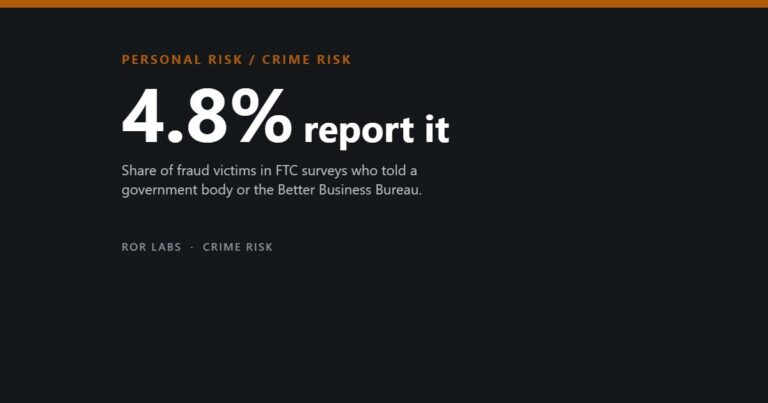
Back in 2011 Whitty and Buchanan asked a YouGov panel of 2,028 British adults whether they had been scammed; 0.65% said yes. Scaled up, that suggested about 230,000 victims, far more than police figures at the time. The FTC still cites a 2021 study that found only 4.8% of mass-market fraud victims complained to a Better Business Bureau or a government body.
Most victims stay silent
Reporting and help-seeking in three different samples.
Sources: FTC Data Spotlight (April 2026), citing a 2021 study; Herrera, ISDFS 2025 conference paper (366 victims); Oak and Shafiq, SOUPS 2025 (26 victims).
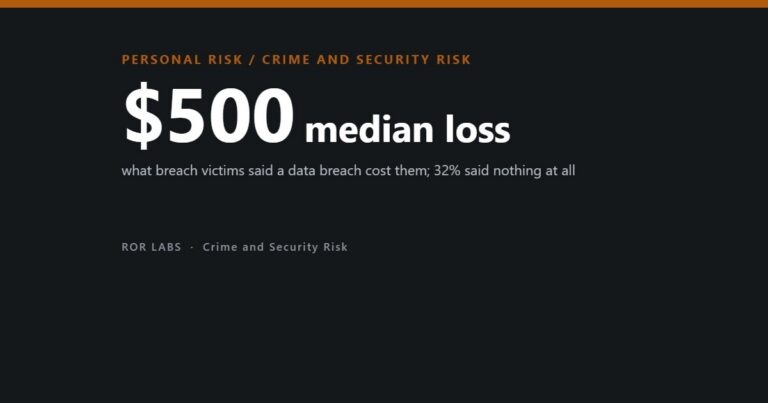
Victims in the interview study said they stayed quiet because they feared being laughed at, and 69.2% found the term ‘pig butchering’ itself offensive. Those who did go to the police were often told little could be done because the scammers were abroad. The FBI’s own notification drive, Operation Level Up, contacted 3,780 crypto fraud victims in 2025; 78% did not know they were being scammed.
UK police said part of the 29% rise in 2025 may reflect more awareness and confidence in reporting, so rising reports are hard to read: complaint counts measure both crime and willingness to report, and nobody can yet separate the two.
Getting money back
Since 7 October 2024 UK banks and payment firms have had to reimburse most victims of authorised push payment (APP) scams, where you are tricked into sending money yourself. The rules cover Faster Payments and CHAPS between UK accounts, up to £85,000 per claim. Firms may deduct an excess of up to £100, and claims must be made within 13 months of the last payment.
In its first-year review the Payment Systems Regulator (PSR) said 88% of money claimed was returned, against 66% before the rules, and 84% of claims were closed within five working days. UK Finance reported that banks paid back £354.3 million to APP victims in 2025, about 61% of APP losses.
The gaps matter for crypto scams. International payments, card payments and payments to another account in your own name are excluded, and pig-butchering victims often buy crypto through an exchange account in their own name first, as Datta did, which may put the transfer outside the scheme. Gross negligence, such as ignoring clear warnings, can also bar a claim, although vulnerable customers are exempt from that test. Ask your bank how the rules apply to your case.
What seems to help
A third person is often what breaks the spell. Cross studied 1,015 Australian romance fraud reports and found five kinds of trigger that made victims realise; one was being told by someone else. Datta’s brother found the stolen photos in minutes. The FTC advises running a reverse image search and talking to someone you trust about the relationship.
Why the bank conversation is hard
Findings from the FCA’s 2025 review of romance fraud cases at UK firms, and the FBI’s victim notification drive.
Sources: FCA romance fraud review, as reported by STV/PA (17 October 2025); FBI, 2025 Internet Crime Report (Operation Level Up).
Banks are in a strong position, but scripted victims often hide the purpose of a payment. The FCA found some firms going to great lengths and others missing chances, with inconsistent staff training. Santander said its specialist team stopped a further £3.5 million in six months of 2025. That figure is the bank’s own and has not been independently evaluated.
No randomised trial shows which warning, delay or conversation prevents the most loss. What we have are complaint data, small interview studies and firms’ own reports, and the consistent thread is that friction, a pause and a trusted outsider give the victim a chance to step back.
What to do
Steps sorted by when they matter. Each one says how strong the evidence is: Measured Official advice Untested
Before
- Run a reverse image search on the photos of anyone you meet online who quickly becomes close. Official advice see Sources
- Talk to someone you trust about a new online relationship, especially if it turns to money or investing. Official advice see Sources
- Treat a fast move to WhatsApp or Telegram, reasons not to meet, and requests for secrecy as warning signs together. Official advice see Sources
- Be wary of any online partner who offers to help you invest in cryptocurrency or a trading app. Official advice see Sources
If it happens
- If you have sent money, contact your bank immediately and report it to the police or the official channel (Report Fraud in the UK, IC3 and ReportFraud.ftc.gov in the US). Official advice see Sources
- Stop paying, including any ‘fees’ or ‘taxes’ demanded before a withdrawal; in one study paying them changed nothing. Measured see Sources
- Tell your bank the real reason for a payment when it asks; the FCA found 42% of victims did not. Measured see Sources
Afterwards
- Keep the messages, profile details and transaction records, and tell the app or site where you met. Official advice see Sources
- In the UK, ask your bank in writing whether your transfers are covered by the APP reimbursement rules; claims must be made within 13 months of the last payment. Official advice see Sources
- Tell someone close to you what happened; shame keeps most victims silent, and silence leaves them open to a second scam. Untested see Sources
What not to do
- Do not pay anyone who offers to recover lost crypto for a fee; more than half of interviewed victims were targeted this way. Measured see Sources
- Do not treat a video call as proof that the relationship is genuine; some victims had matching video calls and were still scammed. Measured see Sources
- Do not send money, cryptocurrency or gift cards to someone you have not met face to face. Official advice see Sources
Not financial or legal advice. Report scams to your bank and the police or official fraud reporting service.
Questions people ask
How can I tell if someone I met online is a scammer?
No single sign proves it, but several together should worry you: a fast move to WhatsApp or Telegram, reasons not to meet, talk of crypto or a trading app, and requests to keep things private. Run a reverse image search on their photos and talk it over with someone you trust.
We have video-called. Doesn’t that prove they are real?
Not on its own. In the interview study, three victims had video calls that matched the photos they had been sent, and the scams still went ahead, so a real face does not guarantee a real intention. The decisive test is whether the relationship leads to money or investments.
I have already sent money. What should I do?
Contact your bank or payment provider straight away, and stop sending money, including any ‘fees’ to unlock withdrawals. Report it: in the UK to Report Fraud (or Police Scotland on 101), in the US to IC3 and ReportFraud.ftc.gov. Tell the app or site where you met. Keep the messages and transaction records.
Will my bank refund me?
In the UK, many bank transfers made since October 2024 are covered up to £85,000, but not international or card payments, or transfers to another account in your name. Elsewhere the rules vary widely. Ask your bank directly, in writing, and keep a record of the reply.
Someone says they can recover my crypto for a fee. Should I pay?
Treat it as a second scam: more than half of the interviewed victims were approached afterwards by people posing as police, lawyers or recovery firms, and some paid again. Real police do not charge to return stolen money, and the approach should be reported to the same channels.
The short version
- Americans reported $929 million lost to romance scams in 2025 and $7.2 billion to cryptocurrency investment fraud, a category that includes the romance-plus-investment pattern known as pig butchering.
- These are complaint figures. Most victims never report, so the real losses are larger by an unknown margin.
- The script is patient: weeks or months of daily contact, a move to a private messaging app, then a fake trading platform that shows invented profits until the victim tries to withdraw.
- Many of the people typing the messages are themselves trafficked workers held in scam compounds in Southeast Asia, according to the UN.
- Victims are not only older or lonely people. Studies are small and self-selected, and they find well-educated, middle-aged and male victims too.
- If you have sent money, contact your bank at once and report it. In the UK many transfers are now refundable up to £85,000.
This article summarises research, official reports and news coverage for general information. It is not financial or legal advice. If you think you are being scammed, stop paying, contact your bank and report it to the police or the official fraud reporting service in your country.
Further reading: Oak and Shafiq, SOUPS 2025, for the stages of pig butchering in victims’ own words. Cross, Current Issues in Criminal Justice (2023), for why romance-led investment fraud slips past both statistics and warnings. The FCA’s 2025 romance fraud review, for what banks see from the inside.
Sources
- City of London Police, Report Fraud. Romance fraud costs UK victims £102 million as cases rise sharply (May 2026).
- Federal Bureau of Investigation, Internet Crime Complaint Center. 2025 Internet Crime Report (April 2026).
- Federal Trade Commission. Reported losses to scams on social media eight times higher than in 2020. Data Spotlight (April 2026).
- Federal Trade Commission. What to know about romance scams. Consumer advice (accessed November 2026).
- Cross C. Romance baiting, cryptorom and ‘pig butchering’: an evolutionary step in romance fraud. Current Issues in Criminal Justice (2023), doi:10.1080/10345329.2023.2248670.
- Cross C. “I knew it was a scam”: understanding the triggers for recognizing romance fraud. Criminology & Public Policy (2023), doi:10.1111/1745-9133.12645.
- Whitty MT. Do you love me? Psychological characteristics of romance scam victims. Cyberpsychology, Behavior, and Social Networking (2018), doi:10.1089/cyber.2016.0729.
- Whitty MT, Buchanan T. The online romance scam: a serious cybercrime. Cyberpsychology, Behavior, and Social Networking (2012), doi:10.1089/cyber.2011.0352.
- Buchanan T, Whitty MT. The online dating romance scam: causes and consequences of victimhood. Psychology, Crime & Law (2014), doi:10.1080/1068316X.2013.772180.
- Carter E. Distort, extort, deceive and exploit: exploring the inner workings of a romance fraud. British Journal of Criminology (2021), doi:10.1093/bjc/azaa072.
- Oak R, Shafiq Z. “Hello, is this Anna?”: unpacking the lifecycle of pig-butchering scams. USENIX Symposium on Usable Privacy and Security (SOUPS 2025), arXiv:2503.20821.
- Dulisse BC, Fitch CH, Denis J, Connealy NT. Old techniques, new technologies: exploring patterns from scammers that commit financial fraud via cryptocurrency. Journal of Economic Criminology (2025), doi:10.1016/j.jeconc.2025.100178.
- Herrera LD. Romance scam victimization: a survey-based examination of financial, psychological, and reporting factors. ISDFS 2025 conference paper, doi:10.1109/ISDFS65363.2025.11012081.
- US Attorney’s Office, District of Kansas. Former CEO of failed bank sentenced to prison (19 August 2024); Fmr. executive pleads guilty after losing bank’s $47.1 million in crypto scheme (23 May 2024); Victims of cryptocurrency scam awarded restitution (4 November 2024).
- The Register. Report on the FBI recovery in the Heartland Tri-State Bank case (5 November 2024).
- AFP. Fake love: crypto scammers ensnare US victims. Taipei Times (29 February 2024).
- STV News / PA. Banks missing opportunities to ‘break spell’ of romance scams, says regulator (17 October 2025), reporting the FCA’s romance fraud review.
- UN News. Hundreds of thousands trafficked into online criminality across SE Asia (29 August 2023), on the OHCHR report on online scam operations.
- Reuters, via Dawn. Report on UNODC findings on the global spread of scam centres (22 April 2025).
- RTÉ News. Report on the US indictment of Chen Zhi and the bitcoin forfeiture action (15 October 2025).
- OCCRP. Cambodia extradites chair of alleged ‘criminal’ conglomerate to China (7 January 2026).
- Payment Systems Regulator. PSR confirms its decision on APP scams reimbursement (25 September 2024); One year on: impact of APP reimbursement on victims (8 October 2025).
- Zempler Bank. APP fraud reimbursement rules (accessed November 2026).
- Payment Expert. UK Finance fraud report 2026 (15 June 2026).