SIM-Swap Attacks: What the Evidence Shows
Key takeaways · 13 min read
- A SIM swap moves your phone number to a SIM card a criminal controls, usually by fooling or bribing carrier staff. Text-message codes and password resets then go to the attacker.
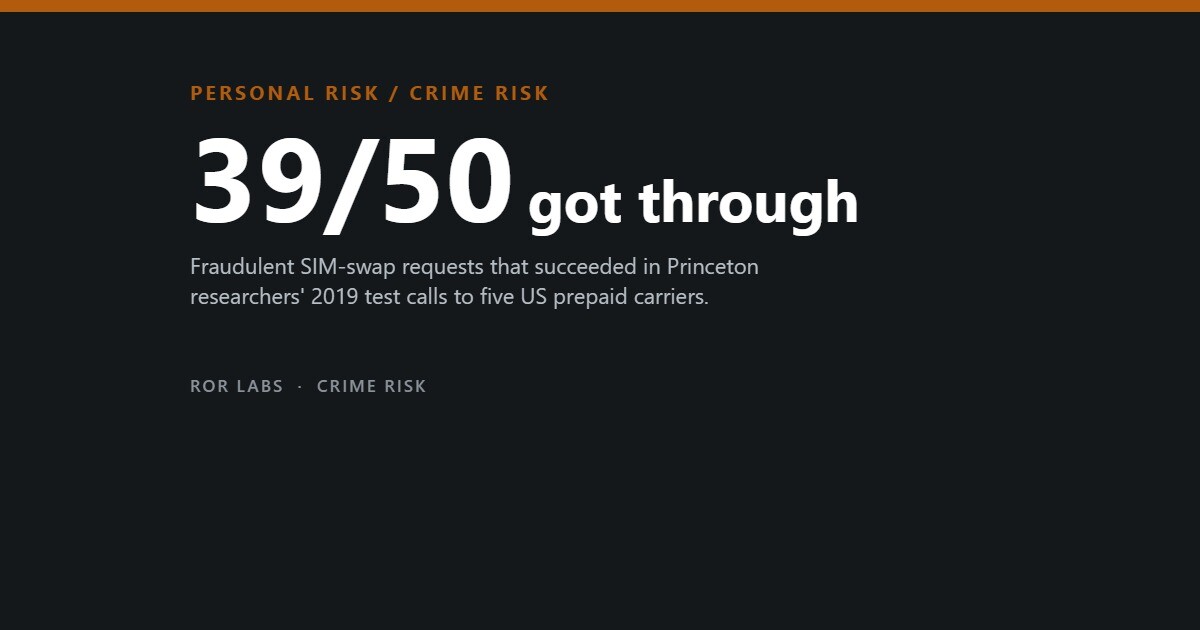
- In Princeton test calls in 2019, 39 of 50 fraudulent SIM-swap requests to five US prepaid carriers succeeded, including all 30 at AT&T, T-Mobile and Verizon.
- The FBI received 971 SIM-swap complaints in 2025 with $17.4 million in losses, down from $68 million in 2021. UK unauthorised SIM swaps rose 1,055% in 2024 and 38% more in 2025.
- These are reported cases, not rates, and the only controlled test of carrier checks dates from 2019. Nobody has measured how well the new rules work.
Your phone number was built to route calls, not to guard your money. Yet for many people it now unlocks email, banking, crypto exchanges and social media, because a text message is how those services reset a forgotten password. Whoever controls the number can often control the accounts. A SIM swap is the shortcut: persuade or pay a mobile carrier to move your number to a SIM card the criminal holds.
The evidence covered here is a Princeton team’s test calls to US carriers, FBI and UK fraud figures, court records from four cases, and new rules in the US and Australia. Earlier articles covered password rules and credential stuffing and security keys and passkeys; this one stays with the phone number itself.
In 2019 carriers were alarmingly easy to fool and reported losses per case are large, but the figures we have describe reported cases rather than how often attempts happen. Regulators now require stronger checks, and whether those checks work has not yet been measured.
How a SIM swap works
Every mobile number is tied to a SIM: a physical card or, increasingly, an eSIM profile downloaded to the phone. Carriers move numbers between SIMs every day for people who lose or break a phone. In a SIM swap, a criminal requests that change while posing as the customer, by phone, online or in a shop, or pays an insider to do it. A port-out does the same by moving the number to another carrier.
The victim’s phone suddenly loses signal. The attacker’s phone now receives the calls and texts, including one-time codes, and a password reset sent by text can open email and everything linked to it. A 2022 review of cases worldwide by Myounghoon Kim, Joon Bae Suh and Hun-Yeong Kwon described three steps: theft of personal data, fraudulent replacement of the SIM, then use of the hijacked number. It found the replacement step especially vulnerable where eSIMs are in use.
A number can also change hands legitimately. About 35 million US numbers are disconnected each year and later reissued. When Kevin Lee and Arvind Narayanan sampled 259 numbers on offer to new subscribers at two major carriers, 171 were still tied to existing accounts at popular websites and 100 were linked to leaked login details.

What happened when researchers tried it
The best direct measurement is still a 2020 study by Kevin Lee, Benjamin Kaiser, Jonathan Mayer and Arvind Narayanan at Princeton, presented at the SOUPS symposium. Between May and July 2019 they opened 50 prepaid accounts, ten each at AT&T, T-Mobile, Verizon, Tracfone and US Mobile, then called customer service posing as an attacker who knew only the account holder’s name and number.
The callers claimed a faulty SIM and were scripted to fail every question a real attacker could not answer. Thirty-nine of the 50 swaps went through, including all 30 at the three big carriers. Carriers accepted details an attacker can manufacture: recent numbers called, created by phoning the victim first, or the last payment, created by buying a top-up voucher for the account.
Most test SIM swaps went through
Fraudulent SIM-swap requests that succeeded, out of 10 calls per carrier, prepaid accounts, May–July 2019.
Source: Lee, Kaiser, Mayer & Narayanan, SOUPS 2020. A deliberately weak attacker; the authors treat the results as a lower bound.
Process failed as well as policy: some representatives forgot to authenticate the caller, some gave hints or disclosed personal details, and some went ahead after failed answers. The attacker was deliberately weak, with no spoofed caller ID, no insider and no stolen data, and the test covered only prepaid accounts and 2019 practices; a check of one postpaid account per carrier hinted at stronger checks there.
The team also reverse-engineered the sign-in policies of 145 websites that offered text-message security. At 17 of them, a SIM swap alone was enough to take over an account, with no password needed. Nine of those 17 left the flaw unfixed after being told. Of the five reports to major carriers, only one led to even partial changes; T-Mobile said it had stopped using call logs to verify callers.
Websites that lean on the phone number
Of 145 websites with text-message sign-in security whose policies the Princeton team analysed, number showing each weakness.
Source: Lee, Kaiser, Mayer & Narayanan, SOUPS 2020; policies as found in 2019.
How often it happens, and what it costs
Reported cases come mainly from complaint systems. The FBI’s Internet Crime Complaint Center (IC3) received 320 SIM-swap complaints, with about $12 million in losses, from 2018 to 2020, then 1,611 complaints and more than $68 million in 2021 alone. Since then the counts have eased: 1,075 complaints in 2023, 982 in 2024 and 971 in 2025, with $17.4 million in losses last year.
US SIM-swap losses reported to the FBI
Losses in complaints to the FBI’s Internet Crime Complaint Center classed as SIM swapping, with the number of complaints.
Sources: FBI IC3 public service announcement (February 2022); IC3 2025 Internet Crime Report. Reported complaints only; 2022 not shown.
In 2025 people aged 60 and over filed 222 SIM-swap complaints but reported $6.74 million in losses, about 39% of the total, so older victims carry a large share. IC3 received more than a million complaints of all kinds that year, with $20.9 billion in losses, which makes SIM swapping a small slice of reported cybercrime; on average, though, each complaint carried about $17,900.
The UK moved the other way. Cifas, which runs the National Fraud Database shared by banks and telecoms firms, recorded nearly 3,000 unauthorised SIM swaps in 2024, up 1,055% on 2023, and a further 38% rise in 2025. In 2024, 48% of the account takeover cases filed to it involved mobile phone accounts.
None of these figures is a rate, since IC3 counts only people who report to it and Cifas counts cases its member firms file. A fall in US complaints could mean fewer attacks, less reporting or thefts filed under another crime type; a jump in the UK could partly reflect better detection.
Four cases on the record
Michael Terpin, a US cryptocurrency investor, lost about $24 million in 2018 after his AT&T number was moved to another SIM. According to the Ninth Circuit appeals court’s summary, a teenager, Ellis Pinsky, bribed an employee of an AT&T authorised retailer to bypass AT&T’s security, then used password resets sent to the number to reach Terpin’s online accounts, where he found crypto access details.

Terpin had already reported a fraudulent swap to AT&T in 2017. He sued the carrier in 2018. Most claims failed, but in September 2024 the Ninth Circuit revived one under the Communications Act’s protection of customer network data, and in July 2025 a district judge left it for a jury, with trial set for March 2026. Pinsky agreed in 2022 to pay Terpin $22 million.
Some victims are targeted because their number is useful. Eric Council Jr., of Huntsville, Alabama, printed a fake ID with a victim’s personal details and used it to take over that person’s phone number. Co-conspirators then posted a false claim on the US Securities and Exchange Commission’s X account that bitcoin funds had been approved. He pleaded guilty and was sentenced to 14 months in May 2025.
Most cases are quieter. In February 2026 a federal judge in Texas sentenced Kimionte Bennett, who had pleaded guilty to wire-fraud conspiracy, to 70 months for SIM swaps used to drain victims’ crypto accounts of $1,769,438. One victim told the court the money “represented my family’s savings, our future security, our dreams.”
What regulators now require
The US Federal Communications Commission opened a rulemaking in September 2021, citing the Princeton study, and adopted rules in November 2023. Carriers must use authentication “reasonably designed” to confirm identity before a SIM change or port-out; biographical details, recent payments and call records do not count as secure. They must notify customers before a change takes effect and offer a free lock against SIM changes and port-outs.
Staff must not see account data until the caller is authenticated, and carriers must keep three years of records on SIM-change requests and fraud. The rules were due to apply from 8 July 2024, but on 5 July the FCC postponed compliance until a federal paperwork review was finished, which it expected no earlier than late November 2024.
Australia moved earlier: the regulator ACMA’s customer identity authentication rules, in force from 30 June 2022, require multi-factor authentication for high-risk transactions, SIM swaps included. They still depend on staff in shops and call centres, and in a report dated 4 June 2026 ACMA found that Telstra, including its Belong brand, had breached them 28 times in 2025.
Where one carrier’s checks broke down
Breaches of Australia’s customer identity authentication rules found by ACMA at Telstra and Belong, 2025.
Source: ACMA, Telstra Limited investigation report (4 June 2026). Counts of breaches found, not of customers or losses.
In the UK, Which? reported in April 2026 on a Lebara customer whose attackers failed several security questions yet still got her email unlinked from the account, and on a Vodafone customer who waited 10 days to get her number back. Ofcom told Which? it sets no deadline for recovering a number, because each case differs.
Is a text code still better than nothing?
SIM swaps are a reason to move important accounts off text-message codes while keeping two-step sign-in on. In a 2023 preprint, Microsoft researchers led by Lucas Augusto Meyer examined 7,861 accounts with multi-factor authentication whose leaked passwords attackers had tried. The extra step stopped 98.6% of those attempts. Text codes failed in 1.66% of accounts, against 0.99% for codes from Microsoft’s authenticator app.
Text codes help, apps help more
Share of accounts compromised despite multi-factor authentication: 7,861 Microsoft accounts whose passwords leaked in April–September 2022.
Source: Meyer et al., arXiv preprint (2023), table 2. Authors are Microsoft employees; not peer-reviewed.
The study is not peer-reviewed, its authors work for the company whose app came out best, and it measured attacks with stolen passwords rather than SIM swaps. It fits the Princeton finding, though: the danger is concentrated where a number alone can reset an account. The article on passkeys and security keys covers the stronger options.

What you can do
Start with the carrier. In the US, ask for the free SIM-change and port-out lock that the FCC rules oblige carriers to offer, and set an account PIN that is not your birthday or part of your number. In the UK, Which? suggests asking your network for an extra PIN or password for sensitive changes. Turn on any alerts for SIM or account changes.
Then reduce what the number can unlock. On email, banking and crypto accounts, check whether a text message alone can reset the password. If it can, switch to an authenticator app, security key or passkey, and remove the phone as a recovery route where the service allows. The FBI also advises not posting about crypto holdings and keeping your number off public websites.
If your phone suddenly loses service where it normally works and a restart does not fix it, contact your carrier at once from another phone or in a shop, then your bank and email provider. Cifas also advises caution about unexpected messages from your network saying a PIN or password has changed.
If it happens, report it to the police, to IC3 in the US or to Action Fraud in the UK, and ask the carrier for written documentation of the change, which US carriers must now provide. In the Princeton test the defence depended on a stranger in a call centre, so being SIM-swapped is no sign of carelessness.
Where the evidence is thin
The only published controlled test of carrier checks used 50 calls to prepaid accounts in 2019, before the FCC and ACMA rules. This review found no comparable published test since, so whether today’s checks would stop the same calls is unknown. Insider bribery, as in the Terpin case, sits outside any authentication script.
Loss figures depend on who reports, and IC3 and Cifas count filings rather than incidence. Court cases lean towards large crypto thefts, because those are the ones investigated and prosecuted, while a few thousand pounds stolen and refunded rarely reaches any record.
What to do
Steps sorted by when they matter. Each one says how strong the evidence is: Measured Official advice Untested
Before
- In the US, ask your carrier for the free lock against SIM changes and port-outs that FCC rules oblige carriers to offer. Official advice see Sources
- Set a carrier account PIN or passcode that is not your birthday or part of your phone number; in the UK, ask for an extra PIN or password for sensitive changes. Official advice see Sources
- Check whether a text message alone can reset your email, bank or crypto passwords, and switch those accounts to an authenticator app, security key or passkey. Measured see Sources
- Remove your phone number as a recovery route on important accounts where the service allows it. Untested see Sources
- Do not post about crypto holdings, and keep your phone number off public websites, as the FBI advises. Official advice see Sources
If it happens
- If your phone suddenly loses service where it normally works and a restart does not fix it, contact your carrier at once from another phone or in a shop. Untested see Sources
- Then contact your bank and email provider straight away, before the attacker can move money or change passwords. Untested see Sources
- Treat unexpected messages from your network about a changed PIN or password as a warning sign. Official advice see Sources
Afterwards
- Report it to the police and, in the US, to the FBI’s IC3, or in the UK to Action Fraud. Official advice see Sources
- Ask the carrier for written documentation of the SIM change or port-out, which US carriers must now provide. Official advice see Sources
- Keep records of every call and message with the carrier and your bank. Untested see Sources
What not to do
- Do not switch two-step sign-in off because of SIM swaps; in Microsoft’s data even text codes blocked about 98% of attacks using leaked passwords. Measured see Sources
- Do not rely on a carrier PIN alone; in test calls some staff skipped checks, and bribed insiders can bypass them. Measured see Sources
- Do not give a PIN or password to anyone who calls you; hang up and call your carrier’s official number. Official advice see Sources
Not legal or financial advice. If money has been taken, contact your bank and report it to the police or the FBI’s IC3 straight away.
Questions people ask
How would I know my number has been swapped?
The usual first sign is that your phone loses service and cannot make calls or send texts, while others around you have signal. You may also get emails or messages about a SIM change or a new PIN, or find you are logged out of accounts.
Is an eSIM safer than a physical SIM?
There is no good evidence either way. Kim and colleagues warned that eSIM replacement can be easier to abuse remotely, and in the London case police linked the defendant to four eSIM-capable devices. What matters most is how the carrier checks who is asking for the change.
Will my carrier or bank pay me back?
It depends on the country, the account and the contract. The Lebara customer’s £3,500 was refunded. Terpin, by contrast, has spent years in court, and the Ninth Circuit upheld a liability limit in his AT&T contract. Report quickly and keep records of every call.
Should I stop using text-message codes?
Not without a replacement. In Microsoft’s data, text codes still blocked about 98% of attacks on accounts with leaked passwords. For email, banking and crypto, move to an authenticator app, security key or passkey, and keep text codes for less important accounts.
Does a carrier PIN make me safe?
It helps without being a guarantee: in the Princeton calls some representatives skipped checks altogether, and a bribed insider can bypass them. A PIN works best alongside removing your number as the only way to reset important accounts.
The short version
- A SIM swap moves your phone number to a SIM card a criminal controls, usually by fooling or bribing carrier staff. Text-message codes and password resets then go to the attacker.
- In Princeton test calls in 2019, 39 of 50 fraudulent SIM-swap requests to five US prepaid carriers succeeded, including all 30 at AT&T, T-Mobile and Verizon.
- The FBI received 971 SIM-swap complaints in 2025 with $17.4 million in losses, down from $68 million in 2021. UK unauthorised SIM swaps rose 1,055% in 2024 and 38% more in 2025.
- These are reported cases, not rates, and the only controlled test of carrier checks dates from 2019. Nobody has measured how well the new rules work.
- US carriers must now use secure checks, warn customers before a SIM change or port-out and offer a free lock. Australia has required multi-factor checks for SIM swaps since 2022.
- Lock your mobile account, and move email, banking and crypto off text-message resets to an authenticator app, security key or passkey. Sudden loss of signal is the warning sign.
This article summarises research, agency reports, court records and news for general information. It is not legal, financial or security advice for your situation. If you think your number has been hijacked, contact your carrier, your bank and the police straight away.
Further reading: Lee, Kaiser, Mayer and Narayanan, SOUPS 2020, for the only controlled test of carrier checks. The FCC’s 2023 Report and Order on SIM-swap and port-out fraud, for what US carriers must now do. Cifas, Fraudscape 2026, for the UK trend.
Sources
- The Record. Crypto thief who splurged on gold grills sentenced in London (8 October 2026).
- Lee K, Kaiser B, Mayer J, Narayanan A. An empirical study of wireless carrier authentication for SIM swaps. Proceedings of the Sixteenth Symposium on Usable Privacy and Security (SOUPS 2020), 61–79.
- Narayanan A, Lee K. Security policy audits: why and how. IEEE Security & Privacy (published online 2022).
- Lee K, Narayanan A. Security and privacy risks of number recycling at mobile carriers in the United States. APWG eCrime 2021, doi:10.1109/ecrime54498.2021.9738792.
- Kim M, Suh JB, Kwon HY. A study of the emerging trends in SIM swapping crime and effective countermeasures. IEEE BCD 2022, doi:10.1109/bcd54882.2022.9900510.
- Meyer LA, Calvo Romero S, Bertoli G, Burt T, Weinert A, Lavista Ferres J. How effective is multifactor authentication at deterring cyberattacks? arXiv:2305.00945 (2023), preprint.
- Federal Bureau of Investigation, Internet Crime Complaint Center. Criminals increasing SIM swap schemes to steal millions of dollars from US public. Public service announcement (8 February 2022).
- Federal Bureau of Investigation, Internet Crime Complaint Center. 2025 Internet Crime Report (2026).
- Cifas. 1,055% surge in unauthorised SIM swaps as mobile and telecoms sector hit hard by rising fraud (7 May 2025).
- Cifas. Fraudscape 2026 (12 March 2026).
- Federal Communications Commission. Protecting Consumers from SIM-Swap and Port-Out Fraud, Report and Order and Further Notice of Proposed Rulemaking, FCC 23-95 (released 16 November 2023); 88 FR 85794 (8 December 2023).
- Federal Communications Commission. Order on compliance date for the SIM-swap and port-out fraud rules, WC Docket No. 21-341 (5 July 2024), as summarised by Telecommunications Law Professionals (8 July 2024).
- Australian Communications and Media Authority. Telecommunications Service Provider (Customer Identity Authentication) Determination 2022; customer identity authentication rules (acma.gov.au).
- Australian Communications and Media Authority. Telstra Limited: investigation report (4 June 2026).
- Which? Mobile networks must step up to prevent Sim-swap fraud (30 April 2026).
- Terpin v. AT&T Mobility LLC, No. 23-55375 (9th Cir. 30 September 2024).
- Terpin v. AT&T Mobility LLC, No. 2:18-cv-06975 (C.D. Cal. 16 July 2025).
- The Register. Report on the Pinsky–Terpin settlement (15 October 2022).
- US Department of Justice, Office of Public Affairs. Alabama man sentenced to 14 months in connection with Securities and Exchange Commission X hack (16 May 2025).
- US Attorney’s Office, Northern District of Texas. Waxahachie man sentenced to 70 months in federal prison for SIM card swapping fraud scheme (27 February 2026).