Social Prescribing: What the Evidence Shows
Key takeaways · 14 min read
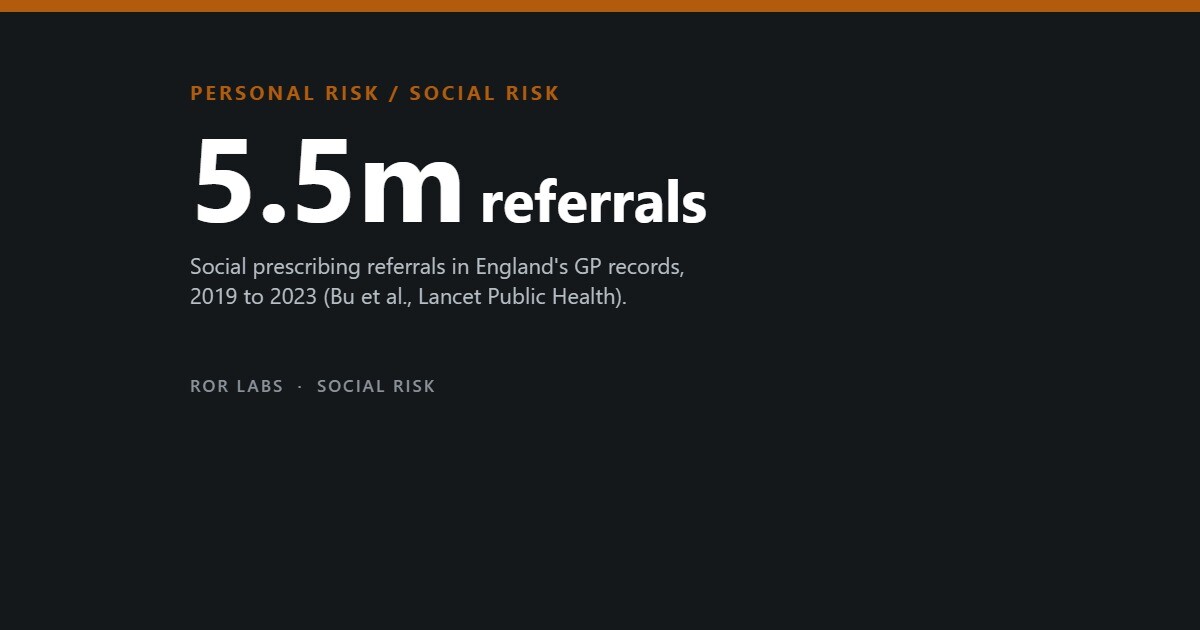
- England’s GPs recorded about 5.5 million social prescribing referrals between 2019 and 2023, far above the NHS goal of 900,000.
- A 2017 review of 15 UK evaluations rated every one at high risk of bias, yet most reported positive conclusions.
- A 2026 preprint pooling 33 randomised trials found modest gains in depressive symptoms, blood pressure, activity and quality of life, but no clear effect on loneliness or health-care use.
- People in more deprived areas were less likely to be offered a referral, even though the scheme was meant to reduce health inequalities.
Some of what brings people to a doctor is not medical. Debt, a cold flat, a death in the family, the long silence of living alone. Social prescribing is the idea that a GP can answer these with something other than a pill: a referral to a link worker, who helps the patient find a walking group, a benefits adviser, a choir or a community garden. It sounds humane and cheap, and it has spread fast.
England has gone furthest. Since 2019 the NHS has paid for thousands of link workers in general practice, and millions of referrals have followed. Other countries, from Canada to Australia, are building their own versions. The World Health Organization’s 2025 report on social connection put loneliness on the global health agenda, and social prescribing is one of the obvious tools to reach for.
The question this article asks is simple: does it work? The answer depends on what you count as evidence. Hopeful case studies are plentiful. Controlled trials are fewer, smaller and more sobering. Below we set out what the reviews found, what the randomised trials show, whether the scheme saves money, and who actually gets referred.
What social prescribing is
NHS England defines social prescribing as an approach that connects people to activities, groups and services in their community to meet the practical, social and emotional needs that affect their health. The usual model has three steps. A GP or other professional refers the patient; a link worker meets them, often several times, to agree what matters to them; and the link worker connects them to local support, usually run by charities and volunteers.
That makes it hard to study. There is no single treatment. One person might be steered to debt advice, another to an art class, a third to a befriending service. Link workers range from trained staff to volunteers with a directory of local groups. When researchers ask whether social prescribing works, they are really asking whether a referral pathway works, and the answer may differ by town, by link worker and by what the community has to offer.
A national roll-out
NHS England set a goal of 1,000 new link workers by 2020/21 and at least 900,000 people referred by 2023/24. NHS England has called it the biggest investment in social prescribing by any national health system. Since 2022/23, primary care networks have been required to offer social prescribing proactively to groups experiencing health inequalities.
The scale of social prescribing in England
GP records and the NHS target, 2019–2023, millions.
Sources: Bu F et al., Lancet Public Health (2025), doi:10.1016/S2468-2667(25)00217-8, as summarised by UCL (September 2025); NHS England, social prescribing. Estimates scaled from records of 1.2 million patients.
Uptake beat the plan. A 2025 study in The Lancet Public Health by Feifei Bu and colleagues, using records from 1.2 million patients in 1,736 practices, estimated that 9.4 million GP consultations involved social prescribing codes by the end of 2023, and 5.5 million had led to referrals. About 1.3 million people were referred in 2023 alone, and more than 3,300 link workers were employed. The policy had arrived well before the evidence.
What the first reviews found
The review most often cited by sceptics appeared in BMJ Open in 2017, under the title “less rhetoric and more reality”. Liz Bickerdike and colleagues at the University of York found 15 evaluations of UK link-worker schemes. Only one was a randomised trial and one a non-randomised comparison. The rest were before-and-after studies, qualitative studies and descriptive reports, often with fewer than 100 participants and follow-up of four months or less.
Every evaluation was rated at high risk of bias. Common faults were no comparison group, unvalidated questionnaires, missing data and no attempt to deal with confounding. Even so, most reports drew positive conclusions. The authors were careful about what that meant. They had not shown that social prescribing fails; the evidence simply could not say whether it succeeded or offered value for money.
How the evidence was gathered
Designs of studies in four systematic reviews of social prescribing.
| Review | Studies | Randomised trials | Verdict on quality |
|---|---|---|---|
| Bickerdike 2017, UK link workers | 15 | 1 | All at high risk of bias |
| Vidovic 2021, well-being and loneliness | 51 | 1 peer-reviewed | Measures often unclear |
| Cooper 2022, UK, mental health | 17 | 1 | 15 uncontrolled before-and-after |
| Kiely 2022, controlled studies only | 8 | RCTs and controlled before-and-after | Certainty low or very low |
Sources: Bickerdike L et al., BMJ Open 7:e013384 (2017); Vidovic D et al., Int J Environ Res Public Health 18(10):5276 (2021); Cooper M et al., BMJ Open 12(7):e060214 (2022); Kiely B et al., BMJ Open 12(10):e062951 (2022).
Later reviews found the same pattern. A 2021 review by Dragana Vidovic and colleagues covered 51 studies and found exactly one peer-reviewed randomised trial. A 2022 review of UK schemes aimed at mental health, by Matthew Cooper and colleagues, found 17 studies, of which 15 were uncontrolled before-and-after designs. Before-and-after studies are weak here because people tend to seek help when they feel worst, and many improve anyway.
What the randomised trials show
In 2022 Bridget Kiely and colleagues in Ireland kept only studies that met Cochrane standards for a controlled comparison. Eight qualified. Link workers “may have little or no impact” on health-related quality of life, based on two US trials with 894 participants and two UK controlled studies, and the effect on mental health was unknown because the evidence was of very low certainty. Two US trials of an intensive programme for people with several conditions reported fewer days in hospital.

Kiely’s team then ran its own exploratory trial in deprived parts of Dublin during the pandemic. Of 600 planned participants, 251 were recruited and 240 randomised; all had at least two long-term conditions. After a month with a practice-based link worker there was no difference from usual care in quality of life or in anxiety and depression scores. A month is short, and the authors said so, but it is also the length of many real link-worker relationships.
The largest pooled analysis so far is a preprint posted in August 2026, which has not yet been peer reviewed. Xiaoqi Feng and colleagues combined 33 randomised trials with 13,714 participants, 40% of them at high risk of bias. They found modest improvements: depressive symptoms fell by a standardised mean difference of 0.23, systolic blood pressure by 2.69 mm Hg, and physical activity and quality of life rose slightly.
33 randomised trials, pooled
Outcomes of social prescribing against usual care or a waiting list. Preprint, not yet peer reviewed.
Depressive symptoms: SMD −0.23 (7 trials)
Systolic blood pressure: −2.69 mm Hg (11 trials)
Physical activity: SMD 0.16 (7 trials)
Quality of life: SMD 0.15 (10 trials)
Loneliness and social isolation
Anxiety
Blood sugar control and blood fats
Health-care use
Adverse events were rarely reported
Source: Feng X et al., medRxiv preprint (3 August 2026), doi:10.64898/2026.08.02.26359484. SMD is a standardised mean difference; 0.2 is conventionally read as a small effect.
Those effects are small. A standardised difference of 0.2 is conventionally read as a small effect, and a drop of under 3 mm Hg in blood pressure matters across a population more than to one patient. Still, the preprint is the first large synthesis to find any consistent benefit in trials, which is a step beyond the earlier verdict that nothing could be judged. Only one of the 33 trials reported a process evaluation explaining how it worked.
The loneliness gap
Loneliness is the problem social prescribing is most often sold as solving. The World Health Organization’s Commission on Social Connection reported in June 2025 that about one in six people worldwide are affected by loneliness, and estimated that it is linked to 871,000 deaths a year, roughly 100 every hour. That figure is a modelled estimate built on observational studies, not a count, but the scale of the problem is not in doubt.
How common loneliness is
Share of people reporting loneliness, WHO Commission on Social Connection, 2025.
Source: World Health Organization, news release on the Commission on Social Connection report (30 June 2025). The 871,000 deaths a year attributed to loneliness is a modelled estimate.
The trial evidence on loneliness itself is thin. The 2026 preprint found no clear effect on loneliness or social isolation across the trials that measured it. A 2021 review of nine studies of loneliness by Gina Yannitell Reinhardt and colleagues found that all reported positive individual effects, but none used randomised samples or a common measure, so they could not be pooled. Feeling less lonely after joining a group is plausible. It has not yet been shown well.
There is also a supply problem. A link worker can only connect someone to what exists, and many of the groups people are sent to run on small grants and volunteers. A referral to a lunch club that closed last year helps nobody. Social prescribing can only be as good as the local voluntary sector behind it, and the national money has gone mainly to link workers rather than to the groups they refer people to.
Does it save money?
One promise of social prescribing is that it frees GP time and keeps people out of hospital. The best UK test of the hospital claim comes from north-east England. John and Josephine Wildman followed 8,283 people aged 40 to 74 with type 2 diabetes in a deprived area for six years, using the timing of the scheme’s introduction as a natural experiment. Across everyone eligible, emergency hospital costs fell by about £15.57 per patient a year, a difference that was not statistically significant.
Costs and savings in controlled studies
Selected results from comparative studies of link-worker social prescribing.
| Study | Measure | Result |
|---|---|---|
| Wildman 2022, type 2 diabetes, north-east England, all eligible | Emergency hospital costs per patient a year | About −£15.57, not significant |
| Same study, most engaged patients | Emergency hospital costs per patient a year | Up to −£77.57 |
| Kiely 2024 trial, Dublin, one month | Mean total cost per patient | €1,191 vs €225 usual care |
| Grant 2000 trial, Avon | Mean total cost per patient | £153 vs £133 usual care |
Sources: Wildman J, Wildman JM, Soc Sci Med (2022), doi:10.1016/j.socscimed.2022.115598; Kiely B et al., BMC Primary Care (2024), doi:10.1186/s12875-024-02482-6; Grant 2000 as reported in Bickerdike L et al., BMJ Open (2017).
The savings were larger for patients who engaged most, up to £77.57 a year. That is the kind of result to treat with care: people who keep coming back to a link worker may differ in many ways from those who do not. The Dublin trial put the cost of its intervention at about €1,057 per participant, and estimated only a 28% chance that it was cost-effective at a threshold of €45,000 per quality-adjusted life year.
A national analysis gives a gentler reading. Anna Wilding and colleagues, writing in the British Journal of General Practice in 2025, linked the roll-out of link workers to a repeated national survey of patients. More link workers per 50,000 patients were associated with slightly better patient experience and confidence in managing long-term conditions. The authors called the improvements small and said it was still unclear whether the scheme was financially sustainable.
Who gets referred
Social prescribing was meant to reach people whose health is shaped by poverty and isolation. A 2026 study in PLOS ONE by Efundem Agboraw and colleagues examined the records of more than 12 million adults in England from 2019 to 2024. About 4% had been offered a referral, and 77.7% of those were referred. Women, older people and those with several long-term conditions were more likely to be offered one; women had 35% higher odds than men.
Who is offered social prescribing
Findings from GP records in England, 2019–2024.
Sources: Agboraw E et al., PLOS ONE (2026), doi:10.1371/journal.pone.0350842; Bu F et al., Lancet Public Health (2025), as summarised by UCL. The two studies use different samples and definitions of deprivation.
The awkward finding was deprivation. Patients in more deprived areas had lower odds of being offered social prescribing than those in the least deprived, with odds ratios of roughly 0.5 to 0.8 depending on the band. The Bu study found the trend moving the other way over time: the share of referrals from deprived areas rose from 23% before 2019 to 42% in 2023. Both can be true. Reach is improving, but the people most in need may still be offered it less often.
This matters for the trials too. If the patients who are referred and who engage are the more confident and better connected, then good outcomes in uncontrolled studies may reflect who was chosen rather than what was done. It is one more reason why the controlled evidence is so much less flattering than the case studies.
What the evidence suggests
Social prescribing is now part of ordinary general practice in England, used millions of times. The early evidence was too weak to judge, not proof of failure. The better trials point to small benefits for mood, blood pressure, activity and quality of life, and little or nothing yet for loneliness, GP workload or hospital use, with the largest synthesis still a preprint. It is cheap compared with many treatments but not free, and it depends on community groups that are themselves fragile. The people most likely to benefit are not always the ones being offered it.
Questions people ask
What is a link worker?
A non-clinical worker, usually based in or attached to a GP practice, who spends time with a patient to find out what matters to them and connects them with local groups and services.
Does social prescribing reduce loneliness?
Participants often say so, but randomised trials have not shown a clear effect on loneliness or social isolation so far.
Can I ask for a referral myself?
In England you can ask your GP practice, and some schemes accept self-referral. Elsewhere, availability varies by country and region, so ask your doctor or local council.
Does it take pressure off GPs?
Not clearly. Controlled studies have not shown consistent reductions in GP visits, and the pooled trials found no clear change in health-care use.
Is there a Cochrane review?
We did not find a completed one. The strictest published review, from 2022, used Cochrane criteria for study design and rated most evidence as low or very low certainty.
The short version
- England’s GPs recorded about 5.5 million social prescribing referrals between 2019 and 2023, far above the NHS goal of 900,000.
- A 2017 review of 15 UK evaluations rated every one at high risk of bias, yet most reported positive conclusions.
- A 2026 preprint pooling 33 randomised trials found modest gains in depressive symptoms, blood pressure, activity and quality of life, but no clear effect on loneliness or health-care use.
- People in more deprived areas were less likely to be offered a referral, even though the scheme was meant to reduce health inequalities.
- Savings for the health service have not been shown reliably; the strongest UK study found no significant fall in emergency hospital costs overall.
This article summarises published research for general information. It is not medical advice and does not assess any particular scheme. If loneliness, money worries or low mood are affecting your health, talk to your GP or doctor, who can discuss local support, including social prescribing where it exists. If you are in emotional crisis, contact a local crisis line or emergency services.
Further reading: Bickerdike et al., BMJ Open (2017), for the review that first set out how weak the early evidence was. Kiely et al., BMJ Open (2022), for the strictest review of controlled studies. Agboraw et al., PLOS ONE (2026), for who is offered social prescribing in England.
- Together, Vivek H. Murthy (2020). The former US Surgeon General on loneliness and why connection matters for health. Warm and readable; it is stronger on the case for connection than on which interventions have been shown to work.
- The Lonely Century, Noreena Hertz (2020). An economist argues that loneliness is shaped by work, cities and technology, not only by personal circumstance. Wide-ranging; some of its policy ideas run ahead of the evidence.
- The Good Life, Robert Waldinger and Marc Schulz (2023). Lessons on relationships and well-being from the Harvard Study of Adult Development. Rich long-term data; its original sample was narrow, mostly white American men.
Sources
NHS England. Social prescribing (accessed October 2026). — Bu F, Burton A, Launders N, Taylor AE, Richards-Belle A, Tierney S et al. National roll-out of social prescribing in England’s primary care system. Lancet Public Health (2025), doi:10.1016/S2468-2667(25)00217-8; UCL news, September 2025. — Bickerdike L, Booth A, Wilson PM, Farley K, Wright K. BMJ Open 7:e013384 (2017), doi:10.1136/bmjopen-2016-013384. — Vidovic D, Reinhardt GY, Hammerton C. Int J Environ Res Public Health 18(10):5276 (2021). — Cooper M et al. BMJ Open 12(7):e060214 (2022). — Kiely B et al. Effect of social prescribing link workers on health outcomes and costs. BMJ Open 12(10):e062951 (2022). — Kiely B et al. An exploratory randomised trial of link workers for people living with multimorbidity. BMC Primary Care (2024), doi:10.1186/s12875-024-02482-6. — Feng X, Kanukula R, Evangelidis N, Neal B, Davidson P, Koczwara B et al. Effects of social prescribing on mental, physical, and social health outcomes. medRxiv preprint (August 2026), doi:10.64898/2026.08.02.26359484. — World Health Organization. Social connection linked to improved health and reduced risk of early death, news release (30 June 2025). — Reinhardt GY, Vidovic D, Hammerton C. Perspectives in Public Health (2021), doi:10.1177/1757913920967040. — Wildman J, Wildman JM. Soc Sci Med (2022), doi:10.1016/j.socscimed.2022.115598. — Wilding A et al. Br J Gen Pract 75(761):e880 (2025). — Agboraw E, Wilding A, Munford L, Sutton M, Wilson P. PLOS ONE (2026), doi:10.1371/journal.pone.0350842. — Canadian Affairs, 14 September 2026.