Surprise Medical Bills: What the Evidence Shows
Key takeaways · 16 min read
- In 2016, 42.8% of emergency visits and 42.0% of inpatient stays at in-network US hospitals involved an out-of-network bill, up from 32.3% and 26.3% in 2010.
- Surprise billing was concentrated: in 2015 half of hospitals had almost none in their emergency departments, while 15% had out-of-network rates above 80%.
- Since January 2022 the No Surprises Act has limited patients to in-network cost-sharing for most of these bills; one study found out-of-pocket spending fell 18% relative to states already protected.
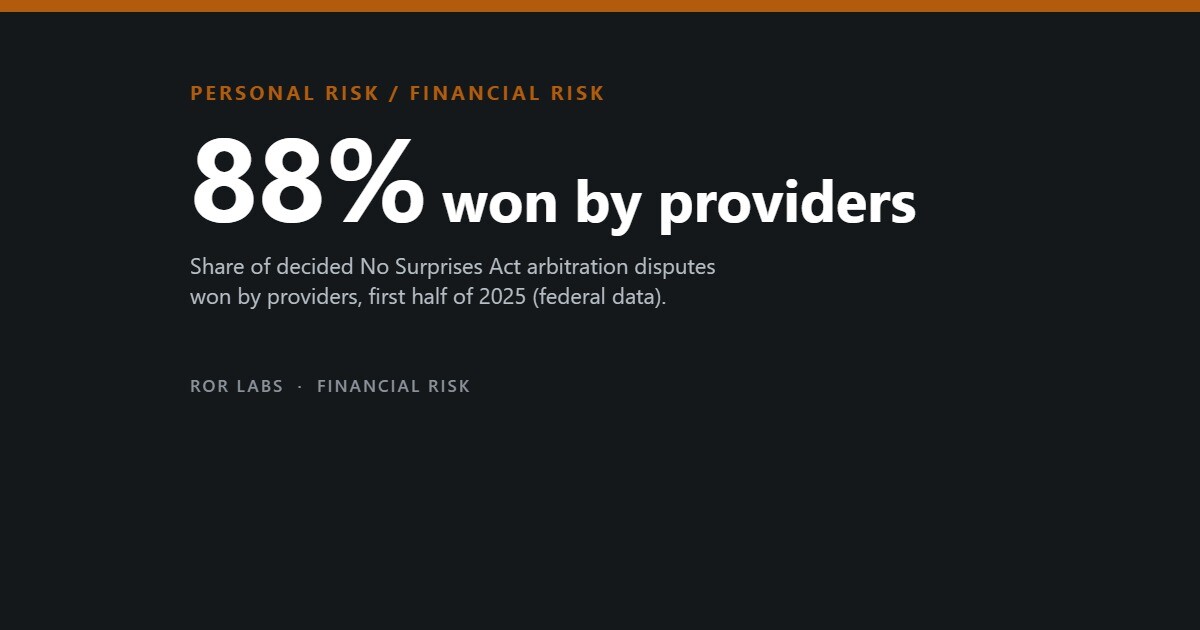
- The arbitration system behind the law received about 2.5 million disputes in 2025, against roughly 17,000 a year expected, and providers won 88% of decisions in the first half of 2025.
In this article
A surprise medical bill is one you could not have seen coming and could not have avoided. The anaesthetist at your in-network hospital turns out not to be in your insurer’s network, or the emergency doctor who treated you works for a staffing firm that never signed a contract. Until 2022, Americans with private insurance could be billed the difference. In 2016, in one large claims study, 42.8% of emergency visits at in-network hospitals involved an out-of-network bill.
Congress closed most of that gap with the No Surprises Act, which took effect on 1 January 2022. Patients now pay what they would have paid in network, and the insurer and the clinician settle the rest between themselves, by arbitration if they cannot agree. That second half of the law has turned out very differently from what its authors expected, and who ends up paying for it is now one of the most argued-over questions in American health policy.
This article sets out how common surprise bills were, why they happened, what the law changed, where the gaps remain, and what the arbitration figures do and do not show. It describes research findings; it is not legal or financial advice about any particular bill.

How a surprise bill happens
In the United States, hospitals and the doctors who work in them usually sign separate contracts with each insurer. A hospital can be in a patient’s network while its emergency physicians, anaesthetists, radiologists or pathologists are not. Patients rarely choose these clinicians and often never meet them. When one was out of network, the insurer paid what it considered reasonable, and the clinician could send the patient a bill for the rest, a practice known as balance billing.
Christopher Garmon and Benjamin Chartock, writing in Health Affairs in 2017, produced one of the first national estimates. Using insurance claims from 2014, they asked how often a hospital episode at an in-network facility was likely to produce a surprise bill. One in five admissions that began in the emergency department did, as did one in seven emergency visits that ended without admission. Even planned stays, where patients had time to check, were not safe.
How often a hospital stay led to a likely surprise bill, 2014
Share of episodes at in-network hospitals likely to produce a bill from an out-of-network provider. Privately insured patients.
Source: Garmon C, Chartock B, Health Affairs 36(1) (2017), doi:10.1377/hlthaff.2016.0970. Estimates of exposure from insurance claims, not counts of bills sent.
These were estimates of exposure rather than counts of bills actually sent. An insurer could pay the full charge, a clinician could decide not to pursue the patient, and some patients negotiated the amount down. But the risk was real, and it fell on people at the moments they were least able to shop around.
How common they became
Eric Sun and colleagues at Stanford looked at a longer stretch. They analysed 13.6 million emergency visits and 5.5 million inpatient admissions at in-network hospitals between 2010 and 2016, using claims from one large commercial insurer, and counted bills from out-of-network doctors and ambulance services. The share of emergency visits with at least one out-of-network bill rose from 32.3% to 42.8%. For inpatient stays it rose from 26.3% to 42.0%.
Out-of-network bills at in-network hospitals, 2010 and 2016
Share of episodes with at least one out-of-network bill, and mean potential patient liability for those episodes.
| Setting | 2010 | 2016 | Mean liability 2010 | Mean liability 2016 |
|---|---|---|---|---|
| Emergency visits | 32.3% | 42.8% | $220 | $628 |
| Inpatient admissions | 26.3% | 42.0% | $804 | $2,040 |
Source: Sun EC, Mello MM, Moshfegh J, Baker LC, JAMA Internal Medicine (2019). 13.6 million emergency visits and 5.5 million admissions, one large commercial insurer, 2010–2016.
The sums at stake grew faster than the frequency. The mean potential liability for an emergency visit with an out-of-network bill nearly tripled, from $220 to $628; for an admission it went from $804 to $2,040. Those are averages over many small bills, and they measure what a clinician could have billed, not what patients actually paid. Still, a bill of a few thousand dollars is enough to push many households into debt.
A business model, not an accident
If surprise billing were simply a matter of paperwork, it would be spread fairly evenly across hospitals. It was not. Zack Cooper, Fiona Scott Morton and Nathan Shekita studied 8.9 million emergency episodes from 2011 to 2015 in data from one large insurer. Over that period the share of patients at in-network hospitals who were treated by an out-of-network emergency physician fell from 28.6% to 21.9%. The average, however, hid a sharp split.
In 2015, half of hospitals had out-of-network rates of about 1%, while 15% had rates above 80%. The authors traced much of the gap to outsourcing. When one large staffing firm took over emergency departments at hospitals that had mostly been in network, the share of out-of-network patients rose by about 83 percentage points and physician charges more than doubled. Patients’ own cost-sharing for the doctor rose by 92%.
Concentrated, not random
Out-of-network emergency physician billing at in-network hospitals, one large insurer.
Median hospital: about 1% of patients
Hospital at the 75th percentile: 28%
Hospitals above 80%: 15% of all
8.9 million emergency episodes, 2011–2015
Out-of-network share: +83 points
Physician charges per case: +$480
Patient cost-sharing: +92%
Hospitals mostly in network before entry
Source: Cooper Z, Scott Morton F, Shekita N, Journal of Political Economy 128(9) (2020), doi:10.1086/708819.
The paper also tested a state remedy. New York’s 2014 law took patients out of the dispute and sent contested bills to binding arbitration, in which the arbitrator had to pick either the insurer’s offer or the doctor’s bill. Out-of-network billing in the state fell by 88%. That result helped persuade Congress that arbitration could work nationally. As later sections show, the national version has behaved very differently.
Ambulances on the ground and in the air
Ambulances were the most extreme case. Karan Chhabra and colleagues examined rides covered by a large national insurer from 2013 to 2017 and found that 71% involved a potential surprise bill. A patient lifted from a roadside has no choice of provider at all. The median potential bill was $450 for a ground ambulance and $21,698 for an air ambulance.
Ambulance rides and potential surprise bills, 2013–2017
Members of a large national insurer. In all, 71% of ambulance rides involved a potential surprise bill.
| Measure | Ground ambulance | Air ambulance |
|---|---|---|
| Median potential surprise bill | $450 | $21,698 |
| Yearly total of out-of-network bills | $129 million | $91 million (average) |
| Trend in yearly total | – | $41m (2013) to $143m (2017) |
Source: Chhabra KR et al., Health Affairs (2020), doi:10.1377/hlthaff.2019.01484.
Air ambulance bills were rarer but enormous, and growing: the yearly total of out-of-network air ambulance bills in the data rose from $41 million in 2013 to $143 million in 2017. A separate analysis by Erin Fuse Brown and colleagues found that more than three-quarters of air ambulance transports were out of network. States could do little, because a 1978 federal aviation law pre-empts state regulation of airline prices and had been applied to air ambulances.
Ground ambulances are a different business. Many are run by local governments or fire services, and many have no contract with any insurer. Their bills were smaller but far more common: in Chhabra’s data, out-of-network ground ambulance bills added up to $129 million a year, more than the air ambulance total.
What the No Surprises Act changed

The No Surprises Act was passed in December 2020 as part of a larger spending bill and took effect on 1 January 2022. For people with private or employer insurance, it covers emergency care, care from out-of-network clinicians at in-network hospitals and surgical centres, and air ambulances. Patients pay only their normal in-network cost-sharing, and that counts towards their deductible. Anaesthetists, emergency doctors and similar clinicians cannot ask patients to sign these protections away.
The law left the payment itself to the insurer and the clinician. If they cannot agree within a 30-day negotiation period, either side can start independent dispute resolution. Each submits a final offer and a certified arbitrator picks one. A central reference point is the qualifying payment amount, or QPA, which is roughly the insurer’s median in-network rate for that service in that area. Ground ambulances were left out and referred to an advisory committee.
Did the law reach patients?
Two measures from very different sources, both pointing the same way.
Out-of-pocket, newly protected states: $3,674 → $2,922
Relative to already-protected states: −18%
Premium spending: no clear change
17,351 adults who buy their own cover, 2019–2024
Surprise bills prevented, January–September 2023: over 10 million
21 insurers, 65% of the commercial market; survey by insurer trade groups
Sources: Liu M, Kadakia KT, Mein SA, Wadhera RK, BMJ (2025), PMID 40865998; AHIP and Blue Cross Blue Shield Association, insurer survey (November 2023).
Both numbers have limits. The BMJ study relied on self-reported spending in a household survey and covered only people who buy their own insurance. The insurer count comes from one side of the arbitration fight. But they point the same way, and a 2024 study of earlier state laws by Garmon and colleagues found that such laws drew more emergency clinicians into networks and reduced potential surprise-billing episodes.
The arbitration boom
When the rules were written, officials expected independent dispute resolution to handle about 17,000 cases a year. By June 2025 it had received 3.4 million, according to an analysis of federal data by Jack Hoadley and colleagues at Georgetown University. Filings in the first half of 2025, 1.2 million, were double those in the first half of 2024. Figures cited by congressional Democrats put the full-year 2025 total at 2.5 million.
Who wins federal arbitration
Share of decided No Surprises Act disputes in which the provider’s offer was chosen.
Source: Hoadley J, Watts K, Keith K, DeGarmo E, Georgetown University Center on Health Insurance Reforms (20 March 2026), from federal public use files. In the first half of 2025, 87% of awards exceeded the qualifying payment amount.
Providers now win most decisions. Their share rose from 81% of decided disputes in 2023 to 88% in the first half of 2025, and 87% of awards in that period exceeded the QPA. The volume is concentrated: four organisations, including large physician staffing groups and a company that files disputes for clinicians, accounted for 56% of disputes in the first half of 2025.
How high are the awards? An analysis of 7,076 disputes involving the insurer Elevance Health in 2023 found that providers won 80%, and that the median final amount was 3.72 times the QPA, about twice the median local in-network rate and 4.5 times what Medicare pays. One of its two authors works for Elevance, so this is an insurer’s data read by an insurer’s researcher, though it was published in a peer-reviewed journal.
Who pays for arbitration
Georgetown researchers estimated in August 2026 that the dispute process had added $22.4 billion in costs from 2022 to 2025: $15.6 billion in awards above the QPA, $4.2 billion in administrative costs and $2.7 billion in fees. None of this lands on the patient’s bill. It lands on insurers and employers, and can feed through into premiums.
Doctors’ groups reject the estimate. The American Society of Anesthesiologists, the American College of Emergency Physicians and the American College of Radiology argue that it rests on the QPA, which insurers calculate themselves and which, they say, is often inaccurate and too low. On that view, high awards are a correction, not a windfall. Neither side’s preferred benchmark is neutral, which is why the same data can be read as overpayment or as fair pay.
A 2026 working paper from the National Bureau of Economic Research, not yet peer reviewed, adds a twist. Using marketplace insurance data, Panle Jia Barwick and colleagues found that network participation fell in the specialties and states most exposed to the law: by 4.7 percentage points in emergency medicine, 3.4 in anaesthesiology and 1.8 in radiology. After a provider group’s first favourable arbitration result, its in-network share fell by 6.8 points.
The authors also report suggestive evidence that insurers more exposed to arbitration raised premiums. That runs against the earlier state evidence, where protections drew clinicians into networks. If arbitration reliably pays more than a contract would, staying out of network becomes attractive again. The difference now is that the patient is not the one who gets the bill.
The gaps that remain
Ground ambulances are the largest hole. In February 2026, researchers at Georgetown counted 22 states with some protection against surprise ground ambulance bills, five of which acted in 2025. State laws cannot reach self-funded employer plans, which cover most American workers. A federal advisory committee made recommendations in 2024; Congress has not acted on them.
Other bills fall outside the law’s definitions. Care that a patient knowingly chooses from an out-of-network clinician, after signing a notice at least 72 hours ahead, can still be billed, as can services the insurer simply denies. Surveys capture the confusion. In a Morning Consult poll in June 2022, six months after the law took effect, 21% of insured adults said they had received an unexpected medical bill that year, and 22% of those people said it exceeded $1,000.
An unexpected bill is not the same as an illegal surprise bill. It might be a deductible, a denied claim or a billing error. But the same poll found that only 16% of adults had any knowledge of the law, which matters, because patients still have to recognise a protected bill before they can challenge it.
What the evidence suggests
Before 2022, surprise bills were common, rising, and concentrated where staffing firms and air ambulance operators had found that staying out of network paid. The No Surprises Act appears to have taken most of that risk off patients: a spending study, insurer counts and claims trends point the same way, though none is perfect. The cost has moved rather than vanished. Arbitration volumes are more than a hundred times the original expectation, providers win nearly nine times in ten, and whether the awards are too high depends on a benchmark the two sides dispute. Ground ambulances remain the clearest gap for patients.
Questions people ask
What is a surprise medical bill?
A bill from an out-of-network provider that the patient did not choose or could not avoid, such as an emergency doctor or anaesthetist working at an in-network hospital.
Does the No Surprises Act cover ground ambulances?
No. Ground ambulances were excluded from the federal law. Some states protect people in state-regulated plans, but not people in self-funded employer plans.
What does the law say a patient owes for a protected bill?
Only the normal in-network cost-sharing, such as a copayment, coinsurance or deductible. Federal and state regulators take complaints about bills that appear to break the rules.
Who usually wins No Surprises Act arbitration?
Providers. Their share of decided disputes rose from 81% in 2023 to 88% in the first half of 2025, according to an analysis of federal data.
Does arbitration raise insurance premiums?
Possibly. Its costs fall on insurers and employers, and one working paper found suggestive evidence of higher premiums, but the effect has not been firmly established.
The short version
- In 2016, 42.8% of emergency visits and 42.0% of inpatient stays at in-network US hospitals involved an out-of-network bill, up from 32.3% and 26.3% in 2010.
- Surprise billing was concentrated: in 2015 half of hospitals had almost none in their emergency departments, while 15% had out-of-network rates above 80%.
- Since January 2022 the No Surprises Act has limited patients to in-network cost-sharing for most of these bills; one study found out-of-pocket spending fell 18% relative to states already protected.
- The arbitration system behind the law received about 2.5 million disputes in 2025, against roughly 17,000 a year expected, and providers won 88% of decisions in the first half of 2025.
- Ground ambulances are still outside the federal law. Some 22 states offer some protection, but state rules cannot reach self-funded employer plans.
This article summarises published research and public data for general information. It is not legal, insurance or financial advice, and it does not recommend any insurer, plan or provider. If you receive a bill that you think may be covered by the No Surprises Act or a state law, check with your insurer, your state insurance regulator or the federal No Surprises Help Desk before paying.
Further reading: Sun et al., JAMA Internal Medicine (2019), for how common out-of-network bills had become. Cooper, Scott Morton and Shekita, Journal of Political Economy 128(9) (2020), for why they clustered in certain hospitals. The Georgetown Center on Health Insurance Reforms’ March 2026 analysis of federal dispute data, for the arbitration numbers.
- Never Pay the First Bill, Marshall Allen (2021). An investigative reporter’s practical guide to challenging medical bills, drawn from years of covering them. Useful and specific; written largely before the No Surprises Act took effect, so some of its tactics are now less needed.
- The Price We Pay, Marty Makary (2019). A surgeon on pricing practices in American medicine, including billing that patients cannot foresee. Vivid on the problems; its reform ideas get less scrutiny than its stories.
- We’ve Got You Covered, Liran Einav and Amy Finkelstein (2023). Two health economists argue for a basic level of automatic coverage for everyone. Clear on why American insurance leaves gaps; it addresses surprise billing only in passing.
Sources
- Garmon C, Chartock B. One in five inpatient emergency department cases may lead to surprise bills. Health Affairs 36(1) (2017), doi:10.1377/hlthaff.2016.0970.
- Cooper Z, Scott Morton F. Out-of-network emergency-physician bills: an unwelcome surprise. NEJM (2016), doi:10.1056/NEJMp1608571.
- Cooper Z, Scott Morton F, Shekita N. Surprise! Out-of-network billing for emergency care in the United States. Journal of Political Economy 128(9) (2020), doi:10.1086/708819.
- Sun EC, Mello MM, Moshfegh J, Baker LC. Assessment of out-of-network billing for privately insured patients receiving care in in-network hospitals. JAMA Internal Medicine (2019).
- Chhabra KR et al. Most patients undergoing ground and air ambulance transportation receive sizable out-of-network bills. Health Affairs (2020), doi:10.1377/hlthaff.2019.01484.
- Fuse Brown EC, Trish E, Ly B, Hall MA, Adler L. Out-of-network air ambulance bills: prevalence, magnitude, and policy solutions. Milbank Quarterly (2020), doi:10.1111/1468-0009.12464.
- Garmon C, Li Y, Retchin SM, Xu W. The impact of surprise billing laws on emergency services. Health Economics (2024), doi:10.1002/hec.4874.
- Liu M, Kadakia KT, Mein SA, Wadhera RK. Patient healthcare spending after the No Surprises Act: quasi-experimental difference-in-differences study. BMJ (2025), PMID 40865998.
- Ukert B, Gordon AS. Arbitration outcomes for out-of-network medical bills under the No Surprises Act. INQUIRY (2025), doi:10.1177/00469580251401475.
- Barwick PJ, Li A, Xia T, Yu S. The No Surprises Act’s surprises: arbitration, provider network, and insurer pricing. NBER Working Paper 35717 (2026), doi:10.3386/w35717. Not peer reviewed.
- Hoadley J, Watts K, Keith K, DeGarmo E. The No Surprises Act IDR process: an early look at 2025 data. Georgetown CHIR, 20 March 2026.
- CMS, Federal IDR public use files, Q1–Q2 2025 (released January 2026), reported by the American College of Radiology, 29 January 2026.
- Healthcare Dive, 26 August 2026 (Georgetown $22.4 billion estimate) and 28 August 2026 (response by ASA, ACEP and ACR).
- Healthcare Dive, 9 September 2026, Pallone letters to independent dispute resolution entities.
- PSCA, 9 September 2026, summary of NBER Working Paper 35717.
- AHIP and Blue Cross Blue Shield Association, survey of insurers on the No Surprises Act (November 2023).
- Harden-Stein M, Hoadley J. Consumers still face surprise bills for ground ambulances. Commonwealth Fund / Georgetown CHIR, 18 February 2026.
- Morning Consult survey, 22–24 June 2022, reported by TechTarget, 11 July 2022.