Do Protests Work? What the Evidence Shows
Key takeaways · 11 min read
- Nonviolent campaigns succeeded about twice as often as violent ones from 1900 to 2006, by the best-known count.
- Their success rate fell from 65% in the 1990s to 34% in the 2010s as governments adapted.
- A 2026 replication argues the nonviolent advantage is not robust; the debate is open.
- Protester violence tends to shift public opinion towards order; nonviolence met with repression tends to win sympathy.
In this article
- The finding that shaped a generation of activism
- The 3.5% idea, and its limits
- The success rate fell
- A replication that challenges the finding
- Why some movements win
- What protests do to public opinion
- Recent cases: Kenya, Bangladesh and England
- The personal risks of taking part
- Questions people ask
- The short version
- Sources
Every year millions of people march, sit in, strike and block roads to change something about the way they are governed. Some of those protests topple governments within weeks. Others fill the streets for months and change nothing. A few turn violent, and the violence often becomes the only thing anyone remembers.
For anyone deciding whether to join a protest, or trying to make sense of one on the news, two questions matter. Do protests actually work? And does it make a difference whether they stay peaceful? For more than a decade, one answer dominated: nonviolent campaigns succeed about twice as often as violent ones. That finding shaped activist training around the world.
The evidence has become more complicated. The success rate of nonviolent movements fell sharply in the 2010s, a 2026 replication argued that the famous advantage is not as robust as it looked, and studies of public opinion show that disruptive tactics can win attention while losing sympathy. This article looks at what the research found, where it is disputed, and what the risks are for the people taking part.
The finding that shaped a generation of activism
In 2008, Maria Stephan and Erica Chenoweth published an article in International Security titled ‘Why Civil Resistance Works’, followed by a book of the same name in 2011. They assembled a dataset of major campaigns from 1900 to 2006 that aimed to overthrow a government, end a foreign occupation or achieve independence, each with at least 1,000 participants.
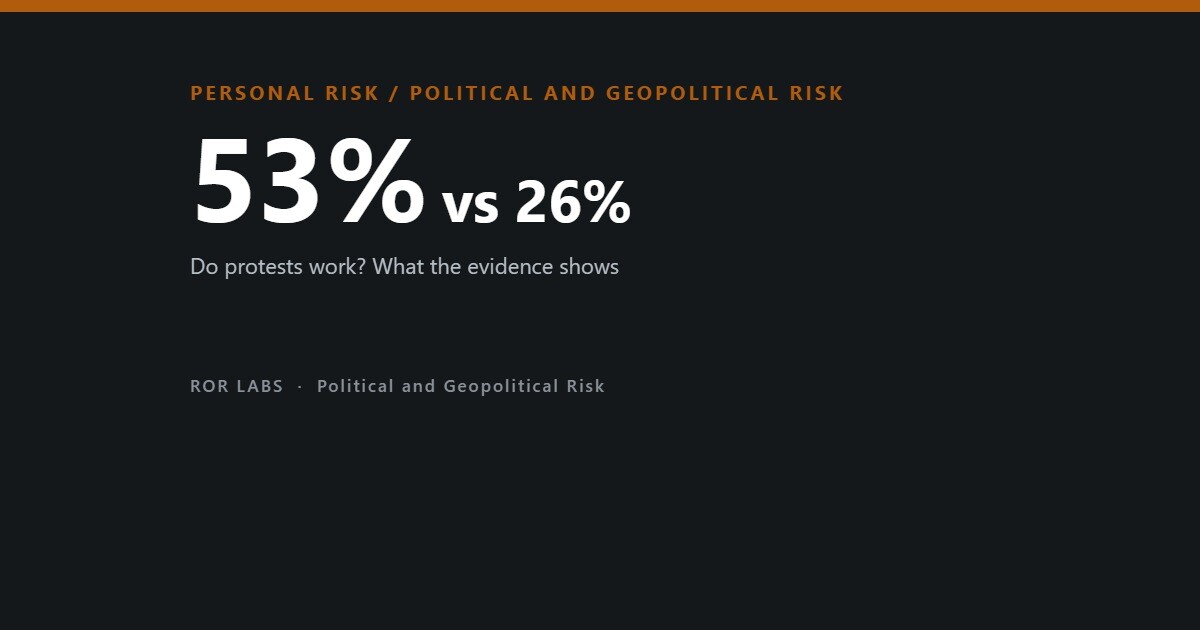
Their headline result was striking. Nonviolent campaigns achieved full or partial success in 53% of cases, compared with 26% for violent campaigns, roughly twice as often. They argued that nonviolent movements succeed because they can attract far more participants from every part of society, which makes it harder for the regime to repress them and more likely that soldiers, police and officials will refuse orders or switch sides.
The results varied by goal. Nonviolent campaigns against a regime were the most successful, with close to 60% ousting the incumbent. Campaigns against foreign occupation succeeded far less often, and nonviolent campaigns for secession almost never did.
Nonviolent and violent campaigns, 1900–2006
Share of major resistance campaigns that achieved full or partial success.
Stephan MJ, Chenoweth E, International Security, 2008;33(1):7–44; Chenoweth E, Stephan MJ, Why Civil Resistance Works, 2011.
The 3.5% idea, and its limits
Chenoweth later popularised a striking observation from the data: no campaign that had mobilised at least 3.5% of a country’s population at its peak had failed. The idea spread quickly among climate and democracy movements as a target.
Chenoweth herself has since stressed the caveats, in a 2020 discussion paper for Harvard’s Carr Center. It was a historical observation, not a law; the cases that reached 3.5% were few; participation is hard to measure; and several movements have since passed the threshold without winning. The number describes what successful movements looked like, not a switch that guarantees success. It also says nothing about the smaller, local protests that make up most real-world activism.
The success rate fell
The bigger surprise came from Chenoweth’s own updated data. In a 2020 article in the Journal of Democracy, she reported that nonviolent campaigns were becoming more common than ever, but much less successful. As later summarised by other researchers, the success rate fell from 65% in the 1990s to 34% in the 2010s.
She suggested several reasons. Governments have learnt how to respond, using surveillance, targeted arrests, disinformation and their own counter-mobilisation. Many modern movements gather quickly through social media but lack the organisation, discipline and long-term strategy that sustained earlier campaigns. And fewer foreign governments now put pressure on regimes that repress their citizens.
Nonviolent campaigns became less successful
Share of major nonviolent campaigns that succeeded, by decade.
Chenoweth E, Journal of Democracy, 2020;31(3):69–84, as summarised by Sombatpoonsiri J, Journal of Peace Research, 2023.
A replication that challenges the finding
In 2026, the political scientists Charles Crabtree and John Holbein released a replication and extension of the original analysis. They reported that some results had been misreported in ways that made the data look more favourable to civil resistance, that the findings were not robust to modest and reasonable changes in the statistical model, and that the analysis relied on instrumental variable models with implausible assumptions.
Their conclusion was careful. They did not argue that nonviolence backfires or that violence works better. They argued that the cross-national data provide no clear basis for claiming that nonviolent campaigns are substantially more effective than violent ones. The paper is a preprint that has not yet been through peer review, and Chenoweth and others may respond. But it is a reminder that a single dataset, however influential, is not the same as a settled fact.
There is also a deeper problem that all studies of this kind face. Movements choose their tactics. Groups that expect to win by mass mobilisation may choose nonviolence, while groups that are small, persecuted or fighting a brutal occupation may see no alternative to arms. If the conditions that favour success also favour nonviolence, comparing outcomes cannot fully separate the effect of the tactic from the situation.
Where the debate stands
Main studies on whether nonviolent resistance works better.
| Study | Claim |
|---|---|
| Stephan and Chenoweth, 2008 and 2011 | Nonviolent campaigns succeed about twice as often |
| Chenoweth, 2020 | Nonviolent success fell from 65% to 34% between the 1990s and 2010s |
| Orazani and colleagues, 2021 | Nonviolence wins modestly more outside support in experiments |
| Crabtree and Holbein, 2026 (preprint) | The cross-national advantage is not robust |
Sources as listed at the end of this article. The 2026 paper has not been peer reviewed.
Why some movements win
Whatever the precise success rate, the research agrees on several features of campaigns that win. The first is breadth. Movements that draw in people of different ages, classes, religions, regions and occupations are harder to dismiss as a faction and harder to repress without alienating the whole society.
The second is defection. Regimes survive on the loyalty of soldiers, police, civil servants and business elites. Chenoweth and Stephan argued that the single most important route to success is persuading some of these people to stop obeying. That is easier when protesters are neighbours, relatives and colleagues rather than armed enemies.
The third is repression that backfires. When security forces attack peaceful crowds, the images can turn public opinion and foreign governments against them. Wasow’s findings on the 1960s point the same way. The mechanism has limits: repression that is swift, hidden or widely supported can crush a movement instead. And the fourth is organisation. Campaigns that plan beyond the next demonstration, with alternatives such as strikes and boycotts, tend to last longer than those that rely only on crowds in the street.
What protests do to public opinion
Another way to study protests is to look at how they change what ordinary people think and how they vote. Omar Wasow, in the American Political Science Review in 2020, studied Black-led protests in the United States between 1960 and 1972. Nonviolent protests, especially when met with violent repression by police or vigilantes, drove media coverage and public opinion towards civil rights. Counties near nonviolent protests saw the Democratic share of the presidential vote rise by 1.6 to 2.5 percentage points.
Protester-initiated violence had the opposite effect. It shifted news coverage and public concern towards ‘social control’. Using rainfall as a natural experiment, since rain reduces the chance of unrest, Wasow estimated that violent protests in 1968 likely caused a shift of 1.5 to 7.9 percentage points among white voters towards Republicans, enough to tip that year’s presidential election.
How 1960s protests moved voters
Estimated effects on the US presidential vote.
| Protest type | Effect on vote |
|---|---|
| Nonviolent, nearby counties | Democratic share up 1.6–2.5 points |
| Protester-initiated violence, 1968 | White voters shifted 1.5–7.9 points to Republicans |
Wasow O, American Political Science Review, 2020;114(3):638–659.
Laboratory and survey experiments point the same way on average, but the effect is smaller than the historical studies suggest. A 2021 meta-analysis in the European Journal of Social Psychology by Nima Orazani and colleagues combined 16 studies with 4,598 participants. Nonviolent tactics produced a small to moderate increase in support from outsiders, a standardised effect of 0.25. Violent tactics did not significantly change willingness to help compared with a baseline. The authors also found signs of publication bias: published studies showed larger effects than unpublished ones.
Emma Thomas and Winnifred Louis found a similar pattern among people who already sympathised with a cause. In two experiments published in 2014, nonviolent action did more than violent action to convince sympathisers that the grievance was legitimate and the group could succeed. But when participants were told the authorities were corrupt, that advantage shrank and support for more extreme action rose.
Disruptive but nonviolent tactics sit in between. In a 2026 review in PNAS Nexus, Clara Vandeweerdt found that blockades, strikes and sit-ins generally make people dislike the group and its tactics, and perhaps its specific demand. But they generate far more media attention than conventional marches, and effects on concern about the underlying issue are usually null or slightly positive. Disliked, in other words, is not the same as ineffective.
Violence, nonviolence and outside support
Meta-analysis of experiments on third-party support for social movements, 16 studies, 4,598 people.
Orazani N, Tabri N, Wohl MJA, Leidner B, European Journal of Social Psychology, 2021;51(4–5):645–658. Published studies showed larger effects than unpublished ones.
Recent cases: Kenya, Bangladesh and England
Three events in 2024 showed how different protest outcomes can be. In Kenya, youth-led protests against a finance bill that would have raised taxes spread nationwide in June; after demonstrators broke into parliament and dozens were killed, President William Ruto withdrew the bill. In Bangladesh, student protests over job quotas grew into a national uprising, and Prime Minister Sheikh Hasina resigned and fled in August. A UN human rights investigation later estimated that as many as 1,400 people may have been killed, most by security forces.
In England, a very different kind of unrest followed the killing of three girls in Southport in July 2024 and false claims online about the attacker’s identity. Riots targeted mosques and hotels housing asylum seekers. More than a thousand people were arrested, and many were charged and sentenced within weeks. That outcome was the opposite of success for those involved, and it illustrates the Wasow finding in a modern setting: violence shifted the public conversation towards order and punishment.
The personal risks of taking part
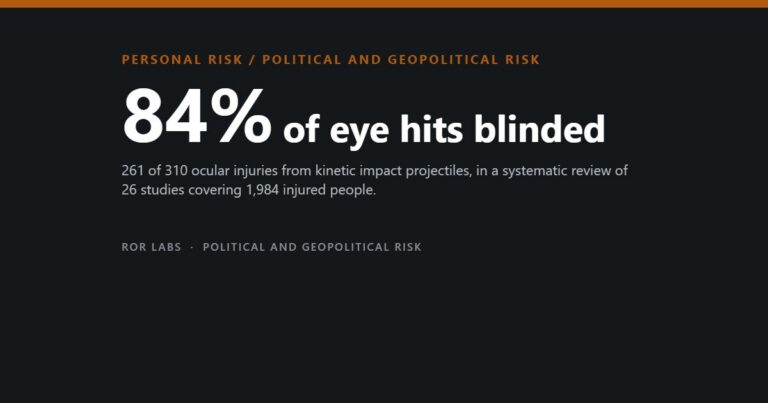
For individuals, protest carries real risks even when the movement is peaceful. The main ones are injury from crowd crushes, from police weapons and from counter-protesters, arrest and its consequences for work, travel and immigration status, and surveillance, including facial recognition and phone location data. We looked at the injuries caused by rubber bullets and tear gas in our article on crowd-control weapons.
The research on campaigns suggests that discipline and numbers protect participants as well as movements. Large, broad, nonviolent crowds are harder to repress and less likely to be framed as dangerous. Knowing the local law on assembly, staying with people you trust, and having a plan to leave if a crowd becomes too dense or a situation turns violent are sensible steps. We covered crowd density in our article on crowd crushes.
The consequences of arrest can outlast the protest by years. A charge or conviction may show up in background checks for jobs, affect visa applications and, for people who are not citizens, threaten their right to stay. Legal observers and protest support groups in many countries publish guidance on rights during arrest, and it is worth reading before rather than after.
Digital traces are the newest risk. Phones reveal location to networks and apps, photos posted online can identify people in a crowd, and some police forces use live facial recognition at large events. Being aware of what your phone shares, and of who appears in your photos, protects others as well as yourself.
Questions people ask
Do nonviolent protests work better than violent ones?
A major study found nonviolent campaigns succeeded 53% of the time against 26% for violent ones, from 1900 to 2006. A 2026 replication argues the advantage is not robust.
What is the 3.5% rule?
An observation that no campaign mobilising 3.5% of a population at its peak had failed. It is a historical pattern, not a guarantee, and has since been challenged.
Are protests less successful than they used to be?
Yes. By Chenoweth’s count, the success rate of nonviolent campaigns fell from 65% in the 1990s to 34% in the 2010s.
Does violence at protests backfire?
Often. In the 1960s US, violent protests shifted white voters towards Republicans by an estimated 1.5 to 7.9 points in 1968.
Do disruptive protests hurt their cause?
They tend to make the group unpopular but raise attention to the issue; effects on concern about the issue itself are usually neutral or slightly positive.
The short version
- Nonviolent campaigns succeeded about twice as often as violent ones from 1900 to 2006, by the best-known count.
- Their success rate fell from 65% in the 1990s to 34% in the 2010s as governments adapted.
- A 2026 replication argues the nonviolent advantage is not robust; the debate is open.
- Protester violence tends to shift public opinion towards order; nonviolence met with repression tends to win sympathy.
- For participants, the main risks are crowds, police weapons, arrest and surveillance.
This article summarises published research on protest and civil resistance. It does not take a position on any movement, government or cause mentioned, and it is not legal advice. Laws on assembly and protest differ widely between countries; check them before taking part.
Further reading. Chenoweth, ‘The Future of Nonviolent Resistance’, Journal of Democracy, 2020, and Wasow, ‘Agenda Seeding’, American Political Science Review, 2020, are good places to start.
- Civil Resistance: What Everyone Needs to Know, Erica Chenoweth (2021). The leading researcher in the field answers common questions about how nonviolent movements succeed and fail.
- If We Burn, Vincent Bevins (2023). A journalist on the mass protests of the 2010s, from Brazil to Egypt, and why so many failed to deliver change.
- How Civil Wars Start, Barbara F. Walter (2022). A political scientist on the conditions under which political unrest turns into armed conflict.
Sources
- Stephan MJ, Chenoweth E. Why civil resistance works: the strategic logic of nonviolent conflict. International Security, 2008;33(1):7–44. doi:10.1162/isec.2008.33.1.7.
- Chenoweth E, Stephan MJ. Why Civil Resistance Works: The Strategic Logic of Nonviolent Conflict. Columbia University Press, 2011.
- Chenoweth E. The future of nonviolent resistance. Journal of Democracy, 2020;31(3):69–84. doi:10.1353/jod.2020.0046.
- Sombatpoonsiri J. ‘A lot of people still love and worship the monarchy’: how polarizing frames trigger countermobilization in Thailand. Journal of Peace Research, 2023. doi:10.1177/00223433221142932.
- Chenoweth E. Questions, answers, and some cautionary updates regarding the 3.5% rule. Carr Center Discussion Paper, Harvard Kennedy School, 2020.
- Crabtree C, Holbein JB. How strong is the evidence for peaceful resistance? Not very. SocArXiv preprint, 2026. doi:10.31235/osf.io/pbrej_v4.
- Wasow O. Agenda seeding: how 1960s Black protests moved elites, public opinion and voting. American Political Science Review, 2020;114(3):638–659. doi:10.1017/S000305542000009X.
- Orazani N, Tabri N, Wohl MJA, Leidner B. Social movement strategy (nonviolent vs. violent) and the garnering of third-party support: a meta-analysis. European Journal of Social Psychology, 2021;51(4–5):645–658. doi:10.1002/ejsp.2722.
- Vandeweerdt C. The effect of disruptive protests on public opinion. PNAS Nexus, 2026;5(4):pgag082. doi:10.1093/pnasnexus/pgag082.
- Thomas EF, Louis WR. When will collective action be effective? Violent and non-violent protests differentially influence perceptions of legitimacy and efficacy among sympathizers. Personality and Social Psychology Bulletin, 2014;40(2):263–276. doi:10.1177/0146167213510525.
- Office of the UN High Commissioner for Human Rights. Human Rights Violations and Abuses related to the Protests of July and August 2024 in Bangladesh. OHCHR, February 2025.