Platform Falls and Train Strikes: What the Evidence Shows
Key takeaways · 13 min read
- Deaths at the platform edge are rare for the number of journeys made, but in Britain falls from the platform make up around 37% of the modelled risk of death that passengers face.
- Alcohol, curved platforms with wide gaps, crowding and poor sight come up again and again in investigations and studies.
- In New York, suicides were 4% of track intrusions but 35% of the resulting deaths in 2019–2021. Pushes, though widely feared, were three of 105 collisions in early 2022.
- Platform screen doors are linked with large falls in suicides and accidents in Hong Kong, Seoul and Tokyo, but the evidence comes from before-and-after comparisons, not trials.
In this article
- What goes wrong at the platform edge
- Who gets hurt, and why
- Three investigations in Britain
- New York: pushes, falls and track intrusions
- What platform screen doors do
- Blue lights, tactile paving and gap fillers
- Why the numbers are hard to read
- What passengers can do
- Questions people ask
- The short version
- Sources
Most of us cross the edge of a railway platform twice on every trip without a thought. It is a narrow strip where a moving train, a drop to the track and a hurried crowd meet, and engineers call it the platform–train interface; on Britain’s railways most of the risk of death to passengers sits there.
We look at falls into the gap, falls onto the track, being dragged by doors and being struck by trains, drawing on investigations in Britain, New York and Japan and on studies of screen doors in Hong Kong, Seoul and Tokyo. An earlier article covered level crossing deaths.
On many metros a large share of track deaths are suicides, and the strongest evidence for screen doors, mostly before-and-after comparisons rather than trials, comes from suicide data. Where suicide comes up, this article stays with overall numbers.
What goes wrong at the platform edge
Britain’s Rail Accident Investigation Branch (RAIB) sees the same patterns repeatedly. People slip into the gap while boarding or alighting. People fall from the edge, sometimes with no train in sight. A strap, coat or hand is caught in closing doors and the person is dragged. And people on the track are struck.
In 2024/25 RSSB, the industry’s safety body, recorded five passenger deaths in stations or on trains outside train accidents. Three were at the platform–train interface, all falls onto the track. Its risk model puts such falls at around 37% of passenger fatality risk, across 1.6 billion journeys.
Counting non-fatal injuries, slips, trips and falls dominate, with more than 3,300 reported in stations that year. Doors are their own problem: RAIB cites RSSB research finding that 58% of passengers wrongly believe train doors will reopen, like lift doors, if obstructed.
Falls from platforms in Japan
Reported falls from station platforms that did not involve contact with a train, by fiscal year (April to March).
Source: Ministry of Land, Infrastructure, Transport and Tourism (MLIT), railway safety information for FY2023, corrected edition (May 2025).
Japan’s transport ministry publishes the fullest count. In fiscal 2023, 2,262 people fell from platforms without being hit, 57 of them visually impaired; a further 31 were struck after falling and 119 were hit while still on the platform. The 2020 dip follows the pandemic slump in travel: these counts move with passenger numbers.
Who gets hurt, and why
In 2016 RSSB reported that intoxication was partly to blame for two in three of 32 platform-edge deaths in Britain over ten years, a figure now a decade old. In a 2016 study by Patrick Waterson and colleagues, station managers ranked rushing and drinking among their main worries about falls.
Shintaro Terabe and colleagues modelled accidents on 158 platforms at 52 Japanese stations and found them more frequent where narrow sections were longer, the gap to the train wider, the platform more curved and passenger flows crossed. Curved platforms leave wide gaps at some doors.
People with impaired sight face particular danger. Tomomi Mizuno and Katsumi Tokuda examined platforms at 412 Japanese stations and traced the risk to layout, warning tactile pavers, the hoods under the edge, and whether fences or screen doors were fitted. They recommended closing the gap to the train.
A 2020 review by Clément Poirier and colleagues of 42 studies found a fair picture of personal risk factors but little on equipment and organisation. Of 20 preventive measures described, only seven had been evaluated.
Three investigations in Britain
On 26 May 2020 a passenger leaving a Bakerloo line train at Waterloo Underground station fell into the large gap left by the curving track. He could not free himself, the train left, and a second train struck him. RAIB’s report (September 2021) found the driver had checked on CCTV monitors, where someone with only head and arm above the platform was hard to see.
London Underground had not fully quantified the extra risk at curved platforms, and its risk model ‘makes no allowance for non-fatal injuries’, so the harm at the edge is understated.
On 26 February 2020 a man fell from the platform at Eden Park station in Kent and was struck by an arriving train. He was registered as partially sighted and used a walking aid he had painted white. The edge had no tactile surface; RAIB judged he probably did not know how close he was, and named the missing strip a possible causal factor. About 60% of mainline platforms then had one.
Ambulance staff waited over 12 minutes to reach the track because its safety could not be confirmed. By February 2022 Network Rail had been funded to fit tactile edges to all mainline platforms by 2029.
At Ickenham, on the London Underground, a passenger fell onto the track late on 28 March 2025. The train operator, probably watching the stopping point, did not see them against the dark track bed, and staff did not know they had entered in a vulnerable state.
New York: pushes, falls and track intrusions
On 15 January 2022 Michelle Go, 40, was pushed onto the tracks at Times Square–42nd Street station as a train arrived, and died. Police called the attack unprovoked. The man charged was found unfit to stand trial and placed in the custody of the city’s mental health department in April 2022, NY1 reported. Attacks like this are rare, but they colour how riders feel at the edge.
The MTA’s May 2022 track-safety report puts a number on how rare. From 2019 to 2021 the subway recorded 3,423 track intrusions, 561 collisions with trains and 189 deaths; 2021 alone had 200 collisions and 68 deaths. In early 2022, three of 105 collisions were classed as an assault or push.
Why people were hit by subway trains
New York City subway collisions between people and trains, January to April 2022, by cause as recorded (total 105).
Source: MTA, Addressing Track Trespassing (May 2022). Categories are assigned at the time and may be wrong in individual cases.
The biggest category covers people on the tracks deliberately, such as walking along them. Labels are set at the scene, so some cases will be misfiled, and four months is a short window.
Suicides and attempts were only 4% of intrusions in 2019–2021 but 35% of deaths. Most people who end up on the tracks survive, and a count of ‘deaths at stations’ mixes very different events that need different responses.
A small share of intrusions, a large share of deaths
Share recorded as suicides or suicide attempts, New York City subway, 2019–2021.
Source: MTA, Addressing Track Trespassing (May 2022).
What platform screen doors do
Screen doors are a wall of panels along the edge, opening only when a train is in place. Full-height versions reach the ceiling; half-height ones are common in Japan. They have the most consistent evidence, almost all from before-and-after comparisons.
In Hong Kong, Chi-kin Law, Paul Yip and colleagues used 1997–2007 records from the railway operators and the Coroner’s Court. Railway suicides fell by 59.9% after screen doors were fitted, with no sign of a shift to platforms without doors. A follow-up economic study found that railway injuries of all kinds fell by an adjusted 68.8%.
In Seoul, Yong Chung and colleagues studied 121 subway stations from 2003 to 2012. Doors cut suicide deaths by 89% (confidence interval 57% to 97%). Full-height doors eliminated them; half-height doors did less. The data came from one operator, so shifts to other operators’ stations went unchecked.
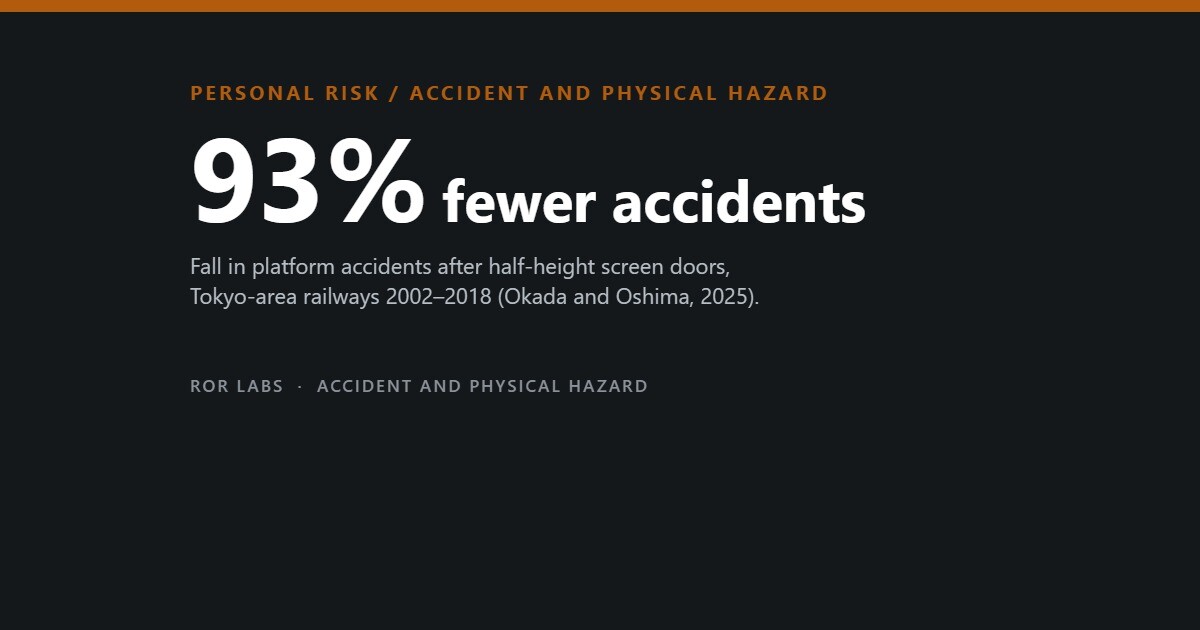
In Tokyo, Michiko Ueda and colleagues found half-height doors on one railway cut suicides by 76% (33% to 93%), not to zero, with no accidental falls at fitted stations. Akira Okada and Taku Oshima, using 2002–2018 Tokyo-area data, found a 93.1% fall in platform accidents, with deaths almost entirely prevented.
Before and after screen doors
Estimated change in incidents at stations after platform screen doors were installed, compared with stations without them.
Sources: Okada and Oshima, IATSS Research (2025); Chung et al. (2016) and Ueda et al. (2015), Journal of Affective Disorders; Law and Yip, J Epidemiol Community Health (2011); Law et al., Journal of Affective Disorders (2009). Before-and-after designs with wide confidence intervals.
Doors also cost money and time. The MTA found only 128 of 472 stations could take them, 41 with compatible trains, at over $7 billion for all 128. Engineers note they can lengthen stops, trap people between door and train, and slow evacuation. Japan targets 3,000 fitted platform lines by fiscal 2025, with 4,000 proposed by 2030.
Blue lights, tactile paving and gap fillers
Some Japanese operators fitted cheaper blue LED lights at platform ends. Tetsuya Matsubayashi and colleagues reported an 84% fall in suicides at 11 lit stations against 60 without (confidence interval 14% to 97%). A 2014 follow-up across 14 stations found 74% and no systematic shift to neighbouring stations.
Masao Ichikawa and colleagues called the 84% potentially misleading. Of 5,841 attempts in national data, only 14% were both within stations and at night, when lights are on. A reduction that large is hard to square with so few events in reach, and both studies use one company’s data.
How many events could blue lights reach?
Share of reported railway suicide attempts in Japan, April 2002 to March 2012 (total 5,841).
Source: Ichikawa, Inada and Kumeji, Journal of Affective Disorders (2014), using government data.
Tactile paving, the blistered strip warning a cane or foot of the drop, is argued for mostly from cases like Eden Park, not trials. Placement matters: Mizuno and Tokuda advised keeping directional strips away from edges where carriage couplings stop.
Gap fillers, extending steps or strips that close the space, target falls like Waterloo’s. We found no study measuring what they prevent. Terabe linked wider gaps with more accidents, which gives a reason to test them without proving they work.
Why the numbers are hard to read
Japan counts falls whether or not a train arrives; Britain’s figures separate passengers from trespassers and suicides; New York counts intrusions and collisions, with causes set at the scene. ‘Deaths at stations’ means different things to different counters.
The screen-door studies share one design: stations that got doors against those that did not yet, before and after. Operators may fit the most troubled stations first, which can exaggerate a fall, and intervals are wide because events are rare. No randomised trial exists, and none is likely.
Hong Kong and Japanese studies found little shift nearby on displacement. But a 2026 study in Health Economics by Minsung Park and colleagues, using platform-level data, found shifts to unbarriered lines in the same station, to other stations and to other methods. Doors are not pointless, but a falling count at one station is not lives saved across a city. Accidents have another problem: many falls never reach a database, and the alcohol figures are old.
What passengers can do
Evidence on personal behaviour is thinner; the investigations point to a few habits. Stand back until the train has stopped, especially on curves or in crowds. Watch the gap as you step on and off. Never stop closing doors with a hand, bag or foot; they may not reopen.
If you drop something onto the track, leave it and tell staff. If you see someone fall, do not climb down after them. Use the emergency help point or alert staff at once so trains can be stopped, and call emergency services. At Ickenham, staff did not know anyone was on the track.
If your sight is impaired, check the operator’s accessibility information and ask for assistance where offered. If a companion has drunk a lot, stay with them and keep them back from the edge. If someone near the edge seems distressed, tell a member of staff.
What to do
Steps sorted by when they matter. Each one says how strong the evidence is: Measured Official advice Untested
Before
- If your sight is impaired, check the operator’s accessibility information before you travel and ask for assistance where it is offered. Untested see Sources
- Take extra care on curved platforms, where gaps between train and platform can be wide. Measured see Sources
- If you or a companion have been drinking, plan to wait well back from the edge; intoxication features in many platform-edge deaths. Measured see Sources
If it happens
- If someone falls onto the track, do not climb down; use the emergency help point or alert staff at once, and call emergency services. Official advice see Sources
- Stand back from the edge until the train has fully stopped, especially in crowds. Untested see Sources
- Watch the gap as you step on and off the train. Untested see Sources
- Do not try to stop closing doors with a hand, bag or foot; many passengers wrongly expect doors to reopen like lift doors. Measured see Sources
Afterwards
- If you dropped something onto the track, leave it and tell staff or use a help point. Measured see Sources
- If someone near the edge seemed distressed or very drunk, tell a member of staff. Untested see Sources
What not to do
- Do not go down onto the track for any reason, including a dropped phone; retrieving objects is a recorded cause of people being struck. Measured see Sources
- Do not assume screen doors or blue lights make a platform completely safe; the evidence is before-and-after, and half-height doors do not stop every incident. Measured see Sources
- Do not assume staff know someone is on the track; at Ickenham they did not. Official advice see Sources
Not professional advice. Follow station staff instructions and local rail safety guidance.
Questions people ask
How likely is it to be hurt at the platform edge?
On any one journey, very unlikely: Britain recorded three such passenger deaths in 2024/25 across 1.6 billion journeys. Non-fatal falls are far more common, more so with alcohol, crowding and wide gaps.
Are pushes common?
No, though they are widely reported. In New York’s early-2022 figures, three of 105 collisions were classed as an assault or push. Standing back from the edge costs nothing.
Why don’t all stations have screen doors?
Cost and fit. Doors work only where every train’s doors line up with them. New York found just 41 of 472 stations both feasible and compatible, at a cost of billions.
Do the blue lights in Japan work?
Possibly, but it is contested. The positive studies used one company’s data with wide intervals, and critics argue the lights reach few events. Barriers have stronger evidence.
I dropped my phone onto the track. What should I do?
Leave it and tell staff or use a help point. Retrieving objects is one of the recorded causes of people being struck by trains.
The short version
- Deaths at the platform edge are rare for the number of journeys made, but in Britain falls from the platform make up around 37% of the modelled risk of death that passengers face.
- Alcohol, curved platforms with wide gaps, crowding and poor sight come up again and again in investigations and studies.
- In New York, suicides were 4% of track intrusions but 35% of the resulting deaths in 2019–2021. Pushes, though widely feared, were three of 105 collisions in early 2022.
- Platform screen doors are linked with large falls in suicides and accidents in Hong Kong, Seoul and Tokyo, but the evidence comes from before-and-after comparisons, not trials.
- Blue lights and tactile paving are cheaper. The blue-light results are contested, and the case for tactile paving rests mostly on investigation findings.
- Stand back until the train stops and never block closing doors. If someone falls, do not climb down: use the help point, tell staff and call emergency services.
This article summarises research, accident investigations and news reports for general information. It is not professional safety or medical advice. If you are struggling or having thoughts of suicide, please talk to someone: in the UK and Ireland, Samaritans on 116 123; in the US, call or text 988; in South Korea, call 109; elsewhere, contact your local crisis line or emergency number.
Further reading: RAIB’s report on Eden Park (01/2021), for how a missing tactile strip became a national programme. Chung et al., Journal of Affective Disorders (2016), for full- versus half-height doors. The MTA’s Addressing Track Trespassing (2022), for what lies behind the subway’s collision numbers.
Sources
- Rail Accident Investigation Branch. Report 02/2026: Fatal accident at Ickenham London Underground station (5 March 2026).
- Rail Accident Investigation Branch. Report 05/2021: Fatal accident at Waterloo Underground station (7 September 2021).
- Rail Accident Investigation Branch. Report 01/2021: Person struck by a train at Eden Park station (2021).
- Rail Accident Investigation Branch. Summary of learning 3: managing risk at the platform–train interface (version 6, May 2026).
- RSSB. Annual Health and Safety Report 2024/25.
- Railway-News. RSSB: rail can do more to tackle impact of alcohol (21 September 2016).
- Transport Network. Tactile surfacing to be fitted to all mainline rail platforms (22 February 2022).
- Metropolitan Transportation Authority. Addressing Track Trespassing (May 2022).
- NY1. Fatal subway shove suspect deemed unfit to stand trial (20 April 2022).
- Ministry of Land, Infrastructure, Transport and Tourism (Japan). Railway safety information for FY2023, correction notice (May 2025).
- Cabinet Office (Japan). White Paper on Traffic Safety 2025, topic 12: platform doors.
- Law CK, Yip PSF, Chan WSC, et al. Evaluating the effectiveness of barrier installation for preventing railway suicides in Hong Kong. J Affect Disord (2009), doi:10.1016/j.jad.2008.07.021.
- Law CK, Yip PSF. An economic evaluation of setting up physical barriers in railway stations for preventing railway injury: evidence from Hong Kong. J Epidemiol Community Health 65(10):915 (2011).
- Chung YW, Kang SJ, Matsubayashi T, et al. The effectiveness of platform screen doors for the prevention of subway suicides in South Korea. J Affect Disord (2016), doi:10.1016/j.jad.2016.01.026.
- Ueda M, Sawada Y, Matsubayashi T. The effectiveness of installing physical barriers for preventing railway suicides and accidents: evidence from Japan. J Affect Disord (2015), doi:10.1016/j.jad.2015.02.017.
- Okada A, Oshima T. Assessing the potential of half-height platform screen doors to prevent personal injury accidents: evidence from the Tokyo metropolitan area railway network. IATSS Research (2025), doi:10.1016/j.iatssr.2025.01.002.
- Matsubayashi T, Sawada Y, Ueda M. Does the installation of blue lights on train platforms prevent suicide? A before-and-after observational study from Japan. J Affect Disord (2013), doi:10.1016/j.jad.2012.08.018.
- Matsubayashi T, Sawada Y, Ueda M. Does the installation of blue lights on train platforms shift suicide to another station? Evidence from Japan. J Affect Disord (2014), doi:10.1016/j.jad.2014.07.036.
- Ichikawa M, Inada H, Kumeji M. Reconsidering the effects of blue-light installation for prevention of railway suicides. J Affect Disord (2014).
- Park M, Lee Y, Nakazawa N. Unintended consequences of installing platform screen doors: displacement and substitution for suicide attempts. Health Econ (2026), doi:10.1002/hec.70131.
- Terabe S, Kato T, Yaginuma H, et al. Risk assessment model for railway passengers on a crowded platform. Transp Res Rec (2019), doi:10.1177/0361198118821925.
- Mizuno T, Tokuda K. Reducing falls among visually impaired individuals on railway platforms: field research on environmental challenges and solutions. Heliyon (2023).
- Poirier C, Adelé S, Burkhardt JM. Individual accidents at the interface between platform, train and tracks (PT2I) in the subway: a literature review. Cogn Technol Work (2020), doi:10.1007/s10111-020-00624-1.
- Waterson PE, Kendrick VL, Ryan B, et al. Probing deeper into the risks of slips, trips and falls for an ageing rail passenger population: applying a systems approach. IET Intell Transp Syst (2016), doi:10.1049/iet-its.2015.0047.
- Abdurrahman UT, Jack A, Schmid F. Effects of platform screen doors on the overall railway system. Conference paper (2018), doi:10.1049/cp.2018.0053.