Forklift Accidents: What the Evidence Shows
Key takeaways · 13 min read
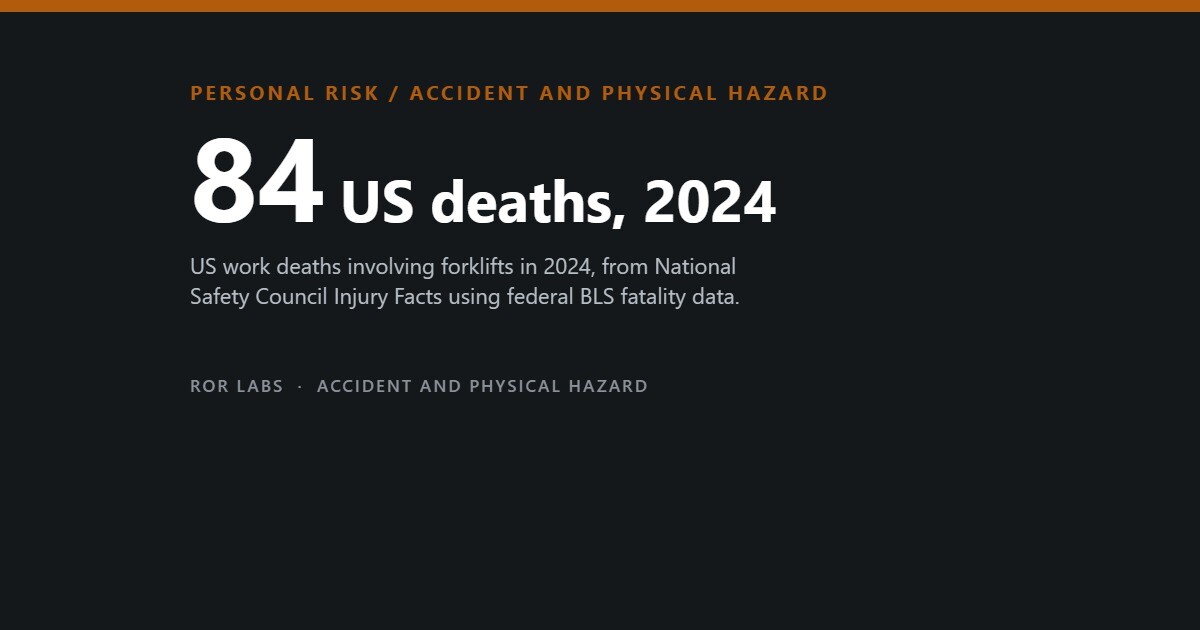
- Forklifts are involved in roughly 70 to 150 US work deaths a year: 150 at the 2005 peak and 84 in 2024. In Britain, being struck by a moving vehicle was the second commonest way workers died in 2025/26.
- The main killers are overturns that trap the driver under the overhead guard, people on foot struck by trucks, crushing, and falls from forks.
- If a sit-down forklift tips, official advice is to stay belted in, hold the wheel and lean away rather than jump. In two recent British deaths, the employer had not enforced seatbelt use.
- Separating people from trucks has the most consistent support: in US car plants, cluttered aisles went with more collisions and mirrors at blind corners with fewer.
Forklifts are so ordinary in warehouses, builders’ merchants and factories that it is easy to forget they are heavy machines carrying loads above head height. In the United States they are involved in roughly 70 to 150 work deaths a year, depending on the year, and in more than 12,000 recorded injuries a year that mean time off, restricted duties or a job transfer.
We cover the US fatality census, the classic NIOSH studies, three recent British enforcement cases, and the research on seatbelts, traffic layout, training and proximity sensors; an earlier article dealt with lockout and machine guarding.
Deaths are counted well but injuries are not, and most of the evidence for the fixes on offer comes from case reviews, simulators and manufacturers rather than from trials.
How many people forklifts kill
The US Census of Fatal Occupational Injuries (CFOI), run by the Bureau of Labor Statistics (BLS), aims to count every work death, so it is the firmest number in this field. A conference analysis of CFOI data by Ramirez and Bulzacchelli found 1,788 forklift-related deaths from 2001 to 2017, rising from 123 in 2001 to a peak of 150 in 2005 before falling to 74 in 2017.
US work deaths involving forklifts
Fatal occupational injuries in which a forklift was involved, selected years.
Sources: Ramirez & Bulzacchelli, Injury Prevention (2021, conference abstract, CFOI data); BLS fact sheet (2017); National Safety Council Injury Facts, from BLS data (2022, 2024).
The National Safety Council, using BLS data, puts the figure at 73 in 2022 and 84 in 2024. Manufacturing accounted for 22.5% of the 2001–2017 deaths, construction 16.3% and transportation and warehousing 13.2%. A BLS fact sheet counted 614 forklift deaths from 2011 to 2017.
Britain counts differently. HSE publishes no forklift total, but its workplace transport pages say there are over 5,000 workplace transport incidents a year, about 50 of them fatal, with lift trucks among the vehicles named.
How British workers were killed, 2025/26
Worker deaths in Great Britain by kind of accident, five most common kinds (provisional).
Source: HSE, Work-related fatal injuries in Great Britain, 2025/26 (provisional, published July 2026). Not all vehicle deaths involve lift trucks.
How the deaths happen
The most detailed breakdown is still NIOSH’s. James Collins and colleagues searched death certificates from 1980 to 1994 and found 1,021 forklift deaths; the average age of those killed was 38. The three commonest circumstances were the truck overturning, a worker on foot being struck, and a worker being crushed by the truck, followed by falls from the forklift.
Four ways forklifts kill
Share of 1,021 US forklift-related deaths, 1980–1994, by circumstance.
Source: Collins et al., American Journal of Industrial Medicine (1999), as summarised in the NIOSH Alert 2001-109. Death-certificate data; old but still the most detailed US breakdown.
In the classic operator death, a sit-down truck tips sideways, the driver jumps, and the overhead guard, the steel frame meant to protect them from falling loads, comes down on them. NIOSH’s alert describes several such deaths, including a foreman backing down a 4% slope with a raised load and a labourer whose truck went off a damaged loading dock.
Pedestrian deaths involve someone other than the driver. In Victoria, Australia, George Rechnitzer and Tore Larsson found that a pedestrian hit by a forklift made up 45% of the injuries they studied, and concluded that forklifts were simply not managed as traffic.
Falls make up much of the rest. In one NIOSH case an assistant warehouse manager stood on a pallet raised 16 feet on the forks; it became unstable and he fell.
Three recent cases
HSE issues a press release when a company is sentenced, and these give the detail that statistics flatten; in each case below the employer was prosecuted.
On 19 November 2020 Ian Dawson, 60, from Rochdale, was loading pallets onto a lorry at Chorlton Express Transport in Oldham when the lorry moved forward and his forklift overturned. He was not wearing a seatbelt, was trapped beneath the truck and died. HSE found the company had no adequate safe system for vehicle movements and did not require its drivers to wear seatbelts. The court heard a belt would probably have saved his life; the firm was fined £86,710 in April 2024.
On 20 November 2023 Chris Keegan, a delivery driver, was at Hessle Plant’s depot in Castleford, taking a repaired forklift back to a customer. Shortly after 6am, as he reversed it onto a trailer, it fell from the side of the trailer bed. He was thrown from the seat and trapped between the truck and a neighbouring trailer, and died at the scene. HSE found the forklift had not been fully inspected after repair, that staff rarely wore seatbelts and that nothing monitored their use. The company was fined £433,550 in November 2025. The inspector called it “a tragic and preventable death”.
The third case is a pedestrian. On 26 September 2024 a 43-year-old yard worker at Palmerston Quay in Aberdeen was unclipping the curtain side of a trailer when a reversing forklift caught his right leg and pulled him to the ground. He suffered multiple fractures and a degloving injury, needed two operations and skin grafts, and had not returned to work by May 2026. His employer’s traffic plan, HSE said, lacked the detail to keep people on foot apart from trucks during loading. It was fined £146,700.
Seatbelts and the overhead guard
Seatbelts figured in two of those three cases, and the official advice on them is consistent. OSHA tells operators of sit-down counterbalanced trucks to stay in the truck with the belt already fastened, hold the steering wheel, brace their feet and lean away from the impact, and not to jump. Operators of stand-up trucks with rear entry should instead step backward off the truck.
NIOSH noted that US manufacturers have had to fit operator restraints to new sit-down forklifts since 1992, and judged that several overturn deaths it investigated might have been prevented if the operator had been restrained. In Britain, counterbalanced and rough-terrain trucks have needed a restraining system since 2002, and HSE says that where restraints are fitted they should be used.
That advice rests on engineering reasoning and case review, with no trial behind it. One early study, a 1985 University of Michigan report prepared for Caterpillar, a forklift maker, examined how seat wings and seatbelts changed an operator’s movement in sideways tip-overs. We found no study measuring, across many trucks, how much belt use lowers the death rate, and belt use itself is rarely recorded, as the Castleford case shows.
Keeping people and trucks apart
The best observational evidence on layout comes from US car plants. Collins and colleagues studied 916 incidents with forklifts and other industrial vehicles in 54 plants over three years; in 35% a pedestrian was struck by the vehicle, its load or something it knocked into. Of the injuries, 41% led to time off work, an average of 61 days each.

A companion case-control study compared 171 collisions in eight plants with randomly chosen sites, trucks and drivers that had no incident in the previous three years. Half the cases involved a pedestrian. An obstruction narrowing the aisle raised the odds of a collision, carrying a load raised them, and overhead mirrors at blind corners went with odds about a third as high.
NIOSH recommends separating forklift and foot traffic, barriers around workstations, keeping trucks away from time clocks, break rooms and exits at shift changes, and mirrors at blind corners, which fits the plant findings, and HSE’s Aberdeen case makes the same point. A case-control study shows associations, though, and cannot prove that changing a layout will cut collisions by that much.
What went with collisions in car plants
Odds of a forklift or industrial-vehicle collision, case-control study in eight US automotive plants, 1992–1995.
Source: Collins et al., American Journal of Industrial Medicine (1999); 171 collision cases compared with incident-free sites. Odds ratios, not tested interventions.
Training, speed and sensors
In the US, OSHA’s rule 29 CFR 1910.178(l) requires every operator to be trained through formal instruction, practical training and an evaluation in the workplace, and certified by the employer. Performance must be re-evaluated at least once every three years, and refresher training is needed after unsafe driving, an accident or near miss, or a switch to a different type of truck. HSE suggests reassessment every three to five years.
Training is required by law, but we found no controlled study showing that certification itself reduces forklift deaths. The same goes for speed: NIOSH and OSHA advise a speed that allows a safe stop and slowing at cross aisles, yet we found no published evaluation of electronic speed limiters on injury rates.
Proximity warning systems, which use tags, radio, cameras or lasers to alert drivers or pedestrians, are a growing line of prevention, though the evidence is early. Armin Lang reported in 2018 that commercial systems often give false alarms at short working distances, so drivers sooner or later switch them off. A 2018 study in a forklift cab found faster braking with LED-bar warnings, and a 2024 team tested warning lights and vibration on a forklift simulator.
The strongest real-world clue comes from mining, where NIOSH researchers reviewed 32 fatal collisions involving underground coal equipment and judged that a detection system able to stop the machine may have helped prevent 25 of them. This is a judgement on accident reports, with no measured effect behind it. A 2025 Quebec review of 34 fatal pedestrian collision reports was designed to guide how such devices are chosen and set up.
Warehouses and the e-commerce boom
Employment where forklifts work has grown fast: BLS counted 409,000 jobs in US warehousing and storage in January 1990 and about 1.2 million in August 2019. By June 2024 employment was 34.0% higher than in February 2020, though it had fallen since a peak in May 2022. Ramirez and Bulzacchelli began their analysis because of concern that online retailers were trading safety for speed.
Deaths have not risen in step: 150 in 2005, 74 in 2017, 84 in 2024. A falling count does not mean a falling risk, though, since we found no official count of forklifts in use or hours driven, and a death rate per truck cannot be calculated. The work has also changed shape, with the same CFOI analysis finding manufacturing and construction, not only warehousing, at the top of the list.

Where the evidence is thin
Fatality counts are solid, injury counts much less so. The BLS Survey of Occupational Injuries and Illnesses relies on employers’ own records, and studies matching it against workers’ compensation claims found it captured between 50% and 75% of cases in the states studied. Leslie Boden and Al Ozonoff estimated it missed almost 340,000 lost-time injuries in six states over five years.
Not everyone accepts the size of that gap; one Minnesota analysis put the undercount at 10–16%. But in interviews with Washington State recordkeepers, 90% did not comply with OSHA recordkeeping rules, and businesses that judged supervisors on low injury rates were more likely to leave cases out. The National Safety Council adds that reporting changed to two-year totals from 2021, which makes trends hard to read.
Recorded forklift injuries, two years at a time
US private-industry cases involving forklifts, order pickers and platform trucks, reported by employers to BLS.
Source: National Safety Council Injury Facts, from the BLS Survey of Occupational Injuries and Illnesses. Two-year totals; likely undercounts.
The best injury studies are also old: the most cited emergency-department estimates, 24,000 forklift injuries in 1983 and 34,000 in 1985, predate most modern warehouses. For the fixes, separating people from trucks has the most consistent support, and even that rests on case-control data, not trials.
What to do
Steps sorted by when they matter. Each one says how strong the evidence is: Measured Official advice Untested
Before
- On a sit-down forklift, fasten the seatbelt before moving off, every time; HSE says restraints that are fitted should be used. Official advice see Sources
- Employers: keep people on foot apart from forklift routes with separate aisles and barriers, and keep trucks away from exits and break rooms at shift changes. Official advice see Sources
- Make sure every operator is trained, evaluated in the workplace and certified, with a re-evaluation at least every three years (OSHA). Official advice see Sources
- Keep aisles clear and fit mirrors at blind corners: in US car plants, obstructed aisles went with more collisions and mirrors with fewer. Measured see Sources
If it happens
- If a sit-down forklift starts to tip, do not jump: stay in the seat with the belt on, hold the wheel, brace your feet and lean away from the fall. If someone is struck or pinned, call emergency services. Official advice see Sources
- Drive at a speed that lets you stop safely, and slow down and sound the horn at cross aisles and blind corners. Official advice see Sources
- On foot near a working forklift, do not assume the driver has seen you, especially when it is reversing. Untested see Sources
Afterwards
- Report every accident and near miss; OSHA requires refresher training after one. Official advice see Sources
- Have a repaired or damaged truck fully inspected before it is used again. Untested see Sources
What not to do
- Do not ride on the forks or stand on a pallet raised by a forklift. Official advice see Sources
- Do not jump from a tipping sit-down truck; the overhead guard can crush someone who leaves the seat. Official advice see Sources
- Do not rely on a proximity sensor instead of separated routes; the evidence for sensors comes mainly from simulators and case reviews. Measured see Sources
Not professional advice. Follow your employer’s training and local workplace safety law.
Questions people ask
Should I jump if a forklift starts to tip?
Not from a sit-down truck. OSHA and NIOSH say to stay in the seat with the belt on, hold the wheel, brace your feet and lean away from the fall. Jumping is how operators end up under the overhead guard. On a stand-up truck with rear entry, the advice is to step backward off it.
Do I need a licence to drive a forklift?
In the US, OSHA’s rule makes the employer responsible for training, evaluating and certifying each operator, with a re-evaluation at least every three years. In Britain employers must make sure operators are adequately trained; HSE’s publication L117 sets out basic training for rider-operated trucks.
Why are so many people on foot hit?
Forklifts reverse often, carry loads that block the view and share aisles with people busy with their own jobs. OSHA warns that pedestrians may not expect how quickly forklifts accelerate or turn.
Do proximity sensors work?
They may help, but the evidence is mostly from laboratories, simulators and suppliers, and drivers switch off systems that give false alarms. Treat them as an extra layer on top of separated routes.
Is it ever safe to ride on the forks?
No. US rules ban unauthorised riders on powered industrial trucks, and NIOSH’s case files include deaths from falls off forks, raised pallets and an unsecured platform.
The short version
- Forklifts are involved in roughly 70 to 150 US work deaths a year: 150 at the 2005 peak and 84 in 2024. In Britain, being struck by a moving vehicle was the second commonest way workers died in 2025/26.
- The main killers are overturns that trap the driver under the overhead guard, people on foot struck by trucks, crushing, and falls from forks.
- If a sit-down forklift tips, official advice is to stay belted in, hold the wheel and lean away rather than jump. In two recent British deaths, the employer had not enforced seatbelt use.
- Separating people from trucks has the most consistent support: in US car plants, cluttered aisles went with more collisions and mirrors at blind corners with fewer.
- Death counts are solid, but injury counts are not: employer-reported surveys miss a large share of cases.
- Evidence for seatbelts, speed limiters and proximity sensors comes mainly from case reviews, simulators and vendors, not trials.
This article summarises research, official statistics and enforcement records for general information. It is not legal or safety advice for a particular workplace. Employers should follow their national regulator’s guidance and take advice from a competent safety professional.
Further reading: the NIOSH Alert Preventing Injuries and Deaths of Workers Who Operate or Work Near Forklifts (2001), for case reports and practical advice. Collins et al., American Journal of Industrial Medicine (1999), for the car-plant case-control study. HSE’s workplace transport guidance, for how British regulators expect traffic to be managed.
Sources
- Health and Safety Executive. Work-related fatal injuries in Great Britain, 2025/26 (provisional). July 2026.
- Health and Safety Executive. “Wonderful, kind and generous man” killed in forklift truck incident. Press release, 3 December 2025.
- Health and Safety Executive. Haulage firm fined after man went to work and didn’t come home. Press release (sentencing 17 April 2024).
- Health and Safety Executive. Shipping company fined £146,700 after worker seriously injured by forklift truck. Press release, 28 May 2026.
- Collins JW, Landen DD, Kisner SM, Johnston JJ, Chin SF, Kennedy RD. Fatal occupational injuries associated with forklifts, United States, 1980–1994. Am J Ind Med 36(5):504 (1999).
- Collins JW, Smith GS, Baker SP, Warner M. Injuries related to forklifts and other powered industrial vehicles in automobile manufacturing. Am J Ind Med 36(5):513 (1999).
- Collins JW, Smith GS, Baker SP, Landsittel DP, Warner M. A case-control study of forklift and other powered industrial vehicle incidents. Am J Ind Med 36(5):522 (1999).
- NIOSH. Preventing injuries and deaths of workers who operate or work near forklifts. NIOSH Alert, Publication No. 2001-109 (2001).
- Bureau of Labor Statistics. Fatal occupational injuries involving forklifts, 2017. Fact sheet.
- National Safety Council. Injury Facts: Forklifts (accessed November 2026).
- Ramirez R, Bulzacchelli MT. An analysis of forklift related fatalities in the United States from 2001 to 2017 (conference abstract). Inj Prev 27(Suppl 3):A32 (2021).
- Rechnitzer G, Larsson TJ. Forklift trucks and severe injuries: priorities for prevention. Monash University Accident Research Centre (1992).
- Stout-Wiegand N. Characteristics of work-related injuries involving forklift trucks. J Safety Res (1987), doi:10.1016/0022-4375(87)90081-8.
- Occupational Safety and Health Administration. 29 CFR 1910.178, Powered industrial trucks; Powered Industrial Trucks eTool, Traveling and maneuvering.
- Health and Safety Executive. Lift trucks: frequently asked questions; Introduction to workplace transport safety.
- Alem NM. Effects of seatwings and seatbelts on the response of forklift operator during lateral dynamic tipovers. Final report, University of Michigan (1985), hdl:2027.42/166.
- Lang A. Evaluation of an intelligent collision warning system for forklift truck drivers in industry. Conference proceedings, Springer (2018), doi:10.1007/978-3-319-91397-1_50.
- vom Stein AM, Dorofeev A, Fottner J. Visual collision warning displays in industrial trucks. IEEE ICVES conference (2018), doi:10.1109/icves.2018.8519519.
- García-Carrillo D, García R, Pañeda XG, et al. Testing driver warning systems for off-road industrial vehicles using a cyber-physical simulator. J Multimodal User Interfaces (2024), doi:10.1007/s12193-024-00435-y.
- Noll JD, DeGennaro CR, Carr JL, DuCarme JP, Homce GT. Causal factors of collision accidents involving underground coal mobile equipment. ASME IMECE conference (2017), doi:10.1115/imece2017-70714.
- Burlet-Vienney D, Gauthier F, Gauvin C. Systematic analysis of fatal collisions between mobile equipment and pedestrian workers to inform the use of proximity detection devices. Conference proceedings, IRSST (2025).
- Boden LI, Ozonoff A. Capture–recapture estimates of nonfatal workplace injuries and illnesses. Ann Epidemiol (2008), doi:10.1016/j.annepidem.2007.11.003.
- Nestoriak N, Pierce B. Comparing workers’ compensation claims with establishments’ responses to the SOII. Monthly Labor Review (May 2009).
- Oleinick A, Zaidman B. The law and incomplete database information as confounders in epidemiologic research on occupational injuries and illnesses. Am J Ind Med (published online December 2009).
- Wuellner SE, Bonauto DK. Exploring the relationship between employer recordkeeping and underreporting in the BLS Survey of Occupational Injuries and Illnesses. Am J Ind Med 57:1133–1143 (2014), doi:10.1002/ajim.22350.
- Bureau of Labor Statistics. Employment in warehousing and storage nearly triples since January 1990. The Economics Daily (31 October 2019); Keeping America moving, Spotlight on Statistics (July 2024).