Romance Scam Victims Were Better Educated Than People Who Never Fell for One. The Newest Version Never Asks for Money.
In This Series: Fraud & Digital Security
- Nobody Updates the Router. The FBI Says Criminals Are Living in the Old Ones.
- Your Voice Is No Longer Proof That It Is You
- A Credit Freeze Blocks the Rarer Kind of Identity Theft. Here Is What Blocks the Rest.
- Four Points Identify You. That Is Why Your Location Is Worth Selling.
- The Two-Factor Code on Your Phone Will Not Stop This
- Changing Your Password Every 90 Days Made It Easier to Guess. The Standard That Started the Rule Now Says to Stop.
- They Asked 422 Burglars What Made Them Walk Away. The Locks Did Not Come First.
- The Same Offer Went From 11% Acceptance to 42%. Only the Buttons Changed.
Key takeaways · 16 min read
- Victims were better educated than people who had never been scammed — roughly 1.8 times the odds per step up the education scale. How knowledgeable people thought they were about online security predicted nothing.
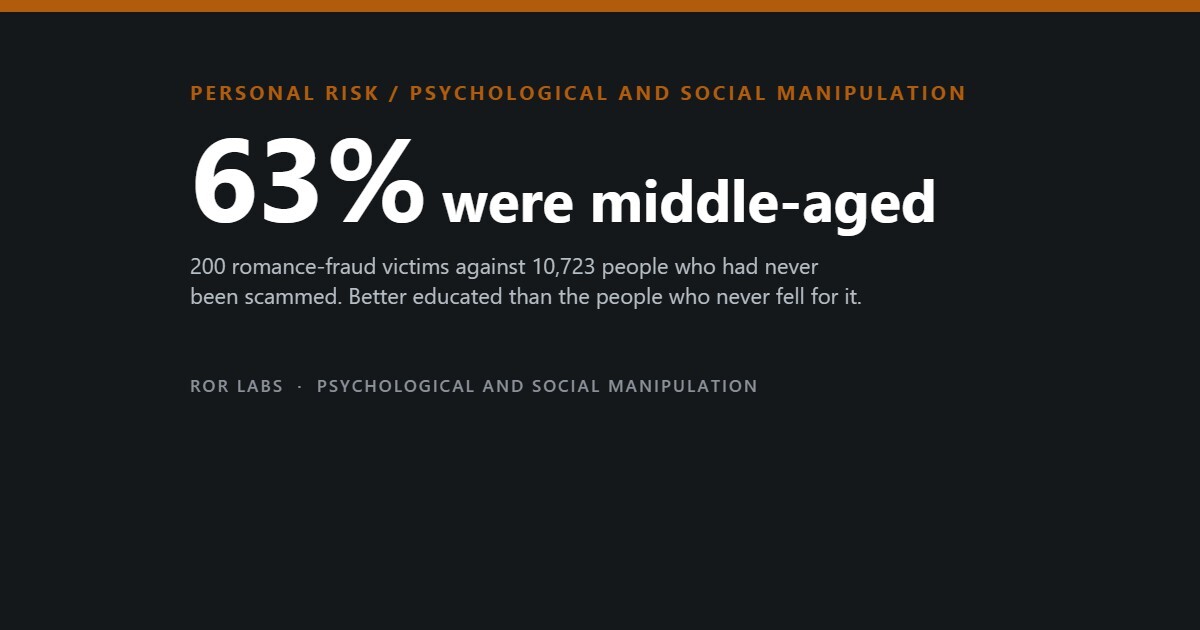
- They were middle-aged, not old: 63% aged 35 to 54, and only 16% over 55. Sixty per cent were women.
- The grooming is finished before money is mentioned. Almost all prevention advice addresses the last stage of a script that has been running for months.
- The current version does not ask for money at all. It suggests an investment — which steps neatly between the romance warning and the investment warning, because each was written for the other crime.
In this article
- The script has stages, and the money comes late
- Who it actually happens to
- The version that walks between the two warnings
- The numbers, and why they are wrong in both directions
- Spotting a fake profile is genuinely hard
- Where this evidence is weaker than it sounds
- What actually reduces the damage
- Questions people ask
- The short version
- Sources
The picture most people carry of a romance scam victim is a lonely pensioner who does not understand computers. When researchers actually compared victims with non-victims, that picture was wrong in every particular. Victims were middle-aged rather than old, more likely to be women but not overwhelmingly so, and — the finding that should end the conversation about gullibility — better educated than the people who had never been scammed. How knowledgeable someone believed they were about online security predicted nothing at all.
The other thing worth knowing is that the version of this fraud now doing the most damage never asks you for money. It asks you to invest. That single change walks straight between the two pieces of advice everyone has been given, because each of them was written for a different crime.
This article is about the script rather than the mark: the stages it moves through, what the evidence says about who it works on, why the official numbers understate one category and inflate another, and what actually reduces the damage — which turns out to be a rule about transactions and a change in banking law, not a sharper eye for a fake profile.

The script has stages, and the money comes late
Monica Whitty interviewed twenty people who had been through the online dating romance scam, including victims who had lost money and victims who had not, and built a stage model from what they described. It has been the reference point in this field since 2013. The important structural feature is that the grooming is complete before any financial request is made — often after weeks or months of daily contact. By the time money is mentioned, the relationship is the thing being protected, and the request is a test of it.
The stages, and which piece of standard advice fails at each one
| Stage | What happens | Why the usual warning misses |
|---|---|---|
| 1. Motivation | The person is looking for a partner. This is not a weakness; it is the ordinary state of anyone on a dating site. | Advice aimed at this stage amounts to telling people not to look for a relationship. |
| 2. The ideal profile | A profile built to match, either a stolen identity or an invented one, presented as unusually well suited. | “Check whether the profile is fake.” When 261 people were asked to do exactly that in a controlled study, it proved difficult. |
| 3. Grooming | Weeks or months of intense daily contact. Isolation from friends and family. No money is mentioned. | There is nothing to report and no transaction to stop. Every warning is about money, and money has not appeared. |
| 4. Testing the waters | A small request. Often a gift, or a modest sum, in circumstances that make refusing feel unkind. | The amount is small enough that refusing looks like a statement about the relationship rather than about the money. |
| 5. The sting | The large request, usually framed as an emergency — medical, legal, a business trapped abroad. | This is the only stage the standard advice was written for, and it arrives last. |
| 6. Revictimisation | Some victims are approached again, sometimes by people offering to recover the lost money. | Whitty points to the near-win phenomenon — the sense of having come close — as part of why people stay in, and come back. |
Sources: Whitty, M.T., “The Scammers Persuasive Techniques Model”, British Journal of Criminology 53(4), 2013, from interviews with 20 victims. Stage list as summarised in Whitty, M.T., “Who can spot an online romance scam?”, Journal of Financial Crime, 2019.
Who it actually happens to
Whitty surveyed 11,780 adults in the United Kingdom and compared the 200 who had been defrauded by a romance scam with the 10,723 who had never been scammed by any mass-marketing fraud. This is the largest comparison of its kind, and almost every popular assumption comes out of it badly.
Age of romance scam victims
200 victims, from a survey of 11,780 UK adults.
Source: Whitty, M.T., “Do You Love Me? Psychological Characteristics of Romance Scam Victims”, Cyberpsychology, Behavior, and Social Networking, 2017.
Education ran the opposite way to the stereotype. In a logistic regression against every other measured characteristic, each step up the education scale multiplied the odds of having been a romance scam victim by roughly 1.8 (b = 0.590, p < 0.001). Whitty says plainly what this contradicts: the popular belief that it is unintelligent people who fall for scams. Her suggested explanation is uncomfortable and worth sitting with — better-educated people may be more confident they would spot it.
Two results that undo the standard picture
Source: Whitty, 2017, binary logistic regression, N = 10,923 in the model.
One finding in that model deserves scepticism rather than repetition: victims scored lower on kindness. Whitty herself says it is hard to explain, and offers two competing readings — that less connected people have fewer friends to sanity-check a profile, or that the measure is picking up the aftermath rather than the cause, since these scams isolate people from everyone around them. It is in the paper; it should not be in a headline.
The version that walks between the two warnings
Since about 2021 the dominant form of this fraud has not ended with an emergency and a bank transfer. It ends with an investment. The names vary — romance baiting in Australia, cryptorom in the security industry, and pig butchering, a translation of the Chinese term for fattening an animal before slaughter. Cassandra Cross, who has studied fraud victimisation for over a decade, argues that this is not a new crime but a deliberate amalgamation of two old ones, and that the merge is effective for a specific and slightly chilling reason: it defeats both sets of prevention advice at once.
The advice, and why it no longer bites
Source: Cross, C., “Romance baiting, cryptorom and ‘pig butchering’: an evolutionary step in romance fraud”, Current Issues in Criminal Justice, 2023.
The numbers, and why they are wrong in both directions

The headline figures are large. In the first nine months of 2025 the US Federal Trade Commission received 55,604 romance scam reports with $1.16 billion in losses, a 22% increase on the same period a year earlier; the median reported loss in the third quarter of 2025 was $2,218. The FBI’s Internet Crime Complaint Center recorded around $21 billion in total losses across just over a million complaints in 2025, with investment fraud accounting for nearly half of all scam-related losses and people over 60 reporting $7.7 billion, a 37% rise on the year. Nearly 60% of people who reported losing money to a romance scam in 2025 said it began on social media rather than on a dating site.
Now the caveats, which matter more than the totals. Fraud has one of the lowest reporting rates of any crime — estimates put it at under a third, and lower still online — so every figure above is a floor. And the merge described in the last section quietly moves losses from one column to another.
Where the romance fraud losses went
Australian reported losses, ACCC Scamwatch, as set out by Cross (2023). Investment fraud absorbed the merged category.
| Year | Investment fraud | Romance fraud |
|---|---|---|
| 2020 | AUD $328m | AUD $132m |
| 2021 | AUD $720m+ | AUD $148m |
| 2022 | AUD $1.5bn | AUD $210m |
Source: Cross, 2023, citing ACCC Targeting Scams reports. The paper cites slightly different values for 2020 and 2021 in two places; the figures used here are from its statistics section.
Spotting a fake profile is genuinely hard
The most common advice is to look carefully at the profile. Whitty tested that directly: 261 people were shown profiles and asked to judge each as genuine or fraudulent. The headline result is that it was difficult. Accuracy was better among people who scored low on romantic beliefs, high on impulsivity, high on consideration of future consequences, who had previously encountered a romance scam, and — the only actionable item on the list — who took longer to answer.
That last one is the whole of what individual vigilance has to offer here, and it is worth taking seriously precisely because it is so small. Slowing down helped. Being clever did not, being confident did not, and knowing about scams in the abstract did not. The finding was also considered important enough that Whitty added a detection stage to her own model.
Where this evidence is weaker than it sounds
Everything above comes with limits, and an article that only pointed one way would be doing the same thing it criticises.
Four reasons to hold these findings loosely
Sources: Whitty, 2017 and 2019; Whitty, 2013; Cross, 2023.
What actually reduces the damage
Two things, neither of which is about being harder to fool.
The first is a rule attached to the transaction rather than to the person. Every version of this fraud, from the 2013 emergency story to the 2025 trading dashboard, ends at the same place: money leaving your control, quickly, on the basis of a relationship formed online. A rule that triggers on that shape — no transfer connected to anyone I have not met, no exceptions, no urgency, and I tell one named person before any transfer over a set amount — survives the storyline changing, which is exactly what the specific warnings do not do.
The second is structural, and it is the only genuinely new protection in this area. Since 7 October 2024, UK payment firms have been required to reimburse victims of authorised push payment fraud — that is, transfers the victim themselves authorised — for payments made in sterling over Faster Payments or CHAPS. Romance scams are explicitly covered. The cap is £85,000, which the regulator says covers over 99% of claims; firms may charge an excess of up to £100 but not to vulnerable consumers; claims must be made within 13 months; and reimbursement can be refused for gross negligence, which the regulator describes as a high bar that does not apply to vulnerable consumers at all.
Two limits worth stating plainly. This is a UK scheme and has no equivalent in most countries. And its shape fits traditional romance fraud better than romance baiting: a victim who buys cryptocurrency in their own name at a legitimate exchange and then sends the coins onward has not made a Faster Payments transfer into a fraudster’s account, and whether the scheme reaches that is not a question it was designed around. If it applies to you, ask your bank in writing rather than assuming either answer.

Questions people ask
Someone I know is in one of these. What actually helps?
Not evidence, in the early stages. Victims routinely refuse to accept the fraud even when told by law enforcement, and the isolation of the target from friends and family is a deliberate part of the script rather than a side effect — so an accusation tends to confirm what the offender has already said about the people around them. What is left is staying in contact without making contact conditional on being believed, and putting the friction on the money: a named person to tell before any transfer, agreed in advance. If money has already gone and you are in the UK, the reimbursement route above is time-limited to 13 months, which makes it urgent rather than optional.
Is a reverse image search worth doing?
It is cheap and it occasionally works, so yes, but do not mistake it for a defence. The controlled test of profile judgement found the task difficult in general, and photographs are increasingly generated rather than stolen, which removes the match a reverse search depends on. It belongs in the same category as slowing down: small, free, and not a substitute for a rule about money.
Why does the money always end up in cryptocurrency?
Because it does what the fraud needs. It moves internationally without a counterparty bank that can reverse it, it lets the victim be shown a fabricated dashboard with growing balances, and it converts the victim into the person who sent the funds voluntarily — which weakens their position with their own bank and with the schemes designed to reimburse them.
Are older people not the main victims after all?
Not for this fraud, in this dataset. Sixty-three per cent of romance scam victims were 35 to 54 and only 16% were 55 or over. That is a statement about romance scams specifically, not about fraud in general — the FBI recorded $7.7 billion in losses among people over 60 across all internet crime in 2025. Different frauds select for different people, and lumping them together is how prevention money ends up in the wrong place.
If they never ask me for money, what is the tell?
The shape rather than the words. Someone met online who moves the conversation to a private messaging app, becomes intensely available, mentions their own investing without pressing you, and then responds to your interest rather than creating it. The absence of a request is not evidence of good faith; in this design it is the technique.
Does telling people about these scams reduce them?
There is no good evidence that it does, and the researcher who has looked hardest at this says current efforts are not working as intended. That is one reason this article is built around the structure of the fraud rather than a list of warning signs: the signs are rewritten every couple of years by people who read the campaigns.
The short version
- Victims were better educated than people who had never been scammed — roughly 1.8 times the odds per step up the education scale. How knowledgeable people thought they were about online security predicted nothing.
- They were middle-aged, not old: 63% aged 35 to 54, and only 16% over 55. Sixty per cent were women.
- The grooming is finished before money is mentioned. Almost all prevention advice addresses the last stage of a script that has been running for months.
- The current version does not ask for money at all. It suggests an investment — which steps neatly between the romance warning and the investment warning, because each was written for the other crime.
- Official figures are a floor, not a measure: fraud reporting is estimated at under a third, and romance baiting losses are being counted as investment fraud, which is why romance figures look flat.
- Detecting a fake profile is hard even when you are told to try. The one thing that helped was taking longer to decide.
- What survives the storyline changing is a rule about the transaction, not about the person — and, in the UK since October 2024, a legal right to reimbursement for authorised push payment fraud, capped at £85,000, claimable within 13 months.
This article is not legal or financial advice. The reimbursement scheme described is specific to the United Kingdom and to particular payment types; the fraud statistics are US, UK and Australian. If you have lost money, report it to your bank immediately and to the fraud reporting body in your country — the time limits attached to recovery are short, and they start from the payment, not from the day you realised.
Further reading: The Psychology of Fraud, Persuasion and Scam Techniques — Martina Dove (Routledge, 2020). Covers why fraud is under-reported, how victimisation is perceived, and — unusually — why prevention advice often fails. It is an academic book at an academic price, and a library is the sensible route. Find it (paid link)
On the link above: it is an affiliate link, marked (paid link). If you buy through it we may earn a commission at no additional cost to you. As an Amazon Associate I earn from qualifying purchases. It is the only link of its kind in this article: we do not link recovery services, background-check sites, dating-safety subscriptions or scam-detection apps, because none of them has published evidence that it changes the outcomes described above, and the recovery-service category in particular is a known site of second victimisation. Full policy: Affiliate Disclosure.
Sources
- Whitty, M.T., “The Scammers Persuasive Techniques Model: Development of a Stage Model to Explain the Online Dating Romance Scam”, British Journal of Criminology 53(4), 2013. (Interviews with 20 participants, financial and non-financial victims; grooming precedes any financial request; the near-win phenomenon and revictimisation.)
- Whitty, M.T., “Do You Love Me? Psychological Characteristics of Romance Scam Victims”, Cyberpsychology, Behavior, and Social Networking, 2017. (11,780 UK adults in the final sample; 200 romance scam victims compared with 10,723 never scammed. Victims: 60% women, 40% men; 21% aged 18–34, 63% aged 35–54, 16% aged 55 and over. Logistic regression, N = 10,923: education b = 0.590, Exp(b) = 1.804, p < 0.001; urgency and sensation seeking p < 0.001; addictive disposition Exp(b) = 1.185, p < 0.001; trustworthiness and kindness negative; self-rated cybersecurity knowledge p = 0.656, not significant.)
- Whitty, M.T., “Who can spot an online romance scam?”, Journal of Financial Crime, 2019. (261 participants judging profiles as genuine or fraudulent; the task proved difficult; accuracy predicted by low romantic beliefs, high impulsivity, high consideration of future consequences, prior experience of spotting a scam, and longer response times. A detection stage was added to the 2013 model.)
- Cross, C., “Romance baiting, cryptorom and ‘pig butchering’: an evolutionary step in romance fraud”, Current Issues in Criminal Justice, 2023. (The convergence of romance and investment fraud; five reasons it is effective; fraud reporting estimated at under one third of cases and lower online; ACCC reported losses to investment fraud AUD $328m in 2020, over $720m in 2021 and $1.5bn in 2022, against romance fraud of $132m, $148m and $210m; romance baiting recorded under investment fraud; both standard prevention messages circumvented.)
- Modic, D. and Lea, S., “Scam Compliance and the Psychology of Persuasion”, 2013. (A susceptibility-to-persuasion scale with four reliable factors — influence of authority, social influence, self-control and the need for consistency — of which social influence, need for consistency and self-control predicted lifetime scam compliance.)
- US Federal Trade Commission, Consumer Sentinel Network data for the first nine months of 2025, as reported in press coverage of the FTC figures: 55,604 romance scam reports and $1.16 billion in reported losses, up 22% on the same period in 2024; median reported loss $2,218 in the third quarter of 2025.
- US Federal Trade Commission, press release of 27 April 2026: $2.1 billion reported lost in 2025 to scams that began on social media, an eightfold increase since 2020; nearly 30% of people who reported losing money to any scam said it started on social media; nearly 60% of people reporting romance scam losses said it began there.
- Federal Bureau of Investigation, Internet Crime Complaint Center, 2025 Internet Crime Report, published 6 April 2026. (1,008,597 complaints and close to $21 billion in losses; 181,565 cryptocurrency complaints totalling more than $11 billion; investment fraud nearly 49% of scam-related losses; approximately $7.7 billion reported lost by people aged 60 and over, a 37% increase on 2024.)
- UK Payment Systems Regulator, authorised push payment fraud reimbursement requirement, in force for payments made on or after 7 October 2024. (Faster Payments and CHAPS; all APP fraud types including romance scams; maximum £85,000, said to cover over 99% of claims; optional excess of up to £100, not applicable to vulnerable consumers; claims within 13 months; refusal for gross negligence, described as a high bar and not applicable to vulnerable consumers.)
- Gujarathi, P., Verma, S. and Nair, V.V., “Pig Butchering Scams as Cyber-Enabled Financial Crime: A Scoping Review”, Deviant Behavior, 2026. (Twelve studies, 2020–2025; scripted social engineering, fabricated investment dashboards and cryptocurrency laundering as recurring features.)