Crypto Investing Losses: What the Evidence Shows
Key takeaways · 11 min read
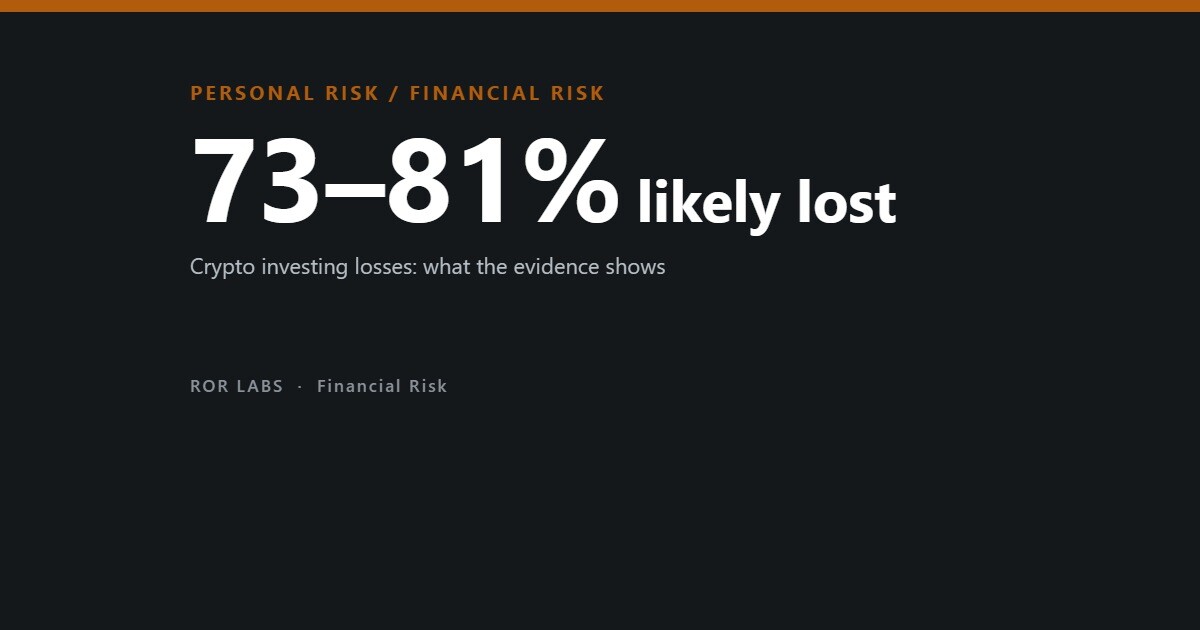
- A BIS study estimated that 73% to 81% of retail bitcoin investors had likely lost money on their first purchase by 2022.
- Most buyers arrived after prices had risen; in one US bank’s data the average purchase price was $43,900.
- The same retail traders who rebalance stocks tend to chase crypto price rises.
- Many smaller coins fail, and pump-and-dump schemes transfer money from outsiders to insiders.
Cryptocurrency is the one market where most people seem to know someone who got rich. Bitcoin went from almost nothing to more than $125,000 in October 2025, and anyone who bought early and held on made extraordinary returns. The less visible story is who bought late, how much they put in, and what happened when prices fell, exchanges collapsed or a scammer got there first.
That story is now measurable. Central bankers have tracked crypto app downloads in 95 countries, a large US bank has followed the transfers of millions of customers, and economists have compared how the same people trade shares and crypto on the same platform. Law enforcement publishes detailed loss figures every year.
The findings are uncomfortable in both directions. Most retail buyers in the studied periods probably lost money, mainly because they arrived after prices had already risen. But the most quoted loss estimates depend heavily on the date they were measured, and later price rises would have changed some of them. This article sets out what the evidence shows, and what it cannot show.

How many retail investors lost money
In 2022, economists at the Bank for International Settlements (BIS), the central bankers’ bank, used daily data on crypto exchange app downloads and use in 95 countries from 2015 to 2022. Their working paper, by Raphael Auer and colleagues, estimated that 73% to 81% of retail investors had likely lost money on their initial bitcoin investment. About 40% of the new users were men under 35.
The mechanism was timing. Rising bitcoin prices were followed by waves of new users. As they arrived, larger holders sold, which the authors described as larger holders likely making a return at retail users’ expense. A later BIS bulletin, published in February 2023 after the collapse of the Terra stablecoin and the FTX exchange, reached a similar conclusion with a simple simulation.
The bulletin assumed each new user bought $100 of bitcoin in the month they downloaded an app, and $100 every month after that. By December 2022, the median investor would have lost $431 of the $900 they had put in. Almost three-quarters of users had downloaded their app when bitcoin was above $20,000. In nearly every one of the 95 economies, a majority of these investors probably lost money.
The same bulletin looked at who was buying and selling around the two shocks. The largest holders, with more than 1,000 bitcoin each, reduced their holdings. Small holders, with less than one bitcoin, and medium holders increased theirs. The pattern is consistent with a transfer from late small buyers to early large ones.
The late buyer’s arithmetic
Simulation of retail bitcoin investors in 95 economies, marked to December 2022.
Cornelli, Doerr, Frost and Gambacorta, BIS Bulletin No. 69, 2023. A simulation based on app data, not account records.
What American households did
The JPMorgan Chase Institute studied almost 5 million active checking customers, more than 600,000 of whom sent money to crypto accounts. The share of customers who had ever done so rose from 3% before 2020 to 13% by June 2022. The typical person transferred money when bitcoin was trading at a weighted average of $43,900, and more than half made their average transfers when it was above $40,000.
Lower-income customers bought at a higher average price, $45,400, than the highest earners, $42,400. Only 13% of people had taken out as much money as they had put in. Most stakes were modest: the median net transfer was less than a week’s take-home pay, although almost 15% of users had transferred more than a month’s pay. Men were about twice as likely as women to buy.
Average bitcoin price when households bought
Transaction-weighted average bitcoin price at the time of transfers, US Chase customers, to mid-2022.
JPMorgan Chase Institute, 2022. Transfers only; the institute could not observe holdings or sales on the exchanges.
A 2025 update from the same institute put the share of active Chase customers who had invested in crypto between 2017 and May 2025 at 17%. About 80% of them had transferred less than one month’s income. Among self-directed investors at J.P. Morgan Wealth Management, about 2% held crypto exchange-traded funds, with a median allocation under 5% of their assets.
Why crypto behaves differently

In 2021, Yukun Liu and Aleh Tsyvinski published one of the first systematic studies of crypto returns in the Review of Financial Studies. They found that the returns had little exposure to the factors that explain stock returns and were driven by factors specific to crypto, especially momentum and investor attention. In their working-paper data, a rise in Google searches for bitcoin predicted higher returns two weeks later.
A 2024 study in the Journal of Financial Economics by Shimon Kogan, Igor Makarov, Marina Niessner and Antoinette Schoar looked at 199,927 retail traders on the eToro platform from 2015 to 2019. The same people behaved in opposite ways in different markets. When a stock rose, they sold some, rebalancing back. When a cryptocurrency rose, they bought more.
A 1% daily rise in a cryptocurrency’s price increased its share of the average portfolio by 0.67%, while a 1% rise in a stock reduced its share by 0.28%. The traders did not rebalance crypto even on days of extreme moves, and nothing changed after the early 2018 crash, when bitcoin lost more than half its value. Daily volatility was about twice that of stocks. The authors ruled out inattention, fees and lottery-seeking, and suggested that traders read rising prices as a signal of future adoption.
Same traders, two markets
Retail traders on one platform, 2015–2019.
| Asset | Daily volatility | Response to a 1% price rise |
|---|---|---|
| Crypto (bitcoin, ether, XRP) | 5.3% | Portfolio share rises 0.67% |
| Top 200 stocks | 2.7% | Portfolio share falls 0.28% |
| Gold | 0.6% | Traded against the trend |
Kogan, Makarov, Niessner and Schoar, Journal of Financial Economics, 2024. One platform, mostly European users, many trades were contracts for difference.
Coins that disappear
Bitcoin is the survivor. Most crypto assets are not. A 2021 study by Neil Gandal, JT Hamrick, Tyler Moore and Marie Vasek followed 1,082 coins and 725 tokens for more than four years. They found that 44% of publicly traded coins had been abandoned at least temporarily. Many were later revived, but 18% failed permanently. Tokens built on other blockchains fared better, with 7% abandoned and 5% permanently failed.
Manipulation is another risk specific to small coins. In a study published in the Review of Finance, Anirudh Dhawan and Tālis Putniņš identified 355 organised pump-and-dump schemes over six months, in which groups coordinated on messaging apps to buy a coin at a set time. The pumps produced average price distortions of 65%. A 2025 study in the Journal of Financial and Quantitative Analysis by Tao Li, Donghwa Shin and Baolian Wang found that prices often rose before the announced start, suggesting wealth transfers from outsiders to insiders.
What happens to coins
Publicly traded coins and tokens followed for more than four years.
Gandal, Hamrick, Moore and Vasek, Decisions in Economics and Finance, 2021. 1,082 coins and 725 tokens.
Platforms, fraud and leverage
Price is not the only risk. When a platform fails, customers can lose money regardless of what the coins are worth. The FTX exchange collapsed in November 2022. Its founder, Sam Bankman-Fried, was convicted of fraud in November 2023 and sentenced to 25 years in March 2024; prosecutors said he had stolen more than $8 billion of customers’ money. The crypto lender Celsius froze withdrawals in June 2022 with about $4.7 billion of assets belonging to some 400,000 customers, and its founder was sentenced to 12 years in May 2025.
Theft from exchanges continues. In February 2025 about $1.5 billion in crypto was stolen from the Bybit exchange, a hack the FBI attributed to North Korea. And fraud aimed directly at individuals is now larger than any single collapse. According to the FBI’s Internet Crime Complaint Center, Americans reported $11.4 billion in crypto-related losses in 2025, up 22% on 2024. Crypto investment fraud alone accounted for $7.2 billion. Victims aged over 60 reported $4.3 billion in crypto-related losses, and losses at crypto ATMs and kiosks reached $389 million.
Reported crypto-related losses in the US
Complaints to the FBI’s Internet Crime Complaint Center.
FBI Internet Crime Complaint Center annual reports, 2024 and 2025. Reported complaints only; many losses are never reported.
Many of these scams begin as relationships or investment tips and move victims onto fake trading platforms that show invented profits. We described how the script works in our article on romance-baiting scams. Leverage adds a third kind of loss. On 10 October 2025, after a US tariff announcement, more than $19 billion of leveraged crypto positions were liquidated within 24 hours, days after bitcoin had set a record above $125,000. By early February 2026, according to one asset manager’s market note, bitcoin had fallen about half from that peak.
What the loss estimates cannot show
The BIS figures are simulations, not account records. They assume users bought on the day they downloaded an app, they ignore sales and fees, they cover only bitcoin, and the bulletin marked the results in December 2022, near a low point. Bitcoin later rose far above the prices at which most of those users arrived. A calculation run in October 2025 would very likely have shown many of the same simulated investors in profit. That is our inference, not the BIS’s, and it shows how much the answer depends on the date.
Studies of small allocations also disagree. In 2015, Marie Brière, Kim Oosterlinck and Ariane Szafarz found that even a small allocation to bitcoin improved a diversified portfolio’s risk-return trade-off, while warning that their data from 2010 to 2013 might reflect early-stage behaviour that would not last. In 2020, Thomas Conlon and Richard McGee found that during the COVID-19 crash, even a small allocation to bitcoin substantially increased a portfolio’s downside risk.
Access has also changed. In January 2024 the SEC approved spot bitcoin exchange-traded products, which let investors hold bitcoin exposure through ordinary brokerage accounts. The then chair, Gary Gensler, stressed that the approval was not an endorsement and described bitcoin as primarily a speculative, volatile asset. Funds of this kind reduce the risk of an exchange collapse or a lost password. They do nothing about price.

What the evidence suggests
Across very different data sources, the same pattern appears. Retail investors tended to arrive after prices had already risen sharply, often with money they could not easily afford, and larger holders sold to them. Most coins other than the largest have a high chance of disappearing. And for many Americans, the largest crypto loss is now not a market crash but fraud.
According to the Federal Reserve’s survey of household economic well-being, 10% of US adults used crypto in 2025, most of them as an investment. For readers who hold some, the research points to questions rather than answers: when did I buy relative to the price, what share of my savings is this, who holds the coins, and how would I know if the platform showing my balance was real? Our article on deposit insurance explains what that protection does and does not cover.
Questions people ask
What percentage of crypto investors lose money?
A 2022 BIS working paper estimated that 73% to 81% of retail bitcoin investors in 95 countries had likely lost money on their initial investment. The estimate depends on the date prices were measured.
Why do most people lose money on crypto?
The studies point mainly to timing. New users arrived after prices had risen, and larger holders sold to them.
How much money is lost to crypto scams?
Americans reported $11.4 billion in crypto-related losses to the FBI in 2025, including $7.2 billion in crypto investment fraud.
Are bitcoin ETFs safer than buying crypto directly?
They remove the risk of an exchange failing or losing access to a wallet, but not the risk of price falls.
How many cryptocurrencies fail?
One study found that 44% of publicly traded coins were abandoned at least temporarily and 18% failed permanently over about four years.
The short version
- A BIS study estimated that 73% to 81% of retail bitcoin investors had likely lost money on their first purchase by 2022.
- Most buyers arrived after prices had risen; in one US bank’s data the average purchase price was $43,900.
- The same retail traders who rebalance stocks tend to chase crypto price rises.
- Many smaller coins fail, and pump-and-dump schemes transfer money from outsiders to insiders.
- Reported US crypto fraud losses reached $11.4 billion in 2025, and loss estimates change sharply with the date they are measured.
This article summarises published research and official data on cryptocurrency losses. It is not financial, investment, tax or legal advice, and it does not recommend buying or selling any crypto asset, fund or platform. Crypto assets can lose all their value. If you think you have been targeted by a scam, report it to the police and, in the United States, to the FBI’s Internet Crime Complaint Center.
Further reading. Cornelli, Doerr, Frost and Gambacorta, ‘Crypto shocks and retail losses’, BIS Bulletin No. 69, 2023, is short and readable. Kogan, Makarov, Niessner and Schoar, Journal of Financial Economics, 2024, explains why the same people treat crypto differently.
- Number Go Up, Zeke Faux (2023). A Bloomberg reporter follows the money through the 2021 crypto boom, from stablecoins to scam compounds. Openly sceptical of the industry.
- Going Infinite, Michael Lewis (2023). An inside account of Sam Bankman-Fried and FTX, written with unusual access. Critics found it too sympathetic to its subject.
- The Data Detective, Tim Harford (2020). An economist’s rules for reading statistics, useful for judging headline loss figures and backtested returns.
Sources
- Auer R, Cornelli G, Doerr S, Frost J, Gambacorta L. Crypto trading and Bitcoin prices: evidence from a new database of retail adoption. BIS Working Papers No. 1049, 2022; published in IMF Economic Review, 2026;74(2):425–460. doi:10.1057/s41308-025-00275-0.
- Cornelli G, Doerr S, Frost J, Gambacorta L. Crypto shocks and retail losses. BIS Bulletin No. 69, February 2023.
- Wheat C, Eckerd G. The dynamics and demographics of U.S. household crypto-asset use. JPMorgan Chase Institute, December 2022.
- JPMorgan Chase Institute. Crypto investor waves since 2017. August 2025.
- Liu Y, Tsyvinski A. Risks and returns of cryptocurrency. Review of Financial Studies, 2021;34(6):2689–2727. doi:10.1093/rfs/hhaa113.
- Kogan S, Makarov I, Niessner M, Schoar A. Are cryptos different? Evidence from retail trading. Journal of Financial Economics, 2024;159:103897. doi:10.1016/j.jfineco.2024.103897.
- Gandal N, Hamrick JT, Moore T, Vasek M. The rise and fall of cryptocurrency coins and tokens. Decisions in Economics and Finance, 2021;44(2):981–1014. doi:10.1007/s10203-021-00329-8.
- Dhawan A, Putniņš TJ. A new wolf in town? Pump-and-dump manipulation in cryptocurrency markets. Review of Finance, 2023;27(3):935–975. doi:10.1093/rof/rfac051.
- Li T, Shin D, Wang B. Cryptocurrency pump-and-dump schemes. Journal of Financial and Quantitative Analysis, 2025;60(8):3622–3659. doi:10.1017/S0022109025000201.
- Brière M, Oosterlinck K, Szafarz A. Virtual currency, tangible return: portfolio diversification with bitcoin. Journal of Asset Management, 2015;16(6):365–373. doi:10.1057/jam.2015.5.
- Conlon T, McGee R. Safe haven or risky hazard? Bitcoin during the Covid-19 bear market. Finance Research Letters, 2020;35:101607. doi:10.1016/j.frl.2020.101607.
- Federal Bureau of Investigation, Internet Crime Complaint Center. Internet Crime Report 2024 and Internet Crime Report 2025.
- Federal Bureau of Investigation. North Korea responsible for $1.5 billion Bybit hack. Public service announcement, 26 February 2025.
- US Department of Justice, Southern District of New York. Samuel Bankman-Fried sentenced to 25 years. March 2024; Alex Mashinsky sentenced to 12 years. May 2025.
- Board of Governors of the Federal Reserve System. Economic Well-Being of U.S. Households in 2025. May 2026.
- Gensler G. Statement on the approval of spot bitcoin exchange-traded products. US Securities and Exchange Commission, 10 January 2024.
- CoinDesk Research. Analysis of the 10 October 2025 crypto liquidation event, citing CoinGlass data. October 2025.