Half of the People Who Die in Crashes Were Not Wearing a Belt
In This Series: Road, Transit & Child Safety
- Nobody Skips the Car Seat. The Deaths Are in the Exceptions.
- Three Quarters of Pedestrian Deaths Happen After Dark. Your Reflective Vest Is in the Wrong Place.
- A Child Physically Cannot See a Car Coming at 30 mph. Start There.
- Sixty-Four Per Cent of Seriously Injured British Bus Passengers Were Never in a Crash. And the Bus Is Still About Four Times Safer Than the Car.
Disclosure: this article contains affiliate links, marked (paid link). If you buy through one we may earn a commission, at no extra cost to you. As an Amazon Associate I earn from qualifying purchases. It costs you nothing and it does not change what we recommend.
Key takeaways · 7 min read
- U.S. traffic deaths fell to an estimated 36,640 in 2025, at the second-lowest fatality rate on record. The long trend is genuinely good.
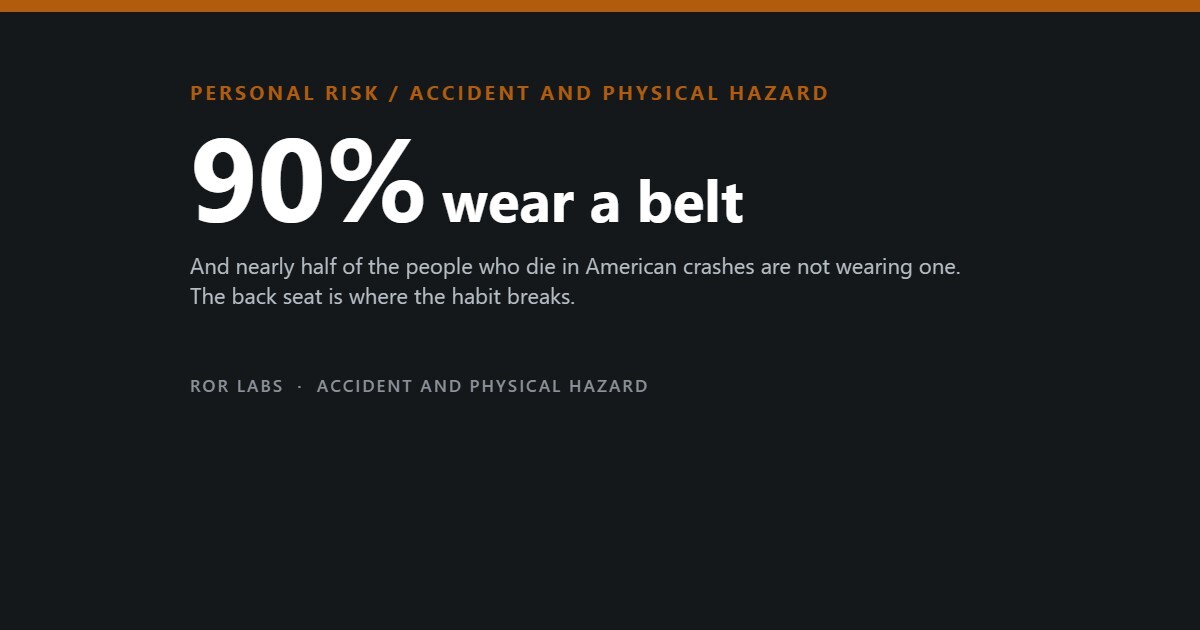
- Nearly half of people killed in crashes were not belted — in a country with over 90% front-seat belt use.
- Among rear-seat occupants killed, only 32% were belted, against 84% everyday rear belt use.
- Belts cut fatal injury risk by 45–75% depending on seat and vehicle type. Nothing else in everyday life comes close.
The most dangerous thing most people do is drive, and the safest thing they can do about it takes two seconds and costs nothing. Nearly half of the people who die in American crashes are not wearing a seat belt — in a country where over 90% of front-seat occupants wear one.
Both halves of that sentence are true at once, and holding them together is the whole point. A small unbelted minority accounts for an enormous share of the deaths. Which means the remaining gains in road safety are not spread thinly across everyone — they are concentrated in a few specific behaviours, and one specific seat.
The good news first, because it is real
U.S. traffic deaths and the fatality rate
NHTSA figures released 1 April 2026.
Source: National Highway Traffic Safety Administration, traffic fatality estimates, 1 April 2026.
It is worth sitting with that number for a moment, because road safety coverage is relentlessly negative and the actual trajectory is good. Cars are dramatically safer than they were, and per mile driven, so is driving.
What has not improved at the same pace is the human input. Which is where the remaining 36,640 are.
The back seat is where the belt habit breaks
Everyone belts up in front now. It has been drilled in for forty years and it worked. The back seat is a different story, and the numbers are startling once you put them side by side.
Belt use by seat, and belt use among those killed
IIHS data, 2025 use rates and 2024 fatality records for occupants aged 13 and over.
Source: Insurance Institute for Highway Safety, seat belt use and fatality data (2024–2025).
And the belt is not a marginal intervention. It is one of the largest single-action risk reductions available to an adult human being in any domain covered on this site.
Reduction in risk of fatal injury from wearing a belt
By seat and vehicle type.
Source: Insurance Institute for Highway Safety, seat belt effectiveness research.
Why the unbelted passenger behind you is your problem too

There is a physical argument that rarely gets made, and it changes how people think about the back seat.
In a frontal crash, an unrestrained rear passenger keeps travelling forward at the speed the car was doing until something stops them. The thing that stops them is usually the back of the front seat, with a person in it. An 80 kg adult at 50 km/h arrives with force in the region of a tonne. Belted front occupants have been killed by unbelted people behind them.
What happens in the cabin
Frontal impact, rear passenger unrestrained.
Source: crash dynamics as described in IIHS rear-seat restraint research.
What actually reduces your risk, ranked
By effect size, and all of the top four are free
Ranked against what the crash data attributes deaths to.
Sources: NHTSA fatality analysis (2026 release); IIHS seat belt and vehicle safety research.
The small things that are genuinely worth having (paid link)
Nothing here competes with the belt. These address the failures around it.
Browse on Amazon →
Browse on Amazon →
Browse on Amazon →
We will not link seat belt “comfort” clips, alarm stoppers or belt-adjusting gadgets. Products that let a belt sit loose, or that silence the reminder chime, defeat the single most effective safety device in the vehicle. The reminder chime exists because it measurably raises belt use — it is an intervention, not a nuisance.
Questions people ask
Is the back seat still the safest place?
For children, yes, unambiguously — and away from active front airbags. For adults the picture has narrowed, because front-seat protection has improved faster than rear-seat protection in recent decades. The back seat is safest when belted; unbelted, it is among the most dangerous places in the car.
Are hands-free calls safe?
Safer than holding a phone, and not the same as not being on a call. The impairment in the research is largely cognitive rather than manual — attention is finite, and a conversation with someone who cannot see the road ahead consumes some of it. Legal is not identical to safe.
Does a bigger vehicle make me safer?
For you, in a two-vehicle crash, generally yes. For everyone else it is the opposite — taller, heavier front ends are substantially more lethal to pedestrians and to occupants of smaller cars. It is worth being honest that this is a choice that transfers risk to others rather than removing it.
I only drive a few minutes to the shops. Does it matter?
A large share of crashes happen close to home, on familiar roads, at ordinary speeds. That is not because short trips are especially dangerous — it is simply where most driving happens. The belt takes two seconds regardless of trip length, which is why “every trip” is the rule rather than a judgement call each time.
The short version
- U.S. traffic deaths fell to an estimated 36,640 in 2025, at the second-lowest fatality rate on record. The long trend is genuinely good.
- Nearly half of people killed in crashes were not belted — in a country with over 90% front-seat belt use.
- Among rear-seat occupants killed, only 32% were belted, against 84% everyday rear belt use.
- Belts cut fatal injury risk by 45–75% depending on seat and vehicle type. Nothing else in everyday life comes close.
- An unbelted rear passenger is a hazard to the belted people in front during a frontal crash.
- The top four interventions are free: belt, sober, slower, phone out of reach.
- When you change cars, automatic emergency braking and crash ratings buy more safety than any accessory.
On the links above: some are affiliate links, marked (paid link). If you buy through one we may earn a commission at no additional cost to you. As an Amazon Associate I earn from qualifying purchases. We link to product searches rather than specific items so recommendations do not break as models change, and we say plainly when we are choosing not to link something. Full policy: Affiliate Disclosure.
Sources
- National Highway Traffic Safety Administration. Traffic fatality estimates for 2025 and final 2024 data, released 1 April 2026.
- Insurance Institute for Highway Safety. Seat belts research area — use rates, effectiveness and fatality data (2024–2025).
- National Highway Traffic Safety Administration. “Speeding: 2024 Data,” Traffic Safety Facts.