Soccer hamstring injuries, and the exercise few teams use
Key takeaways · 10 min read
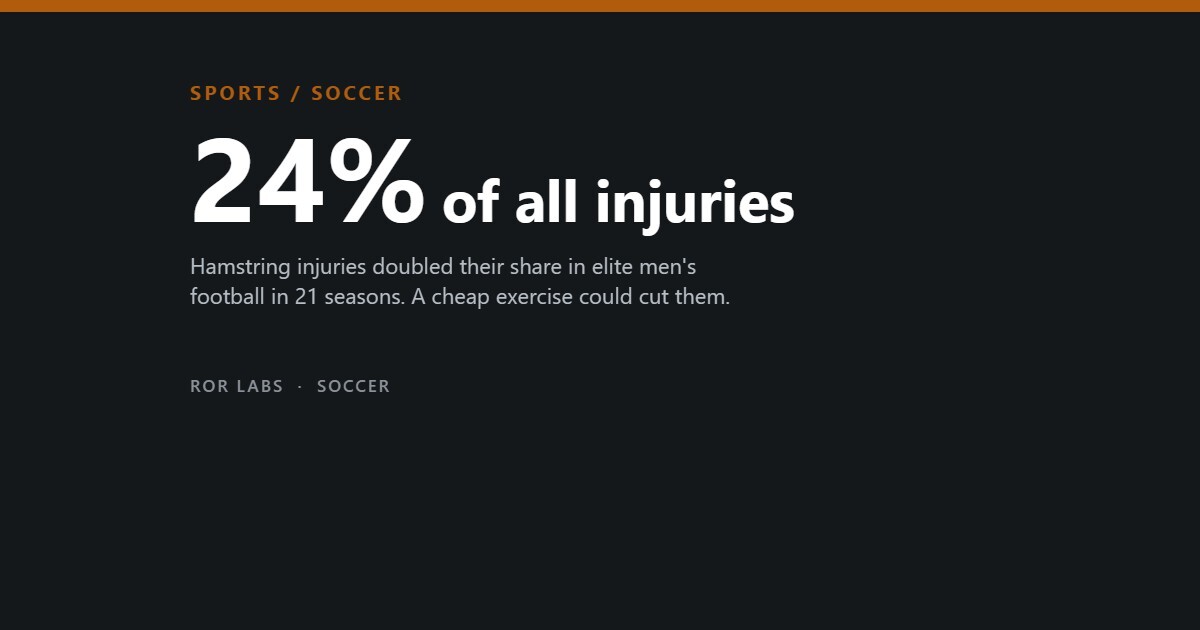
- Hamstring injuries rose from 12% to 24% of all injuries in men’s elite European football between 2001/02 and 2021/22; a squad of 25 can expect about eight a season.
- The risk concentrates in matches, sprints, the last 15 minutes of each half and above all in players who have been injured before.
- In a Danish trial the Nordic hamstring exercise cut new injuries from 8.1 to 3.1 per 100 player-seasons and recurrences from 45.8 to 7.1.
- Only about one elite club-season in ten used the full programme, and a stricter reanalysis found the trial evidence less certain than its reputation.
On 22 April 2026 Lamine Yamal scored a penalty against Celta Vigo, the only goal of the match, and limped off with medical help. Tests the next day confirmed a hamstring injury in his left leg. He was ruled out for the rest of the league season; Barcelona said he would follow a conservative treatment plan and was expected to be available for the World Cup. It was a high-profile case of the single most common injury in men’s professional football.
The numbers behind it come from the UEFA Elite Club Injury Study, which has tracked the medical records of Europe’s top clubs since 2001. In its first season hamstring injuries were 12% of all injuries. By 2021/22 they were 24%, and they caused a fifth of all the days players spent injured. A typical squad of 25 can expect about eight a season. Over the same years, an exercise that halved the injury rate in trials was available, cheap and mostly ignored.
This article covers what a hamstring injury does to a footballer, where the risk concentrates, what has been measured to work, chiefly the Nordic hamstring exercise, why the trial evidence is less tidy than its reputation, and why the answer is to play carefully rather than to stop.
What a hamstring injury does to a footballer
The hamstrings are three muscles at the back of the thigh. In a sprint they work hardest while lengthening, braking the lower leg as it swings forward, and that is when they tear. Since 2011 the UEFA study has recorded where the damage falls: 80% of injuries with a specific diagnosis were in the biceps femoris, the outer muscle, and about seven in ten were structural, with fibre damage visible on a scan.
Most players are back within weeks. Across 21 seasons and 2,636 hamstring injuries, the median lay-off was 13 days, and structural injuries took longer than functional ones, a median of 17 days against six. Returning is the risky part. About 18% of all hamstring injuries were recurrences, and more than two-thirds of those came within two months of the player’s return. In the season, about one player in five missed training or a match with a hamstring injury.
Hamstring injuries take a growing share
Hamstring injuries as a share of all time-loss injuries, and of all days lost to injury, in men’s elite European football.
Source: Ekstrand et al., British Journal of Sports Medicine (2023), UEFA Elite Club Injury Study, 3,909 players from 54 teams in 20 countries.
Part of the rising share is other injuries falling. Over 18 seasons to 2019, the study found total injury incidence dropping by 3% a season and ligament injuries by more, while muscle injuries held steady. But hamstring injuries also rose in absolute terms: between 2014/15 and 2021/22 their incidence in training grew by 6.7% a year, and match incidence rose too, though that trend was not statistically significant.
Where the risk concentrates
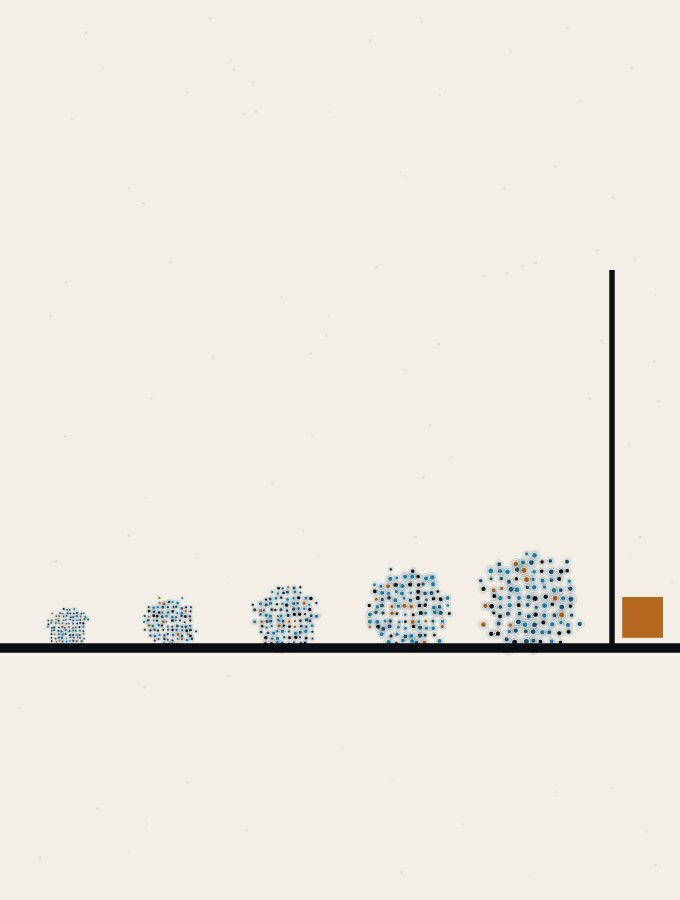
Matches are the dangerous setting. Over 21 seasons the hamstring injury rate was 4.99 per 1,000 hours of match play and 0.52 per 1,000 hours of training, almost ten times higher, and recurrences showed the same ratio. In the earlier 13-season analysis, 22% of players had at least one hamstring injury in a season. Women’s elite teams show a smaller gap: in one season of Women’s Champions League clubs, the match risk was four times the training risk and hamstrings caused 13% of injuries.
Within a match, the injuries cluster in time and action. Running or sprinting was the most common mechanism, behind 62% of structural injuries, and almost half of match injuries came in the last 15 minutes of either half. The authors offer two possible reasons for the rise: elite football now contains more high-intensity running at higher speeds, and players spend more of the year playing, with breaks of four to six weeks between seasons.
The fixture list matters as well. In a 14-year analysis of more than 130,000 match observations, muscle injury rates were 21% lower when players had six days between matches than when they had three or fewer, and 19% lower with seven to ten days. Total injury rates did not differ. The study was observational, and rotation decisions are not random, but the direction matched earlier work.
What raises the risk of a hamstring injury
Risk ratios from a 2020 meta-analysis of 78 prospective studies covering 8,319 hamstring injuries in 71,324 athletes across sports. 1x is no added risk.
Source: Green et al., British Journal of Sports Medicine (2020), doi:10.1136/bjsports-2019-100983. Older age was also a significant risk factor.
The strongest single warning is the player’s own history. In a 2020 meta-analysis of risk factors, a recent hamstring injury carried 4.8 times the risk and any previous one 2.7 times. Older age, a previous knee ligament injury and a previous calf strain added smaller risks. That is why the first two months after return deserve the most care, and why the trials looked separately at players who had been injured before.
What has been measured to work
The Nordic hamstring exercise needs no equipment. A player kneels while a partner holds the ankles, then lowers the upper body towards the ground as slowly as possible, braking with the hamstrings, and pushes back up with the hands. The standard programme builds over ten weeks and 27 sessions, from one weekly session of two sets of five to three weekly sessions of three sets of 12, 10 and 8, then drops to a weekly maintenance session.
The largest trial was run in Denmark. Fifty professional and amateur men’s teams, 942 players, were randomised to that programme or to their usual training for a season. There were 15 acute hamstring injuries in the Nordic group and 52 in the control group: 3.8 against 13.1 per 100 player-seasons, an adjusted rate ratio of 0.29. For new injuries the rates were 3.1 against 8.1; for players who had been injured before, 7.1 against 45.8.
A Dutch trial published in 2015 tested the same idea on 579 amateur players in 40 teams, using 25 sessions over 13 weeks. Hamstring injuries ran at 0.25 per 1,000 player hours in the Nordic group against 0.8 in the control group, with 91% compliance. A 2019 meta-analysis of 15 studies and 8,459 athletes across sports estimated that programmes including the exercise cut hamstring injuries by 51%, and the effect held at 0.52 when only randomised trials were pooled.
The Danish Nordic hamstring trial
Acute hamstring injuries per 100 player-seasons in 50 Danish men’s teams randomised to the Nordic programme or usual training for one season.
Source: Petersen et al., American Journal of Sports Medicine 39(11):2296 (2011). Numbers needed to treat: 25 players to prevent one new injury, 3 to prevent one recurrence.
Yet most elite clubs do not use it as tested. Surveying 50 teams from the Champions League and the Norwegian top division over 2012 to 2014, researchers found the full programme completed in 16 of 150 club-seasons, 10.7%. An English survey of 53 professional clubs found 17% fully compliant, citing players’ attitudes and muscle soreness. In 2020/21 only one of 17 elite men’s teams and one of 11 elite women’s teams used the original programme.
How many elite teams actually do it
Share of teams or club-seasons completing the full Nordic hamstring programme, from four surveys of professional football.
Sources: Bahr et al., BJSM (2015); Chesterton et al., Translational Sports Medicine (2020); Ekstrand et al., BMJ Open Sport & Exercise Medicine (2022 and 2023). Self-reported surveys.
The clubs that did use it for the whole squad fared better. In 2020/21, elite men’s teams that put the exercise into team training had five hamstring injuries per team against 11, and 12 lay-off days per 1,000 hours against 35, compared with teams that kept it for injured players. In women’s teams the match injury rate was 1.4 against 4.0. These were small observational comparisons, and clubs that choose prevention may differ in other ways.
How big is the effect? Depends how you pool it
Risk ratio for hamstring injury with programmes including the Nordic exercise; below 1 means fewer injuries. 95% confidence intervals in brackets.
Sources: van Dyk et al., BJSM 53(21):1362 (2019); Impellizzeri et al., Journal of Clinical Epidemiology (2021).
Here the evidence is weaker than its reputation. A 2021 reappraisal found that only five of the 15 studies in the main meta-analysis had actually randomised players to the exercise. Pooling those five gave a risk ratio of 0.56 with a confidence interval from 0.20 to 1.52; adding one newer trial gave 0.59, from 0.27 to 1.29. Both intervals include no effect. The two studies in women showed no significant reduction, and participants and assessors could not be blinded.
Why the answer is not to stop playing
A hamstring injury is common and inconvenient, but it is rarely career-ending: most players are back in two to three weeks. The risk is also not spread evenly. It gathers in matches rather than training, in sprints, in the closing minutes of each half, in congested weeks and above all in the months after a previous injury. Each of those can be planned around, which makes the risk a distribution that a squad can move rather than a fixed price of playing.
The Danish trial put that in plain terms. Twenty-five players had to do the programme to prevent one new hamstring injury, but only three players with a history of injury had to do it to prevent one recurrence. Even if the true effect is smaller than the early trials suggested, the cost is a few sets of a bodyweight exercise and some soreness, which the original progressive protocol was shown to keep minimal.
For amateur players the practical list is short. Build the Nordic exercise up gradually before the season and keep a weekly session going during it. Treat a previous hamstring injury as the strongest warning sign and finish rehabilitation fully before sprinting flat out. Allow recovery between matches where you can. Our earlier article on knee and head injuries in soccer covers the warm-up trials for other injuries.
Questions people ask
How long does a hamstring injury keep a footballer out?
In elite men’s football the median absence was 13 days over 21 seasons, and 17 days for injuries with visible fibre damage. Recurrences are common, mostly within two months of return.
Does the Nordic hamstring exercise work?
Randomised trials in Danish and Dutch men’s football found large reductions, and a meta-analysis estimated about half fewer injuries. A stricter reanalysis of randomised trials only found the effect uncertain, so it is promising rather than proven beyond doubt.
Why do so few professional clubs use it?
Surveys point to muscle soreness, players’ reluctance, little time in a crowded schedule and limited influence of medical staff over coaching. Most clubs use other exercises with less evidence behind them.
Does it work for women?
The evidence is thinner. Two studies in women showed no significant reduction, though elite women’s teams that used it for the whole squad had fewer match hamstring injuries in one observational season.
The short version
- Hamstring injuries rose from 12% to 24% of all injuries in men’s elite European football between 2001/02 and 2021/22; a squad of 25 can expect about eight a season.
- The risk concentrates in matches, sprints, the last 15 minutes of each half and above all in players who have been injured before.
- In a Danish trial the Nordic hamstring exercise cut new injuries from 8.1 to 3.1 per 100 player-seasons and recurrences from 45.8 to 7.1.
- Only about one elite club-season in ten used the full programme, and a stricter reanalysis found the trial evidence less certain than its reputation.
- Play carefully: build the exercise up before the season, keep it going weekly and treat the first two months after an injury as the riskiest time.
This is a summary of published research, not medical advice. If you have pain at the back of the thigh during or after sprinting, or are returning from a hamstring injury, see a doctor or physiotherapist before going back to full-speed running.
Further reading: Ekstrand et al., British Journal of Sports Medicine (2023), for 21 seasons of hamstring injuries in elite football. Petersen et al., American Journal of Sports Medicine (2011), for the Danish Nordic trial. Impellizzeri et al., Journal of Clinical Epidemiology (2021), for the sceptical reanalysis.
- Net Gains, Ryan O’Hanlon (2022). A journalist on how data reshaped elite football, from scouting to the demands that make the modern game faster.
- Built to Move, Kelly Starrett and Juliet Starrett (2023). Ten simple physical habits for staying mobile and durable; general rather than football-specific.
- The Art of Uncertainty, David Spiegelhalter (2024). A Cambridge statistician on confidence intervals, risk and how to act when the evidence is promising but unsettled.
Sources
- Ekstrand J, Bengtsson H, Waldén M, Davison M, Khan KM, Hägglund M. Hamstring injury rates have increased during recent seasons and now constitute 24% of all injuries in men’s professional football: the UEFA Elite Club Injury Study from 2001/02 to 2021/22. British Journal of Sports Medicine 57(5):292 (2023).
- Ekstrand J, Waldén M, Hägglund M. Hamstring injuries have increased by 4% annually in men’s professional football, since 2001: a 13-year longitudinal analysis of the UEFA Elite Club injury study. British Journal of Sports Medicine (2016), doi:10.1136/bjsports-2015-095359.
- Ekstrand J, Sprečo A, Bengtsson H, Bahr R. Injury rates decreased in men’s professional football: an 18-year prospective cohort study of almost 12 000 injuries sustained during 1.8 million hours of play. British Journal of Sports Medicine 55(19):1084 (2021).
- Bengtsson H, Ekstrand J, Waldén M, Hägglund M. Muscle injury rate in professional football is higher in matches played within 5 days since the previous match: a 14-year prospective study with more than 130 000 match observations. British Journal of Sports Medicine 52(17):1116 (2018).
- Green B, Bourne MN, van Dyk N, Pizzari T. Recalibrating the risk of hamstring strain injury (HSI): a 2020 systematic review and meta-analysis of risk factors for index and recurrent hamstring strain injury in sport. British Journal of Sports Medicine (2020), doi:10.1136/bjsports-2019-100983.
- Petersen J, Thorborg K, Nielsen MB, Budtz-Jørgensen E, Hölmich P. Preventive effect of eccentric training on acute hamstring injuries in men’s soccer: a cluster-randomized controlled trial. American Journal of Sports Medicine 39(11):2296–2303 (2011).
- van der Horst N, Smits DW, Petersen J, Goedhart EA, Backx FJG. The preventive effect of the Nordic hamstring exercise on hamstring injuries in amateur soccer players: a randomized controlled trial. American Journal of Sports Medicine 43(6):1316–1323 (2015).
- Krommes K, Petersen J, Nielsen MB, et al. Sprint and jump performance in elite male soccer players following a 10-week Nordic Hamstring exercise Protocol: a randomised pilot study. BMC Research Notes (2017), doi:10.1186/s13104-017-2986-x (protocol description).
- van Dyk N, Behan FP, Whiteley R. Including the Nordic hamstring exercise in injury prevention programmes halves the rate of hamstring injuries: a systematic review and meta-analysis of 8459 athletes. British Journal of Sports Medicine 53(21):1362 (2019).
- Impellizzeri FM, McCall A, van Smeden M. Why methods matter in a meta-analysis: a reappraisal showed inconclusive injury preventive effect of Nordic hamstring exercise. Journal of Clinical Epidemiology (2021), doi:10.1016/j.jclinepi.2021.09.007.
- Bahr R, Thorborg K, Ekstrand J. Evidence-based hamstring injury prevention is not adopted by the majority of Champions League or Norwegian Premier League football teams: the Nordic Hamstring survey. British Journal of Sports Medicine (2015), doi:10.1136/bjsports-2015-094826.
- Chesterton P, Tears C, Wright M, Portas M. Hamstring injury prevention practices and compliance of the Nordic hamstring program in English professional football. Translational Sports Medicine (2020), doi:10.1002/tsm2.209.
- Ekstrand J, Bengtsson H, Waldén M, Davison M, Hägglund M. Still poorly adopted in male professional football: but teams that used the Nordic Hamstring Exercise in team training had fewer hamstring injuries. BMJ Open Sport & Exercise Medicine 8(3):e001368 (2022).
- Ekstrand J, Hallén A, Gauffin H, Bengtsson H. Low adoption in women’s professional football: teams that used the Nordic Hamstring Exercise in the team training had fewer match hamstring injuries. BMJ Open Sport & Exercise Medicine 9(2):e001523 (2023).
- Lamine Yamal: Barcelona star to miss rest of season with hamstring injury but expected to be available for World Cup with Spain. Sky Sports, 23 April 2026.