American football neck injuries, the 1976 rule that took the head out of the tackle
Key takeaways · 10 min read
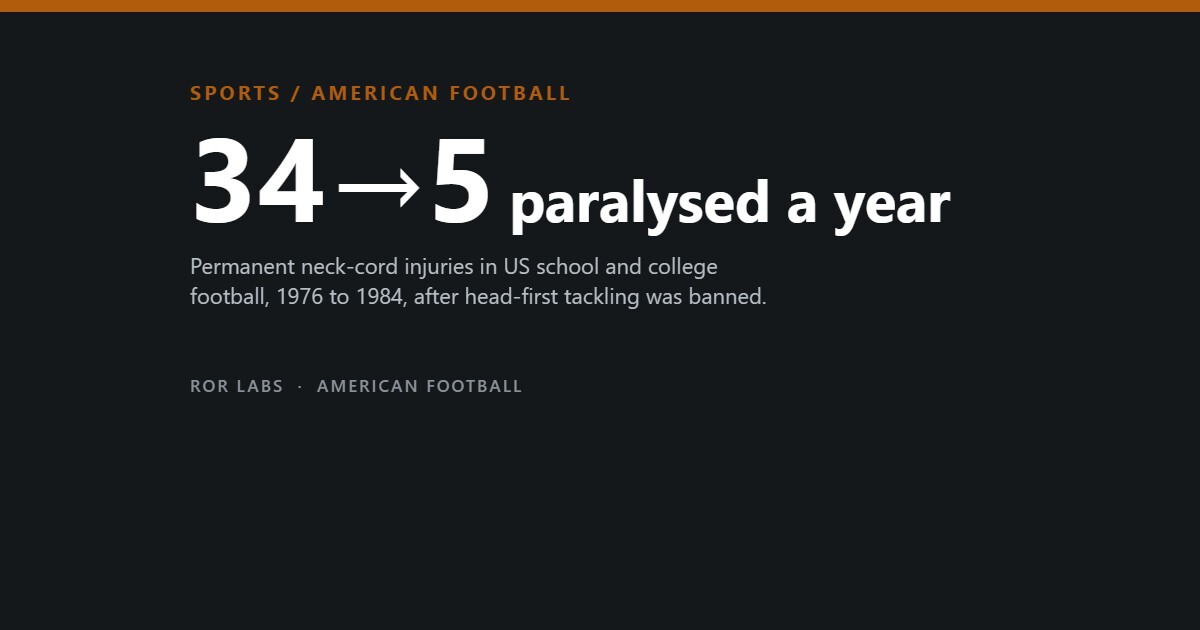
- After the 1976 ban on spearing and initial helmet contact, permanent quadriplegia in US high school and college football fell from 34 cases in 1976 to five in 1984.
- The mechanism is axial loading: a lowered head straightens the neck, which is crushed between the stopped head and the moving body. Helmets cannot prevent it.
- Tacklers carry most of the risk: about two thirds of cord injuries happen while tackling, and defensive backs account for nearly a third. College rates are higher per player.
- Since about 1980 the annual count has plateaued, film studies found head-down contact persisting, and evidence for tackling programmes remains limited.
On Friday 22 August 2025, a 15-year-old freshman at Tuscarawas Valley High School in Ohio went in to make a tackle in his first football game and did not get up. He had fractured the fourth vertebra in his neck, and the broken bone was pressing on his spinal cord. After surgery at Akron Children’s Hospital, his mother said he could shrug his shoulders and move his right arm, but not his hand or his legs.
Fifty years ago this happened far more often. In 1976 a national registry run by the orthopaedic surgeon Joseph Torg counted 34 high school and college players left permanently paralysed by neck injuries. That was the season new NCAA and high school rules took effect, banning spearing and the use of the top of the helmet as the first point of contact in a tackle or block. By 1984 the count was five.
This article covers what a head-first hit does to the neck, which players and which levels carry most of the risk, what the 1976 rule, tackling programmes and on-field care have been shown to change, why the success story is less tidy than it sounds, and why the sensible answer is to play carefully rather than to stop.
What a head-first hit does to the neck
Torg’s group combined injury reports with game film, and found that most cervical fractures and dislocations came from axial loading: a blow to the crown of the helmet with the head lowered. The neck normally curves; dropping the head about 30 degrees straightens it into a column. When the head stops dead, the body keeps moving and the spine is compressed between the two, like a column loaded from both ends.
The forces are not close. A position statement from the National Athletic Trainers’ Association put the energy needed to reproduce a cervical fracture-dislocation in the laboratory at about 200 joules, and the energy of a running player at about ten times that. Helmets protect the skull, not the neck. Clinicians writing in 2003 noted that no available helmet could prevent catastrophic neck injury, and a 2022 trainers’ statement traced spear tackling itself to the false security of hard-shell helmets.
Football deaths from neck injuries, by decade
Direct fatalities from cervical spine injuries recorded by the US annual football injury survey. The 1976 rule falls between the third and fourth rows.
Source: Kucera, Colgate and Cantu, Annual Survey of Football Injury Research 1931–2025, National Center for Catastrophic Sport Injury Research (2026), Table VIII.
Death is now the rarer outcome; paralysis is the usual catastrophe. Barry Boden and colleagues reviewed 196 catastrophic high school and college football injuries reported from 1989 to 2002 and found about 15 direct catastrophic cervical injuries a year. Seventy-six players were left quadriplegic, close to six a year. Far more common are passing injuries: stingers, a burning pain down one arm from a stretched nerve, and brief spinal cord concussion that resolves within minutes or hours.
Where the risk concentrates
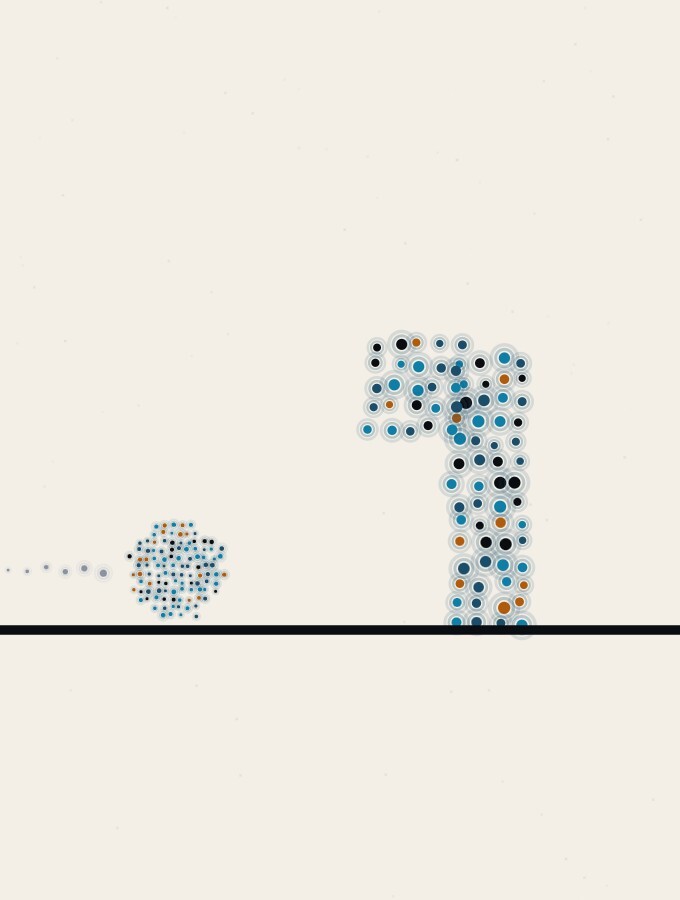
The person most at risk is the tackler, not the ball carrier. The University of North Carolina’s National Center for Catastrophic Sport Injury Research has logged 403 cervical spinal cord injuries with incomplete recovery in American football since 1977. Almost two thirds happened while making a tackle, and defensive backs alone accounted for nearly a third. Spear tackling by defenders remained the main mechanism of quadriplegia in Boden’s data, more than a decade after the ban.
Technique explains part of this. In a Texas study published in 2020, 75% to 83% of youth, middle school and high school coaches who answered a survey said they taught the “head across the bow” tackle, in which the tackler puts his head in front of the runner. On game film, players using it dropped their heads in 55% of attempts, against 5% for arm or shoulder tackles, and they missed more often too.
Who is hurt, and doing what
Share of cervical spinal cord injuries with incomplete recovery in US football, all levels, 1977 to 2024 (403 cases). Rows do not sum to 100% because some cases were unknown.
Source: Kucera and Cantu, Annual Survey of Catastrophic Football Injuries 1977–2024, National Center for Catastrophic Sport Injury Research (2024).
High school produces most of the cases simply because about 1.1 million players take part, against roughly 75,000 to 100,000 in college; four in five injuries in the survey were in middle and high school players. Per player, college is riskier. From 1989 to 2002 the rate of catastrophic cervical injury was 1.10 per 100,000 high school players and 4.72 per 100,000 college players, and the gap for quadriplegia was smaller.
High school against college, per 100,000 players a season
Catastrophic cervical injuries in football. Single recent years swing widely because the counts are so small.
Sources: Boden et al., American Journal of Sports Medicine (2006); Kucera and Cantu, NCCSIR annual catastrophic football report (2024).
The professional game is not immune, but its rate is lower than its reputation. A 2016 systematic review of elite contact sports put the rate of catastrophic cervical injury in the National Football League at 0.6 per 100,000 player-exposures, a single game or practice for one player, and rated that estimate as high-quality evidence. In rugby league, too, the tackle caused 78% to 100% of these injuries.
What has been measured to work
The rule is the clearest success. Torg’s registry identified axial loading in a preliminary analysis in 1975, and the college and high school rules that took effect in 1976 banned spearing and initial contact with the top of the helmet. Permanent quadriplegia fell from 34 cases in 1976 to 12 in 1977 and five in 1984. Cervical fractures, dislocations and subluxations at all levels fell from 110 in 1976 to 42 in 1984.
Rates fell as well as counts. Among high school players, cervical fractures and dislocations dropped from 7.72 per 100,000 in 1976 to 2.31 in 1987, almost threefold. The surveillance centre calls the 1976 rule change “of utmost importance”, and adds a second credit for deaths: the helmet standard of the National Operating Committee on Standards for Athletic Equipment, adopted by the NCAA in 1978 and by high schools in 1980.
Before and after the 1976 rule
Counts from the National Football Head and Neck Injury Registry; the rate is per 100,000 high school players.
Sources: Torg et al., JAMA 254:3439 (1985); Torg et al., American Journal of Sports Medicine (1990), as reported by Stockwell et al., Orthopaedic Journal of Sports Medicine (2020).
The story is less tidy after that. The big drop happened once, between 1976 and 1977, and then stopped. In the national survey, the five-year average of cord injuries with incomplete recovery stayed between about six and eleven a year from 1980 to 2019. When John Heck studied high school game film from 1975 and 1990, he counted almost exactly as many spears after the ban as before, 44 against 43. In nine filmed games from a 1989 New Jersey season, no spearing penalty was called at all.
The plateau after the drop
Average cervical spinal cord injuries with incomplete recovery per year in US football, all levels, by five-year period. The most recent period includes the pandemic-disrupted 2020 season.
Source: Kucera and Cantu, NCCSIR annual catastrophic football report (2024), Table I. The centre warns that its counts are an underestimate, the “tip of the iceberg”.
The counting itself is fragile. The surveillance centre relies on media reports, direct reports from schools and an online portal, and says its numbers underestimate the true total. With so few cases, single years jump around: the high school rate went from 0.09 per 100,000 in 2020 to 0.73 in 2022. Tackling education looks promising, but no study has measured its effect on catastrophic neck injury.
A 2022 trainers’ position statement found little to no high-quality evidence for head-safe tackling programmes. USA Football’s Heads Up programme was linked to fewer concussions in one high school cohort but was inconsistently implemented. Helmetless tackling drills cut head impacts by about 30% in a randomised trial, and the NFL-promoted “hawk” rugby-style tackle has no published evidence yet. On-field care has clearer guidance: a 2020 consensus says remove the face mask before transport, and warns that taking off the helmet without the shoulder pads can throw the neck out of line.
Why the answer is not to stop playing
Measured against the number of players, the risk is very small. In 2023 and 2024 the survey recorded three high school cord injuries with incomplete recovery each year, a rate of 0.27 per 100,000, or roughly one for every 370,000 players a season. Catastrophic injury rates across high school and college sports have been below 0.5 per 100,000, and gymnastics, ice hockey and cheerleading have had higher rates per participant than football, with fewer players.
The lesson of 1976 is that a rule aimed at a clearly defined mechanism moved the whole distribution down, without ending the sport. Torg argued that the same approach could work in diving, rugby and ice hockey. Football did it again later with kickoffs, a story told in our article on the rule that worked. What remains is the residue: the head that drops at the last instant, in a game where most players never meet the worst outcome.
Play carefully. Teach contact with the shoulder and chest, with the head up and out of the hit, and drill it until it is automatic; coaches can drop the head-across-the-bow tackle. Officials should call head-first contact every time. Schools should have an athletic trainer, face-mask tools and a rehearsed plan. A player with burning or weakness in both arms or legs, or neck pain after a hit, should stay down and not be moved until trained help arrives.
Questions people ask
How common are paralysing neck injuries in football?
Rare. US surveillance recorded an average of 4.6 cervical cord injuries with incomplete recovery a year across all levels from 2020 to 2024, among more than a million high school players and about 100,000 college players.
Did the 1976 rule really work?
Permanent quadriplegia fell from 34 cases in 1976 to five in 1984, and neck deaths fell sharply in the following decade. Helmet standards and coaching share the credit, and since about 1980 the numbers have levelled off rather than kept falling.
Is high school or college football riskier for the neck?
High school has more cases because it has far more players. Per player, college rates have been higher, about four times higher for all catastrophic neck injuries in 1989 to 2002.
Should you take the helmet off an injured player?
Not unless you are trained. The 2020 consensus says the face mask should come off before transport for airway access, while helmet and shoulder-pad removal is for trained staff to decide; taking off the helmet alone can misalign the neck.
Does Heads Up or rugby-style tackling prevent neck injuries?
It is plausible and may reduce head impacts, but no study has shown that it lowers catastrophic neck injuries, and the evidence remains limited.
The short version
- After the 1976 ban on spearing and initial helmet contact, permanent quadriplegia in US high school and college football fell from 34 cases in 1976 to five in 1984.
- The mechanism is axial loading: a lowered head straightens the neck, which is crushed between the stopped head and the moving body. Helmets cannot prevent it.
- Tacklers carry most of the risk: about two thirds of cord injuries happen while tackling, and defensive backs account for nearly a third. College rates are higher per player.
- Since about 1980 the annual count has plateaued, film studies found head-down contact persisting, and evidence for tackling programmes remains limited.
- The current risk is about one in 370,000 high school players a season. Tackle with the shoulder, head up, and never move a player with a suspected neck injury.
This is a summary of published research, not medical advice. If a player has neck pain, numbness, tingling or weakness after a hit, keep them still and call emergency services; anyone with recurring stingers or neck symptoms should see a doctor or physiotherapist before returning to contact.
Further reading: Torg et al., JAMA 254:3439 (1985), for the registry that led to the rule. Swartz et al., Journal of Athletic Training 57(2):113 (2022), for the evidence on head-first contact. Mills et al., Journal of Athletic Training 55(6):563 (2020), for on-field care of a suspected neck injury.
- Proof, Adam Kucharski (2025). An epidemiologist on how we decide something is true; useful for judging how much credit a single rule change deserves.
- The Scout Mindset, Julia Galef (2021). Julia Galef on trying to see things as they are; useful when a success story looks tidier than the numbers behind it.
- Fluke, Brian Klaas (2024). A political scientist on chance and small causes; a reminder of why one bad year in a tiny count can mislead.
Sources
- Torg JS, Vegso JJ, Sennett B. The National Football Head and Neck Injury Registry: 14-year report on cervical quadriplegia, 1971 through 1984. JAMA 254:3439–3443 (1985).
- Torg JS, Vegso JJ, O’Neill MJ, Sennett B. The epidemiologic, pathologic, biomechanical, and cinematographic analysis of football-induced cervical spine trauma. American Journal of Sports Medicine (1990), doi:10.1177/036354659001800109.
- Torg JS. Epidemiology, pathomechanics, and prevention of athletic injuries to the cervical spine. Medicine and Science in Sports and Exercise (1985), doi:10.1249/00005768-198506000-00001.
- Chao S, Pacella MJ, Torg JS. The pathomechanics, pathophysiology and prevention of cervical spinal cord and brachial plexus injuries in athletics. Sports Medicine, published online December 2009, doi:10.2165/11319650-000000000-00000.
- Bhamra JS, Morar Y, Khan WS, Deep K, Hammer A. Cervical spine immobilization in sports related injuries: review of current guidelines and a case study of an injured athlete. Open Orthopaedics Journal 6:548 (2012).
- Heck JF, Clarke KS, Peterson TR, Torg JS, Weis MP. National Athletic Trainers’ Association position statement: head-down contact and spearing in tackle football. Journal of Athletic Training (2004), PMID 15085218.
- Kim DH, Vaccaro AR, Berta SC. Acute sports-related spinal cord injury: contemporary management principles. Clinics in Sports Medicine (2003), doi:10.1016/s0278-5919(02)00105-9.
- Kucera KL, Colgate B, Cantu RC. Annual Survey of Football Injury Research 1931–2025. National Center for Catastrophic Sport Injury Research, University of North Carolina at Chapel Hill, report 2026-01 (12 March 2026).
- Kucera KL, Cantu RC. Annual Survey of Catastrophic Football Injuries 1977–2024. National Center for Catastrophic Sport Injury Research, University of North Carolina at Chapel Hill (2024).
- Boden BP, Tacchetti RL, Cantu RC, Knowles SB, Mueller FO. Catastrophic cervical spine injuries in high school and college football players. American Journal of Sports Medicine (2006), doi:10.1177/0363546506288306.
- Rihn JA, Anderson DT, Lamb K, et al. Cervical spine injuries in American football. Sports Medicine (2009), doi:10.2165/11315190-000000000-00000.
- Stockwell DW, Blalock R, Podell K, Marco RAW. At-risk tackling techniques in American football. Orthopaedic Journal of Sports Medicine (2020), doi:10.1177/2325967120902714; includes summaries of Heck’s high school film studies of 1975, 1989 and 1990.
- Hutton MJ, McGuire RA, Dunn R, et al. Catastrophic cervical spine injuries in contact sports. Global Spine Journal 6(7) (2016), doi:10.1055/s-0036-1586744.
- Swartz EE, Register-Mihalik JK, Broglio SP, et al. National Athletic Trainers’ Association position statement: reducing intentional head-first contact behavior in American football players. Journal of Athletic Training 57(2):113 (2022), doi:10.4085/1062-6050-0062.21.
- Mills BM, Conrick KM, Anderson S, et al. Consensus recommendations on the prehospital care of the injured athlete with a suspected catastrophic cervical spine injury. Journal of Athletic Training 55(6):563 (2020), doi:10.4085/1062-6050-0434.19.
- Cantu RC, Mueller FO. The prevention of catastrophic head and spine injuries in high school and college sports. British Journal of Sports Medicine (2009), doi:10.1136/bjsm.2009.067728.
- High school football player in Ohio paralyzed after tackle during game. CBS News Pittsburgh, 1 September 2025; Haynes N. Tuscarawas County high school football player paralyzed after injury during game. Cleveland 19 News, 23 August 2025.