Tear Gas and Pepper Spray Health Effects: What the Evidence Shows
Key takeaways · 16 min read
- For most people, tear gas and pepper spray cause intense but short-lived pain, tears and coughing; official guidance says effects usually fade within 15 to 30 minutes of fresh air and washing.
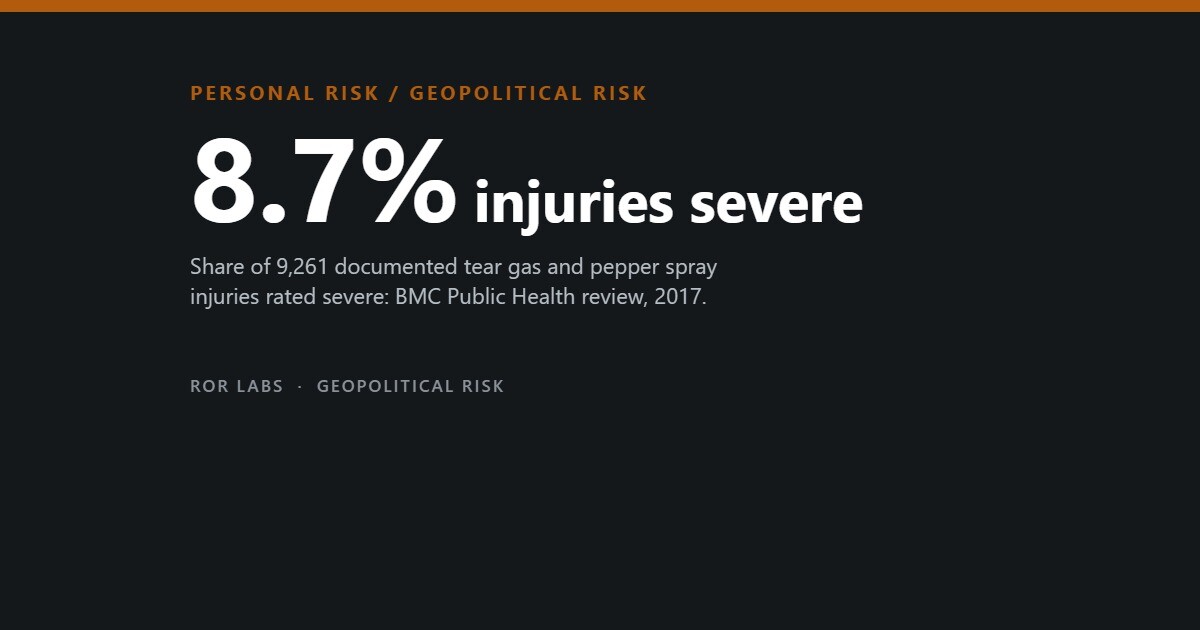
- A systematic review of 9,261 documented injuries found 8.7% were severe; 58 people had a permanent disability and two died.
- The canister itself causes some of the worst harm: 27% of injuries from projectile munitions were severe, and 73 involved the head or neck.
- Enclosed spaces, heavy or repeated exposure and pre-existing lung disease raise the risk; infants and older adults appear more vulnerable.
Tear gas is sold and used on the premise that it hurts without harming. Fired into a crowd, it causes stinging eyes, coughing and panic, and people are meant to move away and recover within the hour. For most people, most of the time, that is roughly what happens. The question this article asks is how often it does not, and what the evidence says about the cases at the edges.
The answer is less tidy than either side of the argument admits. There is no register of everyone exposed, so no one can say what share of people are seriously hurt. What exists is a patchwork of injury reviews, online surveys, emergency records, military training data and small toxicology studies.
This article sets out what those sources show about injuries, lasting harm, canister impacts, people at higher risk, the lungs and the much-discussed reports of menstrual changes, then the international rules. It gives no tactical detail, takes no side on any protest, and its first-aid content goes no further than official public-health guidance.

What these agents are
“Tear gas” is a loose label. The most common agent fired in canisters and grenades is CS, a fine powder dispersed as smoke or aerosol. Pepper spray uses oleoresin capsicum, or OC, the extract that makes chillies hot, usually in a liquid spray. All of them trigger pain-sensing nerve receptors in the eyes, airways and skin, which is why the effect is so fast.
The US Centers for Disease Control and Prevention lists the immediate effects as tearing, burning and blurred vision, a runny nose, chest tightness, coughing, a choking sensation, and burns or rash. It says these usually last 15 to 30 minutes once a person is away from the source and cleaned off. It also warns that prolonged or heavy exposure can cause lasting eye damage, breathing problems such as asthma, and respiratory failure that may be fatal.
The best overall count
The most complete summary is a 2017 systematic review in BMC Public Health by Rohini Haar and colleagues, working with Physicians for Human Rights. They searched for injuries, disabilities and deaths from chemical irritants worldwide between 1990 and 2015 and found 31 studies from 11 countries: protests, arrests, training exercises, accidents and a detention-centre riot. Together these described 5,131 injured people with 9,261 separate injuries, most of them to the skin, eyes and heart and lungs.
Most injuries were minor, not all
Severity of 9,261 documented injuries from tear gas and pepper spray in 31 studies, %.
Source: Haar RJ et al., BMC Public Health (2017), doi:10.1186/s12889-017-4814-6. Counts injuries, not people; each person could have several. Only people who reached medical care or researchers are included.
Most injuries were minor, but 8.7% were rated severe, meaning they needed professional medical management. Fifty-eight people were left with a permanent disability and two died: a man in Bahrain who stopped breathing after CS was fired inside his home, and a protester in Nepal whose brain injury was caused by a projectile. Permanent harms included lost sight, amputations, persistent breathing complaints in 23 people and lasting psychiatric symptoms in 14.
The denominator is the catch. Because no study counted how many people were exposed, these numbers describe injured people who reached care, not the risk to anyone in a crowd. The authors say serious harm is probably under-reported, since there is no systematic reporting and follow-up was short; but published case reports also lean towards dramatic incidents. Both biases are real, and the review cannot say which is larger.
Share of injuries rated severe
Severe injuries as % of all documented injuries, by agent, form and mechanism. Not a like-for-like comparison.
Source: Haar RJ et al., BMC Public Health (2017). The authors did not compare agents or forms statistically because the settings differed too much.
The split by agent is striking: 27.9% of CS injuries were severe against 6% for pepper spray. But the authors warn against reading it as a ranking: the studies differed in setting, dose and form of agent, so they did not compare the two statistically. A 2020 review of 22 documents on pepper spray in policing likewise found injuries were usually minor, while stressing how limited the research is.
What protest surveys report
Surveys of people exposed during protests give a fuller picture of common, non-hospital effects. The largest was run in Portland, Oregon, in summer 2020, when tear gas was used on many nights. Researchers led by Britta Torgrimson-Ojerio collected web responses from 2,257 adults who reported recent exposure, published in BMC Public Health in 2021. Most had been exposed at a protest, typically on two to four days.
Portland 2020: what respondents reported
Adults reporting recent tear gas exposure, % reporting each issue (2,257 respondents; menstrual changes among 1,650).
Source: Torgrimson-Ojerio BN et al., BMC Public Health (2021), doi:10.1186/s12889-021-10859-w. Self-selected online sample; self-reported symptoms, not clinically assessed.
Classic symptoms faded fast: excessive tearing fell by about 90% within a day or two. Yet 77.5% still reported some physical issue a day or two later, most often in the chest, and 72.4% reported anxiety, fear or similar feelings. Reports rose with the number of days exposed. Over half received or planned to seek care, though immediate help came mostly from volunteer medics, not hospitals.
The authors are frank about the weaknesses. People who felt worse were probably more likely to answer, symptoms were self-reported and not examined, and exposure to gas came with exposure to other force and to stress. Surveys elsewhere show a similar pattern. In Santiago, Chile, 62.5% of 112 exposed residents and volunteer health workers reported eye pain and 54.4% breathing difficulty; in a congress abstract from Turkey, cough lasted a median of 15 days.
The canister is also a projectile
Some of the worst harm associated with tear gas has nothing to do with chemistry. Canisters and grenades are metal or hard plastic objects launched at speed, and when they strike someone they behave like any other blunt or penetrating projectile. They can also be hot enough to burn. In the Haar review, projectile munitions caused 231 injuries, of which 27% were severe, the highest share of any mechanism apart from CS itself.
Where canister impacts landed
Injuries caused by the impact of chemical-irritant projectile munitions, by body region, number of injuries.
Source: Haar RJ et al., BMC Public Health (2017). At least four people lost vision in an eye, three needed amputations and ten lost function in a limb.
Seventy-three of those injuries were to the head or neck, and at least four people lost the sight of an eye. Eighteen of the 58 permanent disabilities in the review came from impacts, not from the chemical. A 2020 neurosurgery meeting abstract from Baghdad described ten young men, aged 14 to 19, with penetrating head wounds from canisters during the 2019 protests. Rubber bullets and similar projectiles are a separate subject, covered in another article on this site.
This is also where guidance is clearest. The 2020 United Nations human rights guidance on less-lethal weapons says irritant projectiles should generally not be fired at an individual, and never at the head or face, because of the risk of death or serious injury from impact.
Lungs and repeated exposure
The cleanest evidence on breathing comes, perhaps surprisingly, from the army. US recruits walk through a CS-filled chamber as part of training, so exposure can be measured. A study of 6,723 recruits at Fort Jackson in 2012, by Joseph Hout and colleagues in Military Medicine, found the risk of being diagnosed with an acute respiratory illness was 2.44 times higher after the chamber than before, and rose with concentration.
Breathing: four kinds of evidence
Selected studies of tear gas and respiratory health, by design.
| Study | Design | Finding |
|---|---|---|
| Hout 2014, 6,723 US Army recruits | Measured CS exposure in training | Respiratory illness risk 2.44 times higher after exposure |
| Hout 2014, 5,298 recruits after a rule change | Same, after concentrations cut tenfold | Risk still raised, 1.79 times |
| Arbak 2014, 93 frequently exposed men vs 55 unexposed | Questionnaire and lung tests | Cough and phlegm over 3 months: 24.7% vs 11.3% |
| Huerta 2023, six emergency centres, Concepción, Chile | Emergency records, uprising vs year before | Infants’ and older adults’ share of respiratory visits up about 1.4 points |
Sources: Hout JJ et al., Military Medicine 179(7) (2014); Hout JJ et al., Open Epidemiology Journal 7 (2014); Arbak P et al., Scientific World Journal (2014), article 963638; Huerta P et al., BMJ Open 13(6):e067548 (2023).
After the army reduced chamber concentrations about tenfold in 2013, a second study of 5,298 recruits found the risk was lower but still raised, at 1.79 times. That suggests a dose-response relationship in young, healthy, screened adults. The limitation is the reverse of the protest surveys: the measurement is good, but the people are not typical of a crowd, which may include children, older people and people with asthma.
Longer-term evidence is thinner. A Turkish study compared 93 men exposed many times with 55 who were not, and found more long-lasting cough and phlegm and more chest tightness among the exposed; but the exposed group also smoked more heavily, which muddies the result. A French case report describes asthma in a teacher whose classroom was repeatedly reached by tear gas. Such cases show lasting harm is possible, not how common it is.
Who is more vulnerable
Tear gas does not stay where it is aimed. It drifts with the wind into side streets, homes, shops and schools, so people who are not part of a protest are often exposed. Reviews consistently name the same higher-risk groups: young children, older adults, people with asthma or other lung or heart disease, and anyone who cannot easily move away. Direct evidence for each group is limited, and much of it comes from case reports.

The Chilean study is one of the few population-level clues. During the 2019 uprising in Concepción, when tear gas was used heavily in residential areas, infants’ share of respiratory emergency visits rose from 5.74% to 6.98% and older adults’ share rose by a similar margin, with more bronchitis and bronchiolitis. The authors could not measure who was exposed; they compared time periods, so other changes during the unrest could have played a part.
Setting matters as much as the person. A 2015 systematic review of CS by Yannis Dimitroglou and colleagues found that life-threatening and long-term effects were linked to exposure in confined or enclosed spaces. Haar’s review adds heat, humidity and crowded places with no way out. The UN guidance says chemical irritants should not be used in confined spaces with no viable exit or ventilation, because of the risk of asphyxiation.
For pregnancy, the honest answer is that almost nothing is known. Safety testing was largely done in healthy adult volunteers or animals; a 2016 review in the Annals of the New York Academy of Sciences notes that one study of airway effects used just seven healthy military volunteers. Absence of evidence here means the question has barely been studied, not that the risk is zero.
The menstrual question
After the 2020 protests in the US, many people reported unusual periods after being gassed: early or heavy bleeding, cramping, spotting. The claim spread widely online. It is plausible enough to take seriously, but the evidence so far comes almost entirely from self-selected online surveys.
Menstrual changes: what has been studied
Studies of tear gas exposure and menstrual or reproductive symptoms. None used medical records or an unexposed comparison group.
| Study | Sample | Main result |
|---|---|---|
| Torgrimson-Ojerio 2021, Portland | 1,650 who could menstruate, online convenience sample | 54.5% reported menstrual or breast changes |
| Hassan 2023, US | 1,276 recruited via social media and email lists | 83% any symptom; odds 2.6 times higher with 5 or more exposure days |
| Mahfud 2020, France (preprint) | 145 female protesters | Positive link; authors call it preliminary |
| Reece 2026, US (preprint) | 82 women aged 18 to 45 | More symptoms with repeated exposure; acute symptoms not linked |
Sources: Torgrimson-Ojerio BN et al., BMC Public Health (2021); Hassan A et al., Front Epidemiol (2023), doi:10.3389/fepid.2023.1177874; Mahfud Y et al., PsyArXiv preprint (2020), doi:10.31234/osf.io/y5wcm; Reece EK et al., Preprints.org (2026), doi:10.20944/preprints202605.1517.v1.
The largest study, by Asha Hassan and colleagues in Frontiers in Epidemiology, found that 83% of 1,276 respondents reported at least one change, and that people exposed on five or more days had 2.6 times the odds of a change compared with one day. That looks like a dose-response pattern. But respondents were recruited through social media and Planned Parenthood email lists, and the authors note that those most affected were likely the most willing to answer.
One result shows how fragile the data are: people using hormones had 38 times the odds of reporting a change, which the authors attribute to who was sampled rather than biology. The two other studies are preprints, not yet peer reviewed, with 145 and 82 participants. None compared exposed people with a similar unexposed group or checked medical records. A link is possible; it has not been established, and the size of any effect is unknown.
Rules and first aid

Tear gas sits in an odd legal position. The Chemical Weapons Convention defines riot control agents as chemicals that rapidly cause sensory irritation or disabling effects that disappear shortly after exposure ends. States that join undertake not to use them as a method of warfare. Yet the same treaty expressly allows them for law enforcement, including domestic riot control. A chemical banned on the battlefield can therefore be lawful on a city street.
Within that space, rules vary widely. The UN guidance sets out principles rather than law: it describes the aim as getting a group to disperse and refrain from violence, says canisters should not be fired at people’s heads or faces, rules out confined spaces without an exit, and says anyone exposed should be decontaminated as soon as possible. In the news card above, Berkeley voted narrowly to keep its 2020 ban on police tear gas; elsewhere, national and local rules differ.
For anyone exposed, the CDC’s public guidance is simple: get away from the area and into fresh air; remove contaminated clothing; wash skin with plenty of soap and water; rinse burning eyes with plain water for 10 to 15 minutes; seal the clothing in plastic bags; and call the emergency number. Breathing difficulty, chest pain, an eye injury, a blow from a canister or symptoms that do not settle need prompt medical care.
What the evidence suggests
For most healthy adults briefly exposed outdoors, tear gas and pepper spray cause short-lived, intensely unpleasant symptoms that resolve. That is not the whole story. Serious harm is documented, concentrated in enclosed spaces, heavy or repeated exposure, people with lung disease, and impacts from canisters. Lasting breathing problems are possible but poorly measured, and claims about menstrual changes rest on weak, self-selected surveys. And because no one counts how many people are exposed, true risk cannot be calculated.
What to do
Steps sorted by when they matter. Each one says how strong the evidence is: Measured Official advice Untested
If it happens
- Get out of confined or enclosed spaces. Life-threatening effects were linked to exposure where there was no way out. Measured see Sources
- Move young children, older adults and anyone with asthma or heart disease away first. They are the groups reviews name as most at risk. Official advice see Sources
Afterwards
- Seal contaminated clothing in plastic bags. Get medical care for symptoms that do not settle. Official advice see Sources
Questions people ask
How long do the effects of tear gas last?
The CDC says effects usually last 15 to 30 minutes after leaving the area and washing off. In surveys, many people report cough or chest symptoms for days.
Can tear gas cause permanent damage?
Rarely, yes. A review of 31 studies found 58 people with permanent disabilities, including lost sight and persistent asthma, many from canister impacts.
Is pepper spray safer than tear gas?
Documented pepper-spray injuries were less often severe, but they came from different settings, so the data cannot prove one is safer.
Does tear gas affect periods?
Many people have reported changes, but the studies are self-selected surveys without comparison groups. A link is possible and has not been established.
Is tear gas banned under international law?
Its use as a method of warfare is banned under the Chemical Weapons Convention, but the treaty permits it for law enforcement, including riot control.
The short version
- For most people, tear gas and pepper spray cause intense but short-lived pain, tears and coughing; official guidance says effects usually fade within 15 to 30 minutes of fresh air and washing.
- A systematic review of 9,261 documented injuries found 8.7% were severe; 58 people had a permanent disability and two died.
- The canister itself causes some of the worst harm: 27% of injuries from projectile munitions were severe, and 73 involved the head or neck.
- Enclosed spaces, heavy or repeated exposure and pre-existing lung disease raise the risk; infants and older adults appear more vulnerable.
- Reports of menstrual changes come from self-selected surveys; a link is possible but unproven, and no one knows how many people are exposed overall.
This article summarises published research and official guidance for general information. It is not medical advice and cannot assess anyone’s individual symptoms. If you or someone near you has been exposed and has trouble breathing, chest pain, an eye injury, a head or body injury from a projectile, or symptoms that do not ease, contact local emergency services or see a doctor promptly.
Further reading: Haar et al., BMC Public Health (2017), for the systematic review of injuries and deaths. Torgrimson-Ojerio et al., BMC Public Health (2021), for the Portland survey. The United Nations Human Rights Guidance on Less-Lethal Weapons in Law Enforcement (2020), for international standards.
- Toxic: A History of Nerve Agents, Dan Kaszeta (2020). A chemical-defence specialist traces how chemical weapons were developed, used and regulated. Clear on the treaty background; it is about nerve agents, not tear gas.
- Handbook of Toxicology of Chemical Warfare Agents, edited by Ramesh C. Gupta (3rd edition, 2020). A reference work that includes the toxicology of riot control agents. Thorough and technical; written for specialists and priced accordingly.
- If We Burn, Vincent Bevins (2023). A journalist’s account of the mass protests of the 2010s, from Brazil to Hong Kong. Good on the political context; it is not a health book and is one writer’s interpretation.
Sources
Haar RJ, Iacopino V, Ranadive N, Weiser SD, Dandu M. Health impacts of chemical irritants used for crowd control: a systematic review of the injuries and deaths caused by tear gas and pepper spray. BMC Public Health (2017), doi:10.1186/s12889-017-4814-6. — Torgrimson-Ojerio BN, Mularski KS, Peyton MR et al. BMC Public Health (2021), doi:10.1186/s12889-021-10859-w. — Hassan A, Ojanen-Goldsmith A, Hing AK et al. Front Epidemiol (2023), doi:10.3389/fepid.2023.1177874. — Mahfud Y, Samuel A, Çelebi E, Adam-Troian J. PsyArXiv preprint (2020), doi:10.31234/osf.io/y5wcm. — Reece EK, Unseld M, Gaskins JT et al. Preprints.org (2026), doi:10.20944/preprints202605.1517.v1. — Hout JJ, White DW, Artino AR, Knapik JJ. Military Medicine 179(7) (2014). — Hout JJ et al. Open Epidemiology Journal 7 (2014). — Arbak P, Başer İ, Kumbasar ÖÖ et al. Scientific World Journal (2014), article 963638. — Huerta P, Cifuentes M, González M, Ugarte-Avilés T. BMJ Open 13(6):e067548 (2023). — Dimitroglou Y, Rachiotis G, Hadjichristodoulou C. Int J Environ Res Public Health 12(2):1397 (2015). — Rothenberg C, Achanta S, Svendsen ER, Jordt SE. Ann N Y Acad Sci (2016), doi:10.1111/nyas.13141. — Jara Bravo C, Cernuda Martínez JA, Arcos González PI. Toxicol Res (2025), doi:10.1007/s43188-025-00282-3. — Bayeux-Dunglas MC et al. (1999), in French, PubMed 10549067. — Semple T, Jenkins B, Bennell C. Police Journal (2020), doi:10.1177/0032258X20926873. — Uslu E et al. Eur Respir J 44(Suppl 58) (2014), conference abstract. — Hoz SS et al. Neurosurgery (2020), meeting abstract, doi:10.1093/neuros/nyaa447_445. — US Centers for Disease Control and Prevention. Riot control agents, fact sheet (updated June 2026). — OHCHR. United Nations Human Rights Guidance on Less-Lethal Weapons in Law Enforcement (2020). — OPCW. Chemical Weapons Convention, Articles I and II. — The Daily Californian (29 September 2026).