PTSD Among Civilians in War Zones: What the Evidence Shows
Key takeaways · 13 min read
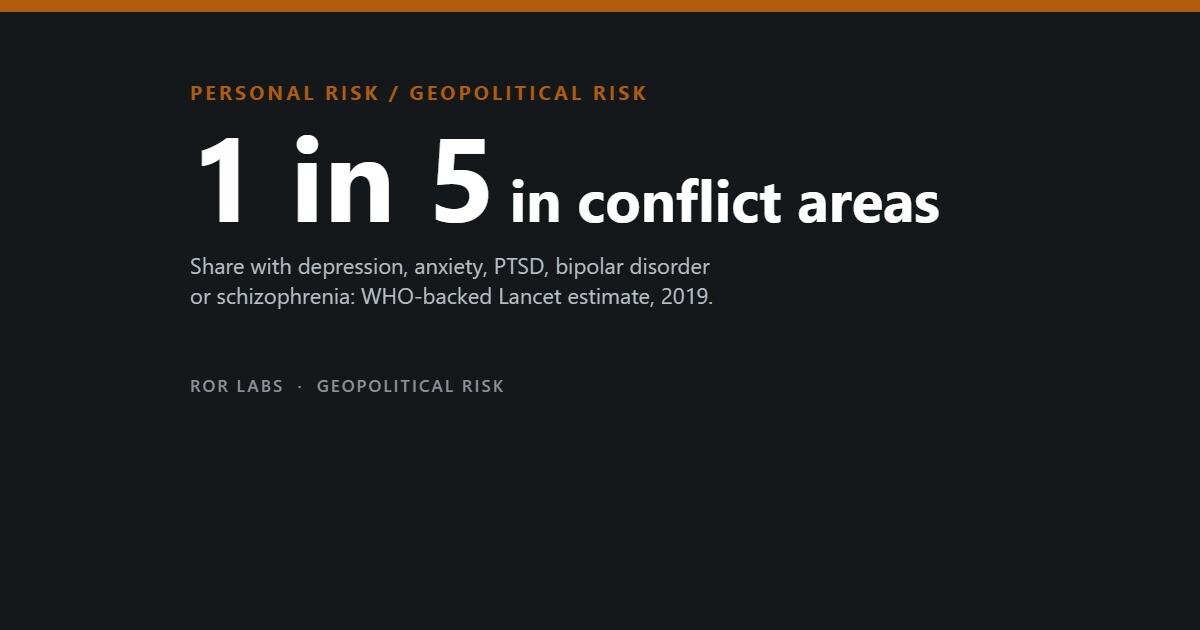
- WHO-backed modelling estimates that 22% of people living through recent conflict have depression, anxiety, PTSD, bipolar disorder or schizophrenia; about 9% have moderate or severe conditions.
- Estimates of PTSD alone range from 15% in the WHO model to about 26% in surveys using clinical interviews, depending on who was sampled and how.
- In Ukraine, a 2026 national telephone survey found 31.2% of adults met criteria for PTSD or complex PTSD.
- Most people exposed to war do not develop lasting PTSD: in one Israeli study, 70% followed a resilient path.
Wars are counted in deaths, injuries and people displaced. Their mental toll is harder to count and lasts longer. Civilians in conflict zones face bombing, loss of family and home, and months or years of uncertainty, and a substantial minority go on to develop post-traumatic stress disorder, depression or anxiety severe enough to disrupt daily life.
How large that minority is depends on who is asked and how. Published estimates for PTSD among civilians range from about 15% to over 40%, and the spread reflects the methods of the studies at least as much as the wars themselves. Behind every estimate is a second, quieter fact: most people who live through war do not develop lasting PTSD.
This article sets out what the main reviews found, why their numbers differ, what surveys in Ukraine show while the war continues, who is most at risk, and what research says about brief psychological support delivered by trained non-specialists. It deliberately avoids detail about violence itself, and it is general information, not a way to assess any individual.

What PTSD is
Post-traumatic stress disorder can follow exposure to a frightening or threatening event. Its core features are re-experiencing the event, for example through intrusive memories or nightmares; avoiding reminders; and a persistent sense of current threat, such as being easily startled or on edge. To count as a disorder, these symptoms must last weeks and cause real difficulty in daily life. Distress soon after a terrible event is a common, normal reaction, not in itself a disorder.
The World Health Organization’s classification, ICD-11, also includes complex PTSD, which adds lasting problems with managing emotions, a deeply negative view of oneself and difficulty in relationships. It is more often linked to prolonged or repeated trauma. In war zones, PTSD rarely comes alone: depression and anxiety are at least as common, and many people have more than one.
One in five
The reference figure comes from a 2019 study in The Lancet by Fiona Charlson, Mark van Ommeren and colleagues, carried out to update WHO’s estimates. Pooling 129 studies from 39 countries published between 1980 and 2017, and adjusting statistically for differences between them, they estimated that 22.1% of people in places affected by conflict in the previous ten years had depression, anxiety, PTSD, bipolar disorder or schizophrenia at any one time.
One in five, by severity
Estimated point prevalence of mental disorders in conflict-affected populations, %.
Source: Charlson F et al., Lancet 394(10194):240–248 (2019), doi:10.1016/S0140-6736(19)30934-1. Disorders: depression, anxiety, PTSD, bipolar disorder, schizophrenia. A modelled estimate.
Most of those conditions were mild: 13.0% of the population, against 4.0% moderate and 5.1% severe. For single disorders, the age-standardised estimates were 21.7% for anxiety disorders, 15.3% for PTSD and 10.8% for depression; the figures overlap because many people have more than one. WHO’s fact sheet on mental health in emergencies uses these numbers, and adds that almost everyone affected by an emergency feels distress, which for most people eases over time.
Which conditions
Age-standardised point prevalence in conflict-affected populations, %. People can have more than one.
Source: Charlson F et al., Lancet (2019). Bipolar disorder and schizophrenia were assigned global rates because data were too sparse.
The estimate is deliberately about whole populations. The review excluded refugees resettled in Western countries, combatants, people recruited from clinics and samples chosen because they had survived torture, all groups in which rates are usually higher. It also counts conditions present at one moment, not over a lifetime. That makes it a conservative figure for planning services, and a poor guide to any particular group, such as people who have been held captive or lost close family.
Why the numbers differ
Other reviews find higher figures. A widely cited 2009 meta-analysis in JAMA by Zachary Steel and colleagues reported that about 30% of people exposed to mass conflict and displacement had PTSD, and a similar share depression. But most of its samples were refugees or groups chosen because they had been through particular events, including torture, so it does not describe whole populations. Surveys that recruit people through clinics or support services also tend to find more illness than random household samples.
Same question, different answers
Pooled prevalence of PTSD among people exposed to war, by review, %. Methods and samples differ.
Sources: Steel Z et al., JAMA (2009), doi:10.1001/jama.2009.1132; Hoppen TH et al., BMJ Global Health 6(7):e006303 (2021); Morina N et al., J Affect Disord (2018), doi:10.1016/j.jad.2018.07.027; Hoppen TH, Morina N, Eur J Psychotraumatol (2019); Charlson F et al., Lancet (2019).
Tools matter too. Short self-report checklists are cheap but tend to count more cases than interviews by trained assessors, and most were developed in English and translated without formal testing. A 2021 review in BMJ Global Health by Thole Hoppen and colleagues used only random general-population surveys with clinical interviews and still found PTSD in 26.5% and depression in 23.3%. The WHO estimate is lower partly because it used stricter inclusion rules and adjusted statistically for differences between studies. All of these figures rest on a few dozen surveys.
Timing adds another layer. In Hoppen’s review, surveys took place on average almost seven years after the fighting ended, and none followed people over time, so they cannot say how many cases began, lasted or recovered. The surveys also disagreed sharply with each other: a heterogeneity statistic of 98% means that almost all the variation between them reflected real differences in setting or method, not chance. A single global number hides that spread.
Ukraine, measured during a war
Ukraine is the first large war in which researchers have run national mental-health surveys while the fighting continues. The results show how much method shapes the answer. The 2026 telephone survey in the news card, which sampled adults at random, found 25.2% with PTSD and 6.0% with complex PTSD. The researchers note that a phone survey may miss people without phones or in front-line roles, and that people may under-report symptoms to a stranger.
Ukraine: one war, several estimates
Share of adults in Ukraine meeting criteria for probable PTSD, by study design.
| Study | Design | PTSD |
|---|---|---|
| Facer-Irwin 2026, 2,504 adults | Random telephone sample | 25.2%, plus 6.0% complex PTSD |
| Wang 2024, 2,364 adults, spring 2023 | Online quota sample | 14.4%, plus 8.9% complex PTSD |
| Lushchak 2023, people not displaced | Online survey, symptom checklist | 32.8% above cut-off |
| Yasenok 2025, 6,036 adults, 2024 | Random population sample, adjusted | 15.0% to 41.2% by region and group |
Sources: Facer-Irwin E et al., Eur J Psychotraumatol (2026), via King’s College London; Wang S et al., Psychiatry Research (2024); Lushchak O et al., Lancet Regional Health – Europe (2023); Yasenok V et al., BMJ Global Health 10(8):e019557 (2025).
An online survey of 2,364 adults in spring 2023 found probable PTSD in 14.4% and complex PTSD in 8.9%. An earlier online survey using a symptom checklist put 32.8% of people who had not left home above its PTSD cut-off, and more among the displaced. A 2024 study with random population sampling in ten regions found PTSD estimates from 15.0% to 41.2%, higher in the south-east and centre than the north-west. Every figure is a snapshot of an ongoing war, not a final toll.
Who is most at risk
The strongest single predictor in Steel’s 2009 review was torture, followed by the number of traumatic events a person had been through. That dose pattern recurs. In the 2026 Ukrainian survey, people exposed to several traumatic events over their lives were more likely to meet criteria, as were women, older adults, people with less education, those who had served in the military and those displaced by the war. A 2023 Ukrainian survey also found a dose-response link between the number of war-related traumatic events and PTSD.
Daily stresses matter as well as frightening events. Displacement, unemployment, poverty and the loss of family and community networks keep people under strain long after the immediate danger has passed. Morina’s 2018 review found higher PTSD rates in samples with more women and more unemployment, and lower rates where more people lived with a partner. These are associations from surveys, so they show where need is concentrated rather than proving cause.
Resilience and recovery
The flip side of one in five is four in five. Even in the highest estimates, most people exposed to war do not meet criteria for PTSD. Studies that follow the same people over time show the pattern most clearly. An Israeli study of 1,231 adults, surveyed four times between 2018 and 2024, including after the attacks of 7 October 2023 and the war that followed, sorted people by how their symptoms changed over time.
About 70% followed a resilient path with consistently low symptoms, 9% had symptoms that then eased, 17% showed a more vulnerable pattern and 3.5% had chronic PTSD; the chronic group had more childhood trauma and more exposure to the war. Recovery over the longer term is also common. Summarising international surveys, Hoppen and Morina note that in mostly high-income countries about nine in ten people with war-related PTSD no longer met criteria after around ten years, though recovery may be slower where poverty and insecurity persist and care is scarce.
Most people follow a resilient path
PTSD symptom trajectories among Israeli adults surveyed in 2018, 2022, 2023 and 2024, % of sample.
Source: Levin Y et al., European Psychiatry (2025). 1,231 adults in a quasi-representative sample; self-reported symptoms. One population, one conflict.
Help that can reach many
Conflict zones rarely have enough psychiatrists or psychologists. WHO’s answer is a stepped approach: psychological first aid soon after events, the mhGAP Humanitarian Intervention Guide for general health workers, and brief psychological programmes that trained non-specialists can deliver. Two of these have been tested in randomised trials. Problem Management Plus is five weekly sessions on stress management, problem-solving and social support; in a 2016 trial with 346 adults in Peshawar, Pakistan, it led to lower anxiety and depression after three months.
Self-Help Plus in three trials
WHO’s five-session, audio-guided group course, compared with enhanced usual care.
| Trial | Soon after the course | Months later |
|---|---|---|
| Uganda, 694 South Sudanese refugee women | Distress reduced, effect size 0.72 | Smaller, 0.26 at 3 months |
| Turkey, 642 mainly Syrian refugees | – | Mental disorders at 6 months: 22% vs 41% |
| Western Europe, 459 refugees and asylum seekers | Risk of a disorder halved | No difference at 6 months |
Sources: Tol WA et al., Lancet Global Health (2020), doi:10.1016/S2214-109X(19)30504-2; Acartürk C et al., World Psychiatry (2022), doi:10.1002/wps.20939, via WHO; Purgato M et al., Psychother Psychosom (2021), doi:10.1159/000517504.
Self-Help Plus is a group course of five two-hour sessions led by briefly trained facilitators using recorded audio and an illustrated book. Among South Sudanese refugee women in Uganda it cut distress, with smaller benefits for PTSD and depression symptoms three months on. In Turkey, 22% of participants had a mental disorder six months later, against 41% in the comparison group. In Western Europe, the benefit seen just after the course had disappeared by six months. These programmes help many people a little, and for some the effect fades.
What the evidence suggests
War raises the burden of mental disorders well above peacetime levels: about one in five people in conflict-affected places has a condition such as depression, anxiety or PTSD, and around one in eleven a moderate or severe one. The exact share of PTSD is uncertain, from about 15% to over 25% in the main reviews, because samples and tools differ. Most people show resilience or recover with time. Brief, scalable programmes help in the short term, but their effects can fade, and people with severe or lasting symptoms need more specialised care.
Questions people ask
How common is PTSD among civilians in war zones?
The WHO-backed estimate is about 15% at any one time; reviews based on clinical interviews find around 24% to 27%. Estimates depend heavily on methods.
Does everyone who lives through war get PTSD?
No. Most people do not. Distress is common and normal at first, and for most people it eases over time.
What is complex PTSD?
A diagnosis in WHO’s ICD-11 that adds lasting problems with emotions, self-image and relationships to the core PTSD symptoms. It is linked to prolonged or repeated trauma.
Can PTSD get better without treatment?
Many people recover over months or years, but some do not, especially under continuing stress. Effective psychological treatments exist, and anyone struggling should seek professional help.
Do brief programmes like Self-Help Plus work?
In randomised trials they reduced distress soon after the course. Benefits were smaller months later, and in one European trial they had disappeared by six months.
The short version
- WHO-backed modelling estimates that 22% of people living through recent conflict have depression, anxiety, PTSD, bipolar disorder or schizophrenia; about 9% have moderate or severe conditions.
- Estimates of PTSD alone range from 15% in the WHO model to about 26% in surveys using clinical interviews, depending on who was sampled and how.
- In Ukraine, a 2026 national telephone survey found 31.2% of adults met criteria for PTSD or complex PTSD.
- Most people exposed to war do not develop lasting PTSD: in one Israeli study, 70% followed a resilient path.
- Brief group programmes delivered by non-specialists reduce distress in the short term, but the benefit can fade within months.
This article summarises published research for general information. It is not a screening or diagnostic tool and cannot tell you whether you or anyone else has PTSD. If you are struggling after traumatic events, talk to a doctor or a mental-health professional, or contact local mental-health or humanitarian support services. If you are in emotional crisis or thinking of harming yourself, contact local emergency services or a local crisis line straight away.
Further reading: Charlson et al., The Lancet 394 (2019), for the WHO prevalence estimates. Hoppen et al., BMJ Global Health 6(7) (2021), for the review limited to random population surveys. Tol et al., The Lancet Global Health (2020), for the Self-Help Plus trial in Uganda.
- What Happened to You?, Bruce D. Perry and Oprah Winfrey (2021). A psychiatrist and a broadcaster discuss how trauma shapes the brain and behaviour, and how people heal. Accessible and humane; it is about trauma in general, not war, and is light on population data.
- Diary of an Invasion, Andrey Kurkov (2023). A Ukrainian novelist’s account of the first months of the full-scale war as lived by civilians. Vivid on everyday life under strain; it is one writer’s view, not research.
- The Myth of Normal, Gabor Maté with Daniel Maté (2022). Argues that trauma and stress underlie much modern illness. Thought-provoking on social causes; some of its broad claims go beyond what the evidence shows.
Sources
Charlson F, van Ommeren M, Flaxman A, Cornett J, Whiteford H, Saxena S. New WHO prevalence estimates of mental disorders in conflict settings: a systematic review and meta-analysis. Lancet 394(10194):240–248 (2019), doi:10.1016/S0140-6736(19)30934-1. — World Health Organization. Mental health in emergencies, fact sheet (updated May 2025). — Steel Z, Chey T, Silove D et al. Association of torture and other potentially traumatic events with mental health outcomes among populations exposed to mass conflict and displacement. JAMA (2009), doi:10.1001/jama.2009.1132. — Morina N, Stam K, Pollet TV, Priebe S. J Affect Disord (2018), doi:10.1016/j.jad.2018.07.027. — Hoppen TH, Morina N. Eur J Psychotraumatol (2019), doi:10.1080/20008198.2019.1578637. — Hoppen TH, Priebe S, Vetter I, Morina N. BMJ Glob Health 6(7):e006303 (2021). — Facer-Irwin E et al. Eur J Psychotraumatol (2026), doi:10.1080/20008066.2026.2697563; King’s College London news release (30 September 2026); The Conversation (2026). — Wang S et al. Psychiatry Res (2024), doi:10.1016/j.psychres.2024.116056. — Lushchak O et al. Lancet Reg Health Eur (2023), doi:10.1016/j.lanepe.2023.100773. — Yasenok V et al. BMJ Glob Health 10(8):e019557 (2025). — Levin Y et al. Longitudinal PTSD trajectories before and after the October 7, 2023, terror attacks. European Psychiatry (2025). — Rahman A et al. JAMA (2016), Problem Management Plus trial in Peshawar; WHO feature story. — Tol WA et al. Lancet Glob Health (2020), doi:10.1016/S2214-109X(19)30504-2. — Acartürk C et al. World Psychiatry (2022), doi:10.1002/wps.20939; WHO news release (11 January 2022). — Purgato M et al. Psychother Psychosom (2021), doi:10.1159/000517504.