Fiber food sources and the trials that never matched the cohorts
Key takeaways · 9 min read
- The adequate intake is 38 g a day for younger men and 25 g for women; the typical American eats about 15.
- The target was derived from heart disease in three cohort studies, not from a trial.
- By the tablespoon, corn bran leads with 11.9 g — the part milling removes. By the serving, beans lead.
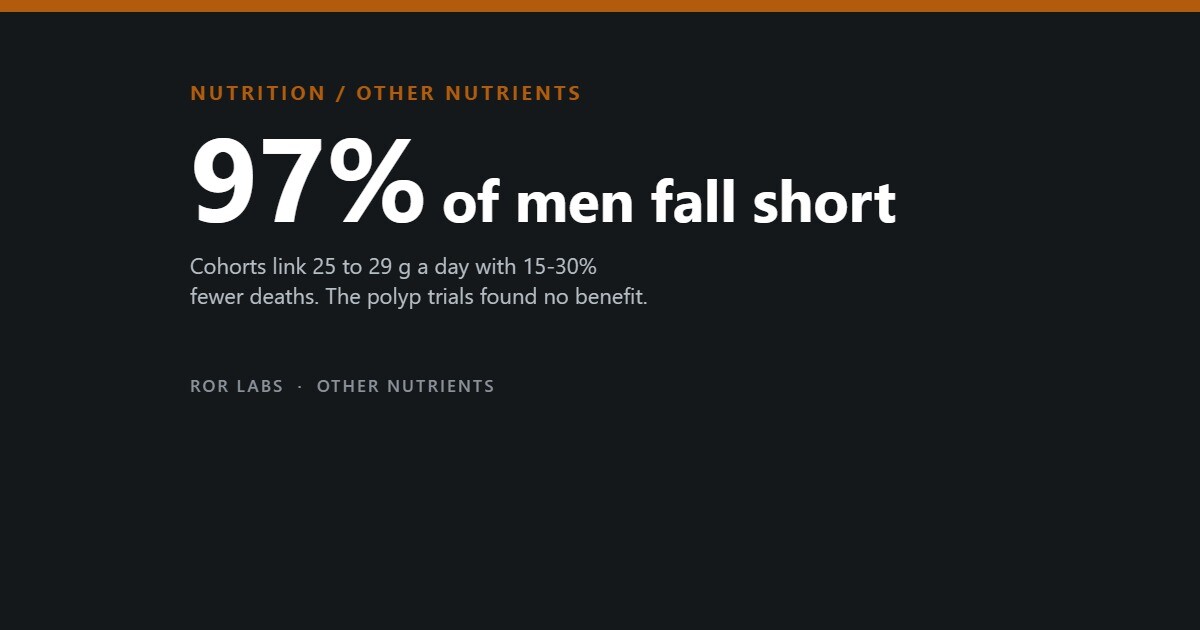
- The largest review links 25 to 29 g a day with 15 to 30% lower death rates, in cohort studies.
More than 90% of American women and 97% of men eat less dietary fibre than the guidelines recommend. That is not a gap at the edges. It makes fibre one of the few nutrients where falling short is the normal state, and the Dietary Guidelines for Americans name it a nutrient of public health concern.
The case for closing the gap rests mostly on large cohort studies, and they are strikingly consistent: people who eat more fibre die less often, from heart disease and from everything else. The randomised trials that tried to test the most famous claim — that fibre prevents bowel cancer — found nothing, and one found more polyps in the fibre group.
This article covers what fibre (fiber, in American spelling) does, which foods carry it by the tablespoon and by the serving, what low intake does, why the cohorts and the trials tell different stories, and what the word on a food label does and does not mean.
What fibre does, and where the target came from
Dietary fibre is the part of plant food that the small intestine cannot digest. Some of it dissolves and thickens into a gel, which slows how fast sugar is absorbed and traps bile acids so the liver pulls more cholesterol out of the blood to replace them. Some of it does not dissolve and adds bulk, which is why it works against constipation. Much of both is fermented by bacteria in the colon into short-chain fatty acids that feed the lining of the gut.
The reference numbers for fibre
US figures for adults aged 19 to 50, in grams per day.
Source: Institute of Medicine dietary reference intakes (14 g per 1,000 kcal); FDA Daily Value; intake as reported alongside Reynolds et al., Lancet 2019.
The adequate intake is 14 grams for every 1,000 calories, which works out at 38 grams a day for younger men and 25 for younger women, falling to 30 and 21 after 50. It is worth knowing how that number was reached. It was not set on laxation, the effect of fibre that is best established, because people vary too much. It was calculated from the reduced risk of coronary heart disease seen in three prospective cohort studies. The target is itself built on the kind of evidence this article goes on to question.
Three foods by the spoonful
The series ranks foods by what one level 15-gram tablespoon delivers, using USDA per-100-gram values.
Fibre in one level tablespoon (15 g)
USDA FoodData Central, SR Legacy. Per-100-gram values converted arithmetically; FDC identifiers given so the figures can be checked.
Source: USDA FoodData Central. A level tablespoon of a ground spice weighs less than 15 g in practice; the series uses a fixed weight so foods can be compared.
Corn bran, cinnamon and savory are the three. The pattern the series keeps finding holds again: the top of a spoon table is made of things nobody eats by the spoon. Cinnamon and savory are seasonings. Corn bran is the outer layer that milling removes, which is the whole story of refined grain in one line — the fibre is in the part that is taken off.
Wheat bran and chia are the spoonfuls people actually take, and even they supply only a quarter or so of a woman’s daily figure. Fibre is a nutrient that has to come from volume. Ranked by an ordinary serving, the table becomes a list of beans.
Fibre per standard serving
Grams per serving, from USDA per-100-gram values and standard serving weights (shown).
Source: USDA FoodData Central, SR Legacy, nutrient 291 (total dietary fibre): FDC 173794, 175257, 167755, 175254, 171705, 173799, 169118, 167959.
Half a cup of navy beans carries more than a tablespoon of wheat bran. A day that includes a serving of beans or lentils, a cup of berries and a piece of fruit is most of the way to the women’s target before bread, vegetables or oats are counted.
What low intake does
There is no deficiency disease in the way there is scurvy or rickets. The short-term consequence of too little fibre is constipation, and it is common. The long-term consequences are inferred from cohort studies, which is where the weight of the case sits.
The largest synthesis was commissioned by the World Health Organization and published in the Lancet in 2019. It pooled 185 prospective studies and 58 clinical trials. Comparing the highest fibre intakes with the lowest, it found 15 to 30% lower death from all causes and from cardiovascular disease, and lower rates of coronary heart disease, stroke, type 2 diabetes and colorectal cancer. The benefit was greatest at 25 to 29 grams a day, and every extra 8 grams was associated with a further reduction of between 5 and 27%, depending on the outcome.
Two kinds of evidence on fibre
What the cohorts associate with fibre, and what the trials measured.
Highest against lowest intake
All-cause and cardiovascular death: 15–30% lower
Heart disease, stroke, diabetes, bowel cancer: lower
Best at 25–29 g a day
Weeks to months of higher fibre
Lower body weight, blood pressure and cholesterol
Risk factors, not events
No trial long enough to count deaths
Source: Reynolds et al., Lancet 393(10170):434–445 (2019).
The authors said themselves that their findings apply to fibre in whole foods, not to isolated fibre in supplements, and that the trials measured risk factors rather than disease. The cohort findings could still be confounded: people who eat beans and whole grains tend to smoke less, exercise more and eat less processed meat. Statistical adjustment reduces that problem. It does not remove it.
The trials that never matched the cohorts
Bowel cancer is where the fibre hypothesis began, with Denis Burkitt’s observations in Africa in the 1970s, and it is the one place where large randomised trials were run. They tested whether fibre stopped new adenomas — the polyps that most bowel cancers grow from — appearing in people who had just had one removed.
Fibre trials in people who had had a polyp removed
Recurrence of colorectal adenomas after three to four years. Around 1.00 means no difference; above 1.00 means more polyps with fibre.
Source: Schatzkin et al., NEJM 2000; Alberts et al., NEJM 2000; Bonithon-Kopp et al., Lancet 2000; Yao et al., Cochrane 2017. Ispaghula 1.45 (1.01–2.08); pooled 1.04 (0.95–1.13).
Two American trials published side by side in April 2000 found no effect. A European trial the same year found that ispaghula husk, the fibre in psyllium laxatives, was followed by more recurrent adenomas than placebo. The 2017 Cochrane review pooled the evidence and concluded that there was no sign fibre reduced recurrence within two to eight years. It also recorded more colorectal cancers in the fibre groups, a risk ratio of 2.70, but rated that evidence low quality because the numbers were small and dropout was high.
There are real reasons to doubt that the trials settle it, and they come from the trials themselves. Three or four years is short for a process that takes decades. People in the high-fibre arm of the wheat bran trial were measurably worse at eating their cereal than those in the low-fibre arm. And the participants already ate about 17.5 grams a day at the start, so the trial compared some fibre with more fibre, not little with a lot.
None of that rescues a claim the trials failed to support. It means the honest position has two halves: the association is large and consistent, and the most direct test did not confirm it. Where trials did find something is on risk factors. A meta-analysis of 21 psyllium trials found LDL cholesterol fell by about 0.28 mmol/L, roughly 11 mg/dL — a modest, reliable effect of the kind that shows up within weeks.
Getting more, and what the label means
The label is less straightforward than it looks. Since the 2016 rule, the fibre figure on a US Nutrition Facts panel can include isolated or synthetic carbohydrates, but only those the FDA has judged to have a beneficial effect — such as lowering cholesterol or blood sugar or increasing bowel regularity. Seven were accepted at first, including psyllium, beta-glucan, cellulose and pectin, and others such as inulin were added later. A high-fibre bar may owe its number to one of these rather than to the mix of fibres in beans and whole grains that the cohort studies measured.
That matters for the latest fashion. In 2025 ‘fibermaxxing’ spread on TikTok, with people piling chia, beans and fibre powders into every meal. Dietitians broadly welcomed the direction and warned about the method: going from 15 to 40 grams overnight brings bloating, gas and diarrhoea. Increase over a few weeks, drink enough fluid, and get most of it from food.
Questions people ask
Does fibre prevent bowel cancer?
Cohort studies link higher intake to lower risk. The randomised trials, which lasted three to four years, found no reduction in polyp recurrence, and one found more with ispaghula. The question is open, not answered.
Are fibre supplements as good as food?
For specific effects, some are proven: psyllium lowers LDL cholesterol and relieves constipation. The broader cohort benefits were measured in people eating fibre-rich foods, and the authors of the largest review said they do not apply to supplements.
Can you eat too much fibre?
There is no upper limit, but a sudden large increase causes bloating and diarrhoea. People with bowel strictures or certain gut conditions may be told to limit it by their doctor.
Is soluble or insoluble fibre better?
They do different jobs. Soluble fibre, in oats, beans and psyllium, is the kind that lowers cholesterol; insoluble fibre, in bran and whole grains, adds bulk. Foods usually contain both.
How can I reach 25 or 38 grams?
Mostly through legumes, whole grains, fruit and vegetables. Half a cup of beans or lentils supplies eight or nine grams on its own.
The short version
- The adequate intake is 38 g a day for younger men and 25 g for women; the typical American eats about 15.
- The target was derived from heart disease in three cohort studies, not from a trial.
- By the tablespoon, corn bran leads with 11.9 g — the part milling removes. By the serving, beans lead.
- The largest review links 25 to 29 g a day with 15 to 30% lower death rates, in cohort studies.
- The bowel-polyp trials found no benefit, and ispaghula was followed by more polyps. They were short, and adherence was imperfect.
- Psyllium reliably lowers LDL cholesterol a little.
- The fibre on a label can include isolated fibres the cohorts never measured. Build up slowly.
This is a summary of published research, not medical advice. If you have inflammatory bowel disease, a history of bowel obstruction or stricture, or are being investigated for bowel symptoms, ask your doctor or a registered dietitian before making large changes to your fibre intake.
Further reading: Reynolds et al., Lancet 393(10170):434–445 (2019), for the cohort evidence and its authors’ own limits. Yao et al., Cochrane Database of Systematic Reviews CD003430.pub2 (2017), for the trial evidence on polyps. Alberts et al., New England Journal of Medicine 342(16):1156–1162 (2000), for the wheat bran trial.
- Fiber Fueled, Will Bulsiewicz (2020). A gastroenterologist’s argument for plant diversity and the gut microbiome. An advocate’s book, more confident than the trial evidence in this article allows.
- Eat Like the Animals, David Raubenheimer and Stephen Simpson (2020). Two nutritional ecologists on how appetite tracks nutrients, useful context for why whole foods behave differently from isolated ingredients.
- Proof, Adam Kucharski (2025). On what it takes to establish that something is true — the gap between a consistent association and a confirmed cause that runs through this whole topic.
Sources
US Departments of Agriculture and Health and Human Services, Dietary Guidelines for Americans 2020–2025: the shortfall figures for women and men and the designation of fibre as a nutrient of public health concern. — Institute of Medicine, Dietary Reference Intakes for energy and macronutrients: 14 g per 1,000 kcal and the age-specific adequate intakes. — Lupton JR. Journal of Food and Drug Analysis (2020), on how the fibre intake value was derived from three prospective cohort studies. — US Food and Drug Administration, questions and answers on dietary fibre: the label definition, the seven initially accepted fibres, later additions and the accepted physiological effects; Daily Value of 28 g. — USDA FoodData Central, SR Legacy, nutrient 291, for both tables; FDC identifiers are printed in the figures. — Reynolds A, Mann J, Cummings J, et al. Carbohydrate quality and human health. Lancet 393(10170):434–445 (2019). — Schatzkin A, Lanza E, Corle D, et al. New England Journal of Medicine 342(16):1149–1155 (2000). — Alberts DS, Martínez ME, Roe DJ, et al. New England Journal of Medicine 342(16):1156–1162 (2000). — Bonithon-Kopp C, Kronborg O, Giacosa A, et al. Lancet 356(9238):1300–1306 (2000). — Yao Y, Suo T, Andersson R, et al. Cochrane Database of Systematic Reviews CD003430.pub2 (2017). — Jacobs ET, et al. Journal of the National Cancer Institute 94(21):1620 (2002), baseline intake; and Cancer Epidemiology, Biomarkers and Prevention (2002), PMID 12223437, adherence. — Wei ZH, Wang H, Chen XY, et al. European Journal of Clinical Nutrition, doi:10.1038/ejcn.2008.49 (2008). — Axios, ‘Fibermaxxing is trending, but don’t overdo it’, 20 August 2025.