Skiing and snowboarding injuries, and what the helmet cannot do
Key takeaways · 9 min read
- Recreational injury rates are around 2.7 per 1,000 skier days; snowboarders are hurt more often than skiers.
- Skiers injure knees; snowboarders injure wrists. Beginners carry more than twice the risk.
- Two randomised trials support wrist guards for snowboarders. Few wear them.
- Helmets cut head injuries by about 35% and do not increase neck injuries.
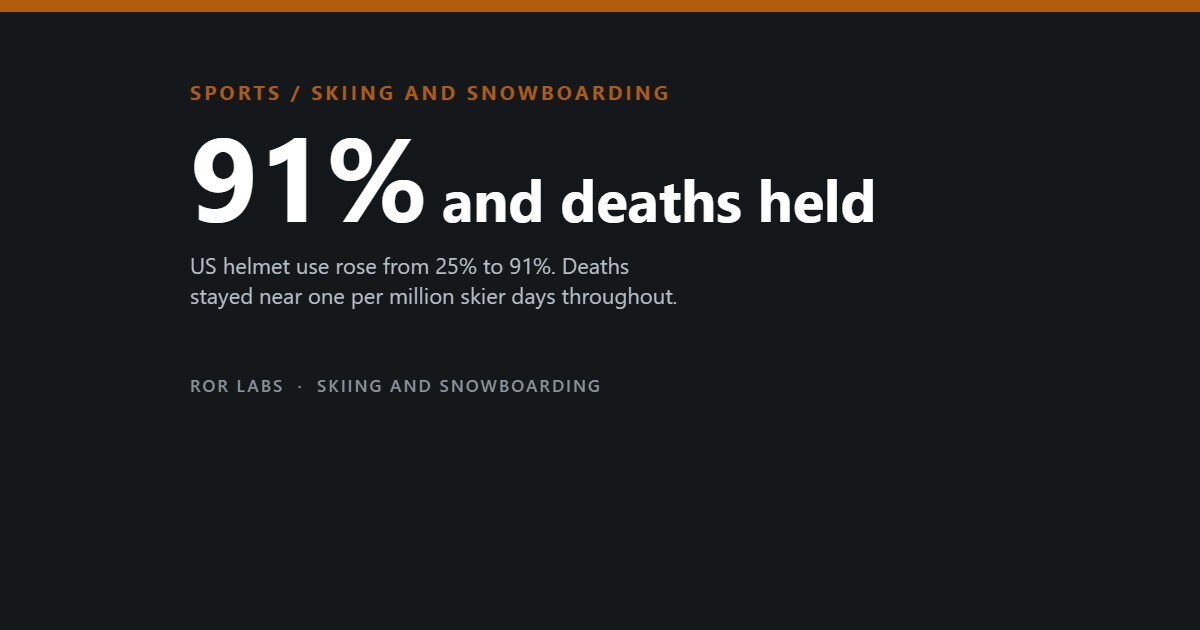
In the 2002-03 season, about a quarter of American skiers and snowboarders wore a helmet. By 2024-25 it was 91%, and 96% of those aged 17 and under. It is one of the fastest safety turnarounds in any sport.
The same 2024-25 season recorded 50 deaths at US ski areas, from 61.5 million visits. The fatality rate has hovered just under one per million skier days for more than a decade, through the whole rise in helmet use. Helmets work. They reduce head injuries by about a third. What they have not been shown to do is change the number of people who die.
This article follows the series format: what skiers and snowboarders actually injure, where the risk concentrates, what has been measured to reduce it — including two randomised trials that most snowboarders have never heard of — and why the answer is not to stay off the mountain.
What actually gets injured
Injury rates on the slopes are counted per 1,000 skier days. Across two American ski areas over five seasons, 16,945 people were reported injured in 6.33 million skier days, a rate of 2.68 per 1,000. That means a typical recreational skier could expect an injury serious enough to report roughly once in several hundred days on snow.
Skiers and snowboarders injure different things
Share of reported injuries by body region, and injury rate per 1,000 days on snow.
Source: Ropret, review of skiing and snowboarding epidemiology (2014), summarising published series. Shares, not rates.
The two sports hurt different parts of the body because the equipment fails differently. A skier’s feet can move independently and the long lever of the ski twists the knee; serious knee sprains, most of them to the anterior cruciate ligament, are now the most common medically significant skiing injury. A snowboarder’s feet are locked to one board, so a fall is caught with the hands. Wrist injuries are around a quarter of snowboarding injuries and a small fraction of skiing ones.
Snowboarders are also injured more often overall. One long-run summary put the rate at about 6.1 per 1,000 days for snowboarders and 2.5 for skiers, and both figures have fallen over three decades. Skiing injury rates in particular have dropped by half or more since the 1970s, mostly because releasable bindings stopped snapping lower legs.
When the risk concentrates
The first concentration is experience. A 2015 meta-analysis of 55 studies found beginners were at clearly higher risk: an odds ratio of 2.72 for beginner skiers and 2.66 for beginner snowboarders. Beginners mostly get hurt falling. More experienced riders are more likely to get hurt on jumps.
For snowboarders the concentration is sharper still. In a Norwegian randomised trial of 5,029 snowboarders, those in their first five days on a board and those on rented equipment were the most likely to injure a wrist. Among injured snowboarders in an older American series, 49% were beginners, against 18% of injured skiers, and wrist injuries were most common among beginners, at 30%.
The second concentration is terrain. At the same two American resorts, 26.7% of injuries happened in terrain parks, the areas built for jumps and rails. Those injured there were more likely to be snowboarders, male, aged 13 to 24 and self-rated experts, and their injuries were more likely to be fractures, concussions, and head or back injuries needing hospital transport.
Deaths concentrate in a different place again. The National Ski Areas Association describes most fatalities as male skiers on intermediate terrain, with speed, loss of control and collisions with objects such as trees as the recurring factors. That profile matters for the helmet question, because a helmet is designed and tested for a fall, not for a high-speed impact with a tree.
Where the injuries gather
Two ways the risk concentrates on the mountain.
Beginner skiers: odds ratio 2.72
Beginner snowboarders: 2.66
Mostly from falls
Experienced riders: mostly from jumps
26.7% of all injuries
Younger, male, self-rated experts
More fractures, concussions, head and back
More often needed hospital transport
Source: Hume et al., Sports Medicine (2015); Brooks et al., Injury Prevention (2010).
What has been measured to work
Snow sports have something most recreational activities lack: randomised trials of a piece of protective equipment. Both tested wrist guards for snowboarders.
Wrist guards for snowboarders: two randomised trials
Wrist injuries in each group over the study period.
Wrist guards: 8 wrist injuries
No guards: 29 wrist injuries
No injuries attributed to the guard
Beginners and renters most at risk
Guards: 1 severe wrist injury
No guards: 9
Hazard ratio 0.13 (0.02 to 1.04)
12 in the guard group secretly took them off
Source: Rønning et al., American Journal of Sports Medicine 29(5):581–585 (2001); Machold et al., Journal of Trauma 52(3):517–520 (2002).
The Norwegian result was clear. The Austrian one points the same way but its interval just crosses 1.00, and it has an honest footnote: twelve snowboarders in the protected group discarded their guards during the trial. A Quebec case-control study of 1,066 injured snowboarders found guards cut hand, wrist and forearm injuries by 85%, an odds ratio of 0.15.

The same study carries the obvious worry. For elbow, upper arm and shoulder injuries the odds ratio was 2.35 — higher, not lower — although the interval, 0.70 to 7.81, is wide enough to include no effect. A guard that stops the wrist bending may pass the load further up the arm. Neither randomised trial found that, but neither was large enough to rule it out. And almost nobody wears one: in a 2012 survey at Whistler, a quarter of snowboarders did.
Helmets have no randomised trials, but a meta-analysis of twelve studies found wearers were 35% less likely to have a head injury, an odds ratio of 0.65, and for children under 13 the figure was 0.41. The old objection, that a helmet’s weight would strain the neck, did not hold up: the pooled odds ratio for neck injury was 0.89, no increase. Nor did a large Quebec study find that helmet wearers skied more recklessly.
What the protective equipment does
Odds ratios from meta-analysis and case-control studies. Below 1.00 means fewer injuries with the equipment.
Source: Russell et al., CMAJ (2010): head 0.65 (0.55–0.79), children 0.41 (0.27–0.59), neck 0.89 (0.72–1.09). Hagel et al., American Journal of Epidemiology (2005): 0.15 (0.05–0.45); 2.35 (0.70–7.81), not significant.
The limit is in the same paper. No study in the meta-analysis reported deaths. An American analysis by Shealy, Johnson and Ettlinger concluded that helmets prevent many minor head injuries and change the primary cause of death, but had not been shown to change the overall fatality rate. The national numbers since then — helmet use up from a quarter to nine in ten, deaths near one per million days throughout — say the same thing.
For knees the evidence is older and weaker. In the 1993-94 season, patrollers and instructors at 20 Vermont ski areas watched videos of how anterior cruciate ligament injuries happen, and serious knee sprains among them fell by 62% compared with 22 areas that did not take part. It was not randomised, and it was tested on expert staff, not holiday skiers.
Why the answer is not to stop
Put the risk on a common scale and it looks different from the headlines. At about 0.8 deaths per million visits, someone who skis twenty days a season for fifty years — a thousand days — would face roughly a 1 in 1,250 chance over a lifetime, if the national average applied to them. That is arithmetic on an average, not a personal forecast; speed and terrain move it in both directions. Injury rates have fallen by half or more over three decades, largely because of equipment that was redesigned once the injury pattern was understood.
The helmet paradox in numbers
US ski areas, National Ski Areas Association figures.
Source: National Ski Areas Association (2025); Russell et al., CMAJ 182(4):333–340 (2010). 50 deaths in 61.5 million visits.
The pattern across this series holds here too: risk is a distribution that can be shifted. Bindings shifted the lower-leg fractures. Helmets shifted the head injuries from falls. Wrist guards, in trials, shifted snowboarders’ wrists. What the numbers do not support is the belief that any of these makes a high-speed collision survivable, which is why the part of skiing that kills people is still the part that is about speed and control.
The practical reading is short. Take lessons on the first days, when the fall rate is highest. Snowboarders should wear wrist guards, which are cheap and trialled. Wear a helmet for the falls it was built to absorb. Have bindings set properly. And treat speed near trees and other skiers as the risk that no equipment covers.
Questions people ask
Do ski helmets save lives?
They reduce head injuries by about a third. No study has shown they reduce deaths, and US fatality rates have stayed near one per million skier days as helmet use rose to 91%.
Are wrist guards worth it for snowboarding?
Yes. They are one of the few pieces of sports equipment tested in randomised trials, and wrist injuries fell sharply in the Norwegian one. They matter most in your first days on a board.
Is snowboarding more dangerous than skiing?
Snowboarders are injured more often, especially as beginners, and mostly in the wrist. Skiers injure knees more. Deaths are concentrated among skiers on intermediate runs.
Do helmets make people ski faster?
A large Quebec study found no sign that helmet wearers were more likely to be in high-speed or risky crashes.
Are terrain parks more dangerous?
Injuries there were more likely to be fractures, concussions and head or back injuries, and to need hospital transport. The riders are also younger and more likely to be attempting jumps.
The short version
- Recreational injury rates are around 2.7 per 1,000 skier days; snowboarders are hurt more often than skiers.
- Skiers injure knees; snowboarders injure wrists. Beginners carry more than twice the risk.
- Two randomised trials support wrist guards for snowboarders. Few wear them.
- Helmets cut head injuries by about 35% and do not increase neck injuries.
- US helmet use rose from 25% to 91%, and deaths stayed near one per million skier days. Helmets change the cause of death more than the count.
- Speed and collisions with trees are the risk no equipment covers.
This is a summary of published research, not medical or safety advice. It does not replace instruction from a qualified ski or snowboard instructor, the rules of the mountain you ride, or assessment of an injury by a doctor.
Further reading: Russell et al., CMAJ 182(4):333–340 (2010), for the helmet meta-analysis and its note that no included study reported deaths. Rønning et al., American Journal of Sports Medicine 29(5):581–585 (2001), for the wrist guard trial. Hagel et al., American Journal of Epidemiology 162(2):149–156 (2005), for the case-control study and its elbow-and-shoulder finding.
- Risk: A User’s Guide, Stanley McChrystal and Anna Butrico (2021). On how organisations misjudge where danger actually sits. Written from a military and business angle, which makes the slope analogy the reader’s job.
- The Art of Uncertainty, David Spiegelhalter (2024). On living with probabilities like one death per million days, and on what a risk that small does and does not mean.
- Everything Is Predictable, Tom Chivers (2024). A readable guide to updating a belief when new evidence arrives — useful for the helmet numbers that did not move.
Sources
National Ski Areas Association, helmet usage and fatality reports, 2024-25 season (91% helmet use, 50 fatalities; 25% in 2002-03), and 2024-25 skier visits (61.5 million). — Brooks MA, Evans MD, Rivara FP. Evaluation of skiing and snowboarding injuries sustained in terrain parks versus traditional slopes. Injury Prevention 16(2) (2010). — Ropret R. Injuries in skiing and snowboarding: epidemiology and risk factors (2014). — Davidson TM, Laliotis AT. Snowboarding injuries, a four-year study with comparison with alpine ski injuries. Western Journal of Medicine 164(3) (1996). — Hume PA, Lorimer AV, Griffiths PC, Carlson I, Lamont M. Recreational snow-sports injury risk factors and countermeasures. Sports Medicine 45 (2015). — Rønning R, Rønning I, Gerner T, Engebretsen L. American Journal of Sports Medicine 29(5):581–585 (2001). — Machold W, Kwasny O, Eisenhardt P, et al. Journal of Trauma 52(3):517–520 (2002). — Hagel B, Pless IB, Goulet C. American Journal of Epidemiology 162(2):149–156 (2005). — Chaudhry T, Noor S, Rajaratnam V. Factors affecting wrist guard use amongst snowboarders. (2012). — Russell K, Christie J, Hagel BE. CMAJ 182(4):333–340 (2010). — Hagel B, Pless IB, Goulet C, Platt R, Robitaille Y. Accident Analysis and Prevention 37(1) (2005). — Shealy JE, Johnson RJ, Ettlinger CF. Do helmets reduce fatalities or merely alter the patterns of death? ASTM STP 1510 (2009). — Ettlinger CF, Johnson RJ, Shealy JE. American Journal of Sports Medicine 23(5):531–537 (1995).