The Weekend Effect in Hospitals: What the Evidence Shows
Key takeaways · 11 min read
- Patients admitted at weekends have slightly higher recorded mortality, 10 to 19% in pooled estimates.
- About 7% fewer patients are admitted through English emergency departments at weekends, so those who are admitted tend to be sicker.
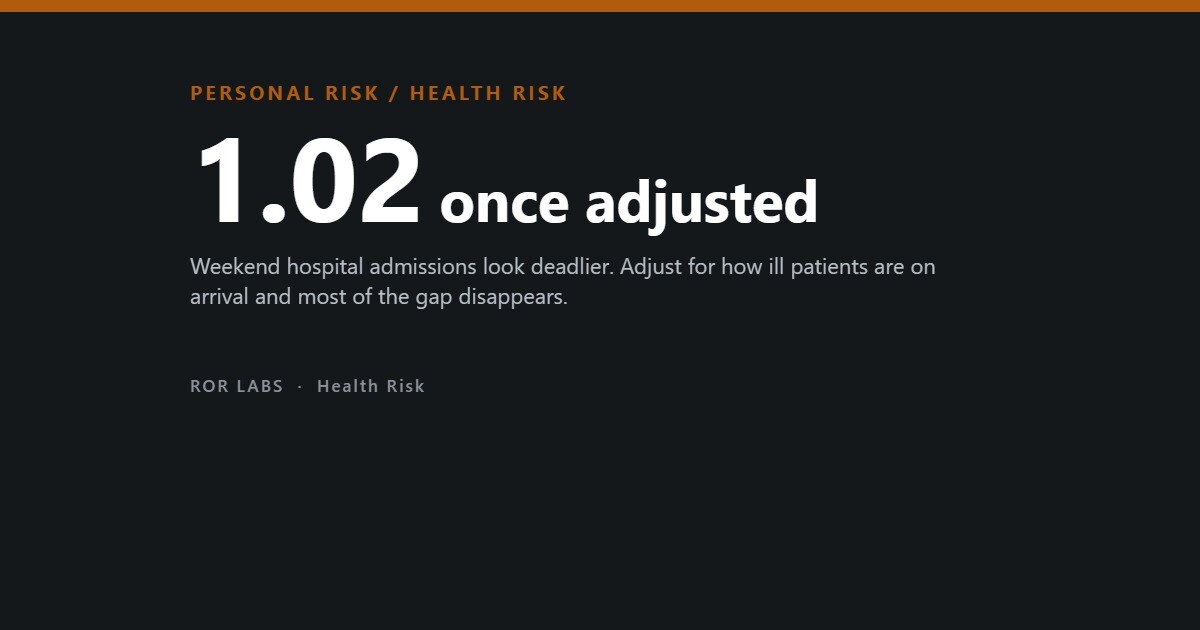
- In one large hospital, adjusting for an early warning score reduced the weekend effect from 1.07 to 1.02, within the range of no difference.
- A review of 4,000 case records in 20 trusts found 0.405 errors per case at weekends and 0.411 on weekdays.
In this article
If you become seriously ill on a Saturday, you may have heard that you are more likely to die than if the same thing happened on a Wednesday. The claim has been repeated for twenty years, and in England it was used to justify one of the largest changes to how hospitals are staffed.
The pattern in the data is real. Patients admitted to hospital at weekends do die at slightly higher rates, in study after study, in country after country. What has been argued over is why. Is it thinner staffing and fewer scans at weekends, or is it that the people who reach a hospital bed on a Sunday are sicker to begin with?
This is what the evidence shows about the weekend effect, how big it is, and what happened when researchers measured how ill patients actually were. The short answer: most of the effect shrinks when you count sickness properly, and the most careful review of care quality found no difference at all.
Where the weekend effect came from
The modern version of the claim starts with a 2001 paper in the New England Journal of Medicine by Chaim Bell and Donald Redelmeier. They looked at nearly 3.8 million emergency admissions in Ontario, Canada, over ten years. For ruptured abdominal aortic aneurysm, 42% of weekend admissions died in hospital against 36% on weekdays. For pulmonary embolism it was 13% against 11%.
Across the 100 conditions that most often led to death, 23 showed higher mortality for weekend admissions. The authors pointed to a plausible reason: hospitals have fewer staff at weekends, while disease does not take the weekend off.
In England, Paul Aylin and colleagues examined all 4.3 million emergency admissions to public hospitals in 2005 and 2006. Crude mortality was 5.2% for weekend admissions and 4.9% for weekday ones, and after adjusting for age, sex, deprivation, diagnosis and other illnesses the odds of death were 10% higher at weekends.
The number that made the effect famous came in 2015. A study by Nick Freemantle and colleagues estimated about 11,000 excess deaths a year in England among patients admitted on a Friday, Saturday, Sunday or Monday. The government summary of that research is careful to add that it remains unclear how many of those deaths were avoidable. That caveat did not travel with the number.
How big the weekend effect looks
Pooled or national estimates of higher mortality for weekend admissions. 1.00 means no difference.
Pauls and colleagues, Journal of Hospital Medicine, 2017; Chen and colleagues, BMJ Open, 2019; Aylin and colleagues, BMJ Quality and Safety, 2010; Cram and colleagues, American Journal of Medicine, 2004. Most studies adjust only for what is in administrative records.

The number that became a policy
The 11,000 figure was quoted by the then Health Secretary, Jeremy Hunt, in 2015 while arguing for a “seven-day NHS”. It arrived in the middle of a contract dispute with junior doctors that led to the first all-out strikes in the history of the health service in 2016.
Researchers objected at the time. One editorial in The BMJ asked whether the authors of the paper should write to the Health Secretary about how their data were being used. The core complaint was simple: the studies showed an association between the day of admission and death. They did not show that weekend staffing caused it.
A 2016 review in The Lancet by Nick Black set out the problem. Studies relied on routine hospital records, which record diagnoses and other illnesses but not how sick someone is on arrival. If the patients admitted at weekends are sicker, the weekend effect would appear even if care were identical.
By then, some evidence already pointed that way. At St James’s Hospital in Dublin, Olga Mikulich and colleagues found 30-day mortality of 9.9% at weekends and 9.0% on weekdays among 49,337 episodes. Once illness severity was included, weekend admission was no longer an independent predictor of death, with an odds ratio of 1.05 and an interval that included no effect.
Who actually gets admitted at weekends
The most revealing study looked not at who died, but at who was admitted in the first place. Rachel Meacock and colleagues at the University of Manchester analysed 12.7 million emergency department attendances and 4.7 million emergency admissions to all 140 non-specialist acute hospital trusts in England.
Roughly the same number of people came to emergency departments at weekends as on weekdays. Among all of them, the whole population walking through the door, there was no higher mortality at weekends. The weekend effect appeared only among the smaller group who were admitted.

That group was smaller at weekends. About 7% fewer patients were admitted through emergency departments at weekends, a difference the patients’ recorded characteristics did not explain. Direct admissions from family doctors and other community services, which largely close at weekends, fell much further, and it was there that the weekend effect was strongest.
The authors’ reading is that staff apply a stricter threshold for admission at weekends, so the people who get a bed are, on average, sicker. Higher mortality among weekend admissions was driven by fewer admissions, not by more deaths. If that is right, the numerator did not change; the denominator shrank.
That does not mean nothing is wrong at weekends. A higher threshold means some patients who would be admitted on a Tuesday go home on a Saturday, and whether that is safe is its own question. But it is a different problem from the one the policy was built to fix.
Same arrivals, fewer admissions
Emergency attendances and admissions in England, all 140 non-specialist acute trusts, April 2013 to February 2014.
Meacock and colleagues, Journal of Health Services Research and Policy, 2017. Among all attendees, the authors found no higher mortality at weekends.
What happens when you count how sick people are
The obvious test is to measure illness severity directly. Hospitals in England record the National Early Warning Score, or NEWS, a number built from pulse, breathing rate, blood pressure, oxygen levels, temperature and alertness. It is a measure of how acutely ill someone is at the bedside, not how many chronic conditions they have.
Jianxia Sun and colleagues used it in 163,128 adult emergency admissions to University Hospitals Birmingham over four years. For the 90% of admissions where NEWS could be calculated within 24 hours, 30-day mortality was 5.2% at weekends and 4.9% on weekdays, an odds ratio of 1.07. Standard adjustment for age, diagnosis and other conditions left it at 1.07.
Adjusting for NEWS alone brought it down to 1.02, with an interval that included no difference at all. Adding the standard variables back made no useful contribution. Weekend patients were also more likely to be moved to intensive care within 24 hours, and more of them went directly from the emergency department. The difference was in how acutely ill they were, not in their age or long-term conditions.
One group did not fit. Among patients with no NEWS recorded in the first 24 hours, weekend mortality was higher, with an odds ratio of 1.88. They were a small group with low average mortality, and the authors flag the result as an anomaly. It is the one place in the study where something about weekends, possibly how patients were assessed, may still be at work.
One hospital, four years, three answers
30-day mortality odds for weekend against weekday emergency admissions, 163,128 adults.
Sun and colleagues, BMJ Quality and Safety, 2019. The adjusted estimate of 1.02 had a 95% CI of 0.96 to 1.08. The last row is crude and covers a small group.
Did weekend patients get worse care?
If weekend care were worse, it should show up in the care itself. The High-intensity Specialist-Led Acute Care project, known as HiSLAC, tested this directly while the seven-day services policy was being rolled out. Julian Bion and colleagues had trained reviewers examine 4,000 case records from 20 hospital trusts in England, in two periods several years apart.
The reviewers counted errors in care from admission to discharge, or to seven days. The error rate was 0.405 per case for weekend admissions and 0.411 for weekday ones, a rate ratio of 0.96. There was no support for the idea that in-hospital care was worse for patients admitted at weekends. If anything, the authors wrote, any signal pointed slightly the other way.
What did change was time. Error rates, error-related harm and overall quality ratings improved between the two periods, for weekend and weekday patients alike. That is a real improvement in hospital care, and it happened on every day of the week.
Errors in care, weekend against weekday
Case-record review of emergency medical admissions, 20 English hospital trusts, 4,000 records.
Bion and colleagues, BMJ Quality and Safety, 2021 (online 2020). Adjusted rate ratio 0.96 (95% CI 0.86 to 1.07).
The newest data: a paradox
A 2026 study in Scientific Reports by Hong-jie Yu, Jean Woo and colleagues shows why the question keeps returning. They examined 3.4 million emergency hospitalisations of older adults in Hong Kong between 2012 and 2021.
Weekend admission or discharge was associated with higher in-hospital mortality, 5.0% against 3.8%, an adjusted odds ratio of 1.36. That is a larger weekend effect than most studies report. But the same patients had slightly lower mortality in the 30 days after discharge, and slightly fewer emergency readmissions.
The authors’ explanation is a “depletion of susceptibles”: the frailest patients died in hospital, leaving a survivor group at lower risk. They conclude that the weekend effect reflects how care is joined up and who is discharged when, rather than simple differences in care quality by day. It is an administrative-data study, with the same blind spot for illness severity as the older ones.
Worse inside, slightly better after
Older adults, 3.4 million emergency hospitalisations, Hong Kong, 2012 to 2021. Adjusted odds ratios, weekend against weekday.
Yu, Lai, Lam, Ho, Wong and Woo, Scientific Reports, 2026. Weekend exposure combined admission or discharge at weekends.
What the evidence does not show
It does not show that there is no weekend effect in any condition. The pooled estimates across tens of millions of admissions all sit above 1, and some specific conditions, including stroke and some cancers, have shown larger effects in individual studies. A 2018 review of UK studies by Kate Honeyford and colleagues still found a weekend effect after adjusting for severity, though the studies were too different to put a single number on it.
It does not show that weekend staffing is irrelevant. The HiSLAC reviewers found no difference in errors, but they could not test every service, and a stricter admission threshold at weekends raises its own question about the patients who were sent home.
And it does not show that the 11,000 were deaths caused by weekends. That figure measured an association in routine records, and its own source said the number of avoidable deaths was unknown.
Questions people ask
Is it more dangerous to be admitted to hospital at the weekend?
Weekend admissions have slightly higher recorded mortality, with pooled estimates of 10 to 19%. But studies that measured how sick patients were found most or all of that difference disappears, and a review of 4,000 case records found no difference in errors in care.
Why are weekend patients sicker?
Community services such as family doctors are largely closed, and hospitals appear to admit fewer patients at weekends. People with milder illness may also wait until Monday. The result is that those admitted at weekends are, on average, more acutely ill.
Should I delay going to hospital until a weekday?
No. Nothing in this evidence suggests that waiting is safer, and delay is dangerous for conditions such as stroke, heart attack and sepsis. If you need emergency care, seek it whatever the day.
Did the seven-day NHS policy reduce deaths?
The HiSLAC research found care quality improved over the period for weekend and weekday patients alike, but no evidence that weekend care had been worse to begin with. It did not show that the policy itself caused a fall in deaths.
Where did the 11,000 figure come from?
From a 2015 analysis of English hospital data by Freemantle and colleagues, covering patients admitted from Friday to Monday. The government summary notes it is unclear how many of those deaths were avoidable.
The short version
- Patients admitted at weekends have slightly higher recorded mortality, 10 to 19% in pooled estimates.
- About 7% fewer patients are admitted through English emergency departments at weekends, so those who are admitted tend to be sicker.
- In one large hospital, adjusting for an early warning score reduced the weekend effect from 1.07 to 1.02, within the range of no difference.
- A review of 4,000 case records in 20 trusts found 0.405 errors per case at weekends and 0.411 on weekdays.
- The 11,000 excess deaths figure was an association, and its source said the number of avoidable deaths was unknown.
This article summarises published research on hospital mortality by day of admission. It is not medical advice. If you or someone with you has symptoms of a medical emergency, call emergency services or go to hospital straight away, on any day of the week.
Further reading. Meacock and colleagues, ‘Higher mortality rates amongst emergency patients admitted to hospital at weekends reflect a lower probability of admission’, Journal of Health Services Research and Policy, 2017, is open access and the clearest single explanation. Bion and colleagues, BMJ Quality and Safety, 2021, is the case-record review.
- Calling Bullshit, Carl Bergstrom and Jevin West (2020). Two scientists on how selection effects and misleading denominators turn real data into wrong conclusions. The weekend effect is a textbook case.
- Breathtaking, Rachel Clarke (2021). An NHS doctor’s account of a hospital under pressure, and a reminder of who works the weekend shifts the debate was about.
- Radical Uncertainty, John Kay and Mervyn King (2020). On decisions made from numbers that cannot bear the weight put on them, which is what happened to the 11,000.
Sources
- Bell CM, Redelmeier DA. Mortality among patients admitted to hospitals on weekends as compared with weekdays. New England Journal of Medicine, 2001;345:663–668.
- Aylin P, Yunus A, Bottle A, Majeed A, Bell D. Weekend mortality for emergency admissions. A large, multicentre study. BMJ Quality and Safety, 2010. doi:10.1136/qshc.2008.028639.
- Department of Health. Research into the weekend effect on patient outcomes and mortality. GOV.UK, 30 October 2015 (summarising Freemantle N and colleagues, BMJ, 2015).
- Black N. Is hospital mortality higher at weekends? If so, why? The Lancet, 2016. doi:10.1016/S0140-6736(16)30505-0.
- Mikulich O, Callaly E, Bennett K, O’Riordan D, Silke B. The increased mortality associated with a weekend emergency admission is due to increased illness severity and altered case-mix. Acute Medicine, 2011.
- Meacock R, Anselmi L, Kristensen SR, Doran T, Sutton M. Higher mortality rates amongst emergency patients admitted to hospital at weekends reflect a lower probability of admission. Journal of Health Services Research and Policy, 2017. doi:10.1177/1355819616649630.
- Sun J, Girling AJ, Aldridge C, and colleagues. Sicker patients account for the weekend mortality effect among adult emergency admissions to a large hospital trust. BMJ Quality and Safety, 2019;28:223–230.
- Bion J, Aldridge C, Girling A, and colleagues. Changes in weekend and weekday care quality of emergency medical admissions to 20 hospitals in England during implementation of the 7-day services national health policy. BMJ Quality and Safety, 2021;30:536–546.
- Pauls LA, Johnson-Paben R, McGready J, and colleagues. The weekend effect in hospitalized patients: a meta-analysis. Journal of Hospital Medicine, 2017. doi:10.12788/jhm.2815.
- Chen YF, Armoiry X, Higenbottam C, and colleagues. Magnitude and modifiers of the weekend effect in hospital admissions: a systematic review and meta-analysis. BMJ Open, 2019.
- Honeyford K, Cecil E, Lo M, Bottle A, Aylin P. The weekend effect: does hospital mortality differ by day of the week? A systematic review and meta-analysis. BMC Health Services Research, 2018.
- Cram P, Hillis SL, Barnett M, Rosenthal GE. Effects of weekend admission and hospital teaching status on in-hospital mortality. American Journal of Medicine, 2004.
- Yu HJ, Lai ETC, Lam K, Ho IYY, Wong GLH, Woo J. Weekend effect in emergency hospitalizations of older adults in Hong Kong. Scientific Reports, 2026;16:24082.