Tick Bites and Lyme Disease: What the Evidence Shows
Key takeaways · 12 min read
- US reports rose from an average of 37,118 cases a year in 2017–2019 to 62,551 in 2022, mostly because the case definition changed; an insurance-claims estimate puts real diagnoses near 476,000 a year.
- Transmission usually needs a tick attached for more than a day. In mice, 1 of 14 were infected after 24 hours and 13 of 14 after 72 hours or more.
- Fine-tipped tweezers and a steady pull work best. Petroleum jelly, nail polish, alcohol and a hot match all failed to make ticks let go.
- A single 200 mg dose of doxycycline after a high-risk bite cut early Lyme disease from 3.2% to 0.4% in a trial with only nine cases in total.
In 2022 the United States reported 62,551 cases of Lyme disease, 68.5% more than the average for 2017 to 2019. The Centers for Disease Control and Prevention looked at that rise and concluded it “likely reflects changes in surveillance methods rather than change in disease risk.” The ticks had not suddenly multiplied. The way cases were counted had changed.
That is a useful place to start, because almost everything about Lyme disease sits on a gap between a measured number and the thing people actually want to know. Reported cases are not infections. A tick bite is not an infection either: most bites transmit nothing, and the few that do usually need a tick to stay attached for more than a day.
This article sets out what the research shows about how many people get Lyme disease, how quickly it is transmitted, what works after a bite, what clothing and repellents really reduce, why long courses of antibiotics have not helped lingering symptoms, and where a new vaccine stands. It covers the blacklegged tick of North America and its European relative, which carry the bacterium Borrelia burgdorferi and its cousins.
Why the case count jumped
In 2022 the United States changed its surveillance case definition. In the 15 high-incidence states and areas, a case could now be reported on laboratory evidence alone, without the clinical details health departments had previously had to chase. The CDC’s own analysis of the first year under the new rules found the national count 1.7 times the earlier average and said the increase was largely an artefact of the method. CDC data compiled by USAFacts put the 2023 count at 89,468, about 27 per 100,000 people.
Reported cases have always been the smallest number available. In 2021 CDC researchers estimated, from insurance claims for 2010 to 2018, that about 476,000 Americans a year were diagnosed and treated for Lyme disease. That figure needs its own caveat. The raw claims gave 205,000; the authors multiplied by 2.33 because only 43% of 672 checked medical records carried the Lyme diagnostic code. They also noted the estimate includes overdiagnosis: 19% of claims-based diagnoses came from low-incidence states, against about 5% of surveillance cases.
Three ways to count Lyme disease in the United States
Reported cases before and after the 2022 change in case definition, and an estimate of diagnoses from insurance claims.
Sources: Kugeler et al., MMWR 73(6) (2024); CDC data via USAFacts (2026); Kugeler et al., Emerging Infectious Diseases 27(2) (2021), estimate for 2010–2018 that includes some overdiagnosis.
Europe counts differently again. A 2025 analysis of national surveillance in 29 countries found an average of 132,000 reported cases of Lyme borreliosis a year between 2015 and 2023, with Estonia, Finland and Slovenia above 100 per 100,000. Not every country reports every form of the disease, so the true number is higher.
The hours that matter
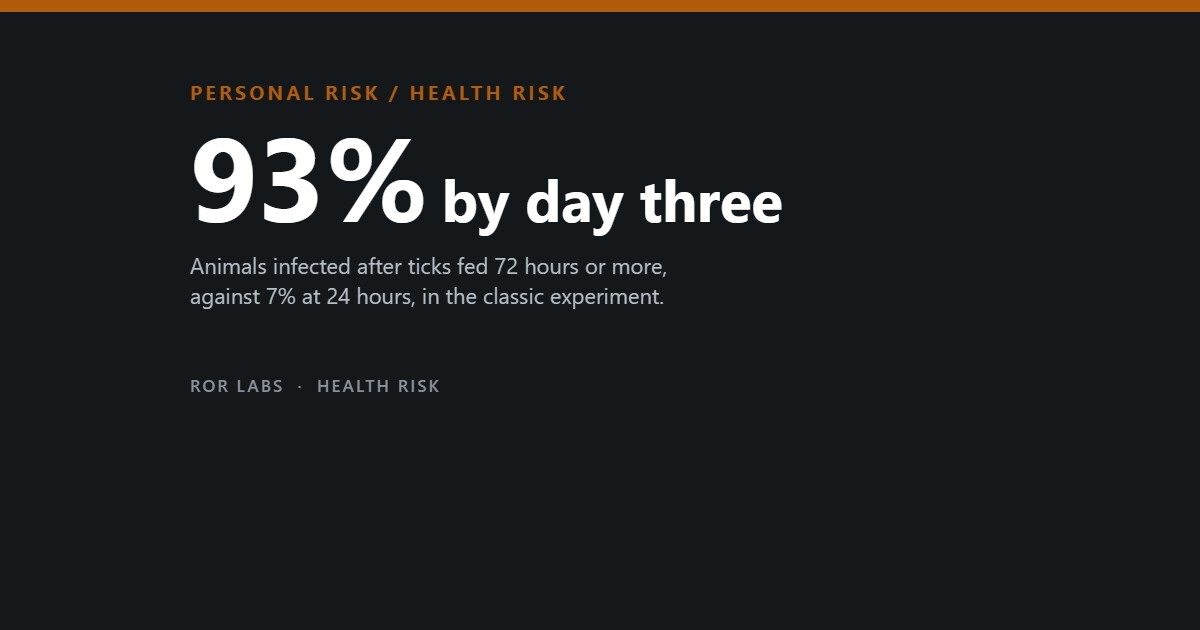
A tick does not transmit the bacterium the moment it bites. The bacteria sit in its gut and start to move to its salivary glands only after it begins to feed. The classic experiment, published by Joseph Piesman and colleagues in 1987, let infected nymphs feed on rodents for set periods. After 24 hours, 1 of 14 animals was infected. After 48 hours, 5 of 14. After 72 hours or more, 13 of 14. A later study found no transmission at all in the first 24 hours across 66 attempts.
How attachment time changed infection in the classic experiment
Rodents infected after infected nymphal ticks were allowed to feed for set periods.
Source: Piesman J et al., Journal of Clinical Microbiology 25(3):557–558 (1987). Animal data; the human evidence is smaller but points the same way.
The human evidence is thinner but consistent. In a prospective study published in 1997, 3 of 15 people bitten by a tick attached for 72 hours or more developed Lyme disease, against 1 of 94 whose tick had been attached for less. The odds ratio was 23.3, but with only four infections in total the confidence interval ran from 2.2 to 242. A Dutch study of 3,525 reported bites found an overall risk of 2.6%, rising from 2.0% when the tick was attached for under 12 hours to 5.2% at four days or more.
The catch is that people often do not notice. Nymphs, the stage responsible for most human infections, are about the size of a poppy seed. When researchers measured ticks that people had removed themselves, nymphs had been attached for an average of 34.7 hours, and 26.8% had been on for more than 48. In older US case series, only about half of patients remembered being bitten at all.
Taking a tick off
The CDC’s advice is plain: grasp the tick with fine-tipped tweezers as close to the skin as possible and pull upward with steady, even pressure, without twisting or jerking. It specifically says not to use petroleum jelly, heat or nail polish to make the tick detach, because the aim is to remove it quickly, not to wait for it to let go.
That warning has an experiment behind it. In 1985 the entomologist Glen Needham tested the folk methods on attached ticks. Petroleum jelly, nail polish, 70% alcohol and a hot match head all failed to make them detach. A later retrospective study of 160 removals compared techniques directly.
Removing a tick: what worked in a comparison of 160 removals
Share of ticks removed completely, by method. A retrospective study, not a trial.
Source: Akın Belli A et al., Journal of the American Academy of Dermatology (2016), doi:10.1016/j.jaad.2016.01.032. Folk methods: Needham GR, Pediatrics 75(6):997 (1985).
The CDC also advises against sending removed ticks to commercial laboratories for testing. What matters more is the date of the bite and how long the tick was attached, because those decide whether anything else is worth doing.
One dose after a bite
The strongest piece of evidence on what to do after a bite is a single randomised trial. Robert Nadelman and colleagues enrolled people in an area of New York State with high rates of Lyme disease who had removed a blacklegged tick within the previous 72 hours. Half received one 200 mg dose of doxycycline and half a placebo. Erythema migrans, the expanding rash of early Lyme disease, developed in 1 of 235 people given the antibiotic (0.4%) and 8 of 247 given placebo (3.2%). The estimated efficacy was 87%.
Two things limit how far that result travels. First, the whole trial rests on nine cases, which is why the confidence interval for the efficacy runs from 25% to 98%. Second, even on placebo, 96.8% of people bitten in a high-risk area did not develop Lyme disease. The CDC therefore reserves the single dose for bites that meet several conditions together: an identified adult or nymph blacklegged tick, attached for an estimated 36 hours or more, in an area where infection is common, with the dose started within 72 hours of removal. Outside those conditions, watching for symptoms is the usual advice.
One dose after a bite
Share of people who developed early Lyme disease after a recognised tick bite.
Single dose of doxycycline: 0.4% (1 of 235)
Placebo: 3.2% (8 of 247)
Efficacy 87%, 95% CI 25–98
Antibiotic after a bite: 0.2%
Placebo: 2.2%
1,082 people in total
Sources: Nadelman RB et al., New England Journal of Medicine 345(2):79–84 (2001); Warshafsky S et al., Journal of Antimicrobial Chemotherapy (2010), doi:10.1093/jac/dkq097.
Clothing, repellents and what they measure
The most rigorous study of prevention clothing is a randomised trial among 82 outdoor workers in Rhode Island and Massachusetts, published in 2020. Workers given clothing treated with the insecticide permethrin reported 65% fewer tick bites in the first year, 50% fewer in the second and 58% fewer over the two years combined. A small pilot study of 34 people gave a mixed picture: fewer people in the treated group were bitten at all, but those who were reported more bites per hour.
Those trials measure bites, not disease, and the distinction matters. The evidence linking prevention to fewer Lyme infections is observational. A case-control study in Connecticut, published in 2008, estimated that protective clothing was about 40% effective against Lyme disease and repellents about 20%. Tick checks after time outdoors were not associated with protection, perhaps because nymphs are so easy to miss.
What prevention studies actually measured
Outcome and design matter as much as the headline figure.
| Study | Design | Outcome measured | Result |
|---|---|---|---|
| Mitchell 2020 | Randomised, 82 outdoor workers | Tick bites | 58% fewer over two years |
| Richards 2015 | Pilot, 34 people | Tick bites | Fewer people bitten; more bites per hour |
| Vázquez 2008 | Case-control | Lyme disease | Clothing about 40%, repellent about 20% |
| Lee 2022 | Field test of DEET | Ticks on cloth | Encounters not reduced; 70–87% dropped off in 3 minutes |
Sources: Mitchell CL et al., Journal of Medical Entomology 57(5) (2020); Richards SL et al. (2015), doi:10.1080/09603123.2014.963033; Vázquez M et al., Emerging Infectious Diseases 14(2) (2008); Lee X et al. (2022), doi:10.1093/jme/tjac111.
A field test of DEET adds a further nuance. Repellent did not reduce how many ticks a treated cloth picked up, but between 70% and 87% of ticks that climbed on dropped off within three minutes. Repellents seem to work less by keeping ticks away than by making them leave before they attach.
The test, the rash and the long tail
The rash is the most reliable sign, and the CDC says it appears in about 70 to 80% of infected people, typically three to 30 days after the bite. In that early window, blood tests are poor at confirming infection, because antibodies take weeks to develop. A 2026 study of 107 early cases found the standard two-tier test was positive at the first blood draw in only 22 to 36% of patients. Guidelines treat a typical rash as a clinical diagnosis rather than waiting for a test.
The hardest part of the subject is what happens after treatment. Some people have fatigue, pain or difficulty concentrating for months. The CDC says that six months after treatment, such symptoms are 5 to 10% more common in people who had Lyme disease than in those who did not. A European study published in 2026 found that 40.9% of 242 patients reported at least one symptom at ten months, but only 6.2% met formal criteria for post-treatment Lyme disease syndrome; several of its authors were affiliated with Pfizer.
Whether more antibiotics help has been tested directly. In two American trials published together in 2001, 129 patients with persistent symptoms received 30 days of intravenous ceftriaxone followed by 60 days of oral doxycycline, or matching placebos. Among those who had antibodies to the bacterium, 37% improved on antibiotics and 40% on placebo; the trials were stopped early because the difference was not going to appear. A Dutch trial of 281 patients, published in 2016, added 12 weeks of oral antibiotics after two weeks of ceftriaxone and found no extra benefit for quality of life.
Longer antibiotics for lingering symptoms
Share of seropositive patients who improved in the Klempner trials, by treatment.
Source: Klempner MS et al., New England Journal of Medicine 345(2):85–92 (2001). P = 0.96; the trials were stopped early for futility. A 2016 Dutch trial (Berende et al., NEJM 374:1209–1220) also found no added benefit from 12 more weeks.
The trials do not show the symptoms are imaginary. They show that the explanation offered most often, a persisting infection that more antibiotics would clear, did not hold up when tested. Long courses also carry risks: CDC investigators have described serious harms, including septic shock and one death, among people treated for months on the basis of a “chronic Lyme” diagnosis.
A vaccine, again
A Lyme vaccine has existed before. LYMErix was licensed in the United States in December 1998 after a trial of 10,906 people showed 76% efficacy after three doses. About 1.4 million doses were distributed, and monitoring did not find arthritis above background rates. The manufacturer withdrew it in February 2002, citing poor market performance.
Its successor, developed by Valneva and Pfizer, reported results from its phase 3 VALOR trial in March 2026. Efficacy was about 73% in people aged five and over. But in the trial’s first pre-specified analysis, the lower bound of the confidence interval did not clear the bar set in advance, largely because fewer infections occurred than expected. In August 2026 the European Medicines Agency began reviewing an application for approval. A 73% point estimate with a wide interval is promising, but it is not the same as a settled answer, and the regulators will have to weigh it.
What the evidence suggests
Three points are better supported than the rest. Bites matter less than attachment time, so prompt removal with fine-tipped tweezers is the most useful single step. A rash after a bite is a reason to see a doctor without waiting for a test. And a single dose of antibiotic after a bite is worth discussing only when the tick, the place and the timing put the risk high. Treated clothing reduces bites in trials; whether it reduces disease rests on weaker evidence. For lingering symptoms after treatment, the trials point away from long antibiotic courses.
Questions people ask
How long does a tick need to be attached to transmit Lyme disease?
Usually more than 24 hours. In animal studies, the risk rose sharply between 48 and 72 hours, and the CDC says that in most cases a tick must be attached for more than a day.
Should I get antibiotics after every tick bite?
Not usually. The CDC limits a single dose to identified blacklegged ticks attached for about 36 hours or more, in high-risk areas, within 72 hours of removal. Ask a doctor.
Does petroleum jelly or a match make a tick let go?
No. In experiments, petroleum jelly, nail polish, alcohol and a hot match all failed. Tweezers and a steady pull are recommended.
Can a blood test confirm Lyme disease right after a bite?
No. Antibodies take weeks to appear, and early tests miss most cases. A typical rash is diagnosed on sight.
Is there a Lyme disease vaccine?
Not currently on the market. A new vaccine was about 73% effective in a trial and is under review in Europe; an earlier one was withdrawn in 2002.
The short version
- US reports rose from an average of 37,118 cases a year in 2017–2019 to 62,551 in 2022, mostly because the case definition changed; an insurance-claims estimate puts real diagnoses near 476,000 a year.
- Transmission usually needs a tick attached for more than a day. In mice, 1 of 14 were infected after 24 hours and 13 of 14 after 72 hours or more.
- Fine-tipped tweezers and a steady pull work best. Petroleum jelly, nail polish, alcohol and a hot match all failed to make ticks let go.
- A single 200 mg dose of doxycycline after a high-risk bite cut early Lyme disease from 3.2% to 0.4% in a trial with only nine cases in total.
- Months of extra antibiotics for lingering symptoms did no better than placebo in randomised trials. A new vaccine was 73% effective but missed its pre-set statistical bar, and is under review in Europe.
This article summarises published research and public-health guidance for general information. It is not medical advice. If you develop an expanding rash, fever or other symptoms after a tick bite, or are unsure whether a bite needs treatment, contact a doctor.
Further reading: Kugeler et al., MMWR 73(6) (2024), for how the case definition change affected the count. Nadelman et al., NEJM 345(2) (2001), for the single-dose trial. The CDC’s pages on tick removal and on symptoms after treatment, updated in 2026, for the current guidance in plain language.
- The Invisible Kingdom, Meghan O’Rourke (2021). A poet and journalist on living with chronic illness, including her own Lyme diagnosis. Valuable on what lingering symptoms feel like; it is a personal account, not a review of the trials.
- Lyme Disease, Ticks and You, Shelley Ball (2021). A biologist’s practical guide to ticks and the diseases they carry. Strongest on tick biology; check its treatment sections against current guidelines.
- Everything Is Tuberculosis, John Green (2025). The history and present of one infectious disease, and why it persists. Not about ticks, but sharp on how surveillance, money and attention shape what we count.
Sources
Kugeler KJ, Earley A, Mead PS, Hinckley AF. MMWR 73(6):118–123 (2024), doi:10.15585/mmwr.mm7306a1. — USAFacts, tickborne disease data compiled from CDC (updated 28 May 2026). — Kugeler KJ et al. Emerging Infectious Diseases 27(2) (2021), doi:10.3201/eid2702.202731. — Davidson A et al. Vector-Borne and Zoonotic Diseases (2025), doi:10.1177/15303667251363125. — Piesman J et al. Journal of Clinical Microbiology 25(3):557–558 (1987). — des Vignes F et al. Journal of Infectious Diseases (2001), doi:10.1086/318818. — Sood SK et al. Journal of Infectious Diseases (1997), doi:10.1086/514009. — Hofhuis A et al. PLoS One 12(7):e0181807 (2017). — Falco RC, Fish D, Piesman J. American Journal of Epidemiology (1996), doi:10.1093/oxfordjournals.aje.a008728. — Needham GR. Pediatrics 75(6):997 (1985). — Akın Belli A et al. JAAD (2016), doi:10.1016/j.jaad.2016.01.032. — Nadelman RB et al. NEJM 345(2):79–84 (2001). — Warshafsky S et al. J Antimicrob Chemother (2010), doi:10.1093/jac/dkq097. — Mitchell CL et al. J Med Entomol 57(5):1532–1538 (2020). — Vázquez M et al. Emerg Infect Dis 14(2) (2008). — Horn EJ et al. J Clin Microbiol 64:e01187-25 (2026). — Klempner MS et al. NEJM 345(2):85–92 (2001). — Berende A et al. NEJM 374:1209–1220 (2016). — Yu H et al. Pathogens 15(8):809 (2026). — Marzec NS et al. MMWR 66(23):607–609 (2017). — Nigrovic LE, Thompson KM. Epidemiol Infect (2007), doi:10.1017/S0950268806007096. — Valneva SA, VALOR phase 3 results, 23 March 2026. — CDC, Lyme disease and tick removal pages (2026).