Riboflavin: Food Sources, Deficiency, and the Migraine Trials
In This Series: Nutrients
- Which Nutrients Are You Actually Short Of?
- How Nutrients Are Classified — and What the Reference Numbers Mean
- Vitamin A: Food Sources, Deficiency, and Safe Limits
- Vitamin C: Food Sources, Scurvy, and the Ceiling the Body Sets
- Vitamin D: Food Sources, Sunlight, and What the Trials Found
- Vitamin D2 vs D3: What the Head-to-Head Trials Found
- Thiamin: Food Sources, Beriberi, and Why There Is No Upper Limit
- Calcium: Food Sources, Bone Density, and What the Trials Found
Key takeaways · 9 min read
- Riboflavin is the backbone of FMN and FAD. It is also required to turn tryptophan into niacin and vitamin B6 into its active form.
- Per tablespoon: yeast extract 2.63 mg, beef liver 0.513, chicken liver 0.347. Milk is last at 0.025 — and milk is why most people are not deficient.
- Light inactivates it. That is why milk is not sold in glass, and why prolonged phototherapy can cause deficiency.
- Deficiency is extremely rare in the US, and rarely occurs alone. Early changes reverse easily; cataracts do not.
Riboflavin is the only vitamin most people have actually seen. It is yellow, and it fluoresces under ultraviolet light, which is why urine turns a startling colour a couple of hours after a multivitamin. That is not the vitamin working. That is the surplus leaving.
Three things about it sit oddly together. Deficiency is extremely rare in wealthy countries. There is no upper intake level. And a dose about three hundred times the daily requirement is endorsed by neurological guidelines for something that has nothing to do with deficiency.
This is the fifth entry in this appendix: what the nutrient does, which foods carry it per measured spoonful, what running short does, and what the reference numbers are.
What it does
Riboflavin is the backbone of two coenzymes, flavin mononucleotide (FMN) and flavin adenine dinucleotide (FAD). Between them they run energy production and the metabolism of fats, drugs and steroids, and they are involved in cellular growth and development.
The part worth holding onto is that riboflavin is also infrastructure for other vitamins. Converting the amino acid tryptophan into niacin requires FAD. Converting vitamin B6 into its active coenzyme, pyridoxal 5-phosphate, requires FMN. Riboflavin also helps keep homocysteine at normal levels. So a riboflavin shortage does not present as one deficiency; it degrades the machinery that handles several others.
The three foods that carry the most per spoonful
Ranked by what fits on a level tablespoon, using USDA composition values:
Riboflavin per level tablespoon
USDA SR Legacy values per 100 g, converted at 15 g. Share is of the 1.3 mg adult male RDA.
| Food (USDA FDC ID) | Per 100 g | Per tablespoon | Share of RDA |
|---|---|---|---|
| Yeast extract spread (167717) | 17.5 mg | 2.63 mg | 202% |
| Beef liver, pan fried (168627) | 3.42 mg | 0.513 mg | 39% |
| Chicken liver, pan fried (174491) | 2.31 mg | 0.347 mg | 27% |
| Almonds, dry roasted (170158) | 1.2 mg | 0.18 mg | 14% |
| Egg, whole, raw (171287) | 0.457 mg | 0.069 mg | 5% |
| Mushrooms, white, raw (169251) | 0.402 mg | 0.060 mg | 5% |
| Milk, whole, with added vitamin D (171265) | 0.169 mg | 0.025 mg | 2% |
Source: USDA FoodData Central, SR Legacy. Tablespoon figures are conversions at 15 g.
Milk is last, at 2 per cent of a day in a spoonful, and milk is the reason most people in dairy-consuming countries are not deficient. A cup of 2 per cent milk carries 0.5 mg — 38 per cent of the daily value — and people drink cups rather than spoonfuls. Plain fat-free yogurt does better still, at 0.6 mg a cup.
The gap between those two facts is the whole point of ranking by spoon. A food can be unremarkable per unit and decisive per diet, and riboflavin is the clearest case of it in this series.
The same nutrient, ranked by serving instead
NIH Office of Dietary Supplements, milligrams per stated serving. Full bar = 2.9 mg.
Source: NIH Office of Dietary Supplements, selected food sources of riboflavin.
Liver still wins on either measure, and almost nobody eats it. Below liver the list is dairy and fortified cereal — two categories that between them carry the riboflavin supply of most Western diets, neither of which anybody chooses for that reason.
The vitamin that light destroys
Riboflavin is unusually fragile in a specific way: ultraviolet and visible light rapidly inactivate it and its derivatives. This is not a laboratory curiosity. It is the reason milk is not typically sold in glass.
The clinical version is stranger. Lengthy light therapy — for neonatal jaundice, or for skin disorders — can itself lead to riboflavin deficiency. A treatment aimed at the skin depletes a vitamin in the blood underneath it.
Cooking matters in a more ordinary way. About twice as much riboflavin is lost into the water when food is boiled as when it is steamed or microwaved. The vitamin is not destroyed by the heat so much as poured down the sink with the water.
Three ways riboflavin leaves food
NIH Office of Dietary Supplements.
What running short does
The deficiency state is called ariboflavinosis, and the signs cluster around the mouth and eyes: angular stomatitis, or lesions at the corners of the mouth; cheilosis, meaning swollen cracked lips; hyperaemia and oedema of the mouth and throat; sore throat; itchy, red eyes. Skin disorders and hair loss occur, and in severe, prolonged deficiency, anaemia and cataracts.
Two features of that list matter more than the list. The early changes are easily reversed — and the later anatomical ones, cataracts among them, rarely are, even with supplementation. And people with riboflavin deficiency typically have deficiencies of several other nutrients at once, so some of the signs attributed to riboflavin may belong to the company it keeps.
In the United States, riboflavin deficiency is extremely rare. The groups where it is worth considering are narrow: vegans and people who consume little milk, pregnant and lactating women eating little meat or dairy, vegetarian athletes, and people with riboflavin transporter deficiency, a rare genetic disorder.
The megadose the guidelines endorse
Now the odd part. Mitochondrial dysfunction is thought to play a causal role in some kinds of migraine, and riboflavin is required for mitochondrial function. That reasoning produced one of the most-cited small trials in headache medicine.
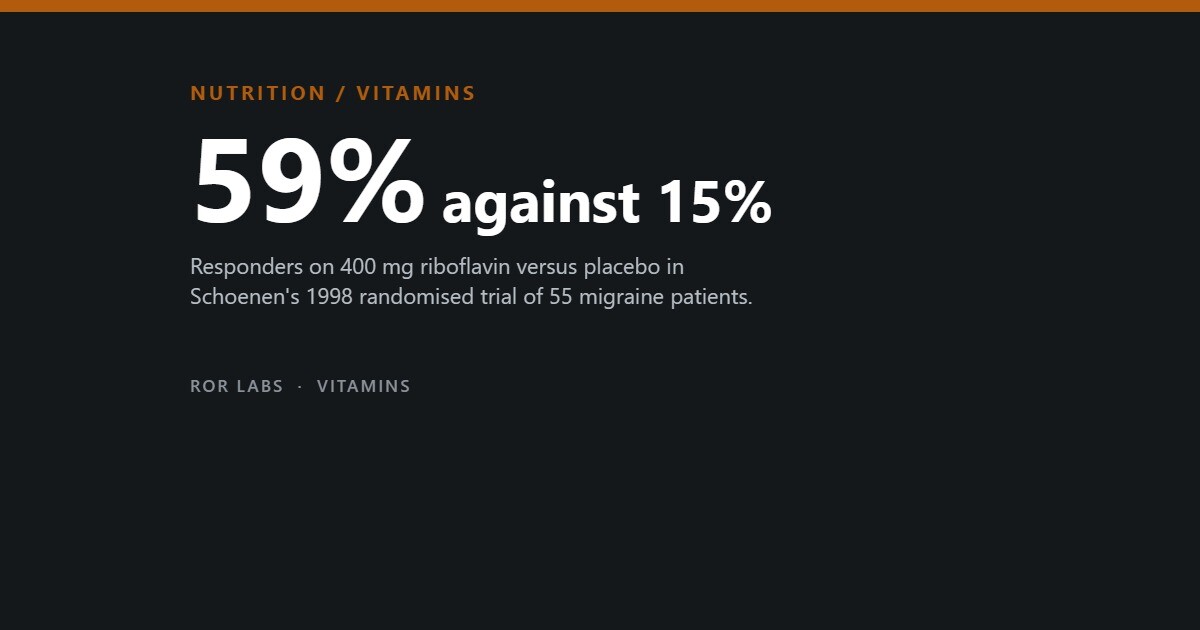
In 1998, Schoenen and colleagues randomised 55 people with migraine to 400 mg a day of riboflavin or placebo for three months. On intention-to-treat analysis, riboflavin beat placebo on attack frequency and on headache days. The figure that made the paper was the responder rate.
Responders, defined as at least 50 per cent improvement in headache days
55 adults with migraine, 400 mg/day riboflavin or placebo, three months, intention to treat.
Source: Schoenen, J., Jacquy, J. and Lenaerts, M., Neurology 50(2), 1998, pp.466–470.
A number needed to treat of 2.3 is a large effect for a cheap, well-tolerated intervention, and the guidance followed. The American Academy of Neurology’s Quality Standards Subcommittee and the American Headache Society concluded riboflavin is probably effective for preventing migraine. The Canadian Headache Society recommends 400 mg a day.
That is roughly three hundred times the 1.3 mg RDA, prescribed for a condition that is not a deficiency. It is the clearest example in this series of a nutrient being used as a drug, and the guidelines are explicit that this is what is happening.
And the finding that complicates it
In 2004, Maizels and colleagues ran a randomised trial of a combination — riboflavin 400 mg with magnesium 300 mg and feverfew 100 mg — against a comparator of riboflavin 25 mg. The combination showed an effect comparable to the 25 mg arm. In the authors’ words, the placebo response exceeded that reported for any other placebo in trials of migraine prophylaxis, which suggests riboflavin 25 mg may itself be an active comparator.
That is an awkward result to hold next to Schoenen. Either 400 mg is not doing much that 25 mg does not, or the 25 mg arm was never a placebo and the comparison cannot settle it. Both readings are live.
A 2026 dose-response meta-analysis of twelve trials, 749 participants, found a linear relationship with increasing dose up to 400 mg a day and no evidence of a threshold, with a pooled reduction in attack frequency of 1.39 a month, interval 0.25 to 2.52. Its heterogeneity was 91.7 per cent. In children the picture is split the same way: 200 to 400 mg a day for three to six months reduced frequency and intensity with benefit persisting at follow-up, while two small randomised studies at 50 to 200 mg a day found no reduction at all.
Why there is no upper limit
No tolerable upper intake level has been set for riboflavin. Adverse effects have not been reported from high intakes — 400 mg a day for at least three months — from food or supplements, and the stated reason is mechanical: riboflavin’s solubility and its capacity to be absorbed in the gut are both limited.
Which returns us to the colour. The visible yellow in urine after a supplement is the part that did not fit through a saturable absorption step, doing exactly what the safety argument says it does. The absence of an upper level is a statement about how little gets in, not about how much the body can use.
The numbers, in milligrams a day
Full bar = 400 mg, the migraine prophylaxis dose. There is no upper intake level to draw.
Sources: NIH Office of Dietary Supplements; Schoenen 1998; Maizels 2004.
Set out that way, the distance is the story. The gap between what a diet needs and what a headache clinic prescribes is a factor of three hundred, and the gap between the guideline dose and the comparator that matched it is a factor of sixteen.
Questions people ask
How much riboflavin is in a tablespoon?
Yeast extract spread about 2.63 mg, beef liver 0.513, chicken liver 0.347, almonds 0.18, egg 0.069, white mushrooms 0.060, milk 0.025. Per serving rather than per spoon the order changes completely: beef liver 2.9 mg per three ounces, a cup of fortified oats 1.1, a cup of fat-free yogurt 0.6, a cup of 2 per cent milk 0.5.
Why does my urine turn bright yellow?
Riboflavin is yellow and fluorescent, and the amount your gut cannot absorb is excreted. It is a visible marker of surplus, not of effect.
Should I take 400 mg for migraine?
It is a recognised option rather than a fringe one: two neurological bodies call it probably effective and a third recommends the dose. The evidence is one strong small trial, supportive open studies, a pooled analysis with very high heterogeneity, and one trial suggesting 25 mg may work as well. That is a decision to make with whoever manages your migraines, not off a shelf.
Does cooking destroy it?
Boiling loses about twice as much as steaming or microwaving, because the vitamin leaches into the water rather than breaking down. Light does the actual destroying — which is why milk is sold in opaque containers.
The short version
- Riboflavin is the backbone of FMN and FAD. It is also required to turn tryptophan into niacin and vitamin B6 into its active form.
- Per tablespoon: yeast extract 2.63 mg, beef liver 0.513, chicken liver 0.347. Milk is last at 0.025 — and milk is why most people are not deficient.
- Light inactivates it. That is why milk is not sold in glass, and why prolonged phototherapy can cause deficiency.
- Deficiency is extremely rare in the US, and rarely occurs alone. Early changes reverse easily; cataracts do not.
- RDA 1.3 mg men, 1.1 mg women. No upper level — solubility and absorption are both limited.
- For migraine, 400 mg a day gave 59 per cent responders against 15 on placebo, NNT 2.3. A later trial found 25 mg did about as well, which nobody has resolved.
This is a reference page, not clinical guidance. Migraine prophylaxis is a medical decision, and a dose three hundred times the RDA belongs in that conversation rather than in a shopping basket.
Further reading: Schoenen 1998 is four pages and worth reading in full. The Maizels trial is the useful companion, because its authors say plainly that their own comparator may have been active.
- Sickening, John Abramson (2022). On how industry-funded trials and regulatory capture undermine clinical evidence — relevant to any single-supplement trial.
- The Scout Mindset, Julia Galef (2021). On reasoning to see clearly rather than to defend a position one already holds.
- The Data Detective, Tim Harford (2020). Ten rules for reading numbers in the news skeptically.
Sources
- NIH Office of Dietary Supplements, “Riboflavin”, fact sheet for health professionals. (RDA 1.3/1.1 mg; no UL, with the solubility and absorption reasoning and the 400 mg for three months figure; FMN and FAD roles including tryptophan to niacin and B6 to PLP; ariboflavinosis signs, reversibility, co-occurring deficiencies, rarity in the US and the at-risk groups; light inactivation, milk packaging and phototherapy; boiling losses; the migraine trials and the AAN, American Headache Society and Canadian Headache Society positions; per-serving food figures.)
- USDA FoodData Central, SR Legacy, riboflavin per 100 g. (Yeast extract spread 167717, 17.5 mg; beef liver pan fried 168627, 3.42; chicken liver pan fried 174491, 2.31; almonds dry roasted 170158, 1.2; egg whole raw 171287, 0.457; white mushrooms 169251, 0.402; whole milk with added vitamin D 171265, 0.169.)
- Schoenen, J., Jacquy, J. and Lenaerts, M., “Effectiveness of high-dose riboflavin in migraine prophylaxis”, Neurology 50(2), 1998, pp.466–470. (55 patients, 400 mg/day, three months; attack frequency P = 0.005 and headache days P = 0.012 on intention to treat; responders 59% against 15%, P = 0.002; NNT 2.3; three minor adverse events.)
- Maizels, M., Blumenfeld, A. and Burchette, R., “A combination of riboflavin, magnesium, and feverfew for migraine prophylaxis”, Headache 44(9), 2004. (Riboflavin 25 mg showed an effect comparable to riboflavin 400 mg with magnesium 300 mg and feverfew 100 mg; the placebo response exceeded that of any other placebo in migraine prophylaxis trials, suggesting 25 mg may be an active comparator.)
- Amini, S. et al., dose-response meta-analysis of riboflavin and migraine, 2026. (12 trials, 749 participants; linear relationship up to 400 mg/day with no threshold; frequency WMD −1.39, 95% CI −2.52 to −0.25; I² 91.7%.)