Boxing hand injuries, and the “boxer’s fracture” boxers rarely get
Key takeaways · 9 min read
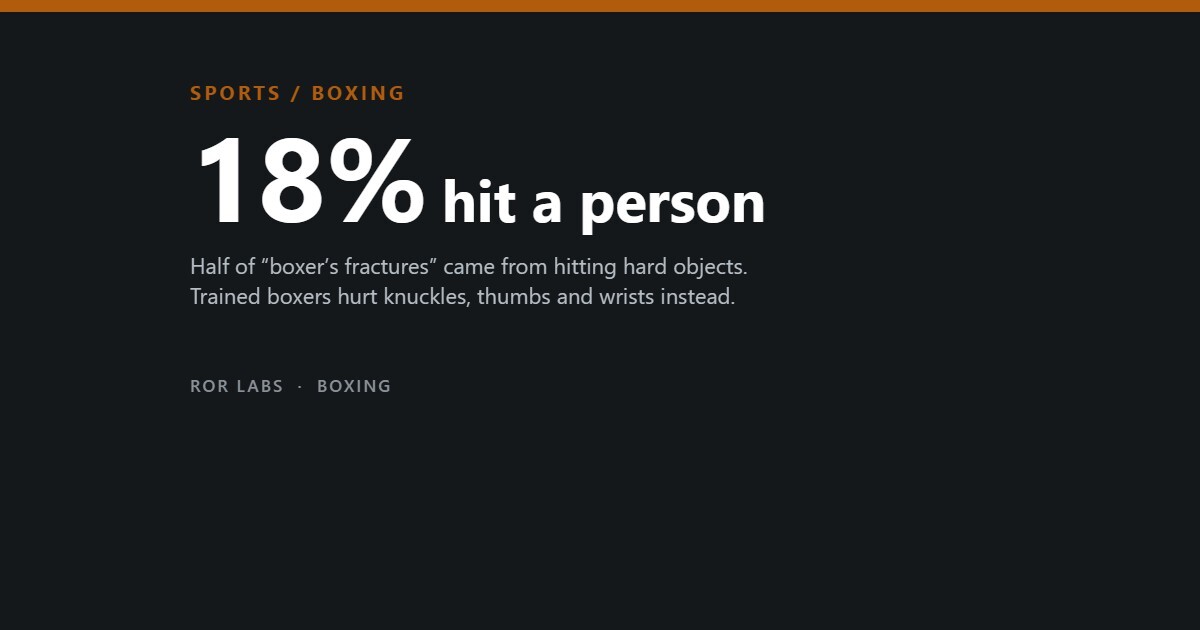
- Most “boxer’s fractures” are not from boxing: in one series 51% came from deliberately hitting a hard object and 18% from hitting a person.
- In Britain’s elite squad, carpometacarpal instability, boxer’s knuckle, thumb ligament sprains and wrist sprains made up about two thirds of 172 hand and wrist injuries.
- The rear hand and the index and middle knuckles take the load; elite rear-hand punches reached about 4,800 newtons in the laboratory.
- Adding rigid tape over a wrap cut wrist movement at impact from up to half the available range to about a fifth, though no study has yet counted injuries.
In September 2024 the WBC lightweight champion Shakur Stevenson pulled out of an October title defence against Joe Cordina; a Matchroom statement said he had undergone surgery on his hand. A year later something smaller did similar damage. Sebastian Fundora, the WBC junior middleweight champion, suffered a hand contusion in sparring, and on 10 October 2025 his defence against Keith Thurman, and the whole Las Vegas pay-per-view card around it, was postponed.
Hands are boxing’s most ordinary casualty, yet the best-known hand injury carries the wrong name. In a US series of 51 patients with a “boxer’s fracture” of the little-finger metacarpal, only 18% had hit another person and 51% had deliberately struck a hard object. The radiologists proposed calling it the MACHO fracture, for men angrily cuffing hard objects, and argued that trained boxers tend to break the second or third metacarpal instead.
This article covers what actually breaks and tears in a boxer’s hand, where the strain concentrates, what wraps, tape and padding were measured to do, and how the injuries are treated and how long they take. It is written for gym boxers and fitness-class punchers as much as for competitors. The aim is not to keep anyone away from the bag. It is to box carefully.
What actually gets hurt in a boxer’s hand
As our earlier article on boxing injuries and headguards showed, the hand is where boxers are hurt most often. The most detailed picture of which structures fail comes from Great Britain’s Olympic squad. Team doctors and physiotherapists logged every injury in 98 boxers from 2005 to 2012 and recorded 172 hand and wrist injuries. Four diagnoses made up about two thirds of them, and none was the classic little-finger fracture.
Hand and wrist diagnoses in Britain’s elite boxing squad
Share of 172 hand and wrist injuries recorded prospectively in the GB amateur squad, 2005–2012 (98 boxers).
Source: Loosemore et al., HAND 12(2):181 (2017).
Carpometacarpal instability is a loosening of the joints where the index and middle metacarpals meet the wrist, the bones that should carry a well-thrown punch; repeated loading can raise a bony lump called a carpal boss. Boxer’s knuckle is a tear of the sagittal band or extensor hood, the sling that keeps the tendon centred over the knuckle, sometimes with a torn joint capsule beneath. The thumb injury is a sprain of the ligament at its base, the one skiers tear on a pole.
An older series of 100 consecutive boxing hand injuries found 39% around the thumb, mostly from the thumb being forced away from the fist, and 35% at the metacarpal bases and wrist, from forced flexion. Wrist injuries were the slower ones in the British squad: a median of 31.5 days lost each, against 16.5 for hand injuries. Scapholunate instability, a tear between two wrist bones, was second only to carpometacarpal instability in total days lost.
How “boxer’s fractures” actually happen
Mechanism of fifth metacarpal fractures in two hospital series. None of these categories describes a gloved, wrapped punch.
Sources: Brandser and Ellingson (2000), doi:10.1007/PL00011855; Gudmundsen and Borgen, Acta Radiologica (2009).
The Norwegian hospital found the fifth metacarpal in 271 of 1,475 hand fractures, with a weekend peak among the aggression cases. A different worry is the scaphoid, a small wrist bone that can break from a punch or a fall on an outstretched hand. NHS guidance warns it may not show clearly on the first X-ray, so a suspected fracture is treated as one until it is ruled out.
Where the risk concentrates
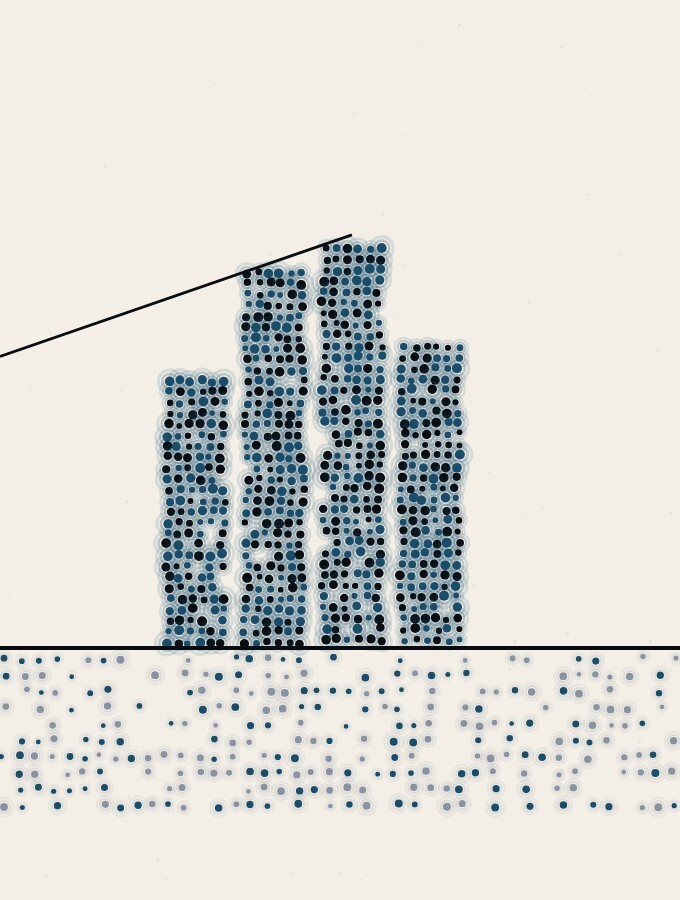
Force is the first concentrator. In a laboratory test of straight punches into an instrumented manikin, elite amateurs’ rear hands produced about 4,800 newtons, twice the figure for novices, so skill raises the load on the hand rather than lowering it. Sensors inside the gloves during six professional fights recorded far smaller averages, roughly 870 to 1,150 newtons depending on weight class, because most punches in a fight are not maximal.
The rear hand takes the worst of it. In a British series of 57 fingers in 45 boxers operated on for extensor hood injuries, 65% were on the right hand, the rear hand for the orthodox fighters who made up nearly all of the group, and the middle and index knuckles accounted for almost nine in ten. In a 2026 series of 20 combat athletes with carpometacarpal instability, 18 had injured the rear hand. Fatigue adds to it: as a boxer tires, the squad study notes, the wrist tends to collapse into flexion and strains the back of those joints.
How hard a straight punch lands
Peak force in newtons. Laboratory maximal punches into an instrumented manikin, and mean punch force measured inside gloves during six professional bouts.
Sources: Smith et al., Journal of Sports Sciences (2000); Pierce et al., Journal of Quantitative Analysis in Sports (2006).
Competition looks far more dangerous than training, and the headline figures say so: in the British squad the hand and wrist injury rate was 347 per 1,000 hours of bouts, against an estimated fewer than 0.5 per 1,000 hours of training. The authors flagged the catch themselves. Training hours were estimated from schedules, and much of training is running and weights. Counted only by time spent punching, training produced about 30 hand and wrist injuries per 1,000 hours, and 44% of all such injuries happened in training.
For fitness boxers the evidence is thinner. US emergency data for 2012 to 2016 found hand fractures were the commonest boxing-related upper-limb injury. A 2025 French review of four studies found heavy-bag training associated with hand injuries, though it could not establish cause, and surgeons have described knuckle injuries in two people who hit recreational punching machines.
What has been measured to work
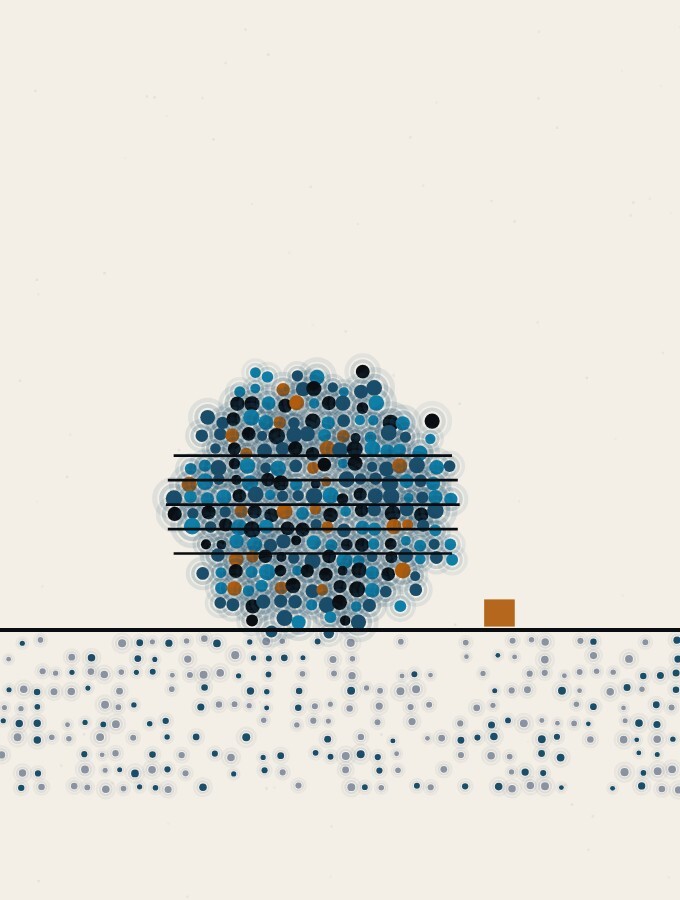
Hand wraps are older than the evidence for them. The clearest modern test came from British researchers who fitted electromagnetic sensors to 18 elite male boxers and measured wrist movement at the moment of impact. With wraps alone, the wrist bent and tilted towards the little finger by up to half of its available range on straight punches. Adding rigid tape over the wrap cut that to about a fifth and slowed the wrist’s travel to its peak angle.
Padding over the knuckles changes what the hand feels and what the target receives. In a 2015 study, a 1.2-centimetre foam pad over the knuckles lowered punching force by 12.6% in professional fighters and 8.9% in untrained men. A 2022 thesis put a load cell over the knuckles of six combat athletes and found less force at the hand with gel-reinforced wraps in all six. A 2024 Thai study of 12 elite boxers, by contrast, found silicone-padded wraps delivered slightly more force to the target than gauze.
What tape adds to a hand wrap
Wrist movement on impact as a share of each boxer’s total active wrist motion, 18 elite male boxers. Lower means a stiffer, better-aligned wrist. Figures are the upper bounds reported.
Source: Gatt, Allen and Wheat, Physical Therapy in Sport (2023), doi:10.1016/j.ptsp.2023.03.002.
None of these studies counted injuries. They measured angles and forces in a laboratory, over a handful of punches, in small groups, and the gel-wrap result comes from a master’s thesis rather than a peer-reviewed paper. No one has yet randomised boxers to different wraps and followed their hands through a season.
The treatment evidence is firmer for the fracture boxers rarely get. A 2019 meta-analysis of two randomised trials of fifth metacarpal neck fractures found no difference in function at 12 months between surgery and non-surgical care, but surgical patients had three times the odds of an adverse event. A multicentre trial of 68 patients found soft wrap and buddy taping non-inferior to reduction and casting, and a 2023 trial of 84 active adults found union in about seven and a half weeks with or without pinning.
Why the answer is not to stop boxing
The injuries peculiar to trained boxers are usually fixable. In a British series of 44 elite boxers operated on for extensor hood injuries between 2008 and 2021, 43 returned to the same level of competition, on average eight months after surgery. A 2000 series of eight professional athletes returned in about five months after extensor repair, and 15 professional combat athletes whose unstable carpometacarpal joints were fused were back competing after a mean of six months, with grip 32% stronger than before.
The weak point is delay. The British boxers had lived with symptoms for 8.6 months on average before surgery, and some had been given steroid injections into the joint; the one repair that re-ruptured followed an injection six weeks before the operation, and the surgeon now prefers a 12-week gap. A swollen, boggy knuckle or a tendon that slips sideways when you make a fist is a reason to see a hand specialist, not to tape up and carry on.
How long serious hand injuries keep boxers out
Months, from surgical case series of elite boxers and professional athletes. Ranges in brackets.
Sources: Matharu et al., Journal of Hand Surgery (European Volume) (2022); Polatsch et al., Orthopedics (2021); Hame and Melone, American Journal of Sports Medicine (2000).
For gym boxers the practical lessons are modest. Wrap every session, and ask a coach or physiotherapist whether tape over the wrist suits you. Keep the padding between your knuckles and the bag, and do not punch hard objects, bare-handed, or with a wrist that is folding from fatigue. Build bag volume gradually. A hand injury reported early usually costs a few weeks; one boxed through can cost the better part of a year.
What to do
Steps sorted by when they matter. Each one says how strong the evidence is: Measured Official advice Untested
Before
- Wrap your hands every session, and ask a coach or physiotherapist whether rigid tape over the wrist suits you. Tape over a wrap cut wrist movement at impact from up to half its range to about a fifth. Measured see Sources
- Build bag volume gradually, and keep padding between your knuckles and the bag. Official advice see Sources
If it happens
- Stop punching when your wrist starts folding from fatigue. Tired wrists collapse into flexion and strain the joints at the base of the fingers. Official advice see Sources
Afterwards
- See a hand specialist early if a knuckle stays swollen or a tendon slips sideways when you make a fist. British boxers had lived with symptoms for 8.6 months on average before surgery. Measured see Sources
- Treat wrist pain after a punch or a fall as a possible scaphoid fracture until a doctor rules it out; it may not show on the first X-ray. Official advice see Sources
What not to do
- Do not punch walls, hard objects or anything bare-handed. In one series 51% of “boxer’s fractures” came from deliberately hitting a hard object. Measured see Sources
- Do not tape up and box through a hand injury. One reported early usually costs a few weeks; one boxed through can cost most of a year. Official advice see Sources
Not medical advice. For a swollen knuckle, an unstable thumb or wrist pain after a punch, see a doctor or a hand physiotherapist before going back to the bag.
Questions people ask
Do boxers usually get a boxer’s fracture?
Less often than the name suggests. In hospital series most fifth metacarpal fractures come from punching walls, objects or people. Trained boxers more often injure the index and middle finger joints and knuckles.
Are gel wraps better than traditional wraps?
Possibly, but the evidence is thin: one thesis of six athletes found less force at the hand with gel-reinforced wraps. Adding rigid tape to a traditional wrap reduced wrist movement in elite boxers.
Does a broken little-finger knuckle need surgery?
Often not. Randomised trials found similar function at a year with or without surgery, and more complications after it. Displaced, rotated or open fractures are different, and a doctor should decide.
How long does boxer’s knuckle take to recover?
Minor sprains may settle with splinting. After surgical repair, elite boxers in a British series returned at a mean of eight months, nearly all at their previous level.
The short version
- Most “boxer’s fractures” are not from boxing: in one series 51% came from deliberately hitting a hard object and 18% from hitting a person.
- In Britain’s elite squad, carpometacarpal instability, boxer’s knuckle, thumb ligament sprains and wrist sprains made up about two thirds of 172 hand and wrist injuries.
- The rear hand and the index and middle knuckles take the load; elite rear-hand punches reached about 4,800 newtons in the laboratory.
- Adding rigid tape over a wrap cut wrist movement at impact from up to half the available range to about a fifth, though no study has yet counted injuries.
- After surgery for boxer’s knuckle or carpometacarpal instability, nearly all elite fighters in case series returned to competition, on average six to eight months later.
This is a summary of published research, not medical advice. If a knuckle stays swollen, a tendon slips when you make a fist, your thumb feels unstable, or your wrist hurts after a punch or a fall, see a doctor or a physiotherapist with hand experience before going back to the bag.
Further reading: Loosemore et al., HAND 12(2):181 (2017), for the British squad’s hand and wrist injuries. Matharu et al., Journal of Hand Surgery (European Volume) (2022), for extensor hood repair in boxers. Gatt, Allen and Wheat, Physical Therapy in Sport (2023), for what tape adds to a wrap.
Sources
- Campbell B. Sebastian Fundora vs. Keith Thurman: fight postponed after Fundora suffers hand injury in training camp. CBS Sports, 10 October 2025.
- Wellings S. Injured Shakur Stevenson out of Joe Cordina fight. Boxing News, 12 September 2024.
- Brandser EA, Ellingson BT. MACHO fracture: distal fifth metacarpal fracture revisited (2000), doi:10.1007/PL00011855.
- Gudmundsen TE, Borgen L. Fractures of the fifth metacarpal. Acta Radiologica (2009), doi:10.1080/02841850802709201.
- Loosemore M, Lightfoot J, Gatt I, Hayton M, Beardsley C. Hand and wrist injuries in elite boxing: a longitudinal prospective study (2005–2012) of the Great Britain Olympic boxing squad. HAND 12(2):181–187 (2017), doi:10.1177/1558944716642756.
- Noble C. Hand injuries in boxing. American Journal of Sports Medicine (1987), doi:10.1177/036354658701500408.
- University Hospitals Sussex NHS Foundation Trust. Scaphoid fracture, patient information leaflet 929.1 (2025).
- Smith MS, Dyson RJ, Hale T, Janaway L. Development of a boxing dynamometer and its punch force discrimination efficacy. Journal of Sports Sciences (2000), doi:10.1080/02640410050074377.
- Pierce JD, Reinbold KA, Lyngard BC, Goldman RJ, Pastore CM. Direct measurement of punch force during six professional boxing matches. Journal of Quantitative Analysis in Sports (2006), doi:10.2202/1559-0410.1004.
- Iijima Y, Kusunose K. Treatment of second and third carpometacarpal joint instability in elite boxers. Journal of Hand Surgery (Asian-Pacific Volume) (2026), doi:10.1142/S2424835526500074.
- Lemme NJ, Ready L, Faria M, et al. Epidemiology of boxing-related upper extremity injuries in the United States. The Physician and Sportsmedicine (2018), doi:10.1080/00913847.2018.1516478.
- Chabot M. Les facteurs de risques de blessures à la main chez les boxeurs. Dissertation, HAL dumas-05283154 (2025).
- Javed MU, Hemington-Gorse SJ, Shokrollahi K. A new recreational mechanism for the boxer’s knuckle: cause for concern? (2011), doi:10.1308/147870811X583250.
- Gatt IT, Allen T, Wheat J. Effects of using rigid tape with bandaging techniques on wrist joint motion during boxing shots in elite male athletes. Physical Therapy in Sport (2023), doi:10.1016/j.ptsp.2023.03.002.
- Galpin AJ, Gulick CN, Jacobo K, et al. The influence of a padded hand wrap on punching force in elite and untrained punchers. International Journal of Kinesiology and Sports Science 3(4):22 (2015).
- Gusnowski EM. Determination of the protective capacity of hand wraps in combat athletes using force analysis. MSc thesis, Western University (2022).
- Punthipayanon S, Kwanboonchan S, Rachnavy P, Kuo CH. Enhanced boxing punch impact with silicone cushioning. Frontiers in Sports and Active Living (2024), doi:10.3389/fspor.2024.1358224.
- Wormald JCR, Claireaux HA, Gardiner MD, et al. Management of extra-articular fractures of the fifth metacarpal: operative vs. non-operative treatment (FORTE). JPRAS Open (2019).
- van Aaken J, Fusetti C, Luchina S, et al. Fifth metacarpal neck fractures treated with soft wrap/buddy taping compared to reduction and casting. Archives of Orthopaedic and Trauma Surgery (2016), doi:10.1007/s00402-015-2361-0.
- Zawam SH, Abdelrazek BHMZ, El-Mofty AO, et al. Conservative treatment versus transverse pinning in fifth metacarpal neck fractures in active adults: a randomized controlled trial. European Journal of Trauma and Emergency Surgery (2023), doi:10.1007/s00068-023-02417-3.
- Matharu GS, Gatt IT, Delaney R, Loosemore MP, Hayton MJ. Extensor hood injuries in elite boxers: injury characteristics, surgical technique and outcomes. Journal of Hand Surgery (European Volume) (2022), doi:10.1177/17531934221123139.
- Hame SL, Melone CP. Boxer’s knuckle in the professional athlete. American Journal of Sports Medicine (2000), doi:10.1177/03635465000280061701.
- Polatsch DB, Zbeda RM, Beldner S, Melone CP. Carpometacarpal arthrodesis for traumatic carpal boss among combative athletes. Orthopedics (2021), doi:10.3928/01477447-20211101-05.