Boxing ring deaths, and the brain bleed behind most of the 2,076 on record
Key takeaways · 10 min read
- John Cooney died a week after a title fight in Belfast in February 2025; a historical archive lists 2,076 boxing deaths since 1720, roughly ten a year.
- Most boxing deaths are acute subdural haematomas: bridging veins tear when a punch turns the head suddenly, and symptoms can appear after a lucid interval.
- 73% of recorded deaths followed professional bouts and 65.2% followed a knockout; professional deaths were most common in the sixth round, amateur deaths in the first.
- Fast transfer to neurosurgery matters, but the famous four-hour rule has not held up cleanly in later studies.
On 1 February 2025 the Irish boxer John Cooney defended his Celtic super-featherweight title at the Ulster Hall in Belfast. The fight was stopped in the ninth round. The British Boxing Board of Control’s medical team assessed him at ringside, and at the Royal Victoria Hospital doctors found an intracranial haemorrhage, a bleed inside the skull, and operated at once. He died on 8 February, aged 28. CBS News counted at least five other boxers who had died of fight injuries in the previous year.
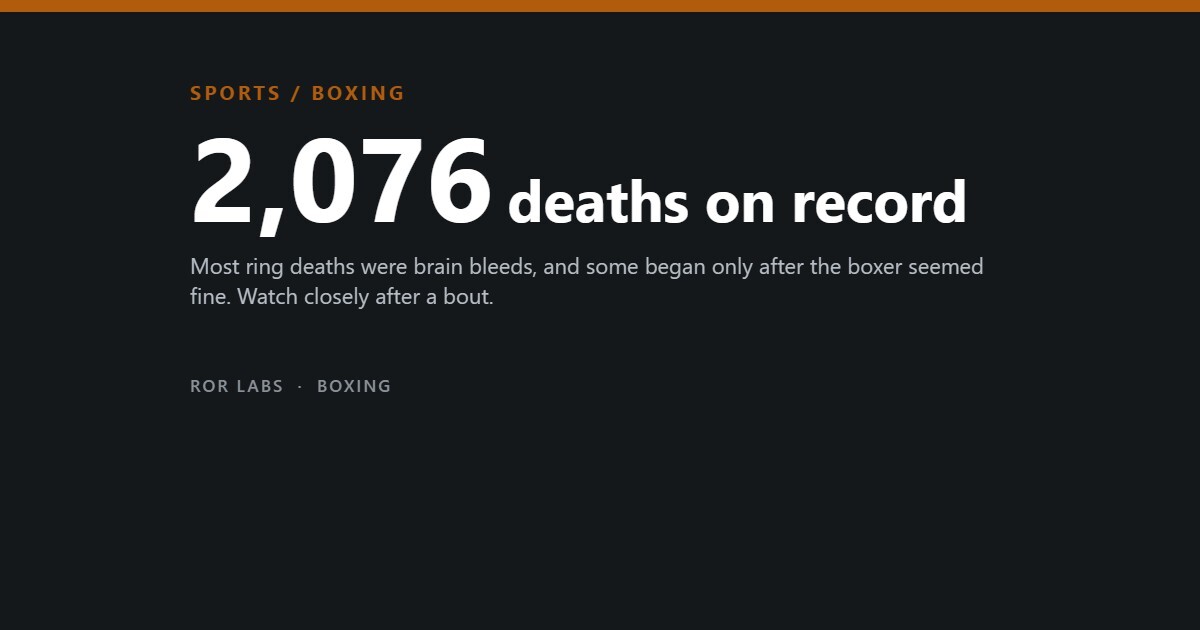
Deaths like his are rare, but they have been counted for a long time. The Velazquez collection, begun in the 1950s from newspaper and magazine clippings and later digitised by the historian Joseph Svinth, lists 2,076 boxing deaths from 1720 onwards, roughly ten a year. A 2023 neurosurgical review that analysed its latest version found the average boxer was 23 when he died. Most of these deaths have one cause.
This article covers what happens inside the skull, where the deaths cluster, what ringside medicine, fast surgery, scans and suspensions have been shown to achieve, and why the answer is to box carefully, not to stop. Our earlier article on boxing injuries and headguards covers the everyday injuries; this one is about the rare worst case.
What actually happens inside the skull
Acute subdural haematoma is the injury that kills most boxers. In a Japanese series of 15 professionals it accounted for 75% of all acute brain injuries in boxing and was the leading cause of boxing deaths. Blood collects between the brain and its tough outer covering, usually from bridging veins, the short vessels that cross that gap. In experiments, Gennarelli and Thibault showed these veins tear when the head accelerates very suddenly; how fast the force builds matters as much as its size.
Boxing supplies exactly that kind of force: a punch turns the head as well as pushing it. When eleven Olympic boxers threw 78 blows at an instrumented crash-test dummy, the hook produced the greatest punch force and rotated the head at about 9,300 radians per second squared, levels the researchers said were consistent with concussions in American football. Straight punches to the jaw, tested separately, rotated it about two thirds as fast.
What a punch does to the head
Average values when Olympic boxers struck an instrumented Hybrid III dummy. Rotational acceleration in radians per second squared; force in newtons; translational acceleration in g.
Sources: Viano et al., Neurosurgery (2005), 78 blows by 11 boxers; Walilko, Viano & Bir, British Journal of Sports Medicine 39(10):710 (2005), 18 straight punches by 7 boxers. Laboratory measurements, not fights.
The bleed does not always show at once. In the Japanese series, some boxers were alert after the knockout and then deteriorated between ten minutes and an hour later, a pattern doctors call a lucid interval. A 2023 review adds that young athletes have little spare room around the brain, so pressure can rise quickly once a haematoma starts to grow. That is why the hour after a fight matters as much as the fight itself.
Where the risk concentrates
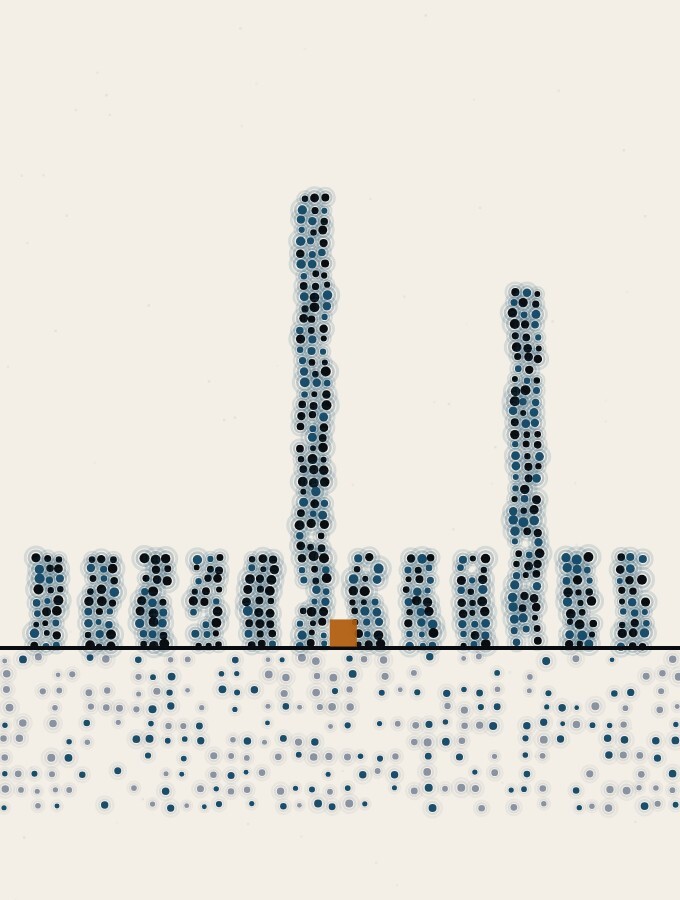
Nearly three quarters of the deaths in the Velazquez collection, 73%, followed professional bouts; 26% were amateur and 1% were “toughman” contests between untrained fighters. A separate analysis of professional boxing alone, by Baird and colleagues with Svinth, found 339 deaths between 1950 and 2007, at an average age of 24, with a higher share in the lighter weight classes and a significant decline after 1983.
The strongest pattern is the knockout. Knockouts end fewer than 5% of professional bouts, yet 64% of the deaths Baird counted followed one, and another 15% followed a technical knockout. Amateur knockouts are rarer still: the 2001 world amateur championships produced 6 in 366 bouts. In Japan, 38 boxing deaths were recorded between 1952 and 2016, at an average age of 23.9; about 60% of those boxers lost their final fight and 52.6% lost it by knockout.
How the recorded ring deaths happened
Share of the 2,076 deaths in the Velazquez collection, 1720 to 2023, by type of bout, result and where the final collapse began. Compiled from press reports, so incomplete.
Source: Da Broi et al., Brain and Spine 3:102743 (2023), updated analysis of the Velazquez collection supplied by J. R. Svinth.
The round in which the fatal fight ended is less obvious than fatigue would suggest. Among professional deaths in the collection, the sixth round was the most common, followed by the tenth and the fifth, not the final rounds of long fights. Amateur deaths clustered at the start: 45% came in the first round of bouts that last only three. The Japanese series likewise found haematomas most often in ten-round fights.
The round of the fatal bout
Share of deaths by the round in which the fatal bout ended, Velazquez collection. Professional and amateur bouts shown separately; only the most common rounds are listed.
Source: Da Broi et al., Brain and Spine (2023); 1,008 professional and 248 amateur deaths with a known round.
Women are almost absent from the data. The 2023 review found practically nothing beyond case reports. The first reported subdural haematoma in a female boxer, in 2004, followed a sparring knockdown: she had worsening headaches and vomiting but kept training and fought two weeks later. In Montreal in 2021, the 18-year-old Mexican boxer Jeanette Zacarias Zapata died five days after a knockout; a coroner later found she had a likely concussion 15 weeks earlier.
What has been measured to work
Close medical supervision is the oldest safeguard, and the evidence is observational. Over two years in New York State, professional boxers fought 3,110 rounds and sustained 376 injuries, but only four needed immediate neurological assessment in hospital; one of them died of subdural haematomas on both sides of the brain. The authors concluded that severe acute brain injuries are rare under strict medical supervision, without a comparison group to prove it.
Speed to the operating theatre is the next link. In a 1981 study of 82 comatose patients with acute subdural haematoma, mortality was 30% when surgery came within four hours and 90% when it came later. In Chicago, patients admitted straight to a trauma centre died less often than those transferred from another hospital, 50% against 76%. The Association of Ringside Physicians therefore recommends an on-site ambulance and transfer to a trauma centre with round-the-clock neurosurgery.
Deaths after acute subdural haematoma, by time and route to surgery
Mortality in hospital series of traumatic acute subdural haematoma from all causes, not boxing alone. Groups differ in severity, so the comparisons are observational.
Sources: Seelig et al., New England Journal of Medicine (1981); Stone et al., Journal of Trauma (1986); Wilberger et al., Journal of Neurosurgery 74(2):212 (1991); Hatashita et al., Neurologia Medico-Chirurgica (1993).
The four-hour rule is less solid than its fame suggests. Wilberger’s team reviewed 101 patients with acute subdural haematoma and found no link between time to surgery and death, even hour by hour. A Tokyo series found higher mortality among moderately comatose patients operated on sooner, and a 2024 meta-analysis of five studies found lower mortality when surgery came after four hours. A plausible explanation is that the worst bleeds reach theatre fastest, or never arrive. Speed still matters; a clean cut-off does not.
Brain scans before licensing aim at a different problem: hidden weak spots. A 2022 consensus statement from the Association of Ringside Physicians recommends an MRI at first licence, a repeat at least every three years, and an angiogram for fighters aged 40 or older. Fighters with an aneurysm, a tangle of abnormal vessels or a large fluid-filled cyst should be refused a licence. The authors say these rules rest on expert experience, because studies are lacking.
Minimum rest periods written into the rules
Days before a combatant may fight again, from two regulators’ published rules. These are minimums; doctors can extend them.
Sources: Combat Sports Authority of NSW, Authority Rules 2024; Illinois Administrative Code, title 68, section 1370.200.
Suspensions after knockouts are common, but we found no study measuring whether they prevent deaths, and they depend on honest records. A Quebec coroner revised his report on Zacarias Zapata in 2025 after Radio-Canada found that scans submitted for her carried the signature of a doctor who does not exist; a doctor in Mexico had ordered 45 days of bed rest. The revised report asks for medical reports from boxers knocked out in a previous fight.
Dehydration from cutting weight is a proposed contributor, not a proven one. Cooney’s family believes extreme weight loss before his fight played a part; that is their view, not a finding. Losing 2% to 3% of body mass through sweat measurably changes the brain’s fluid-filled spaces on MRI, and the hypothesis is that a dehydrated brain is less well cushioned. No study has shown that weight cutting causes boxing brain bleeds, and moving Japanese weigh-ins to the day before did not change death rates. Cut weight only with a doctor and a registered dietitian.
Why the answer is not to stop boxing
A figure of 1.3 deaths per 100,000 participants, from a medical textbook on boxing reviewed in JAMA in 1996, is often used to show the sport is safer than horse racing or parachuting. Treat it with caution. Nobody knows how many people box, so any denominator is a guess, and the Velazquez collection relies on press reports, so deaths in unofficial bouts go missing. Ring deaths are rare, falling and imperfectly counted.
For gym boxers the lessons are simple. Knockouts are not part of fitness boxing, and sparring is not about hurting a partner. Anyone knocked down or dazed should stop for the day and be checked; a worsening headache, vomiting, confusion or drowsiness afterwards needs an ambulance, not a nap. Because of the lucid interval, nobody should go home alone after a hard knockout. Tell coaches and doctors about every previous one.
For professionals, the measures follow the evidence: a ringside doctor who can stop a fight, an ambulance at the venue, a neurosurgical centre agreed in advance, scans before licensing, suspensions that follow a boxer across borders and medically supervised weight management. The inquest into Cooney’s death, still at a preliminary stage in September 2026, is examining medical oversight, weight management and the ambulance that took him to hospital.
What to do
Steps sorted by when they matter. Each one says how strong the evidence is: Measured Official advice Untested
Before
- Tell coaches and doctors about every previous knockout or concussion. Official advice see Sources
- For competition, expect a ringside doctor, an ambulance at the venue and a neurosurgical centre agreed in advance. Official advice see Sources
If it happens
- Anyone knocked down or dazed should stop for the day and be checked. 65.2% of recorded ring deaths followed a knockout. Measured see Sources
Afterwards
- Do not go home alone after a hard knockout, because of the lucid interval. Official advice see Sources
- Respect the mandatory rest periods, and do not return to sparring until a doctor clears you. Official advice see Sources
What not to do
- Do not cut weight on your own. Plan any weight loss with a doctor and a registered dietitian. Official advice see Sources
Not medical advice. Headache, vomiting, confusion or drowsiness after a bout or sparring needs emergency care: call emergency services.
Questions people ask
Why do some boxers collapse after they seem fine?
A subdural haematoma can keep growing after the fight. In a Japanese series some boxers were alert after a knockout and deteriorated ten minutes to an hour later. Symptoms after a bout should never be slept off.
What kills boxers most often?
Acute subdural haematoma, bleeding between the brain and its outer covering after bridging veins tear under sudden rotation of the head. In the Velazquez collection, 65.2% of deaths followed a knockout.
Are amateur boxers at risk too?
Yes, though less. Amateur bouts account for 26% of recorded deaths, and knockouts in amateur competition are rare. Recorded amateur deaths cluster in the first round.
Does cutting weight cause brain bleeds?
It is a hypothesis, not a proven cause. Dehydration changes the fluid spaces of the brain on MRI, but no study has shown that it causes boxing deaths. Plan any weight loss with a doctor and a registered dietitian.
The short version
- John Cooney died a week after a title fight in Belfast in February 2025; a historical archive lists 2,076 boxing deaths since 1720, roughly ten a year.
- Most boxing deaths are acute subdural haematomas: bridging veins tear when a punch turns the head suddenly, and symptoms can appear after a lucid interval.
- 73% of recorded deaths followed professional bouts and 65.2% followed a knockout; professional deaths were most common in the sixth round, amateur deaths in the first.
- Fast transfer to neurosurgery matters, but the famous four-hour rule has not held up cleanly in later studies.
- Brain scans, suspensions and weight rules rest largely on expert judgement; weight cutting as a cause of bleeds remains a hypothesis.
This is a summary of published research, not medical advice. Anyone who has a headache, vomiting, confusion or drowsiness after a bout or sparring needs emergency care: call emergency services. For return to training after any head injury, and for weight management, talk to a doctor, a physiotherapist or a registered dietitian.
Further reading: Da Broi et al., Brain and Spine (2023), for the updated Velazquez analysis and its limits. Sethi & Neidecker, The Physician and Sportsmedicine (2022), for the ringside physicians’ imaging rules. Baird et al., Neurosurgery 67(5):1444 (2010), for professional deaths from 1950 to 2007.
Sources
- Black R. Boxer’s family ‘hope inquest will bring change to the sport’. Press Association, via Express & Star and The Irish News, 25 March 2026; Irish Times, Boxer John Cooney in intensive care after title fight defeat in Belfast, 3 February 2025; CBS News, Irish boxer John Cooney dies a week after being injured in super-featherweight title fight, February 2025.
- The Irish News. Neurosurgeon to complete report over boxer John Cooney’s death in Belfast, 25 September 2026.
- Da Broi M, Al Awadhi A, Voruz P, Nouri A, Schaller K. The spectrum of acute and chronic consequences of neurotrauma in professional and amateur boxing. Brain and Spine 3:102743 (2023), doi:10.1016/j.bas.2023.102743.
- Baird LC, Newman CB, Volk H, Svinth JR, Conklin J, Levy ML. Mortality resulting from head injury in professional boxing. Neurosurgery 67(5):1444–1450 (2010), PMID 20948404.
- Sawauchi S, Murakami S, Tani S, et al. Acute subdural hematoma caused by professional boxing [in Japanese]. No Shinkei Geka 24(10):905–911 (1996), PMID 8914149.
- Gennarelli TA, Thibault LE. Biomechanics of acute subdural hematoma. Journal of Trauma 22(8):680–686 (1982), PMID 7108984.
- Viano DC, Casson IR, Pellman EJ, et al. Concussion in professional football: comparison with boxing head impacts – part 10. Neurosurgery (2005), doi:10.1227/01.neu.0000187541.87937.d9.
- Walilko TJ, Viano DC, Bir CA. Biomechanics of the head for Olympic boxer punches to the face. British Journal of Sports Medicine 39(10):710 (2005).
- McCrory P, Falvey É, Turner M. Returning to the golden age of boxing. British Journal of Sports Medicine (2012), doi:10.1136/bjsports-2012-091276.
- Teramoto M, Cross CL, Cushman DM, Willick SE. Boxing fatalities in relation to rule changes in Japan: secondary data analysis. The Physician and Sportsmedicine 46(3):349–354 (2018), doi:10.1080/00913847.2018.1428028.
- Mièle VJ, Carson L, Carr A, Bailes JE. Acute on chronic subdural hematoma in a female boxer: a case report. Medicine & Science in Sports & Exercise (2004), doi:10.1249/01.mss.0000145470.16938.7a.
- Global News (The Canadian Press). Quebec coroner revises report on Mexican boxer’s death after news investigation, 21 March 2025.
- Jordan BD, Campbell EA. Acute injuries among professional boxers in New York State: a two-year survey. The Physician and Sportsmedicine (1988), doi:10.1080/00913847.1988.11709407.
- Seelig JM, Becker DP, Miller JD, et al. Traumatic acute subdural hematoma: major mortality reduction in comatose patients treated within four hours. New England Journal of Medicine (1981), PMID 7231489.
- Stone JL, Lowe RJ, Jonasson O, et al. Acute subdural hematoma: direct admission to a trauma center yields improved results. Journal of Trauma (1986), doi:10.1097/00005373-198605000-00006.
- Wilberger JE, Harris M, Diamond DL. Acute subdural hematoma: morbidity, mortality, and operative timing. Journal of Neurosurgery 74(2):212 (1991), doi:10.3171/jns.1991.74.2.0212.
- Hatashita S, Koga N, Hosaka Y, Takagi S. Acute subdural hematoma: severity of injury, surgical intervention, and mortality. Neurologia Medico-Chirurgica (1993).
- Kotwica Z, Brzeziński J. Acute subdural haematoma in adults: an analysis of outcome in comatose patients. Acta Neurochirurgica (1993), doi:10.1007/bf01809257.
- Merakis M, Lewis DP, Weaver N, Balogh ZJ. Time from injury to operative intervention in traumatic intracranial hematoma: a systematic literature review and meta-analysis. World Journal of Surgery (2024), doi:10.1002/wjs.12298.
- Sethi NK, Neidecker JM. Neuroimaging in professional combat sports: consensus statement from the Association of Ringside Physicians. The Physician and Sportsmedicine (2022), doi:10.1080/00913847.2022.2083922.
- Combat Sports Authority of NSW. Authority Rules 2024 (published June 2024); Illinois Administrative Code, title 68, section 1370.200, Suspensions and Mandatory Rest Periods.
- Watson P, Head KE, Pitiot A, Morris P, Maughan RJ. Effect of exercise and heat-induced hypohydration on brain volume. Medicine & Science in Sports & Exercise (2010), doi:10.1249/mss.0b013e3181e39788; Dickson JM, Weavers HM, Mitchell N, et al. The effects of dehydration on brain volume: preliminary results (2005), doi:10.1055/s-2004-821318.
- Press JM. Review of Boxing and Medicine, ed. Cantu RC. JAMA (1996), doi:10.1001/jama.1996.03530440089044; Heilbronner RL, Ravdin L. Boxing. In: Sports Neuropsychology chapter (2020), doi:10.1201/9780367810535-14.