Golf ball strikes, and what a 171 mph drive can do to an eye
Key takeaways · 10 min read
- A tour drive leaves the club at about 171 mph, roughly 134 joules for a ball of the maximum legal mass; an average amateur’s drive carries about 81.
- In hospital case series of golf eye injuries, about half tore the eye open and a third ended with the eye removed, but those series overrepresent the worst cases.
- The largest group of errant-ball lawsuits involves shots from another group on another hole, followed by damage to cars and homes beside courses.
- New York’s highest court held in 2010 that failing to shout “fore” did not make a golfer liable; a Malaysian court in 2026 made a resort pay for persistent strikes on a house.
In September 2026 a High Court in Alor Setar, Malaysia, ordered a golf resort and its parent company to pay RM100,000 to a retired civil servant whose house sat beside the seventh tee. Balls had broken a window, cracked roof tiles and dented walls; 16 police reports were filed between 2019 and 2026. The judge called the club’s netting “reactive, delayed and demonstrably ineffective” and gave it 60 days to raise and extend it.
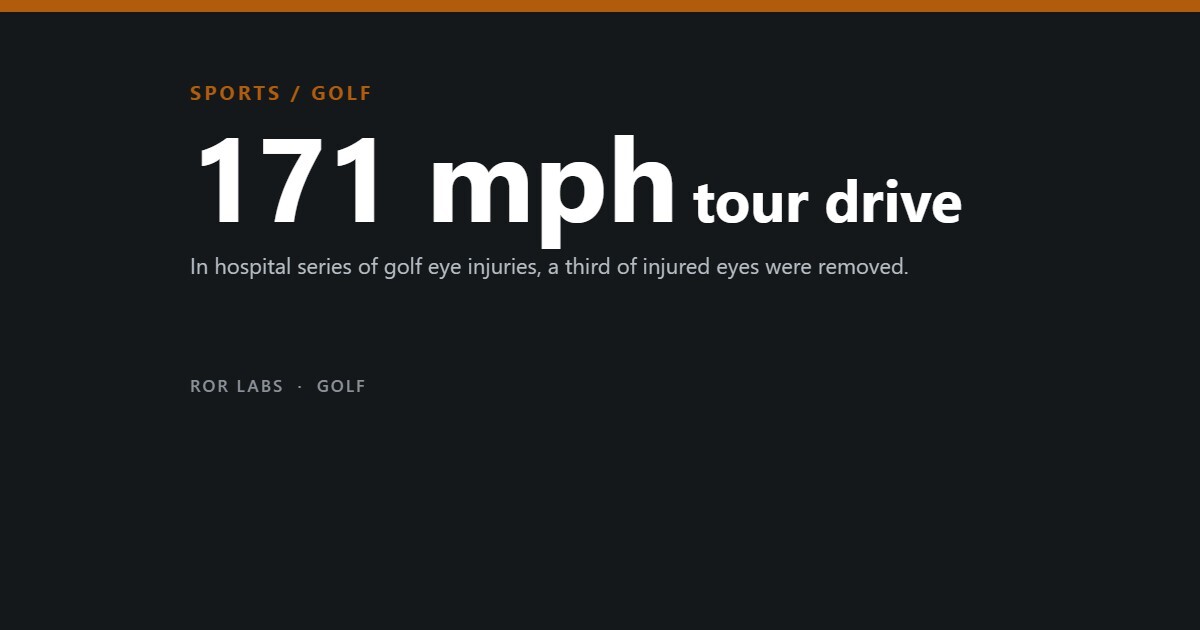
A golf ball is small, hard and fast. The rules cap its weight at 45.93 grams, and a PGA Tour drive leaves the clubface at about 171 miles an hour on average. When one goes astray, the people in the way are other golfers, spectators, greenkeepers and neighbours, and the damage ranges from a bruise to a lost eye. Courts, meanwhile, keep being asked who should pay.
This article covers what a struck ball actually does to an eye or a head, where the risk concentrates, from the next fairway to the gallery to the house over the fence, what has been measured to reduce it, from eyewear to course design, and what the law in a few countries has said about shouting “fore”. The conclusion is not to give up golf. It is to play carefully.
What a golf ball does when it hits a person
Launch-monitor maker Trackman puts the average PGA Tour driver ball speed at 171 mph and the LPGA Tour’s at 143. Its data from amateur men put a 14.5-handicap golfer at 133 mph. Using the maximum legal mass, that is about 134 joules of energy at launch for the tour player and 81 for the average amateur, by our calculation. The ball slows in flight, but at short range, or on a low shot, much of that energy remains.
How fast a golf ball leaves the club
Average ball speed at launch, miles per hour. Energy at launch for a 45.93 g ball is given in the label, calculated by us.
Sources: Trackman, tour and Trackman Combine averages; R&A Rules of Equipment, Part 4 (maximum ball mass). Energy = ½ × mass × speed², at launch only.
The eye takes the worst of it: a 2025 review notes that small, dense, fast balls such as golf balls tend to rupture the eye rather than merely bruise it. Pooling 11 case series with 102 patients, a 2016 review in Retina found that 51% of golf-related eye injuries were open-globe injuries, in which the wall of the eye is torn, and a third ended in removal of the eye. Balls caused 92% of the adult injuries. None of the patients had been wearing adequate eye protection.
When golf injures an eye
Golf-related eye injuries in published hospital case series. Two overlapping pooled analyses; denominators differ by outcome.
Sources: Crane et al., Retina (2016), doi:10.1097/IAE.0000000000001119; Jenkins, Hawkes and Murray, Journal of Sports Medicine (2016), article 7216325. Hospital and eye-unit series only.
Those percentages need a health warning, and the authors of the 2016 scoping review gave it themselves: every series came from emergency departments or specialist eye hospitals, which see the worst cases, and reports to course staff or family doctors would probably show milder injuries. A 2022 analysis of 20 years of US emergency department records bore this out. Among 379 sampled golf-associated eye injuries, half were contusions or corneal abrasions, and the authors concluded that minor injuries were more common than severe ones.
Heads are harder to break, but not immune. In a computer model published in 2019, a frontal strike at 35 metres a second, about 78 mph, did not fracture the skull but could cause mild brain injury, and blows to the side of the head were more dangerous. Deaths are rare and appear as single reports. In February 2018 a 27-year-old man hit in the head near the second tee at Frankton Golf Course in Queenstown, New Zealand, died in hospital after treatment for a brain bleed.
Where the risk concentrates
Most people hit by golf balls are golfers, and the ball usually comes from someone they are not playing with. When two American researchers searched 1,561 golf negligence lawsuits and kept the 85 errant-ball cases that a buffer zone might have prevented, the largest group, 34 cases, involved a shot from a different group on a different hole. Parallel fairways and paths crossing lines of play bring people into range of shots meant for elsewhere.
Across datasets the ball’s share depends on what is counted. US emergency department data covering 1990 to 2011 put being struck by a ball at 16% of all golf injuries, as described in our article on golf injuries, golf carts and the lightning myth. The share is higher for injuries to the face, and higher again for the eye, where club injuries are mainly a childhood problem. In a Korean hospital’s ten-year series of 173 craniofacial injuries, published in 2025, balls caused almost half.
How often the ball is to blame
Share of injuries caused by a golf ball rather than a club, fall or other cause, by dataset.
Sources: Crane et al., Retina (2016); Kim et al., Journal of Craniofacial Surgery (2025), doi:10.1097/SCS.0000000000011470; Oska, Chaiyasate and Lu, PRS Global Open (2020), NEISS; Wilks and Jones, 300 patients (1996).
Spectators stand closer to the line of play than most golfers would, and tournament galleries line the very landing zones where wayward drives end up. At the 2018 Ryder Cup near Paris, a tee shot by Brooks Koepka on the sixth hole struck a 49-year-old spectator beside the right eye. A scan showed a ruptured eyeball and a fractured eye socket; she said she lost the sight of that eye. She told reporters no warning was shouted; the European Tour said “fore” was called several times.
Most gallery strikes end better. At the 2025 PGA Championship at Quail Hollow, Jon Rahm’s approach to the 11th hit a crouching fan, who appeared unhurt and was given a signed souvenir. Houses and cars are the other concentration. In the lawsuit study, 26 of the 85 cases involved damage or injury off the course, mostly to vehicles and homes. In Marietta, Georgia, one homeowner told InvestigateTV she had spent more than $70,000 replacing windows broken over almost 25 years.
Where errant-ball lawsuits arise
85 US court cases involving errant golf shots that a buffer zone might have prevented, found among 1,561 golf negligence cases on Westlaw. Number of cases.
Source: Bird and Moiseichik, Journal of Legal Aspects of Sport 34(1):77 (2024), doi:10.18060/27261. Remaining cases involved patrons in other settings.
Those counts are a rough guide. Westlaw mostly captures cases that produced a written decision, so settled claims and the everyday broken window are probably invisible. The paper is also inconsistent with itself: its abstract says courses prevailed in 47.5% of the cases brought against them, while its results say injured parties won half. Either way, poor design and unsafe conditions were the commonest complaints.
What has been measured to reduce the risk
The hardest evidence is about eyes. In a Korean series of 22 golf-ball eye injuries, published in 2014, nine were open-globe injuries, and among those, wearing glasses was linked to a lower chance of the eye rupturing; every ruptured eye in the series had to be removed. That is a small, observational study, and ordinary glasses are not safety lenses. Still, it fits what eye surgeons see in other ball sports, where protective standards have cut injuries sharply.
Behaviour is the cheapest protection, though nobody has trialled it. The Rules of Golf say a player who hits towards someone “should immediately shout a warning, such as the traditional warning of ‘fore’”. The 2016 review added that people who hear the call tend to look up, exposing the face; better to look down and shield the head.
The law does not always punish silence. In Anand v Kapoor (December 2010), New York’s highest court dismissed a claim by a golfer who lost the sight of one eye after a companion shanked a shot without calling “fore”. Being hit while looking for a ball, it held, “reflects a commonly appreciated risk of golf”. Other places apply different rules; this is general information, not legal advice.
Rules of thumb for safe course layout
Distances used by golf course architects. Professional guidance, not derived from injury trials.
Sources: Baker Turner Inc., golf ball spray report for Collingwood, Ontario (2014, updated 2021), citing Hurdzan, Golf Course Architecture (2006); Grauballe, Norwegian Golf Federation facilities conference (2025).
Design offers the biggest gains, but its guidance is rule of thumb, not trial evidence. A Canadian landscape architects’ report, drawing on Michael Hurdzan’s textbook, calls a 121-metre corridor per hole common practice. A 2025 talk by a past president of the European Institute of Golf Course Architects said nets must be 25 to 30 metres high to work.
Why the answer is to play carefully, not to stop
Measured against the number of people who play, being hit by a ball is uncommon, and the 2022 emergency department study found most golf eye injuries were minor, with no significant change over 20 years. The rare severe cases are a reason for care, not for quitting, and prevention mostly costs patience. Wait until the group ahead is beyond your longest shot, not your usual one. Shout “fore” early and loudly; if you hear it, turn away and cover your head. Stand behind the player who is hitting, and at tournaments keep watching the tee.
For people who live beside a course, the legal picture is mixed. A Rhode Island court held in 1997 that a single errant shot during lawful play was not a nuisance. In a California case decided on appeal in 1979, a trial court had ordered two holes redesigned after repeated intrusions, and the Malaysian case shows that persistent problems can make a club pay. Easements, local law and insurance all matter, so check them before buying, and talk to the club early about nets, trees or moving a tee.
Questions people ask
How fast does a golf ball travel?
Off a driver, Trackman puts the PGA Tour average at about 171 mph and the average male amateur at about 133 mph. Iron and wedge shots leave more slowly, at roughly 86 to 110 mph, and every ball loses speed in flight.
Can a golf ball blind you?
Yes, though it is rare. In published hospital series, about half of golf-related eye injuries tore the eye open and a third ended with the eye being removed. Population data suggest most golf eye injuries are minor.
Who pays if a golf ball breaks my window?
It depends on where you live. Some courts have held that individual golfers are not liable for a single errant shot in normal play, while courses have been held responsible for persistent intrusions. This is general information, not legal advice.
What should I do if I hear “fore”?
Do not look up to find the ball. Turn away, crouch and cover your head with your arms, then look once the ball has landed.
The short version
- A tour drive leaves the club at about 171 mph, roughly 134 joules for a ball of the maximum legal mass; an average amateur’s drive carries about 81.
- In hospital case series of golf eye injuries, about half tore the eye open and a third ended with the eye removed, but those series overrepresent the worst cases.
- The largest group of errant-ball lawsuits involves shots from another group on another hole, followed by damage to cars and homes beside courses.
- New York’s highest court held in 2010 that failing to shout “fore” did not make a golfer liable; a Malaysian court in 2026 made a resort pay for persistent strikes on a house.
- Wait until players ahead are out of range, shout early, and if you hear “fore”, turn away and cover your head rather than look up.
This is a summary of published research and reporting, not medical or legal advice. Anyone struck on the eye or head by a golf ball should be seen urgently by a doctor, even if they feel fine at first, because bleeding inside the eye or skull can develop later. For property disputes, consult a qualified lawyer where you live.
Further reading: Crane et al., Retina (2016), for outcomes of golf-related eye injuries. Bird and Moiseichik, Journal of Legal Aspects of Sport (2024), for where errant-ball lawsuits arise. Anand v Kapoor, 15 NY3d 946 (2010), for the New York ruling on shouting “fore”.
- Fluke, Brian Klaas (2024). A political scientist on how small accidents of timing shape lives. A wider frame for the freak shot that changes everything.
- Noise, Daniel Kahneman, Olivier Sibony and Cass R. Sunstein (2021). Why judges and experts given the same facts reach different answers. Context for courts that split on golf-ball liability.
- Calling Bullshit, Carl T. Bergstrom and Jevin D. West (2020). Two scientists on spotting misleading numbers and selection bias. Not about golf, but sharp on how datasets mislead.
Sources
- Pensioner who endured seven years of golf balls hitting his home finally wins RM100,000 from Jitra resort. Malay Mail, 24 September 2026.
- R&A and USGA. Rules of Equipment, Part 4: Conformance of balls. randa.org, accessed October 2026.
- Trackman. Ball speed: what it is and how to increase it (tour and Trackman Combine averages). trackman.com, accessed October 2026.
- Crane ES, Kolomeyer AM, Kim E, Chu DS. Comprehensive review of golf-related ocular injuries. Retina (2016), doi:10.1097/IAE.0000000000001119.
- Jenkins E, Hawkes RA, Murray AD. A scoping review of the associations of golf with eye injuries in adults and children. Journal of Sports Medicine (2016), article 7216325.
- Kim EJ, Ganga A, Rana V, et al. A 20-year nationwide analysis of golf-associated eye injuries in the United States. American Journal of Emergency Medicine 61:175–178 (2022), doi:10.1016/j.ajem.2022.09.024.
- Li Y, Gao X-L. Modeling of head injuries induced by golf ball impacts. Mechanics of Advanced Materials and Structures (2019), doi:10.1080/15376494.2018.1446570.
- Golf tragedy: player fatally struck by ball to the head. Newstalk ZB, February 2018.
- Bird N, Moiseichik M. Buffer zones through the lens of golf: a negligence case content analysis. Journal of Legal Aspects of Sport 34(1):77–106 (2024), doi:10.18060/27261.
- Walsh BA, Chounthirath T, Friedenberg L, Smith GA. Golf-related injuries treated in United States emergency departments. American Journal of Emergency Medicine (2017), doi:10.1016/j.ajem.2017.05.035.
- Kim H, Ryu J, Kook M-S, Park H-J, Jung S. Golf-related craniofacial injuries: a 10-year retrospective study at a single institute. Journal of Craniofacial Surgery (2025), doi:10.1097/SCS.0000000000011470.
- Oska N, Chaiyasate K, Lu S. Golf-related craniofacial fractures: a NEISS analysis, 2009–2018. Plastic and Reconstructive Surgery Global Open (2020), PMC7647656.
- Wilks J, Jones D. Golf-related injuries seen at hospital emergency departments. Australian Journal of Science and Medicine in Sport (1996), PMID 8836474.
- Ryder Cup: woman struck by tee shot loses vision in one eye. GOLF.com, 2 October 2018.
- 2025 PGA Championship: Jon Rahm drills fan in the head with errant approach shot Saturday at Quail Hollow. Yahoo Sports via AOL, 17 May 2025.
- Olmos A. Rogue golf balls cause thousands in damage to homes near courses. InvestigateTV (Gray Media), 5 January 2026.
- Park SJ, Park KH, Heo JY, Woo SJ. Visual and anatomic outcomes of golf ball-related ocular injuries. Eye (2014), doi:10.1038/eye.2013.283.
- Rohowetz LJ, Fan J, Flynn HW. Vitreoretinal injury associated with sports ball ocular trauma. Clinical Ophthalmology (2025).
- R&A and USGA. Rules of Golf, Rule 1.2a: Conduct expected of all players. randa.org, accessed October 2026.
- Anand v Kapoor, 15 NY3d 946, 2010 NY Slip Op 09380 (Court of Appeals of New York, 21 December 2010).
- Baker Turner Inc. Golf ball spray report, Collingwood, Ontario (2 October 2014, updated 7 January 2021), citing Hurdzan MJ, Golf Course Architecture, 2nd ed. (2006).
- Grauballe C. Safety concerns. Norwegian Golf Federation facilities conference (Golftinget 2025), presentation slides.
- Hennessey v Pyne, 694 A.2d 691 (Supreme Court of Rhode Island, 1997).
- Sierra Screw Products v Azusa Greens, Inc., 88 Cal.App.3d 358 (California Court of Appeal, 16 January 1979).