Whooping Cough: What the Evidence Shows
Key takeaways · 13 min read
- Whooping cough kills mainly babies too young to be fully vaccinated. In the EU/EEA in 2024, 44 of 84 reported deaths were in infants under one; in the US in 2025, 10 of 16 were.
- Cases surged after the pandemic lull. The EU/EEA notification rate rose from 0.7 per 100,000 in 2022 to 54.9 in 2024, a year with 209,674 reported cases.
- Protection from acellular vaccines fades within a few years. In one US state, the teenage booster’s effectiveness fell from 75% in the year it was given to about 12% three to four years later.
- Vaccination in pregnancy is the best-measured protection for newborns: about 90% effective against confirmed infant disease in England and an estimated 95% against infant death, in observational studies.
In this article
- Why young babies are the ones who die
- The 2024–2026 resurgence
- Why protection from the vaccine fades
- Vaccination in pregnancy: what it achieves
- Cocooning, and who infects babies
- The teenagers and adults nobody tests
- Macrolide-resistant strains
- Who should be vaccinated, and when
- Where the evidence is weak
- Questions people ask
- The short version
- Sources
For most teenagers and adults, whooping cough is miserable: people describe the worst cough of their lives, and the fits can last up to ten weeks. For a newborn it is a different disease. Many babies barely cough at all; they stop breathing instead.
Pertussis, as doctors call it, came back hard after the pandemic. Europe’s notification rate in 2024 was about eight times that of 2023, the United States reported more than six times as many cases as the year before, and babies died in England, Mexico and elsewhere. Like measles, it is a disease vaccines control well only while protection is kept up.
One caution runs through all of it: pertussis numbers depend on who gets tested and how. A rise can mean more disease, more testing or a better test, and the most reassuring figures here, on vaccination in pregnancy, come from observational studies rather than trials.
Why young babies are the ones who die
The bacterium, Bordetella pertussis, infects only humans. The illness is driven largely by its toxins, and in small babies it can lead to pneumonia, brain damage from lack of oxygen and death. A 2018 review by Natasha Crowcroft and Elizabeth Miller noted that, in countries with very different health systems, the deaths are concentrated in infants.
The US Centers for Disease Control and Prevention (CDC) says about one in three babies under one year old who catch whooping cough need hospital care. Among those in hospital, 68% have apnoea, life-threatening pauses in breathing, and 22% develop pneumonia. About 1% die. Most deaths happen in the first three months, before the first infant dose has been given (Van Rie et al., 2005).
Who dies of whooping cough
Share of reported pertussis deaths that were in infants under one year old.
Sources: ECDC Annual Epidemiological Report for 2024 (2026); CDC provisional surveillance report for 2025; PAHO epidemiological update (25 March 2026). Counts are provisional.
In England, in 2024 there were 11 infant deaths, against one in 2025. Since the pregnancy vaccination programme began in October 2012, 33 babies have died, and in 27 of them the mother had not been vaccinated in pregnancy.
The 2024–2026 resurgence
Whooping cough has always come in waves every two to five years. Then COVID-19 distancing nearly stopped transmission. In the European Union and European Economic Area, the notification rate fell to 0.7 per 100,000 in 2022. It rose to 6.7 in 2023 and to 54.9 in 2024, when 29 countries reported 209,674 cases. Infants had the highest rate, 318.5 per 100,000, followed by children aged 10 to 14.
Europe’s post-pandemic surge
Pertussis notifications per 100,000 population, EU/EEA countries.
Source: ECDC, Pertussis – Annual Epidemiological Report for 2024 (20 April 2026). Bars scaled to the infant rate. Reporting systems and testing differ by country.
The US had 35,435 provisional cases in 2024 and 28,783 in 2025, with an incidence of 120 per 100,000 in babies under six months, according to the CDC. England confirmed 14,877 cases in 2024 and only 674 in 2025, as the wave burned out.
Why so big? A 2026 review by Quying Yang and colleagues lists overlapping reasons: an immunity gap after years of little circulation, disrupted vaccination, waning protection, changes in the bacterium and wider testing. Nobody can yet say how much each one explains.
Why protection from the vaccine fades
Most rich countries switched in the 1990s from whole-cell vaccines, made from killed bacteria, to acellular vaccines built from a few purified proteins. They caused far fewer side effects, but their protection proved shorter. In a large US health plan, Maxwell Witt and colleagues found that 8- to 20-year-olds given only acellular doses had 8.57 times the risk of pertussis of those with at least one whole-cell dose.
A 2015 meta-analysis by Ashleigh McGirr and David Fisman found that the odds of pertussis rose by 1.33 times for every year since the last childhood dose. The teenage booster fades faster still. During a 2012 outbreak in Wisconsin, Ruth Koepke and colleagues compared teenagers by the year they had received it.
The teenage booster wears off fast
Effectiveness of the adolescent Tdap booster during Wisconsin’s 2012 outbreak, by when it was given.
Source: Koepke et al., Journal of Infectious Diseases (2014); teenagers born 1998–2000. Effectiveness compares booster recipients with teenagers from the same birth years who had not had it.
A 2018 meta-analysis led by Ayman Chit argued that absolute protection is better than these relative figures suggest: about 85% after the full series, falling to about 49% after three years. It was co-funded by Sanofi Pasteur, a pertussis vaccine maker, eight of its authors were Sanofi employees, and its waning curve was modelled.
There is a second limitation. In baboon studies, acellular vaccines were less able than whole-cell vaccine or natural infection to stop the bacteria colonising the nose, as Nicolas Burdin, Lori Handy and Stanley Plotkin noted in a 2017 review. If that holds in humans, vaccinated children and adults can pass the infection on with mild symptoms or none, which matters most for the babies around them.
Vaccination in pregnancy: what it achieves
Because newborns cannot be protected by their own vaccines in time, many countries now vaccinate in pregnancy: antibodies cross the placenta and cover the baby until its own doses start. England began in October 2012 after its highest infant death toll in over a decade.
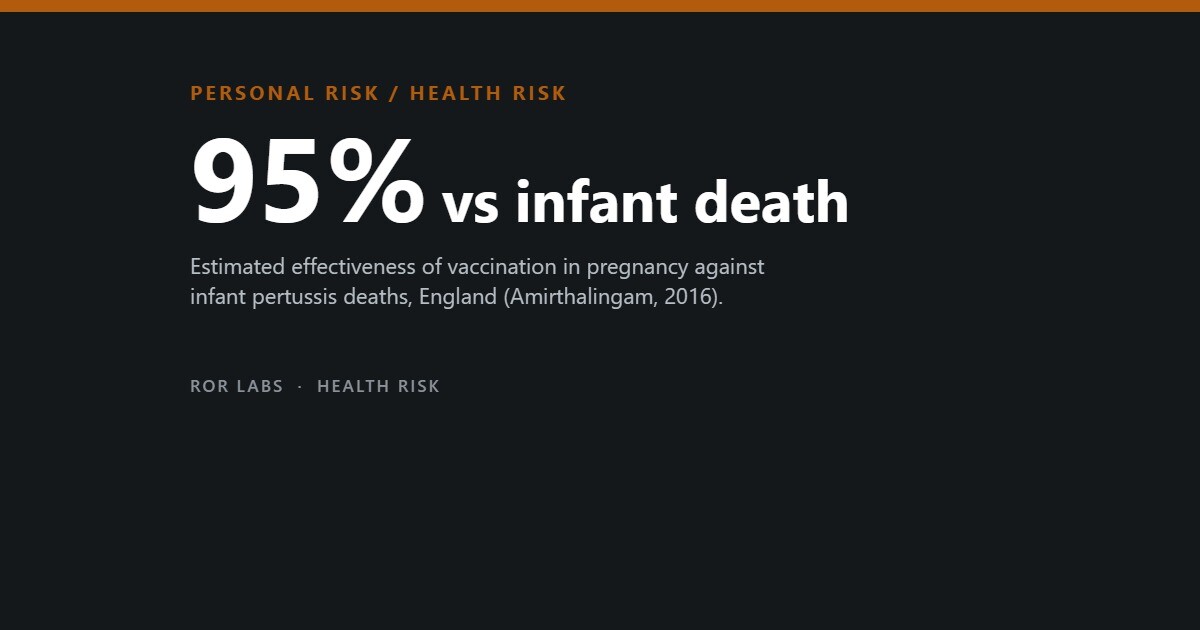
Gayatri Amirthalingam and colleagues at Public Health England reported in 2016 that effectiveness against laboratory-confirmed disease in babies under three months was 91% over the programme’s first three years. Against infant death it was estimated at 95%, with a confidence interval of 79% to 100%. Of 11 infant deaths in that analysis, only one baby’s mother had been vaccinated, fewer than ten days before delivery.
How well vaccination in pregnancy protects babies
Estimated vaccine effectiveness of maternal pertussis vaccination against infant pertussis, observational studies.
Sources: Amirthalingam et al., Clin Infect Dis (2016); Baxter et al., Pediatrics (2017), 148,981 newborns, 95% CI for the 2-month figure 19.5–99.1%; Godoy et al., J Infect (2021). None are randomised trials.
Timing matters. In the English data, protection was about 91% when the mother was vaccinated at least a week before birth, but dropped to 43%, with a very wide interval, when she was vaccinated in the last week of pregnancy or shortly after. Since 2016 England has offered the vaccine from 20 weeks (and as early as 16), while the US recommends 27 to 36 weeks in every pregnancy.
On safety, a 2020 systematic review by Sabine Vygen-Bonnet and colleagues covered 1.4 million pregnant women. It found no difference in stillbirth, preterm birth or malformations. Some studies found a small rise in fever and in chorioamnionitis, an infection of the membranes, but the certainty was low. Uptake remains the weak link: in England in 2024, monthly coverage ranged from 58.9% to 68.2%.
Cocooning, and who infects babies
The older idea is cocooning: vaccinating parents and other close contacts after birth so nobody brings the infection home. In New South Wales, Helen Quinn and colleagues found that when both parents had been vaccinated, a baby’s risk of pertussis before four months fell by 51%. Parents’ vaccination was mostly self-reported, and the confidence interval ran from 10% to 73%.
Cocooning has a built-in delay. In Quinn’s study a parent counted as protected only if vaccinated at least four weeks before the baby fell ill, and the vaccine may not stop carriage. US advisers prefer vaccination in pregnancy to vaccination after birth (Terranella et al., 2013).
Who passed it on
Suspected source of infection among 1,306 US infant pertussis cases, 2006–2013.
Source: Skoff et al., Pediatrics (2015). A source was identified for 569 infants; the percentages for siblings and parents are of those 569. Sources were based on interviews about coughing contacts.
Siblings overtook mothers as the main known source from 2008. An English household study by Edna Kara and colleagues helps explain why: 29% of household contacts with no cough tested positive for recent infection. Some of the people passing pertussis to babies do not know they have it.
The teenagers and adults nobody tests
In adults the illness is often milder, unfamiliar and untested. In a French study published in 2002, Serge Gilberg and colleagues tested 217 adults whose GPs saw them for a persistent cough with no obvious cause; 32% had confirmed pertussis. Their median cough lasted 49 days, and 60% reported having been vaccinated as children.
How many cases go uncounted is harder to pin down. A 2015 study by Cristina Masseria and Girishanthy Krishnarajah used US claims and laboratory data for people aged 50 and over; their regression model put true incidence at 42 to 105 times what doctors had diagnosed. GSK, a pertussis vaccine maker, funded it and employed both authors at the time, and the figure is modelled, not counted.
Testing can also mislead in the other direction. In South Korea’s 2024 epidemic, 13-year-olds had an incidence of 526.2 per 100,000. When the national agency rechecked 234 specimens reported as B. pertussis, 25.6% turned out to be Bordetella holmesii, a relative that standard tests can confuse with it. Not every positive is pertussis.

Macrolide-resistant strains
Macrolide antibiotics are the standard treatment. Given early, they reduce spread, though once the coughing fits start they do little for symptoms (Kang et al., 2024). The first resistant strain was found in a two-month-old in Arizona in 1994, and for years such cases were sporadic.
China changed that. In Shanghai, Zhen Xu and colleagues found resistance rose from 50% or less of isolates before 2020 to nearly 100% afterwards, driven by a single clone. A Hong Kong hospital study found all isolates from 2023 and 2024 resistant, although there were only 29 isolates in total. The same clone was detected in France, Japan and the United States in 2024.
In France, a preprint by Valérie Bouchez and colleagues reported 14 resistant cases in 2024 from three separate introductions. The CDC says resistance remains rare in the US. For resistant infections an older antibiotic combination is the usual alternative, but it is not recommended for babies under two months, the group most at risk.
Who should be vaccinated, and when
This table summarises current US Centers for Disease Control and Prevention (CDC) vaccination guidance, from pages dated December 2025. It is a reference, not medical advice for your own case.
| Group | Recommendation |
|---|---|
| Infants and children under 7 | DTaP, five doses: 2, 4 and 6 months, 15–18 months, and 4–6 years |
| Adolescents | One Tdap dose at 11–12 years |
| Adults who never had Tdap | One dose at any time; no further pertussis boosters are recommended |
| Every pregnancy | One Tdap dose in each pregnancy, optimally at 27–36 weeks, preferably in the earlier part |
| After birth | Only if the mother never had Tdap; the CDC says this is not optimal and does not protect the baby |
Who is at greatest risk. The CDC says babies younger than one year are at greatest risk of severe complications, and names immunocompromising conditions and moderate to severe medically treated asthma as conditions that can make it worse.
If you have been exposed. The CDC supports preventive antibiotics for all household contacts within 21 days of the first person’s cough onset, and for high-risk people within 21 days of exposure, and says antibiotics should be used only when necessary. For treatment, the CDC gives windows from cough onset: three weeks for age one and older, six weeks for infants under one and for pregnant women.
What we could not confirm. The CDC vaccine-recommendations page we read does not say anything about caregivers as a group. CDC pages carry dates between December 2025 and August 2026, so check cdc.gov for the latest version before acting.
Where the evidence is weak
Almost every effectiveness figure here is observational. The English maternal estimates used the screening method, which compares cases with population coverage and adjusts for little beyond age and time. The Californian two-month estimate of 91.4% has a confidence interval running down to 19.5%. The signals are strong and consistent, but not trial results.
Case counts are shaped by testing. England added oral-fluid testing for children in 2013 and wider PCR testing in 2014, and some of the rise in older children reflects that. Comparing countries, or one country across decades, means comparing different nets.
Two often-quoted estimates, the absolute-effectiveness meta-analysis and the adult under-counting model, were funded by vaccine makers and rest on modelling assumptions. The steadiest finding is the oldest one: whooping cough kills babies, and vaccinating their mothers in pregnancy prevents most of those deaths.
What to do
Steps sorted by when they matter. Each one says how strong the evidence is: Measured Official advice Untested
Before
- If you are pregnant, ask your midwife or doctor about the whooping cough vaccine in this pregnancy, even if you had it in an earlier one. Official advice see Sources
- Aim to have it at least a week or two before the birth: in England, protection fell sharply when the vaccine was given in the last week or after delivery. Measured see Sources
- Keep your baby’s own vaccinations on schedule; most infant deaths happen in the first three months, before the first dose. Measured see Sources
- Older siblings, parents and grandparents can ask a doctor or pharmacist whether a booster is due before the baby arrives. Untested see Sources
If it happens
- If a baby has pauses in breathing, turns blue or struggles to breathe, call emergency services or seek immediate care. Official advice see Sources
- Do not wait for a whoop in a baby: the CDC says many babies do not cough at all and some only seem to have a cold. Official advice see Sources
- If you have had a cough for two weeks or more, see a doctor and mention any contact with a young baby; a third of such adults in one study had pertussis. Measured see Sources
Afterwards
- If a doctor confirms whooping cough in your household, ask whether other family members, especially a pregnant woman or a young baby, need assessment. Untested see Sources
- Ask your doctor about a booster later on, since protection from acellular vaccines fades within a few years. Measured see Sources
What not to do
- Do not assume a childhood vaccination still protects you: teenage booster effectiveness fell to about 12% after three to four years in one study. Measured see Sources
- Do not take antibiotics left over from another illness or someone else’s prescription; resistant strains exist and treatment choices belong to a doctor. Untested see Sources
- Do not rely on vaccinating relatives after the birth instead of vaccination in pregnancy; the evidence for cocooning is weaker. Measured see Sources
Not medical advice. If you are pregnant or have a young baby, ask your midwife or doctor.
Questions people ask
I had whooping cough vaccines as a child. Am I still protected?
Probably only partly. Acellular protection fades within a few years, and the teenage booster lost most of its effect in three to four years in one study. Ask your doctor or pharmacist whether a booster is recommended for you.
Why vaccinate in every pregnancy?
Antibodies in the mother fall after birth, so a vaccine from an earlier pregnancy may not leave enough to pass to the next baby. The English data show the benefit when it is given at least a week before birth. Your midwife or doctor can advise on timing.
What does whooping cough look like in a baby?
Often not like a cough. The CDC says many babies do not cough at all; they have pauses in breathing, may turn blue or struggle to breathe, or seem to have a cold. Breathing difficulty in a baby needs immediate medical care.
Is the vaccine in pregnancy safe?
Observational studies of more than a million pregnancies found no increase in stillbirth, preterm birth or malformations. Some found a small rise in fever and in chorioamnionitis, a membrane infection, with low certainty. Discuss any concerns with your midwife or doctor.
Should grandparents be vaccinated before meeting a newborn?
The evidence for cocooning is weaker than for vaccination in pregnancy. But in Europe in 2024, 29 deaths were in people aged 65 or over, so older adults have their own reasons to ask their doctor about a booster.
The short version
- Whooping cough kills mainly babies too young to be fully vaccinated. In the EU/EEA in 2024, 44 of 84 reported deaths were in infants under one; in the US in 2025, 10 of 16 were.
- Cases surged after the pandemic lull. The EU/EEA notification rate rose from 0.7 per 100,000 in 2022 to 54.9 in 2024, a year with 209,674 reported cases.
- Protection from acellular vaccines fades within a few years. In one US state, the teenage booster’s effectiveness fell from 75% in the year it was given to about 12% three to four years later.
- Vaccination in pregnancy is the best-measured protection for newborns: about 90% effective against confirmed infant disease in England and an estimated 95% against infant death, in observational studies.
- Teenagers and adults often carry the infection without a diagnosis, and siblings and parents are the commonest known sources for babies. Vaccinating close contacts after birth protects less directly.
- Macrolide-resistant strains now dominate in parts of China and have been found in France, Japan and the US. They remain rare in the US but complicate treatment. If a baby has pauses in breathing, seek urgent care.
This article summarises research, public health reports and news for general information. It is not medical advice. Ask your doctor, midwife or pharmacist about vaccination in pregnancy, boosters or a persistent cough; if a baby has pauses in breathing or turns blue, call emergency services.
Further reading: Amirthalingam et al., Clinical Infectious Diseases (2016), for the English evaluation of vaccination in pregnancy, including deaths. Koepke et al., Journal of Infectious Diseases (2014), for how fast the teenage booster fades. ECDC’s Annual Epidemiological Report for 2024 (2026), for the size and age profile of Europe’s surge.
Sources
- Pan American Health Organization. Epidemiological Update: Pertussis (Whooping Cough) in the Americas Region (25 March 2026).
- European Centre for Disease Prevention and Control. Pertussis – Annual Epidemiological Report for 2024 (20 April 2026).
- Centers for Disease Control and Prevention. Pertussis surveillance report, 2025 (provisional); Pertussis surveillance and trends; Whooping cough signs and symptoms (accessed October 2026).
- UK Health Security Agency. Laboratory confirmed cases of pertussis in England: annual report for 2025 (25 June 2026).
- Van Rie A, et al. Role of maternal pertussis antibodies in infants. Pediatr Infect Dis J (2005), doi:10.1097/01.inf.0000160915.93979.8f.
- Crowcroft NS, Miller E. Pertussis epidemiology. In: Pertussis: Epidemiology, Immunology, and Evolution. Oxford University Press (2018), doi:10.1093/oso/9780198811879.003.0004.
- Yang Q, et al. Global perspectives on pertussis epidemiology, macrolide resistance, and management in the post-COVID-19 era (2020–2024). J Microbiol Immunol Infect (2026), doi:10.1016/j.jmii.2026.03.002.
- Witt MA, et al. Reduced risk of pertussis among persons ever vaccinated with whole cell pertussis vaccine compared to recipients of acellular pertussis vaccines in a large US cohort. Clin Infect Dis (2013), doi:10.1093/cid/cit046.
- McGirr A, et al. Duration of pertussis immunity after DTaP immunization: a meta-analysis. Pediatrics (2015), doi:10.1542/peds.2014-1729.
- Koepke R, et al. Estimating the effectiveness of tetanus-diphtheria-acellular pertussis vaccine (Tdap) for preventing pertussis: evidence of rapidly waning immunity and difference in effectiveness by Tdap brand. J Infect Dis 210(6):942 (2014).
- Chit A, et al. Acellular pertussis vaccines effectiveness over time: a systematic review, meta-analysis and modeling study. PLoS One (2018), doi:10.1371/journal.pone.0197970.
- Burdin N, et al. What is wrong with pertussis vaccine immunity? The problem of waning effectiveness of pertussis vaccines. Cold Spring Harb Perspect Biol 9(12):a029454 (2017).
- Amirthalingam G, et al. Sustained effectiveness of the maternal pertussis immunization program in England 3 years following introduction. Clin Infect Dis 63(suppl 4):S236 (2016).
- Baxter R, et al. Effectiveness of vaccination during pregnancy to prevent infant pertussis. Pediatrics 139(5):e20164091 (2017), doi:10.1542/peds.2016-4091.
- Godoy P, et al. Effectiveness of maternal pertussis vaccination in protecting newborn: a matched case-control study. J Infect (2021), doi:10.1016/j.jinf.2021.08.022.
- Winter K, et al. Effectiveness of prenatal tetanus, diphtheria, and acellular pertussis vaccination on pertussis severity in infants. Clin Infect Dis (2016), doi:10.1093/cid/ciw633.
- Vygen-Bonnet S, et al. Safety and effectiveness of acellular pertussis vaccination during pregnancy: a systematic review. BMC Infect Dis (2020).
- Quinn HE, et al. Parental Tdap boosters and infant pertussis: a case-control study. Pediatrics (2014), doi:10.1542/peds.2014-1105.
- Terranella A, et al. Pregnancy dose Tdap and postpartum cocooning to prevent infant pertussis: a decision analysis. Pediatrics (2013), doi:10.1542/peds.2012-3144.
- Skoff TH, et al. Sources of infant pertussis infection in the United States. Pediatrics (2015), doi:10.1542/peds.2015-1120.
- Kara EO, et al. Survey of household contacts of infants with laboratory-confirmed pertussis infection during a national pertussis outbreak in England and Wales. Pediatr Infect Dis J (2017), doi:10.1097/INF.0000000000001378.
- Gilberg S, et al. Evidence of Bordetella pertussis infection in adults presenting with persistent cough in a French area with very high whole-cell vaccine coverage. J Infect Dis 186(3):415 (2002).
- Masseria C, et al. The estimated incidence of pertussis in people aged ≥50 years old in the United States, 2006–2010. BMC Infect Dis (2015), doi:10.1186/s12879-015-1269-1.
- Kang HM, et al. Pertussis in the post-COVID-19 era: resurgence, diagnosis, and management. Infect Chemother 57:13 (2025), doi:10.3947/ic.2024.0117.
- Xu Z, et al. Genomic surveillance reveals global spread of macrolide-resistant Bordetella pertussis linked to vaccine changes. J Clin Microbiol (2025), doi:10.1128/jcm.01064-25.
- Hui TY, et al. Macrolide-resistant Bordetella pertussis in Hong Kong: evidence for post-COVID-19 emergence of ptxP3-lineage MT28 clone from a hospital-based surveillance study. Microorganisms 13(8):1947 (2025).
- Bouchez V, et al. Emergence of macrolide-resistant Bordetella pertussis in France, 2024: out of China. medRxiv preprint (2025), doi:10.1101/2025.03.15.25324024.
- CDC. Pertussis vaccination recommendations, 2 December 2025. cdc.gov.
- CDC. Vaccinating pregnant patients, 2 December 2025. cdc.gov.
- CDC. Postexposure antimicrobial prophylaxis, 2 December 2025. cdc.gov.
- CDC. Treatment of pertussis, 25 August 2026. cdc.gov.
- CDC. About whooping cough, 24 June 2026. cdc.gov.