Pickleball Achilles tendon ruptures, and why the typical patient is 60
Key takeaways · 9 min read
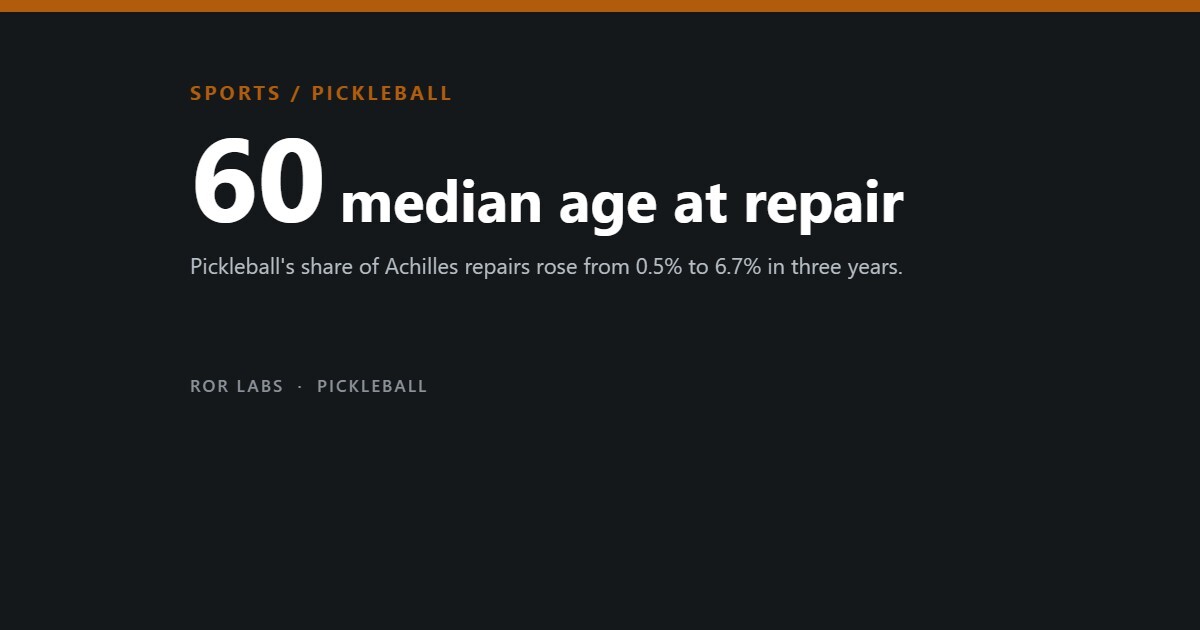
- In one large US orthopaedic group, pickleball’s share of Achilles repairs rose from 0.5% in 2018 to 6.7% in 2021; its patients had a median age of 60.
- Achilles ruptures are getting older everywhere: in Sweden, rates more than doubled among people in their sixties and seventies between 2002 and 2021.
- Fluoroquinolone antibiotics roughly triple the rate of rupture, and combined with oral steroids raise it about 19-fold, though the absolute risk stays small.
- Surgery lowers re-rupture but adds complications; with early-movement rehabilitation the gap narrows, and recovery takes many months either way.
On 1 February 2024 Bernhard Langer, a two-time Masters champion then aged 66, was playing pickleball at his club in Boca Raton, Florida. Someone lobbed him. He stepped backwards, hit an overhead, landed and heard a loud pop. “I knew right away it was a torn Achilles,” he said later. He had surgery the next day, missed what was to be his farewell Masters and returned to senior golf about 13 weeks later, riding a cart.
Langer was unusual only in being famous. In one large American orthopaedic group, pickleball went from 0.5% of Achilles tendon repairs in 2018 to 6.7% in 2021, and the typical pickleball patient was 60 years old. At other clinics, surgeons are seeing the same profile: men and women in their fifties and sixties who took up a friendly, small-court game and found that it asks a great deal of the back of the leg.
This article covers how the tendon fails on court, who is most at risk and why the incidence is climbing in older age groups, which medicines raise the risk, what trials say about surgery and rehabilitation, and why the sensible response is to prepare the calf rather than give up the game. Falls, wrist fractures and eye injuries are covered in our article on pickleball falls and wrist fractures.
What happens when the tendon goes
The Achilles tendon joins the calf muscles to the heel and stores and releases energy with every step. It usually fails without contact, during a sudden start. A 2026 systematic review of video studies, all of professional athletes, found that 64% to 100% of ruptures were non-contact, most often while accelerating from a standstill, and that the ankle was flexed upwards at the moment of injury in every study.
Racket sports supply that movement constantly. A 1989 Danish study described the typical badminton rupture as a sudden forward movement from the rear line, and Langer’s was a landing after a backward step. In pickleball, the short court rewards quick lunges to the net and sudden recoveries to chase lobs. Researchers counted what they called at-risk Achilles movements in the first five minutes of professional singles at the US Open of each sport.
Movements that load the Achilles, pickleball and tennis
Mean count of at-risk Achilles movements per ankle in the first five minutes of professional singles play, from video. A conference abstract; professional players only.
Source: Wagner et al., Foot & Ankle Orthopaedics 9(4), AOFAS annual meeting abstract (2024), doi:10.1177/2473011424S00572.
The tendon has usually changed before it fails. Histological studies have repeatedly found degenerative changes in ruptured tendons, yet many ruptures arrive with no warning pain at all. Many people describe what Langer described: a sudden pop at the back of the ankle, then a leg that will not push off properly. The authors of the video study stressed that only a tiny fraction of at-risk movements ever ends in rupture.
Where the risk concentrates
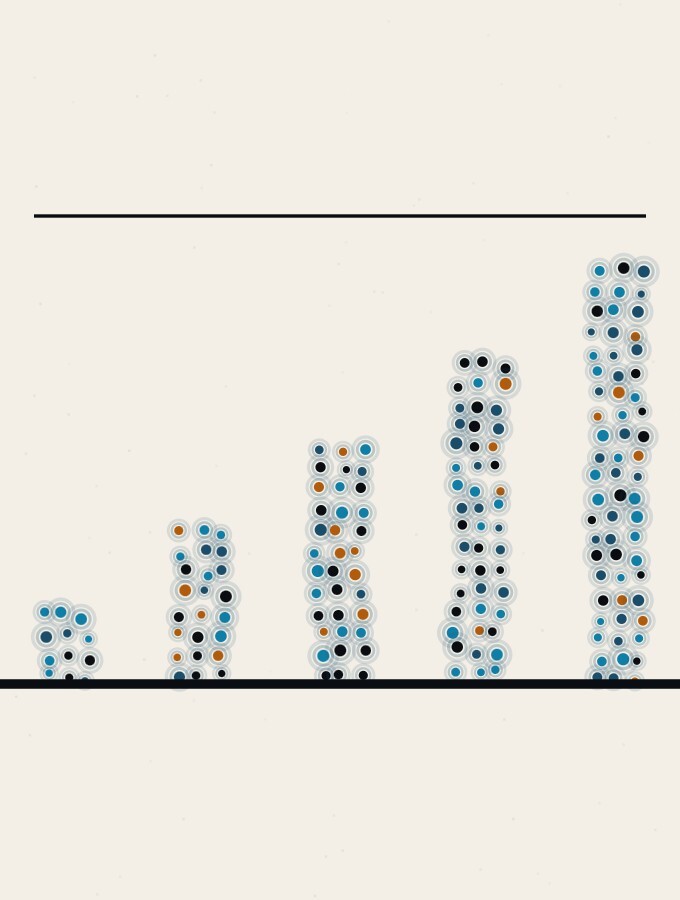
The clearest comparison comes from Padley and colleagues, who reviewed 1,035 surgically repaired acute ruptures in a group of more than 100 orthopaedic surgeons between 2018 and 2022. Forty happened during pickleball and 46 during tennis. The pickleball patients were by far the oldest, with a median age of 60 against 45 for tennis and 37 for all other sports, and 82.5% of them were over 50. About three quarters of the pickleball patients were men, a proportion close to the other groups.
Pickleball’s share of repairs was 1.2% before the pandemic and 5.5% from 2020 to 2022, while tennis held steady. A separate single-institution series found pickleball behind 6.5% of all Achilles ruptures it treated from 2016 to 2023; its 127 surgical patients averaged 54 years old and 77% were men. The broader pattern is that the age of rupture is rising everywhere. In Sweden, a nationwide register of 53,688 ruptures shows the median age climbing from 44 to 50 between 2002 and 2021.
Who ruptured an Achilles, by sport
Surgically repaired acute ruptures in a large US orthopaedic group, 2018–2022 (1,035 ruptures: 40 pickleball, 46 tennis, 942 other sports).
Source: Padley et al., Foot & Ankle Orthopaedics (2026), doi:10.1177/24730114261425665.
The Swedish data show where the growth is. Rates fell slightly among people in their thirties, the traditional peak, but more than doubled in their sixties and seventies. The authors noted that unique players booking padel courts in Sweden rose from 33,990 to 540,000 between 2017 and 2021, when incidence jumped 21%, and suggested the racket-sport boom might be one reason; they did not test it. Women’s rates rose faster than men’s, by 58% against 40%.
How Achilles rupture rates changed in Sweden, by age
Change in incidence between 2002 and 2021, nationwide register, adults of both sexes. Rates per 100,000 person-years in brackets.
Source: Svedman et al., BMJ Open Sport & Exercise Medicine 10(3):e001960 (2024).
Medicines matter too, especially for older players. Fluoroquinolone antibiotics such as ciprofloxacin carry a US boxed warning for tendon rupture, which most often involves the Achilles and is more likely over 60 and with corticosteroids. In a UK primary-care study, current fluoroquinolone use roughly tripled the rate of Achilles rupture, and oral steroids together with a fluoroquinolone raised it about 19-fold. The absolute excess was small: about two extra Achilles ruptures per 10,000 treated patients a year.
Medicines and the rate of Achilles rupture
Adjusted incidence rate ratios from a UK nested case-control study (observational), plus a pooled odds ratio from a meta-analysis of 15 observational studies.
Sources: Morales et al., Clinical Drug Investigation (2019; online 2018), doi:10.1007/s40261-018-0729-y; Alves et al., European Journal of Clinical Pharmacology (2019), doi:10.1007/s00228-019-02713-1; FDA ciprofloxacin label (2016).
Treat the pickleball numbers with care. Padley’s figures are proportions of repairs, not rates per player: nobody counted how many hours each group spent on court, and the authors themselves said 40 cases were too few to judge whether pickleball is riskier than tennis. Surgical series also miss the many patients now treated without an operation. And a much-quoted claim, that 68% of pickleball ruptures happen in a player’s first month, appeared in a 2026 news report without a source we could trace.
What has been measured to work
Whether to operate is the first decision. A 2019 BMJ meta-analysis pooled 29 studies and 15,862 patients. Re-rupture was less common after surgery, 2.3% against 3.9%, but complications other than re-rupture, mostly infection, were more common, 4.9% against 1.6%. When the non-surgical patients received accelerated functional rehabilitation with early movement, the difference in re-rupture was no longer significant. Very few studies have looked specifically at patients aged 50 and over, which leaves older players with thinner evidence.
One British centre followed 173 patients aged 50 and over for a year. Those treated with a percutaneous repair, through small incisions, scored 89.9 on the 100-point Achilles Tendon Total Rupture Score against 74.3 for those treated in a boot, with the largest gaps on running and jumping. Re-ruptures were rare in both groups. But the study was not randomised: the operated patients were about four years younger and healthier, so some of the advantage may be who was chosen.
Surgery or not: what the numbers show
Top four rows: pooled rates from 29 studies (15,862 patients). Bottom two: mean Achilles Tendon Total Rupture Score (0–100, higher is better) at 12 months in an observational cohort aged 50 and over.
Sources: Ochen et al., BMJ 364:k5120 (2019); Sadiq et al., Foot & Ankle Orthopaedics (2026), doi:10.1177/24730114251413239.
Rehabilitation has changed as much as surgery. A 2024 meta-analysis of 43 randomised trials after surgical repair found re-rupture in 4.1% of patients kept immobilised early on, against 1.4% on accelerated programmes without rigid immobilisation; moving the ankle actively straight after surgery, however, may raise the risk. Recovery is slow either way: across studies, patient-reported scores average about 70 at six months and 82 at a year, and some calf weakness can be permanent.
Pickleball players have now been followed too. In the 127 surgically treated patients from 2016 to 2023, the average return to play took 18.4 months, and only about half got back to their previous level, although 97.7% were satisfied with the repair. Three tendons re-ruptured. As for prevention, no trial has tested whether any exercise prevents Achilles rupture in recreational players. Progressive calf loading is well supported for treating sore tendons; for preventing ruptures it remains a sensible bet, not a proven one.
Why the answer is not to stop playing
Even in the oldest Swedish age groups, where rates have risen fastest, about one person in 2,000 ruptures an Achilles in a given year, and that counts everyone, not only those who play. The game itself is the reason many people in their sixties are moving at all. Most of the patterns in the research point to things a player can change: how fast they ramp up, how they warm up, what they do about warning signs and which medicines they take.
Start gradually, particularly after a long layoff: shorter sessions on fewer days, with time to build calf strength through heel raises and similar exercises. Warm up properly before fast play, as surgeons and coaches advise, and wear court shoes rather than running shoes. Treat a sore or stiff Achilles or a calf strain as a reason to ease off and get it checked. If you are prescribed a fluoroquinolone, especially alongside steroids, ask whether to pause the sport.
If the tendon does go, the signs are hard to miss. Langer had his repair within a day and was out of his boot in about two months, yet three months on he still could not walk normally. Ask about the choice between surgery and a functional boot, and plan for months rather than weeks. Asked whether he would play pickleball again, Langer said maybe, but not for about a year. That is the right spirit: back on court, carefully.
Questions people ask
Is pickleball really causing more Achilles ruptures?
In one large US orthopaedic group, pickleball’s share of Achilles repairs rose from 0.5% in 2018 to 6.7% in 2021. That reflects more players, and older players, as well as any risk in the game itself; nobody has measured ruptures per hour played.
What does an Achilles rupture feel like?
Often a sudden pop at the back of the ankle, followed by weakness when pushing off. It needs prompt assessment, even if pain is mild.
Do older players need surgery?
Not always. Pooled studies show surgery lowers re-rupture but adds wound and nerve risks, and non-surgical treatment with early movement narrows the gap. The decision depends on health and activity goals.
Can antibiotics really weaken the tendon?
Fluoroquinolones carry a US boxed warning for tendon rupture, and the risk is higher over 60 and with corticosteroids. The absolute risk is small, but worth discussing with a doctor.
The short version
- In one large US orthopaedic group, pickleball’s share of Achilles repairs rose from 0.5% in 2018 to 6.7% in 2021; its patients had a median age of 60.
- Achilles ruptures are getting older everywhere: in Sweden, rates more than doubled among people in their sixties and seventies between 2002 and 2021.
- Fluoroquinolone antibiotics roughly triple the rate of rupture, and combined with oral steroids raise it about 19-fold, though the absolute risk stays small.
- Surgery lowers re-rupture but adds complications; with early-movement rehabilitation the gap narrows, and recovery takes many months either way.
- No exercise is proven to prevent rupture. Build up gradually, strengthen the calf, warm up, heed warning pain and keep playing.
This is a summary of published research, not medical advice. If you feel a sudden pop or blow at the back of the ankle, or have persistent Achilles or calf pain, see a doctor or physiotherapist promptly, and talk to them before returning to the court. Do not stop a prescribed medicine without speaking to your doctor.
Further reading: Padley et al., Foot & Ankle Orthopaedics (2026), for pickleball and tennis ruptures compared. Svedman et al., BMJ Open Sport & Exercise Medicine (2024), for rising incidence in older age groups. Ochen et al., BMJ (2019), for surgery against non-surgical care.
- Built to Move, Kelly Starrett and Juliet Starrett (2023). Ten everyday physical habits, from ankle range to daily walking, by two physiotherapy-minded coaches. Practical for older players; not specific to tendons or pickleball.
- Outlive, Peter Attia (2023). A physician’s case for training strength and stability to stay active into old age. Useful framing for calf and balance work; read the longevity claims critically.
- Exercised, Daniel E. Lieberman (2021). A Harvard biologist tests common beliefs about exercise against evolution and evidence, including stretching and ageing. Good on why staying active matters.
Sources
- Padley JH, Averkamp BJ, Rieker M, Kalbac T, Murawski CD, Lendrum J. Pickleball-associated Achilles tendon ruptures: shifting Achilles repair demographics. Foot & Ankle Orthopaedics (2026), doi:10.1177/24730114261425665.
- Chen C, Balding KK, Dock CC, Fritz JE, Seiffert KJ, Stone McGaver R. Paper 17: Outcomes after Achilles tendon ruptures while playing pickleball. Orthopaedic Journal of Sports Medicine, meeting abstract (2025), doi:10.1177/2325967125S00074.
- Wagner M, Park J, Sugarman BS, Walley KC, Holmes J, Patel VS. Video analysis comparing pickleball and tennis gameplay: is the Achilles tendon at risk? Foot & Ankle Orthopaedics, meeting abstract (2024), doi:10.1177/2473011424S00572.
- Olivar R, Kellis E. Acceleration and injury-frame biomechanics in Achilles tendon rupture: a systematic review. Journal of Functional Morphology and Kinesiology (2026), doi:10.3390/jfmk11030309.
- Kaalund S, Lass P, Høgsaa B, Nøhr M. Achilles tendon rupture in badminton. British Journal of Sports Medicine 23(2):102 (1989).
- Järvinen TAH, Kannus P, Paavola M, et al. Achilles tendon injuries. Current Opinion in Rheumatology (2001), doi:10.1097/00002281-200103000-00009.
- Svedman S, Marcano AI, Ackermann PW, Felländer-Tsai L, Berg HE. Acute Achilles tendon ruptures between 2002–2021: sustained increased incidence, surgical decline and prolonged delay to surgery. BMJ Open Sport & Exercise Medicine 10(3):e001960 (2024).
- Morales DR, Slattery J, Pacurariu AC, Pinheiro L, McGettigan P, Kurz X. Relative and absolute risk of tendon rupture with fluoroquinolone and concomitant fluoroquinolone/corticosteroid therapy: population-based nested case–control study. Clinical Drug Investigation (2019; online 2018), doi:10.1007/s40261-018-0729-y.
- Alves C, Mendes D, Batel Marques F. Fluoroquinolones and the risk of tendon injury: a systematic review and meta-analysis. European Journal of Clinical Pharmacology (2019), doi:10.1007/s00228-019-02713-1.
- US Food and Drug Administration. CIPRO (ciprofloxacin) prescribing information, boxed warning and section 5.2, tendinitis and tendon rupture (2016).
- Ochen Y, Beks RB, van Heijl M, et al. Operative treatment versus nonoperative treatment of Achilles tendon ruptures: systematic review and meta-analysis. BMJ 364:k5120 (2019).
- Sadiq S, Grocott N, Ibrahim A, et al. Percutaneous repair in patients aged 50 years and older is associated with good outcomes in acute Achilles tendon rupture. Foot & Ankle Orthopaedics (2026), doi:10.1177/24730114251413239.
- Wang R, Huang L, Jiang S, et al. Immediate mobilization after repair of Achilles tendon rupture may increase the incidence of re-rupture: a systematic review and meta-analysis of randomized controlled trials. International Journal of Surgery (2024), doi:10.1097/JS9.0000000000001305.
- Hoeffner R, Svensson RB, Bjerregaard N, Kjær M, Magnusson SP. Persistent deficits after an Achilles tendon rupture: a narrative review. Translational Sports Medicine (2022), article 7445398.
- Brzoza J, Chlipała M, Bylica K, et al. Achilles tendinopathy in athletes: risk, factors, diagnosis, treatment and prevention. A perspective of recent literature. Quality in Sport (2026), doi:10.12775/QS.2026.77.75621.
- PGA Tour. Bernhard Langer determined to ease back into it on PGA Tour Champions, 2 May 2024; NBC Sports, Bernhard Langer reveals how he actually tore his Achilles tendon, 14 March 2024.
- Gonzales G. Pickleball boom sees unexpected surge in tendon injuries among ‘weekend warriors’. Illawarra Mercury, 23 September 2026.