Heart Attack Symptoms in Women: What the Evidence Shows
Key takeaways · 13 min read
- Chest pain, pressure or discomfort is the commonest heart attack symptom in women and men. In interview studies close to nine in ten women report it.
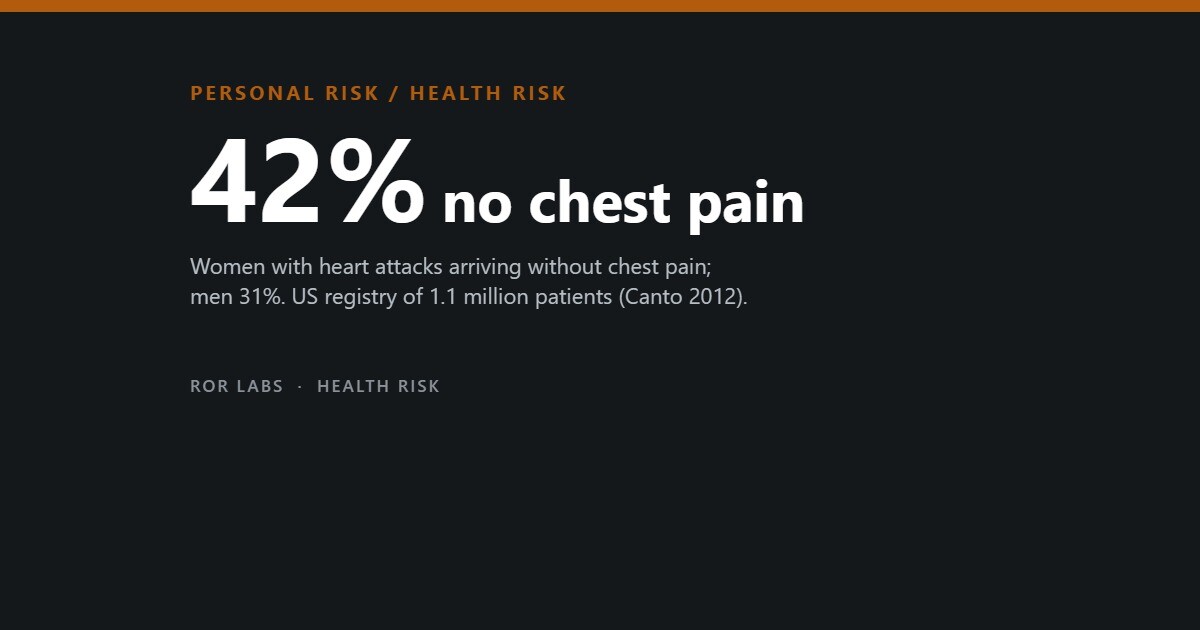
- In US hospital records, 42% of women and 31% of men had no chest pain on arrival. The gap was largest in younger patients.
- Women more often report pain between the shoulder blades, nausea and breathlessness, usually alongside chest pain. The overlap is large, and the ‘atypical’ label is outdated.
- Women reach hospital later and are more often misdiagnosed at first. In one registry their higher risk of death appeared only when arrival took over about two hours.
In this article
- How often chest pain is missing
- Which symptoms differ, and the trouble with ‘atypical’
- The delay before hospital
- Missed in the emergency department
- The troponin threshold trial
- Treatment gaps and survival
- SCAD and MINOCA in younger women
- What to do when it might be a heart attack
- What changes outcomes
- Questions people ask
- The short version
- Sources
Ask most people to picture a heart attack and they describe a man clutching his chest. The usual correction is that women have quieter symptoms: nausea, tiredness, an ache in the back or jaw. Both pictures hold some truth, and both mislead. The worry behind the correction is real, though. In many countries, women having a heart attack reach treatment later and receive less of it.
This article works through the evidence: how often chest pain is absent, which symptoms differ, delay, missed diagnoses, a Scottish trial that changed the blood test for women, the treatment gap, and two causes that mostly affect younger women.
The answer is less tidy than the slogans. Chest pain is the commonest symptom in both sexes, and a large minority of men also arrive without it. Much of the gap lies in what happens next: how symptoms are read, by patients and by clinicians, and how quickly and how fully people are treated.
How often chest pain is missing
The figure behind many warnings comes from the US National Registry of Myocardial Infarction. John Canto and colleagues looked at 1,143,513 patients treated between 1994 and 2006. Of these, 42.0% of women and 30.7% of men had no chest pain when they arrived. In-hospital mortality was 14.6% for women and 10.3% for men.
Two details are easy to miss. Almost one man in three also arrived without chest pain, so this is not a women-only pattern. And the sex gap shrank with age. Women under 45 had 1.30 times the adjusted odds of presenting without chest pain; at 75 and over the figure was 1.03.
How the question is asked matters. Registry figures come from records; when researchers interview patients, chest pain turns up far more often. In the VIRGO study of 2,985 adults aged 18 to 55, 87.0% of women and 89.5% of men reported chest pain, pressure, tightness or discomfort.
Chest pain is common in both sexes
Share of heart attack patients who had chest pain or discomfort, by study and by how symptoms were recorded.
Sources: Canto et al., JAMA (2012), shown as 100% minus the share without chest pain; Lichtman et al., Circulation (2018); Ferry et al., JAHA (2019).
Which symptoms differ, and the trouble with ‘atypical’
A 2020 meta-analysis by Roos van Oosterhout and colleagues pooled 27 studies with more than a million patients with confirmed acute coronary syndrome. Women had higher odds of pain between the shoulder blades, nausea or vomiting, and shortness of breath. They had lower odds of chest pain and sweating. Left arm pain, stomach pain and indigestion showed no clear difference.
What women report more, and less, often
Pooled crude odds ratio of each symptom in women compared with men with confirmed acute coronary syndrome. Equal odds = 1.
Source: van Oosterhout et al., Journal of the American Heart Association (2020); 27 studies. Odds ratios, not the share of patients with each symptom.
The authors stress the other half of their result. The overlap between the sexes was substantial, and the most common symptoms were the same for both. They concluded that calling symptoms ‘typical’ or ‘atypical’ is outdated. They were open about weak spots: the chest-pain analysis was highly heterogeneous, and most data came from records or recall after diagnosis.
A Scottish study tested the labels head on. Amy Ferry and colleagues interviewed 1,941 patients with suspected acute coronary syndrome in an Edinburgh emergency department, before anyone knew the diagnosis. Among those with a type 1 heart attack, the kind caused by a blocked artery, pain was classed as typical in 77% of women and 59% of men. Typical features also predicted a heart attack better in women than in men.
The team pointed to a translation problem. Women more often described extra symptoms, such as nausea or pain spreading to the back, but alongside chest pain, not instead of it. In a written record ‘chest discomfort’ can quietly become ‘no chest pain’. It was one hospital, with daytime recruitment and a mostly white population.
The delay before hospital
Time matters because heart muscle dies while an artery stays blocked. In VIRGO, the median time from first symptoms to hospital was 3.2 hours for women and 2.4 for men. More than one in five women put their symptoms down to stress or anxiety, against 12% of men. More women than men had already sought care for similar symptoms (29.5% against 22.1%), and 53% of women, against 37% of men, said a clinician had not thought it was their heart.
Not all delay is the patient’s. Raffaele Bugiardini and colleagues studied 6,022 people with STEMI, the most severe type of heart attack, at 41 hospitals in eastern Europe. Women and men took a similar time to seek care, yet women reached hospital later: a median of 270 minutes against 240. Most of that gap opened between first medical contact and arrival, not before the call for help.
What delay did to survival was striking. Within 30 days 10.8% of women and 5.3% of men had died. Among patients who reached hospital within an hour, women’s adjusted odds of death were no higher than men’s. Beyond two hours they were more than half as high again. The data are observational, and the authors warn the setting may not carry over elsewhere.
The sex gap in deaths grew with delay
Adjusted odds ratio of death within 30 days for women compared with men after STEMI, by time from symptom onset to hospital. Equal odds = 1.
Source: Bugiardini et al., Journal of the American Heart Association (2017); 6,022 STEMI patients in the ISACS-TC registry, 2010–2016.
Missed in the emergency department
The best-known number here is old. In 2000, Pope and colleagues reported on 10,689 patients at 10 US emergency departments. Of 889 people having a heart attack, 19 (2.1%) were sent home. Women under 55 were 6.7 times more likely not to be admitted with acute cardiac ischaemia, but the confidence interval ran from 1.4 to 32.5, because so few cases were missed.

That figure still travels. A ScienceAlert feature in July 2026 repeated that women under 55 are about seven times more likely to be sent home without proper testing. Later work supports the direction, but the size rests on a handful of cases from a quarter of a century ago, long before today’s high-sensitivity blood tests.
A larger and newer picture comes from England and Wales. Wu, Gale and colleagues analysed 564,412 heart attack patients treated between 2004 and 2013. In 29.9% the first hospital diagnosis differed from the final one, so misdiagnosis was common in men too. According to the University of Leeds summary, women had a 50% higher chance of a wrong initial diagnosis, 59% for STEMI and 41% for NSTEMI. A wrong first diagnosis went with about 70% higher risk of death at 30 days.
The troponin threshold trial
Troponin is a protein released when heart muscle is damaged; a blood test for it is central to diagnosis. Healthy women have lower levels than men, so one cut-off may miss heart attacks in women, and international definitions now recommend separate thresholds. The High-STEACS trial tested what happens when a health system actually uses them.
Across 10 hospitals in Scotland, the trial brought in a high-sensitivity test with thresholds of 16 ng/L for women and 34 ng/L for men, in a stepped-wedge, cluster-randomised design. It included 48,282 consecutive patients, 47% of them women. The new thresholds raised the number of women found to have heart muscle injury by 42%, and of men by 6%.
Outcomes did not improve. Among women with injury, a heart attack or cardiovascular death within a year occurred in 18% before the change and 17% after, an adjusted hazard ratio of 1.11 that was not significant. Kuan Ken Lee and colleagues pointed to one likely reason. Even after the change, women with injury were about half as likely as men to receive treatment.
More women found, still fewer treated
Treatment of patients with heart muscle injury after the high-sensitivity test with sex-specific thresholds was introduced.
Source: Lee et al., Journal of the American College of Cardiology (2019); High-STEACS trial, 48,282 patients in Scotland.
Part of the gap is explained: more women had injury that was not caused by a blocked artery, where these treatments may not help. But it persisted in patients with an adjudicated type 1 heart attack, with revascularisation at 35% for women and 57% for men after the change. Abbott supplied the test reagents free, and several authors reported honoraria from test makers. A Canadian trial, CODE-MI, was set up to compare sex-specific and single thresholds directly.
Treatment gaps and survival
Sweden offers one of the cleaner tests of how much the treatment gap matters. Oras Alabas, Chris Gale and colleagues used the national SWEDEHEART registry for 2003 to 2013 and compared patients with people of the same age and sex in the general population. That measure, excess mortality, removes the simple fact that women having heart attacks tend to be older.
Equal treatment narrows the gap
Excess mortality rate ratio for women compared with men one year after a heart attack, before and after accounting for guideline-recommended treatments. Equal = 1.
Source: Alabas et al., Journal of the American Heart Association (2017); SWEDEHEART registry, Sweden, 2003–2013.
Women had higher excess mortality after both kinds of heart attack. Once the analysis took account of whether people received the treatments guidelines recommend, the one-year excess after NSTEMI disappeared and the STEMI excess shrank from 1.89 to 1.43. At five years a smaller gap remained for both. Treatment explains a large share of the difference, but not all of it.

SCAD and MINOCA in younger women
Not every heart attack is caused by a fatty plaque. In spontaneous coronary artery dissection (SCAD), a tear or bleed inside the artery wall blocks the flow of blood. It accounts for under 1% of all heart attacks, but for up to 25 to 30% of those in women under 50, according to a 2021 systematic review. The 2018 AHA statement on SCAD says it must be evaluated and treated differently from heart attacks caused by plaque.
The Canadian SCAD cohort enrolled 750 patients at 22 North American centres between 2014 and 2018. Mean age was 51.8; 88.5% were women, and 55.0% of those were post-menopausal. A third had no cardiac risk factors. Half reported emotional stress, and 31.1% had fibromuscular dysplasia, a disease of the artery wall. Only 4.5% were around pregnancy. And the main symptom was chest pain, in 91.5%.
MINOCA is a heart attack with no major blockage on the angiogram. A 2015 review of 28 publications put it at 6% of heart attacks, with 40% of patients women; 12-month mortality was 4.7%, against 6.7% in heart attacks with blocked arteries. It is a working diagnosis with several causes, so the 2026 AHA statement sets out a stepwise work-up.
What to do when it might be a heart attack
The evidence above is about delay and missed diagnoses. This section is the practical side, taken from the American Heart Association’s page on heart attack symptoms. It is a reference, not medical advice for your own case.
| Type | What it can feel like |
|---|---|
| Pain or pressure | Lower chest or upper abdomen; jaw, neck or upper back |
| Stomach upset | Nausea or vomiting; indigestion |
| Breathing and energy | Shortness of breath; extreme fatigue; fainting |
Who this applies to. The AHA page does not name a high-risk group. It says women who consider themselves healthy often overlook the signs because they do not think it could happen to them. So it applies to you even if you feel fit. For the group the research flags for a different mechanism, see the section above on SCAD and MINOCA in younger women.
What to do. The AHA says to call 911 immediately and follow the operator’s instructions, not to drive yourself to the hospital, and to stay as calm as you can, breathing slowly and deeply, while you wait for responders. The page does not mention aspirin, so ask the emergency operator whether to take it.
What we could not confirm. The AHA page does not say how long to wait before calling, or how to tell indigestion from a heart attack. Our reading of the evidence is that you cannot reliably tell, which is why the advice is to call rather than to wait and see. Other countries use different emergency numbers.
What changes outcomes
The evidence points at speed and follow-through more than symptom checklists. In Bugiardini’s data, women who reached hospital within an hour did no worse than men. In Sweden, accounting for equal treatment closed much of the gap. In Scotland, finding more women with a better test changed little while their treatment lagged behind.
Public campaigns have a mixed record. The US REACT trial ran an 18-month campaign in 10 of 20 matched cities. Delay to hospital did not fall more than in the comparison cities, but use of emergency medical services rose by 20%. NHS advice is plain: call 999 for chest pain that feels tight or squeezing or spreads to the arms, neck or jaw, and do not drive yourself to A&E.
For clinicians, the Edinburgh data suggest taking a woman’s chest pain at face value, and reading extra symptoms as extra, not as another explanation. For everyone else the message is short: the commonest symptom is still chest pain or pressure, in women and in men.
What to do
Steps sorted by when they matter. Each one says how strong the evidence is: Measured Official advice Untested
Before
- Know that chest pain, pressure or tightness is the commonest heart attack symptom in women as well as men; extra symptoms such as nausea or back pain usually come with it, not instead of it. Measured see Sources
- Know that pain between the shoulder blades, neck or jaw pain, nausea and breathlessness are reported more often by women having a heart attack. Measured see Sources
- If you are a younger woman with no usual risk factors, do not rule out a heart attack: SCAD mainly affects women, and a third of one large cohort had no cardiac risk factors. Measured see Sources
If it happens
- Call emergency services straight away (999 in the UK, 911 in the US) for chest pain that feels tight or squeezing or spreads to the arms, neck or jaw. Official advice see Sources
- Do not drive yourself to A&E; wait for the ambulance and follow the call handler’s advice. Official advice see Sources
- Act within the first hour or two: in one registry women who reached hospital within an hour did no worse than men, but beyond two hours their odds of dying were raised by more than half. Measured see Sources
- Describe chest discomfort as chest pain or pressure, and mention extra symptoms as well, so they are not read as another explanation. Untested see Sources
Afterwards
- Ask what caused the heart attack and whether tests for causes such as SCAD or MINOCA are needed; the AHA 2026 statement sets out a stepwise work-up. Official advice see Sources
- Ask which guideline-recommended treatments apply to you; in Sweden, accounting for them closed much of the excess mortality gap in women. Measured see Sources
- Ask about cardiac rehabilitation; the AHA urges it, and fewer than one in five eligible women attend. Official advice see Sources
What not to do
- Do not put symptoms down to stress or anxiety without getting checked; more than one in five young women with a heart attack did so. Measured see Sources
- Do not wait because there is no chest pain; 31% of men and 42% of women in a large US registry arrived without it. Measured see Sources
- Do not assume being sent home once rules out the heart; in England and Wales 29.9% of heart attack patients first got a different diagnosis. Measured see Sources
Not medical advice. If you think you or someone else is having a heart attack, call emergency services.
Questions people ask
Do women usually have heart attacks without chest pain?
No. When patients are interviewed directly, around nine in ten women with a heart attack report chest pain, pressure or discomfort. Record-based studies find more people without it, 42% of women in a large US registry, but also 31% of men.
Are women’s symptoms really different from men’s?
Partly. Women more often report pain between the shoulder blades, nausea and breathlessness, usually on top of chest pain. The overlap is large; in Edinburgh, women described typical pain more often than men.
Why do women reach hospital later?
Partly how symptoms are read: more younger women than men put them down to stress. Partly the system: in an eastern European registry most of the gap opened after first medical contact.
Can a heart attack happen to a young, fit woman?
Yes. SCAD, a tear in a heart artery wall, mostly affects women and often people without the usual risk factors; a third of one large cohort had none. Most still presented with chest pain.
What should I do if I think I am having a heart attack?
Call emergency services at once (999 in the UK, 911 in the US). The NHS advises not driving yourself to hospital.
The short version
- Chest pain, pressure or discomfort is the commonest heart attack symptom in women and men. In interview studies close to nine in ten women report it.
- In US hospital records, 42% of women and 31% of men had no chest pain on arrival. The gap was largest in younger patients.
- Women more often report pain between the shoulder blades, nausea and breathlessness, usually alongside chest pain. The overlap is large, and the ‘atypical’ label is outdated.
- Women reach hospital later and are more often misdiagnosed at first. In one registry their higher risk of death appeared only when arrival took over about two hours.
- Lower troponin thresholds for women found 42% more women with heart injury in a Scottish trial, but outcomes did not improve while women stayed about half as likely to be treated.
- SCAD and MINOCA mainly affect younger women. If you think someone is having a heart attack, call emergency services straight away.
This article summarises research, public-agency guidance and news reports for general information. It is not medical advice and does not replace assessment by a doctor. If you think someone may be having a heart attack, call emergency services immediately; for questions about your own heart risk, talk to your GP or a cardiologist.
Further reading: van Oosterhout et al., Journal of the American Heart Association (2020), for the pooled symptom data and the case against ‘atypical’. Lee et al., Journal of the American College of Cardiology (2019), for the troponin trial that found more women but not better outcomes. Bugiardini et al., Journal of the American Heart Association (2017), for how delay and sex interact.
Sources
- Kovacic JC, Reynolds HR, Alasnag M, et al. Acute coronary syndromes in premenopausal women: a scientific statement from the American Heart Association. Circulation (2026).
- TCTMD. AHA statement addresses ACS management gap in younger women (9 February 2026).
- Canto JG, et al. Association of age and sex with myocardial infarction symptom presentation and in-hospital mortality. JAMA 307(8):813–822 (2012), doi:10.1001/jama.2012.199.
- van Oosterhout REM, de Boer AR, Maas AHEM, et al. Sex differences in symptom presentation in acute coronary syndromes: a systematic review and meta-analysis. J Am Heart Assoc (2020), doi:10.1161/JAHA.119.014733.
- Lichtman JH, et al. Sex differences in the presentation and perception of symptoms among young patients with myocardial infarction: evidence from the VIRGO study. Circulation (2018), PMID 29459463.
- Ferry AV, Anand A, Strachan FE, et al. Presenting symptoms in men and women diagnosed with myocardial infarction using sex-specific criteria. J Am Heart Assoc (2019), doi:10.1161/JAHA.119.012307.
- Bugiardini R, Ricci B, Cenko E, et al. Delayed care and mortality among women and men with myocardial infarction. J Am Heart Assoc (2017), doi:10.1161/JAHA.117.005968.
- Pope JH, Aufderheide TP, Ruthazer R, et al. Missed diagnoses of acute cardiac ischemia in the emergency department. N Engl J Med (2000), PMID 10770981.
- Cassella C. Doctors are missing women’s heart attacks because of just one word. ScienceAlert (7 July 2026).
- Wu J, Gale CP, Hall M, et al. Impact of initial hospital diagnosis on mortality for acute myocardial infarction: a national cohort study. Eur Heart J Acute Cardiovasc Care (2018), doi:10.1177/2048872616661693.
- University of Leeds. Heart attacks in women more likely to be missed (news release, 30 August 2016).
- Lee KK, Ferry AV, Anand A, et al. Sex-specific thresholds of high-sensitivity troponin in patients with suspected acute coronary syndrome. J Am Coll Cardiol (2019).
- Alabas OA, Gale CP, Hall M, et al. Sex differences in treatments, relative survival, and excess mortality following acute myocardial infarction: national cohort study using the SWEDEHEART registry. J Am Heart Assoc 6(12) (2017), doi:10.1161/JAHA.117.007123.
- Teruzzi G, Santagostino Baldi G, Gili S, et al. Spontaneous coronary artery dissections: a systematic review. J Clin Med 10(24):5925 (2021).
- Hayes SN, Kim ESH, Saw J, et al. Spontaneous coronary artery dissection: current state of the science: a scientific statement from the American Heart Association. Circulation (2018), doi:10.1161/CIR.0000000000000564.
- Saw J, Starovoytov A, Humphries K, et al. Canadian spontaneous coronary artery dissection cohort study: in-hospital and 30-day outcomes. Eur Heart J 40(15):1188 (2019).
- Pasupathy S, Air T, Dreyer RP, Tavella R, Beltrame JF. Systematic review of patients presenting with suspected myocardial infarction and nonobstructive coronary arteries. Circulation (2015), doi:10.1161/CIRCULATIONAHA.114.011201.
- Luepker RV, et al. Rapid Early Action for Coronary Treatment (REACT) trial. JAMA 284:60–67 (2000), PMID 10872014.
- NHS. Heart attack. nhs.uk (accessed October 2026).
- American Heart Association. Symptoms of a heart attack in women and men (Go Red for Women). heart.org.