Drowsy Driving: What the Evidence Shows
Key takeaways · 13 min read
- Police reports put drowsiness in about 1.5% of US fatal crashes. Dashcam and modelling studies put it nearer 10% of all crashes and 17.6% of fatal ones.
- The gap is mostly a measurement problem. Sleepiness leaves no blood test, survivors are jolted awake by the impact, and every larger estimate rests on assumptions of its own.
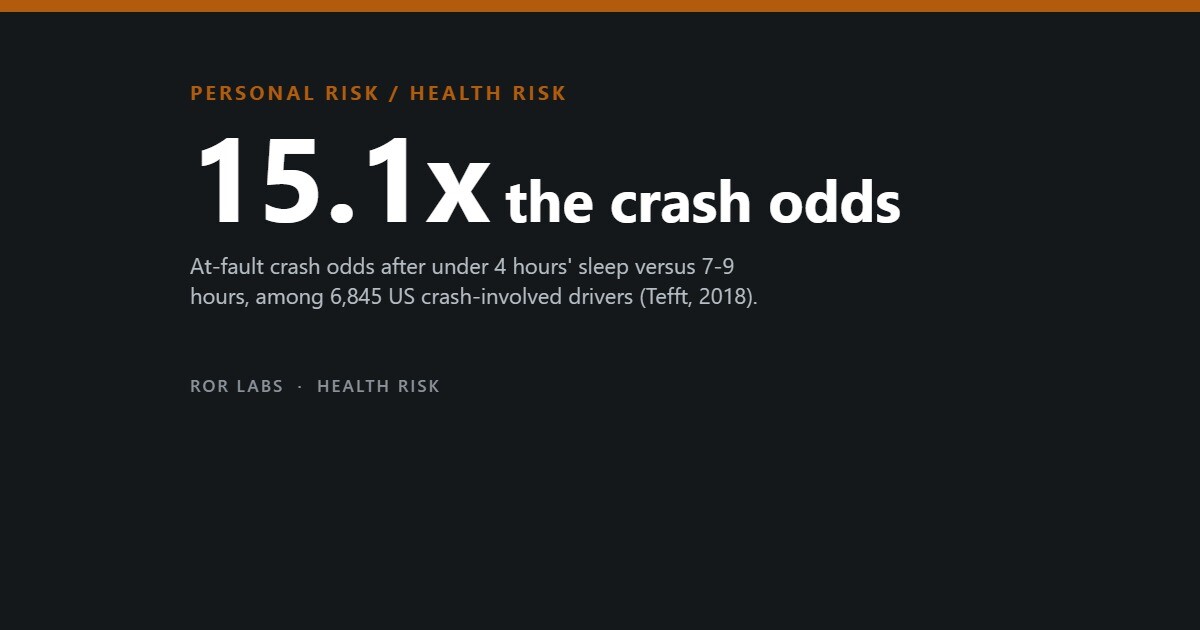
- Risk climbs steeply as sleep falls. Drivers who had slept less than 4 hours in the previous day had 15.1 times the odds of causing their crash, compared with those who slept 7 to 9 hours.
- Night-shift workers, young drivers and people with untreated sleep apnoea carry extra risk. Feeling alert is not a reliable guide, because short sleep raises crash risk even in people who do not feel sleepy.
In this article
- How many crashes involve drowsiness?
- Why the estimates disagree
- How much sleep is too little?
- Microsleeps and the limits of feeling alert
- Shift workers and young drivers
- Sleep apnoea and its treatment
- Who is most at risk, and what to do
- What works, and what does not
- Questions people ask
- The short version
- Sources
Most drivers know the feeling: heavy eyelids, yawning, a stretch of road you cannot remember. Most keep going. Drowsy driving is one of the commonest risks on the road and one of the hardest to count, because tiredness leaves nothing behind for a police officer to measure.
This article looks at what the research says about how many crashes involve sleepiness, how quickly risk climbs as sleep falls, who is most exposed, and which countermeasures hold up in tests. An earlier article here looked at daylight saving time, one of the few natural experiments in lost sleep.
The headline numbers vary tenfold depending on how they were produced. That spread does not mean the problem is invented. It means each method misses something different.
How many crashes involve drowsiness?
The official US figures are modest. NHTSA estimates that in 2017 about 91,000 police-reported crashes involved a drowsy driver, injuring around 50,000 people and killing nearly 800. In 2024 it counted 644 deaths, and says these numbers are probably too low.
A different method gives a very different answer. In a 2018 AAA Foundation study, Owens and colleagues used in-car video from the SHRP2 naturalistic driving study, in which more than 3,500 volunteers drove with cameras installed. They measured how often each driver’s eyes were closed in the minutes before 701 crashes. On that measure, 9.5% of all crashes and 10.8% of the more serious, police-reportable ones involved a drowsy driver.
Same question, very different answers
Share of crashes attributed to driver drowsiness, by method.
Sources: Owens et al., AAA Foundation for Traffic Safety (2018); GHSA (2026), citing FARS 2023; AAA Foundation for Traffic Safety (2024); Gottlieb et al., BMC Medicine (2018). Methods and crash types differ, so the rows are not directly comparable.
In darkness the share rose to 19.0%, against 6.1% in daylight. For fatal crashes, a 2024 AAA Foundation model used NHTSA’s detailed crash investigations to fill in drowsiness where police had recorded it as unknown. It estimated that 17.6% of fatal crashes in 2017–2021 involved a drowsy driver.
Why the estimates disagree
Police reports undercount for plain reasons. Officers do not see the driver before the crash, drowsiness cannot be tested afterwards, and a surviving driver is wide awake by the time anyone asks. US states also record it differently. The 1.5% for fatal crashes is best read as a floor.
The larger figures carry their own limits. The SHRP2 drivers were volunteers who agreed to cameras, young and older drivers were oversampled, and the study had no fatal crashes at all. Almost a quarter of crashes were dropped because the driver’s eyes could not be seen. The 12% eye-closure threshold may also miss drivers who were impaired but blinking normally, which the authors say could make 9.5% an undercount.
The 17.6% figure depends on a model that guesses drowsiness where it was not recorded. The GHSA report behind the news story applied that 2017–2021 share to 2023 deaths. In the Sleep Heart Health Study, Daniel Gottlieb and colleagues attributed 19% of crashes to short sleep or sleep apnoea. Their crashes were self-reported, and the share rose to 40% when they used 9 hours’ sleep rather than 7 as the reference.
So the honest range runs from about 1% to about 20%. The lower end is certainly too low; the upper end rests on reasonable but unproven assumptions. Every method agrees that sleepiness is a real cause of crashes, concentrated at night and on long, monotonous drives.
How much sleep is too little?
The clearest dose–response comes from Brian Tefft’s 2018 study in Sleep. He used 6,845 drivers from a representative sample of crashes that the US Department of Transportation investigated in 2005–2007. He compared drivers judged responsible for their crash with those who were not, by how much they had slept in the previous 24 hours.
Less sleep, more responsibility for the crash
Adjusted odds of being the driver responsible for a crash, by self-reported hours of sleep in the previous 24 hours. 7–9 hours = 1.
Source: Tefft, Sleep (2018); 6,845 drivers in US crashes investigated in 2005–2007. Odds ratios, not absolute risks; the confidence interval for less than 4 hours ran from 4.2 to 54.4.
The curve is not a straight line. Each lost hour adds a little until about four hours, then the risk jumps, though few drivers had slept that little. The journal’s press release compared the top figure with US estimates for a driver at about one and a half times the legal alcohol limit.
Habitual short sleep matters too. Among 3,201 middle-aged and older drivers in the Sleep Heart Health Study, each hour less of usual nightly sleep raised the odds of a crash in the following year by 13%. People who slept 5 hours or less a night had 47% higher odds than those who slept 7 or 8.
Microsleeps and the limits of feeling alert
A microsleep is a lapse into sleep that lasts only seconds, often without the driver realising it happened. NHTSA warns that drivers who rely on coffee alone can still have microsleeps of four or five seconds. At motorway speed of 100 km/h, a car covers about 28 metres a second, so a four-second lapse is more than 100 metres with nobody steering.
Some lapses are shorter still. A Swiss team led by Jelena Skoručak detected microsleeps as short as one second in simulator drivers’ brainwaves, and linked them with worse driving.
On a real road, after a single night without sleep, nine Australian drivers in a study by Brook Shiferaw and colleagues left their lane 3.79 times as often as when rested. Six of the nine had their drive stopped early. The sample was tiny, but the direction matches the larger studies above.
Do drivers notice? A 2021 review of 34 driving studies by Anna Cai and colleagues found they generally do, and that high sleepiness predicted crashes and lane departures. Yet in Gottlieb’s cohort, the link between short sleep and crashes was strongest in people who did not feel sleepy.
Shift workers and young drivers
The drive home after a night shift is one of the riskiest trips anyone takes. In a 2016 PNAS study, Michael Lee and colleagues had 16 night-shift workers drive an instrumented car on a closed track for two hours, once after sleep and once after a night shift.
Driving home after a night shift
Two-hour daytime drives on a closed track by 16 night-shift workers, after a night of sleep and after a night of work.
Source: Lee et al., PNAS (2016). A small, closed-track study; the 11 near-crashes all came after at least 45 minutes of driving.
After night work there were 11 near-crashes across six drives. Lane excursions doubled, from 1.49 to 3.09 a minute. A study of 33 nurses by Megan Mulhall and colleagues found the same pattern on real commutes, with sleep-related driving events highest after night shifts, especially the first one.
Young drivers are the other group that stands out. In the DRIVE study of 19,327 newly licensed drivers aged 17 to 24 in New South Wales, those who usually slept 6 hours or less a night had 21% more police-reported crashes over about two years. Short sleepers’ crashes were more likely to happen between 8 pm and 6 am, with a relative risk of 1.86.
NHTSA notes that teenagers often sleep too little just as their biological need for sleep rises. James Horne and Louise Reyner found that young adults’ sleep-related crashes cluster in the early morning, while older drivers are more vulnerable in mid-afternoon.
Sleep apnoea and its treatment
Obstructive sleep apnoea, in which the airway closes repeatedly during sleep, is the commonest medical cause of daytime sleepiness. A 2009 meta-analysis by Stephen Tregear and colleagues pooled 10 studies and found that people with sleep apnoea had about two and a half times the crash risk of comparable drivers without it.
Sleep apnoea and crash risk
Relative crash risk with obstructive sleep apnoea, and before and after CPAP treatment.
Sources: Tregear et al., Journal of Clinical Sleep Medicine (2009) and Sleep (2010); Gottlieb et al., BMC Medicine (2018), 3,201 adults, odds ratios adjusted for age, sex and miles driven.
The community data add a twist. In Gottlieb’s cohort, severe apnoea went with 123% higher odds of a crash, and the excess showed up even in people who did not report daytime sleepiness. Mild and moderate apnoea had much smaller effects. The authors estimated that 10% of crashes in the cohort were attributable to sleep apnoea.
Treatment with continuous positive airway pressure (CPAP) appears to help. Tregear’s 2010 meta-analysis of nine before-and-after studies found crash risk fell to about 28% of its pre-treatment level, and simulated driving improved within two to seven days. But before-and-after designs flatter treatment, because people are often diagnosed just after a run of trouble.
Controlled comparisons are less clear. In a Spanish study of 80 patients and 80 healthy controls, crashes fell by more than half after CPAP, but they fell almost as much among controls. A Finnish study of 2,060 patients found no significant difference in police-reported crashes before treatment (3.2 per 1,000 person-years), after it (3.9) or in people who had stopped CPAP (2.6). How much treatment cuts crashes is less certain than it looks.
Who is most at risk, and what to do
The US National Highway Traffic Safety Administration (NHTSA) reports 644 deaths in drowsy-driving crashes in 2024. Its page names the people most at risk.
| Group or situation | Why it matters |
|---|---|
| Teens | Named as a high-risk group; delay driving until well rested |
| People with sleep apnea | Named as a high-risk group |
| People on drowsiness-causing medications | Check labels; use public transit if the drug makes you drowsy |
| Shift workers, parents of newborns | Named as high-risk groups |
| Long, monotonous or solo drives | Named as risk situations |
Warning signs. Crossing lane lines or hitting a rumble strip, and micro-sleeps of four to five seconds. NHTSA says adequate sleep, 7 to 8 hours a night, is the only true way to prevent drowsy driving, and advises avoiding driving between midnight and 6 a.m. and in the late afternoon.
If you are already tired. NHTSA says coffee or energy drinks alone are not always enough and their effects are short-lived. It suggests one or two cups of coffee followed by a 20-minute nap in a safe, lit place such as a rest stop, and says this helps alertness only briefly. Pulling over is the point.
What we could not confirm. The NHTSA page is undated, and we did not read the CDC’s drowsy-driving page. We found no official figure for how long the nap-and-coffee effect lasts.
What works, and what does not
The best-supported countermeasure is to stop. In a simulator study, Horne and Reyner gave 10 sleepy drivers a nap of under 15 minutes, 150 mg of caffeine in coffee, or a placebo during a 30-minute break. The nap and the caffeine both reduced driving errors and drowsy brainwaves; a break on its own did not. Road-safety advice now often pairs the two as a ‘caffeine nap’.
A 2026 study by Ashleigh Filtness and colleagues tested the ‘caffeine nap’ in 21 people being treated for sleep apnoea, a group left out of earlier trials. After restricted sleep, coffee followed by a short nap reduced sleepiness, and a 30-minute nap opportunity added little over 15 minutes. NHTSA’s advice is similar: a caffeinated drink and a nap of about 20 minutes in a safe place such as a lit rest stop.
The popular in-car fixes do less. When Reyner and Horne restricted 16 young drivers to five hours’ sleep, cold air on the face and the radio had no significant effect on lane drifting. On a real motorway, a Swedish team found that opening the window had no effect on sleepiness, and music helped only slightly. Coffee has limits too: NHTSA warns it may make drivers overestimate how alert they are.
What one case-control study found
Adjusted relative risk of a crash on rural highways in Washington State, by driver report.
Source: Cummings et al., Injury Prevention (2001); 200 drivers in crashes and 199 matched controls. Observational; the interval for feeling sleepy ran from 1.4 to 147.
In this study by Peter Cummings and colleagues, feeling close to sleep went with a very large rise in risk, and rest stops and recent coffee with half the risk. The radio result conflicts with the experiments; radio listeners probably differ in other ways.
Road design can catch drivers who fail to stop. Federal Highway Administration guidance, based on NCHRP Report 641, credits shoulder rumble strips with cutting fatal and injury run-off-road crashes on two-lane rural roads by 13% to 51%. In-car drowsiness alerts help less if, as GHSA notes, drivers ignore them or switch them off.
What to do
Steps sorted by when they matter. Each one says how strong the evidence is: Measured Official advice Untested
Before
- Get a full night’s sleep before a long drive; NHTSA advises seven to eight hours a night. Official advice see Sources
- Avoid driving between midnight and 6 a.m. and in the late afternoon when you can, especially alone on long, monotonous roads. Official advice see Sources
- After a night shift, arrange another way home if you can: near-crashes and stopped drives were common after night work in a track study. Measured see Sources
- If you snore heavily or often feel sleepy by day, see a doctor about sleep apnoea. Measured see Sources
If it happens
- If you feel drowsy, pull over somewhere safe, such as a lit rest stop, and stop driving. Official advice see Sources
- Treat drifting across lane lines or hitting a rumble strip as a signal to stop, not to push on. Official advice see Sources
- Once stopped, take a short nap of about 20 minutes; a caffeinated drink before it can add to the effect. Official advice see Sources
Afterwards
- If you had to stop because of sleepiness, plan the rest of the trip around sleep, a co-driver or other transport. Untested see Sources
- If you are treated for sleep apnoea, keep up follow-up with your doctor and ask about the driving rules where you live. Untested see Sources
What not to do
- Do not rely on opening the window or turning up the radio; in experiments they did little against sleepiness. Measured see Sources
- Do not rely on coffee alone; microsleeps of a few seconds can still happen. Official advice see Sources
- Do not assume you are fine because you do not feel sleepy; short sleep raised crash risk even in people who felt alert. Measured see Sources
- Do not drink alcohol before driving; it adds to drowsiness. Official advice see Sources
Not medical advice. If you often feel sleepy at the wheel or snore heavily, see a doctor.
Questions people ask
Is driving tired really as bad as drink-driving?
At the extreme, yes. Drivers who had slept less than 4 hours had 15.1 times the odds of causing their crash, similar to US estimates for a driver well over the alcohol limit. After 6 hours’ sleep the increase was 1.3 times.
Will coffee keep me safe on a long drive?
Coffee helps, especially with a short nap during a stop. On its own it does not prevent microsleeps, and NHTSA warns it can make you feel more alert than you are.
Can I tell when I am about to fall asleep?
Drivers generally do notice sleepiness, such as yawning, heavy eyelids or drifting from the lane. But short sleepers in one large cohort crashed more even when they did not feel sleepy, so feeling fine is not proof.
I snore loudly and feel tired during the day. Should I be driving?
Talk to a doctor about sleep apnoea. Untreated apnoea is linked with roughly double the crash risk, even in some people who do not feel sleepy. Ask too about the driving rules where you live.
How long should a roadside nap be?
Studies have used naps of under 15 minutes, and NHTSA suggests about 20 minutes. A recent study found little extra benefit from a 30-minute nap opportunity over 15 minutes. Choose a safe, lit place to stop.
The short version
- Police reports put drowsiness in about 1.5% of US fatal crashes. Dashcam and modelling studies put it nearer 10% of all crashes and 17.6% of fatal ones.
- The gap is mostly a measurement problem. Sleepiness leaves no blood test, survivors are jolted awake by the impact, and every larger estimate rests on assumptions of its own.
- Risk climbs steeply as sleep falls. Drivers who had slept less than 4 hours in the previous day had 15.1 times the odds of causing their crash, compared with those who slept 7 to 9 hours.
- Night-shift workers, young drivers and people with untreated sleep apnoea carry extra risk. Feeling alert is not a reliable guide, because short sleep raises crash risk even in people who do not feel sleepy.
- Stopping is the countermeasure with the best support: a short nap, ideally with caffeine, in a safe place. Opening the window and turning up the radio did little in experiments.
- Shoulder rumble strips cut serious run-off-road crashes on rural roads. If you snore heavily or feel sleepy by day, see a doctor about sleep apnoea.
This article summarises research, agency reports and news for general information. It is not medical or legal advice. If you often feel sleepy by day or snore heavily, talk to a doctor.
Further reading: Owens et al., AAA Foundation for Traffic Safety (2018), for the dashcam estimate and its limits. Tefft, Sleep (2018), for the hours-of-sleep curve. Gottlieb et al., BMC Medicine (2018), for short sleep and sleep apnoea in a community cohort.
Sources
- Governors Highway Safety Association. Drowsy driving kills 6,000 Americans each year, new analysis shows (news release, 26 February 2026) and Wake Up Call 2026 update.
- National Highway Traffic Safety Administration. Drowsy driving (web page, accessed October 2026).
- Owens JM, Dingus TA, Guo F, et al. Prevalence of drowsy driving crashes: estimates from a large-scale naturalistic driving study. AAA Foundation for Traffic Safety (February 2018).
- AAA Foundation for Traffic Safety. Drowsy driving in fatal crashes, United States, 2017–2021 (March 2024).
- Gottlieb DJ, Ellenbogen JM, Bianchi MT, Czeisler CA. Sleep deficiency and motor vehicle crash risk in the general population: a prospective cohort study. BMC Med 16 (2018), doi:10.1186/s12916-018-1025-7.
- Tefft BC. Acute sleep deprivation and culpable motor vehicle crash involvement. Sleep (2018), doi:10.1093/sleep/zsy144.
- Skoručak J, Hertig-Godeschalk A, Achermann P, Mathis J, Schreier DR. Automatically detected microsleep episodes in the fitness-to-drive assessment. Front Neurosci (2020), doi:10.3389/fnins.2020.00008.
- Shiferaw B, Downey LA, Westlake J, et al. Stationary gaze entropy predicts lane departure events in sleep-deprived drivers. Sci Rep 8 (2018), doi:10.1038/s41598-018-20588-7.
- Cai AWT, Manousakis JE, Lo T, Horne JA, Howard ME, Anderson C. I think I’m sleepy, therefore I am: awareness of sleepiness while driving: a systematic review. Sleep Med Rev (2021), doi:10.1016/j.smrv.2021.101533.
- Lee ML, Howard ME, Horrey WJ, et al. High risk of near-crash driving events following night-shift work. Proc Natl Acad Sci USA 113(1):176 (2016), doi:10.1073/pnas.1510383112.
- Mulhall MD, Sletten TL, Magee M, et al. Sleepiness and driving events in shift workers: the impact of circadian and homeostatic factors. Sleep 42(6):zsz074 (2019).
- Martiniuk ALC, Senserrick T, Lo S, et al. Sleep-deprived young drivers and the risk for crash: the DRIVE prospective cohort study. JAMA Pediatr 167(7):647–655 (2013), doi:10.1001/jamapediatrics.2013.1429.
- Horne JA, Reyner LA. Driver sleepiness. J Sleep Res (1995), doi:10.1111/j.1365-2869.1995.tb00222.x.
- Tregear S, Reston J, Schoelles K, Phillips B. Obstructive sleep apnea and risk of motor vehicle crash: systematic review and meta-analysis. J Clin Sleep Med (2009), PMID 20465027.
- Tregear S, Reston J, Schoelles K, Phillips B. Continuous positive airway pressure reduces risk of motor vehicle crash among drivers with obstructive sleep apnea: systematic review and meta-analysis. Sleep 33(10):1373 (2010), doi:10.1093/sleep/33.10.1373.
- Barbé F, Sunyer J, de la Peña A, et al. Effect of continuous positive airway pressure on the risk of road accidents in sleep apnea patients. Respiration (2006), doi:10.1159/000094237.
- Myllylä M, Anttalainen U, Saaresranta T, Laitinen T. Motor vehicle accidents in CPAP-compliant obstructive sleep apnea patients: a long-term observational study. Sleep Breath (2020), doi:10.1007/s11325-020-02023-2.
- Horne JA, Reyner LA. Counteracting driver sleepiness: effects of napping, caffeine, and placebo. Psychophysiology (1996), doi:10.1111/j.1469-8986.1996.tb00428.x.
- Filtness A, Miller KA, Maynard SE, et al. Optimising the caffeine nap for counteracting driver sleepiness in CPAP treated obstructive sleep apnoea patients. Sci Rep (2026), doi:10.1038/s41598-026-42894-1.
- Reyner LA, Horne JA. Evaluation of ‘in-car’ countermeasures to sleepiness: cold air and radio. Sleep 21(1):46 (1998), doi:10.1093/sleep/21.1.46.
- Schwarz J, Ingre M, Fors C, et al. In-car countermeasures open window and music revisited on the real road: popular but hardly effective against driver sleepiness. J Sleep Res (2012), doi:10.1111/j.1365-2869.2012.01009.x.
- Cummings P, Koepsell TD, Moffat J, Rivara FP. Drowsiness, counter-measures to drowsiness, and the risk of a motor vehicle crash. Inj Prev 7(3):194 (2001).
- Federal Highway Administration. Proven safety countermeasures: longitudinal rumble strips and stripes on two-lane roads (FHWA-SA-21-036), citing NCHRP Report 641 (2009).
- NHTSA. Drowsy driving: avoid falling asleep behind the wheel. nhtsa.gov.