Cyberbullying: How Common It Is and What Helps
Key takeaways · 12 min read
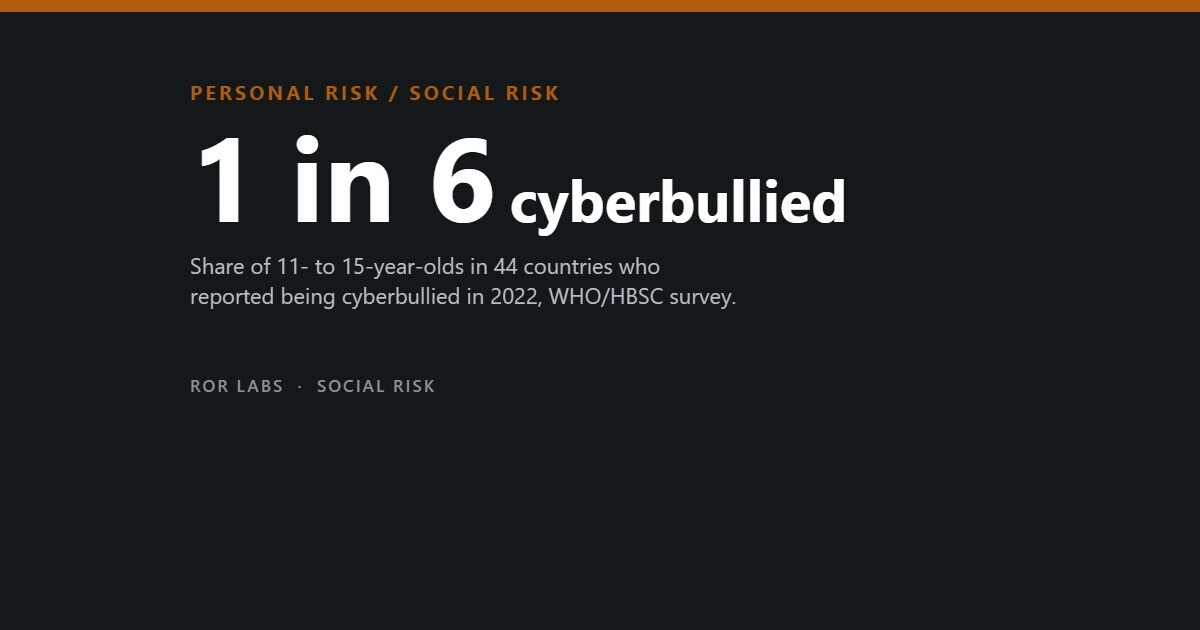
- In a WHO-backed survey of more than 279,000 children aged 11 to 15 in 44 countries, 15%, about one in six, said they had been cyberbullied in 2022.
- Estimates swing wildly with the definition: across 76 long-term studies, reported victimisation ranged from 1.9% to 84%.
- Online and offline bullying overlap heavily: in one meta-analysis, 63% of cyberbullying victims had also been bullied at school.
- School programmes cut cyberbullying perpetration by about 10% to 15% and victimisation by about 14%, according to a 2019 meta-analysis.
Cyberbullying has a reputation as the bullying that never stops: it follows children home, into their bedrooms and onto the phone they check before sleep. That fear has driven new laws, school policies and, in Australia, a ban on social media for under-16s. Parents and teachers want two things from the research: how many children it affects, and what actually helps.
The answers are less tidy than the headlines. Depending on which survey you read, cyberbullying affects one child in ten, one in six or nearly one in two. Most of that spread comes from how the question is asked. And for most children who are bullied online, the online part is not separate from what happens in school corridors. It is the same conflict, carried onto another screen.
This article sets out how researchers define and count cyberbullying, why the estimates disagree, where it happens, what it is linked with, and what the trials say about prevention. The evidence on programmes is more encouraging than many people assume, but the effects are modest, and some of the most popular responses have not been tested at all.
What counts as cyberbullying
Researchers usually borrow the classic definition of bullying: aggression that is deliberate, repeated and aimed at someone who finds it hard to defend themselves. Cyberbullying is the same behaviour carried out through phones, messaging apps, games and social media. In practice, surveys differ on every part of that definition, and on whether to use the word bullying at all.
Some studies ask a single question about being “cyberbullied”. Others list specific acts, such as name-calling, rumours or threats, and count anyone who has experienced any of them even once. Time windows range from the last month to the last few months to a whole lifetime. A 2020 review of 76 long-term studies by Anne-Linda Camerini and colleagues found reported victimisation from 1.9% to 84.0%, and perpetration from 5.3% to 66.2%.
Same topic, very different questions
How four widely quoted sources measure cyberbullying victimisation, and what they found.
| Source | Who and when | What counted | Result |
|---|---|---|---|
| WHO/HBSC survey | Ages 11–15, 44 countries, 2022 | Being cyberbullied, self-reported | 15% |
| Cyberbullying Research Center | US, ages 13–17, 2025 | Repeated online harassment, past 30 days | 32.7% |
| Pew Research Center | US, ages 13–17, 2022 | Any of six listed behaviours | 46% |
| Camerini et al. review | 76 long-term studies, 2007–2017 | Varied by study | 1.9–84% |
Sources: WHO Regional Office for Europe, HBSC press release (27 March 2024); Patchin JW, Cyberbullying Research Center (July 2025), not peer reviewed; Pew Research Center, Teens and Cyberbullying 2022; Camerini AL et al., Telematics and Informatics (2020), doi:10.1016/j.tele.2020.101362.
How common it is
Pooling studies smooths some of that noise. A 2014 meta-analysis in the Journal of Adolescent Health by Kathryn Modecki and colleagues estimated that about 15% of young people had been cyberbullied, and a similar share had cyberbullied someone else. Traditional bullying was more than twice as common: about 36% had been bullied in person and about 35% had bullied others.
Cyberbullying is common, but less common than bullying in person
Average share of young people reporting each experience, pooled across studies.
Sources: Modecki KL et al., Journal of Adolescent Health (2014), doi:10.1016/j.jadohealth.2014.06.007; Li C et al., European Child & Adolescent Psychiatry (2022), doi:10.1007/s00787-022-02128-x, 42 studies and 266,888 participants.
A 2022 meta-analysis of 42 studies and 266,888 children, led by Chao Li, found lower averages, 11.1% for cyberbullying victimisation and 24.3% for traditional bullying, with large differences between regions. Its prediction interval for cyberbullying ran from about 2% to 40%: a plausible range for a new study, which shows how much setting and method matter.
Trend data point upwards. The international Health Behaviour in School-aged Children survey found that 15% of 11- to 15-year-olds had been cyberbullied in 2022, up from 12% among boys and 13% among girls in 2018. A US survey by the Cyberbullying Research Center, which is not peer reviewed, reported that 30-day victimisation among 13- to 17-year-olds rose from 16.7% in 2016 to 32.7% in 2025.
Online and offline overlap
The picture of a separate online threat, striking children who are otherwise safe, fits only a small share of cases. In the 2022 meta-analysis, 63% of children who had been cyberbullied had also been bullied at school. Only about 4% of all children had been bullied online alone, compared with about 7% bullied in both places and 15.5% bullied only in person.
The 2014 meta-analysis found the same link from a different angle. Being bullied online and being bullied offline were moderately correlated, at about 0.40, and so were bullying others online and offline, at about 0.47. Children who bully others online often do so offline too, and many children are both targets and perpetrators at different times.
This matters for what adults do next. If most online bullying is an extension of relationships at school, then school is where much of the solution sits, and a response that focuses only on the device misses the conflict that drives it. It also explains why the children who struggle most in the research are those bullied in both settings, with nowhere that feels safe.
Most cyberbullying victims are bullied offline too
Share of all children in each group, pooled across 30 effect sizes that separated the groups.
Source: Li C et al., European Child & Adolescent Psychiatry (2022), doi:10.1007/s00787-022-02128-x. The last bar is a share of victims, not of all children.
Where it happens
Pew Research Center’s 2022 survey of 1,316 American teenagers found that 46% had experienced at least one of six online behaviours. The most common was offensive name-calling, at 32%, followed by false rumours, at 22%, and receiving explicit images they had not asked for, at 17%. Older teenage girls were most affected: 54% of girls aged 15 to 17 reported at least one.
What teens report, and on which apps
US teens aged 13–17. Upper rows: share of all teens, 2022. Lower rows: share of each app’s teen users harassed on it, autumn 2025.
Sources: Pew Research Center, Teens and Cyberbullying 2022 (1,316 teens); Pew Research Center, teens’ experiences on TikTok, Instagram and Snapchat (April 2026; 1,458 teens surveyed 25 September–9 October 2025). Harassed means called names, targeted by rumours or physically threatened.
A Pew survey published in April 2026 asked about three apps. Among teenagers who used each one, 27% said they had been called names, targeted by rumours or threatened on Snapchat, 19% on Instagram and 18% on TikTok. Roughly three-quarters of users of each app called harassment and bullying a problem for people their age there, while a minority had experienced it themselves.
Links with mental health
Being cyberbullied is consistently linked with distress. A 2014 meta-analysis in Psychological Bulletin by Robin Kowalski and colleagues found that, among the factors studied, stress and suicidal thoughts had the strongest associations with cyberbullying victimisation. The 2022 meta-analysis found the highest risks among children bullied both online and offline.
A 2018 systematic review led by Ann John looked at self-harm and suicidal behaviour in people under 25. Victims of cyberbullying had a little over twice the odds of self-harm and of suicidal behaviours compared with other young people; those who cyberbullied others had slightly raised odds of suicidal behaviours. The review also found five studies that showed no significant association.
Raised odds, mostly from snapshot studies
Pooled odds ratios in children and young people under 25. 1.00 means no difference.
Source: John A et al., Journal of Medical Internet Research 20(4):e129 (2018), as tabulated in McEvoy D et al., Journal of Psychiatric Research (2023), doi:10.1016/j.jpsychires.2023.10.017. Most included studies were cross-sectional.
These figures describe association, not proven cause. Most studies measured bullying and distress at the same moment, so they cannot say which came first; a child who is already struggling may also be more likely to be targeted. If you or a young person you know is having thoughts of self-harm or suicide, contact a local crisis line, such as 988 in the United States or Samaritans on 116 123 in the UK and Ireland.
What reduces it
The most cited review of prevention is a 2019 meta-analysis by Hannah Gaffney, David Farrington, Dorothy Espelage and Maria Ttofi. It included 24 publications, 15 of them randomised trials, testing programmes for school-aged children. Programmes reduced cyberbullying perpetration by about 10% to 15% and victimisation by about 14%. That is a real but modest effect, not an end to the problem.
Programmes help, modestly
Approximate reductions from school-based programmes, according to meta-analyses.
Sources: Gaffney H, Farrington DP, Espelage DL, Ttofi MM, Aggression and Violent Behavior 45 (2019), doi:10.1016/j.avb.2018.07.002; school-bullying figures from Gaffney H, PhD thesis, University of Cambridge (2020). Upper ends of ranges shown.
A larger 2022 meta-analysis in Prevention Science by Joshua Polanin and colleagues pooled 50 studies and 45,371 participants. It found small but significant reductions in both perpetration and victimisation, and few clear differences between types of programme. The programmes it covered ranged from dedicated anti-cyberbullying lessons to general anti-bullying, anti-violence and school-climate work.
There are gaps. Most trials ran in schools over a few months, follow-ups were short, and almost all outcomes were self-reported by pupils who knew they were in a programme. Evidence for children outside school settings, for parents’ monitoring software and for platform features is thin. Reporting tools and blocking are sensible to use, but they have rarely been tested in trials.
Bans, reporting and adults
Governments are increasingly reaching for age limits. Australia’s ban on social media accounts for under-16s took effect in December 2025, but the eSafety Commission’s own study found that more than 80% of under-16s were still using social media months later, and about half had kept accounts. Whatever a ban achieves, it does not yet remove young people from the places where most online bullying happens.
Teens themselves are sceptical of the companies. In Pew’s 2022 survey, only 25% said social media firms were doing a good job of tackling online harassment, against 66% who said that of parents. For an individual child, the practical steps are ordinary ones: save evidence such as screenshots, use the platform’s blocking and reporting tools, tell the school, and talk to a doctor if distress persists.
What the evidence suggests
Cyberbullying is common, but how common depends heavily on the definition, and careful pooled estimates sit around one child in seven to one in nine, below the rate of bullying in person. It overlaps heavily with school bullying, and children bullied in both places fare worst. Links with distress and self-harm are consistent but mostly come from snapshot studies. School programmes reduce it by roughly a seventh, a useful but modest gain, while bans and platform tools remain largely untested.
What to do
Steps sorted by when they matter. Each one says how strong the evidence is: Measured Official advice Untested
Before
- Ask whether the school runs a sustained prevention programme. In trials, programmes cut cyberbullying victimisation by about 14%: a real but modest effect. Measured see Sources
If it happens
- Save evidence such as screenshots before anything is deleted. Untested see Sources
- Use the platform’s blocking and reporting tools. They are sensible to use, though rarely tested in trials. Untested see Sources
- Tell the school. Cyberbullying overlaps heavily with bullying in person, and children bullied in both places fare worst. Measured see Sources
Afterwards
- If distress persists, talk to a doctor. Untested see Sources
What not to do
- Do not count on an age ban to remove the problem. Months after Australia’s under-16 ban, more than 80% of under-16s were still using social media. Measured see Sources
This does not assess any child’s mental health. Persistent distress is a matter for a doctor.
Questions people ask
How many children are cyberbullied?
It depends on the question asked. Pooled studies put it at about 11% to 15%; a WHO-backed survey found 15% in 2022, while broader US surveys report up to 46%.
Is cyberbullying worse than bullying in person?
The two are hard to separate, because most cyberbullying victims are also bullied offline. Children bullied in both settings show the highest risks of distress.
Do anti-bullying programmes work online?
Modestly. A 2019 meta-analysis found reductions of about 10% to 15% in perpetration and about 14% in victimisation, mostly from school-based programmes.
Will banning social media stop it?
There is no trial evidence yet. Australia’s own regulator found more than 80% of under-16s still using social media after its ban took effect.
What should a child do if it happens?
Keep screenshots, block and report the account, and tell a trusted adult and the school. If distress persists, see a doctor; in a crisis, call a local crisis line.
The short version
- In a WHO-backed survey of more than 279,000 children aged 11 to 15 in 44 countries, 15%, about one in six, said they had been cyberbullied in 2022.
- Estimates swing wildly with the definition: across 76 long-term studies, reported victimisation ranged from 1.9% to 84%.
- Online and offline bullying overlap heavily: in one meta-analysis, 63% of cyberbullying victims had also been bullied at school.
- School programmes cut cyberbullying perpetration by about 10% to 15% and victimisation by about 14%, according to a 2019 meta-analysis.
- Links with self-harm and distress are consistent but come mostly from snapshot studies, and bans and platform tools remain largely untested.
This article summarises published research and surveys for general information. It is not a screening or diagnostic tool. If a child is being bullied online, involve the school and use the platform’s reporting tools; if distress continues, talk to a doctor or a mental-health professional. If anyone is thinking about suicide or self-harm, contact a local crisis line, such as 988 in the United States or Samaritans on 116 123 in the UK and Ireland, or local emergency services if there is immediate danger.
Further reading: Modecki et al., Journal of Adolescent Health (2014), for the meta-analysis comparing cyber and traditional bullying. Li et al., European Child & Adolescent Psychiatry (2022), for the overlap between the two. Gaffney et al., Aggression and Violent Behavior 45 (2019), for what prevention programmes achieve.
- Behind Their Screens, Emily Weinstein and Carrie James (2022). Two Harvard researchers draw on thousands of teenagers’ own accounts of digital life, including cruelty online. Nuanced and sympathetic to teens; it is qualitative and US-centred.
- Growing Up in Public, Devorah Heitner (2023). A practical guide for parents on privacy, reputation and mistakes in a connected childhood. Calm and useful; it offers advice more than evidence on what works.
- The Anxious Generation, Jonathan Haidt (2024). An influential argument that smartphones and social media rewired childhood and harmed teen mental health. Widely read; many researchers dispute how strongly the data support its causal claims.
Sources
Al Jazeera, 3 August 2026, reporting an eSafety Commission study on Australia’s under-16 social media ban. — Camerini AL, Marciano L, Carrara A, Schulz PJ. Telematics and Informatics (2020), doi:10.1016/j.tele.2020.101362. — WHO Regional Office for Europe. One in six school-aged children experiences cyberbullying, HBSC study press release (27 March 2024). — Patchin JW. Cyberbullying rates continue to climb, Cyberbullying Research Center (July 2025). — Pew Research Center. Teens and Cyberbullying 2022 (December 2022). — Pew Research Center. Teens’ experiences on TikTok, Instagram and Snapchat (April 2026). — Modecki KL, Minchin J, Harbaugh AG, Guerra NG, Runions KC. J Adolesc Health (2014), doi:10.1016/j.jadohealth.2014.06.007. — Li C, Wang P, Martin-Moratinos M, Bella-Fernandez M, Blasco-Fontecilla H. Eur Child Adolesc Psychiatry (2022), doi:10.1007/s00787-022-02128-x. — Kowalski RM, Giumetti GW, Schroeder AN, Lattanner MR. Psychological Bulletin (2014), doi:10.1037/a0035618. — John A et al. Self-harm, suicidal behaviours, and cyberbullying in children and young people: systematic review. J Med Internet Res 20(4):e129 (2018). — McEvoy D et al. J Psychiatr Res (2023), doi:10.1016/j.jpsychires.2023.10.017. — Gaffney H, Farrington DP, Espelage DL, Ttofi MM. Aggress Violent Behav 45 (2019), doi:10.1016/j.avb.2018.07.002. — Gaffney H. Evaluating the effectiveness of school- and cyber-bullying intervention and prevention programmes. PhD thesis, University of Cambridge (2020). — Polanin JR et al. Prevention Science (2022), doi:10.1007/s11121-021-01259-y.