Which Nutrients Are You Actually Short Of?
In This Series: Nutrients
- How Nutrients Are Classified — and What the Reference Numbers Mean
- Vitamin A: Food Sources, Deficiency, and Safe Limits
- Vitamin C: Food Sources, Scurvy, and the Ceiling the Body Sets
- Vitamin D: Food Sources, Sunlight, and What the Trials Found
- Vitamin D2 vs D3: What the Head-to-Head Trials Found
- Riboflavin: Food Sources, Deficiency, and the Migraine Trials
- Thiamin: Food Sources, Beriberi, and Why There Is No Upper Limit
- Calcium: Food Sources, Bone Density, and What the Trials Found
Disclosure: this article contains affiliate links, marked (paid link). If you buy through one we may earn a commission, at no extra cost to you. As an Amazon Associate I earn from qualifying purchases. It does not change what we recommend — here is how that works.
Key takeaways · 11 min read
- Intake shortfall statistics are not deficiency rates. For vitamin D the two differ by a factor of about eighteen.
- Deficiency clusters in identifiable groups — age, sun exposure, absorption, blood loss, restricted diets, pregnancy.
- Correcting a real deficiency works; topping up a replete person mostly does not.
- Excess is a genuine risk, and regulators are tightening ceilings — vitamin B6 most visibly.
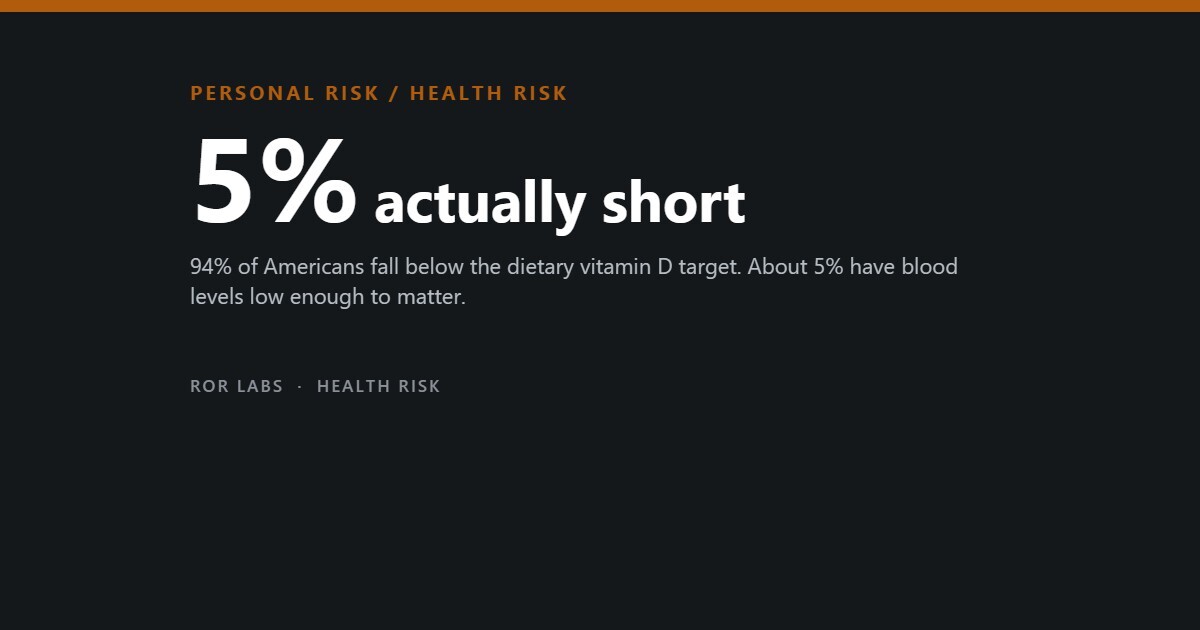
Two numbers, both true, both from U.S. government survey data. Roughly 94% of Americans do not get enough vitamin D from the food they eat. And roughly 5% of Americans actually have blood levels low enough to put them at risk of deficiency.
Almost every supplement advertisement you have ever seen is built on the first number. Almost every useful decision you can make about your own nutrition depends on the second.
This is an attempt to sort out which nutrients ordinary people are genuinely short of, who is genuinely at risk, what the large randomised trials found when they tested supplements properly — and where the risk runs the other way, because taking too much of a vitamin is a real problem that regulators have started acting on.

What the intake numbers say
The Estimated Average Requirement (EAR) is the intake that would meet the needs of half the healthy people in a group. Comparing national food-intake surveys against it produces the figures below — the ones that end up in supplement marketing.
Share of the U.S. population below the Estimated Average Requirement
Intake from food alone, NHANES 2007–2010, ages 4 and over
Source: Linus Pauling Institute, Oregon State University, compiling NHANES 2007–2010 usual intake data
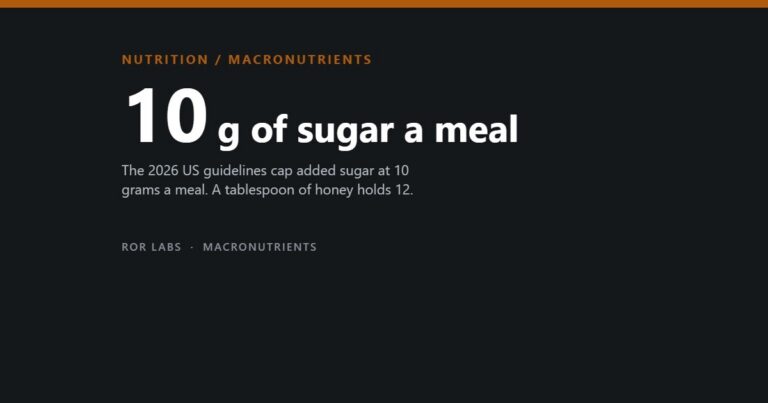
Separately, the Dietary Guidelines for Americans single out four dietary components as underconsumed enough to be called a public health concern: calcium, potassium, dietary fibre and vitamin D, with iron added for pregnancy and some infants. The 2025–2030 edition, released in January 2026, kept that framing while making larger changes elsewhere — a stricter line on added sugars, a first-ever call-out of highly processed foods, and a substantially higher protein target of 1.2–1.6 g per kilogram of body weight. Nutrition researchers at Harvard have publicly criticised parts of it, particularly the mixed messaging on saturated fat.
Why the intake number overstates the problem
An intake statistic measures what went into your mouth. It does not measure what is in your blood, and for several nutrients those are very different things.
Vitamin D: the same population, measured two ways
Dietary intake versus measured serum 25-hydroxyvitamin D
Sources: Linus Pauling Institute (intake); NIH Office of Dietary Supplements, Vitamin D Fact Sheet for Health Professionals (serum)
Three things explain the gap. Skin makes vitamin D from sunlight, and the food-intake calculation cannot see it. Many staple foods are fortified, and fortification has quietly removed several deficiencies that used to be common. And the EAR is a population yardstick, not a personal one — being below it does not mean you personally are short, only that a randomly chosen person below it is more likely to be.
The practical consequence is worth stating plainly: a national shortfall statistic is not a diagnosis. Which is why the useful question is not “which vitamins are people low in” but “am I in one of the groups that actually runs low.”
Who is actually at risk
Deficiency clusters. It follows sunlight, absorption, blood loss, restricted diets, certain medications and life stages — not the general population.
The groups health agencies flag, and what they run short of
Risk groups identified in national dietary guidance and NIH fact sheets
| If this is you | Nutrient to think about | Why |
|---|---|---|
| Older adults | Vitamin D, vitamin B12 | Skin synthesis falls with age; stomach acid declines, which reduces B12 absorption from food |
| Little sun exposure, or darker skin | Vitamin D | Less skin synthesis; NHANES found the highest deficiency rate — 17.5% — among non-Hispanic Black adults |
| BMI 30 or above, or post gastric-bypass | Vitamin D and others | Vitamin D is sequestered in body fat; bypass surgery reduces absorption |
| Crohn’s, coeliac, cystic fibrosis | Fat-soluble vitamins (A, D, E, K) | Fat malabsorption |
| Vegan or strict vegetarian diet | Vitamin B12 | B12 occurs naturally only in animal foods and fortified products |
| Pregnancy, or planning it | Folate, iron, iodine | Requirements rise sharply; folate matters before conception, not after |
| Heavy menstrual bleeding | Iron | Ongoing blood loss is the common cause of iron deficiency in otherwise healthy adults |
| Exclusively breastfed infants | Vitamin D | Breast milk alone does not supply enough; supplementation is standard advice |
Sources: NIH Office of Dietary Supplements fact sheets; Dietary Guidelines for Americans
If you are on this list, a blood test — not a marketing claim — is the thing that settles it, and your doctor can order one. If you are not on it, the honest answer is that you are unlikely to be short of much, and the trial evidence below explains why that matters.
If you are in one of the risk groups (paid link)
Worth taking only when a test or a clinician says you are short — not as a default
Check the vitamin B6 content on any multivitamin or B-complex against the ceilings later in this article, and tell your pharmacist what you take if you are on prescription medication. Nothing here is medical advice.
What happened when supplements were tested properly
Observational studies repeatedly find that people who take supplements are healthier. Randomised trials, which remove the confounding, mostly find something less flattering. Three results define the current state of the evidence.
Three verdicts worth knowing before you buy
Large randomised trials and the U.S. Preventive Services Task Force review
Sources: U.S. Preventive Services Task Force recommendation statement, 21 June 2022; LeBoff et al., New England Journal of Medicine, 2022; COSMOS trial, 2023
Read together, these produce a rule that is neither “supplements are useless” nor “everyone should take them.” Correcting a deficiency helps. Topping up someone who is already replete mostly does not. VITAL is the cleanest demonstration: a well-run trial of a sensible dose in tens of thousands of people, which found nothing, largely because the people in it were not short of vitamin D in the first place.
The other direction: too much is also a risk
This is the half of the story that supplement content almost never covers, and it is the reason a nutrition article belongs on a site about risk at all. Fat-soluble vitamins accumulate. Some water-soluble ones cause harm at doses people reach without noticing, because the same nutrient appears in a multivitamin, an energy drink and a “stress formula” at the same time.
Vitamin B6 is the clearest current case. In 2023 the European Food Safety Authority cut its tolerable upper intake level from 25 mg to 12 mg a day, on the basis of peripheral nerve damage. In November 2025 Australia’s Therapeutic Goods Administration went further and set retail controls: products supplying more than 50 mg per daily dose will require pharmacist involvement, and more than 200 mg will require a prescription, from 1 June 2027.
Where the ceilings sit — and how much regulators disagree
Tolerable upper intake levels for adults
Sources: EFSA scientific opinions on vitamin B6 and selenium (2023); Australian Therapeutic Goods Administration decision, November 2025; NIH Office of Dietary Supplements
The practical hazard is stacking. Add up everything you take — the multivitamin, the separate B-complex, the fortified cereal, the drink mix — before you decide whether a dose is modest.
Food first, and what that actually means
For the four nutrients national guidance flags as genuinely underconsumed, food does the job better than pills — partly because the shortfall is really a shortfall of whole foods, and partly because nobody has ever overdosed on beans.
The four underconsumed nutrients, and where they come from
Dietary components of public health concern in the Dietary Guidelines for Americans
Source: Dietary Guidelines for Americans; NIH Office of Dietary Supplements fact sheets
Two habits move these numbers more than any purchase: a pulse or a whole grain at most meals, and something oily-fish-shaped twice a week. That is dull advice, which is precisely why it keeps surviving contact with the evidence.
The food-first kit (paid link)
Calcium, potassium and fibre are a whole-food problem, and this is what makes whole food quick
Nobody has ever needed an upper intake limit for beans. Where a nutrient can come from food, that is the version with no ceiling to worry about.
We have deliberately narrowed the links in this article. Iron and folate supplementation are decisions that should follow a blood test and a clinician, not an article, so we describe them without a purchase link. Staple foods such as pulses, oats and oily fish are cheaper in any supermarket than they are online, and we are not going to send you to a website to buy oats.
Questions people ask
Should I take a daily multivitamin?
The USPSTF concluded the evidence is insufficient to say it prevents cardiovascular disease or cancer. COSMOS found a modest memory benefit in adults over 60. Serious harm from a standard-dose multivitamin is uncommon. So it is a reasonable low-stakes choice for an older adult, and not a substitute for anything, and not something the evidence obliges anyone to take. If you do take one, check its B6 content against the ceilings above.
How do I know if I am deficient?
By testing, through a doctor, and generally only if you are in one of the risk groups above or have symptoms. Routine screening of healthy adults is not recommended. Symptoms of the common deficiencies are frustratingly non-specific — fatigue, weakness, low mood — which is exactly why guessing does not work and marketing exploits the ambiguity.
Is more vitamin D better?
No. VITAL tested 2,000 IU a day in over 25,000 people and found no fracture, cancer or cardiovascular benefit in a largely replete population. The RDA is 600–800 IU and the upper limit is 4,000 IU. Above that, the risk is hypercalcaemia rather than a bigger benefit.
What about magnesium, since half the population is below the EAR?
The intake gap is real and reflects low intake of whole grains, nuts, legumes and leafy greens. Clinically defined magnesium deficiency, however, is uncommon in healthy people with normal kidney function. Treat it as a signal about your diet rather than an automatic case for a pill.
Do supplements interact with medication?
Yes, and it is one of the more under-appreciated risks. Vitamin K and anticoagulants, calcium and iron with several antibiotics and thyroid medication, and long-term metformin lowering B12 are all well documented. If you take prescription medicine, tell your pharmacist what supplements you take — it is a free check and they are good at it.
The short version
- Intake shortfall statistics are not deficiency rates. For vitamin D the two differ by a factor of about eighteen.
- Deficiency clusters in identifiable groups — age, sun exposure, absorption, blood loss, restricted diets, pregnancy.
- Correcting a real deficiency works; topping up a replete person mostly does not.
- Excess is a genuine risk, and regulators are tightening ceilings — vitamin B6 most visibly.
- For calcium, potassium and fibre, the answer is food, and it has been the same answer for decades.
Sources
- Linus Pauling Institute, Oregon State University, “Micronutrient Inadequacies in the US Population: an Overview,” compiling NHANES 2007–2010. lpi.oregonstate.edu
- NIH Office of Dietary Supplements, “Vitamin D — Fact Sheet for Health Professionals.” ods.od.nih.gov
- US Preventive Services Task Force, “Vitamin, Mineral, and Multivitamin Supplementation to Prevent Cardiovascular Disease and Cancer,” recommendation statement, 21 June 2022. uspreventiveservicestaskforce.org
- LeBoff MS et al., “Supplemental Vitamin D and Incident Fractures in Midlife and Older Adults,” New England Journal of Medicine, 2022. nejm.org
- COSMOS trial, multivitamin and cognition results (2023); summary via the National Eye Institute. nei.nih.gov
- EFSA NDA Panel, “Scientific opinion on the tolerable upper intake level for vitamin B6,” EFSA Journal, 2023. doi:10.2903/j.efsa.2023.8006
- Therapeutic Goods Administration (Australia), “Stronger safety controls to be introduced for products containing vitamin B6,” November 2025. tga.gov.au
- ODPHP, “New Resources Identify Where to Find Key Nutrients,” on the dietary components of public health concern. odphp.health.gov
- Harvard T.H. Chan School of Public Health, The Nutrition Source, “Dietary Guidelines for Americans 2025–2030,” January 2026. nutritionsource.hsph.harvard.edu
This article is general information, not medical advice. It is not a substitute for a conversation with your doctor or pharmacist, and nothing here should be used to diagnose or treat a condition. If you are pregnant, taking prescription medication, or managing a health condition, check before starting any supplement.
Some links in this article are affiliate links, marked (paid link). If you buy through one, ROR Labs may earn a commission at no additional cost to you. As an Amazon Associate I earn from qualifying purchases. No company paid for a mention here, and no product was received in exchange for coverage. See our Affiliate Disclosure.