Vitamin C: Food Sources, Scurvy, and the Ceiling the Body Sets
In This Series: Nutrients
- Which Nutrients Are You Actually Short Of?
- How Nutrients Are Classified — and What the Reference Numbers Mean
- Vitamin A: Food Sources, Deficiency, and Safe Limits
- Vitamin D: Food Sources, Sunlight, and What the Trials Found
- Vitamin D2 vs D3: What the Head-to-Head Trials Found
- Riboflavin: Food Sources, Deficiency, and the Migraine Trials
- Thiamin: Food Sources, Beriberi, and Why There Is No Upper Limit
- Calcium: Food Sources, Bone Density, and What the Trials Found
Key takeaways · 11 min read
- Required for collagen synthesis. It also improves non-haem iron absorption and regenerates vitamin E.
- Per tablespoon: acerola 252 mg, wild rose hips 63.9, guava 34.2. Oranges are near the bottom — they supply so much because of how much of them people eat.
- Scurvy: plasma emptied at day 41 in a deliberate depletion, first visible signs at day 134, a wound that failed to heal at day 192. A few milligrams a day reverses it.
- The dose-response curve is a sigmoid. It is steep between 30 and 100 mg; 200 mg is the first dose past the steep part; 12.5 times that dose raises blood levels by a quarter.
Vitamin C is the nutrient people buy most confidently and understand least. Four numbers attached to it span two orders of magnitude: about 10 milligrams a day prevents scurvy, the recommended intake is 75 to 90, the body stops absorbing efficiently somewhere near 200, and a common supplement tablet is 1,000.
Those numbers are neither disputed nor hidden. They come from unusually careful human studies in which volunteers were deliberately depleted and then measured at every dose. The results are consistent and largely ignored, because the story people carry about vitamin C was fixed before those studies were run.
This is the third vitamin entry in this appendix: what the nutrient does, which foods carry it per measured spoonful, what running short does, and what the reference numbers are.
What it does
Vitamin C is required for the biosynthesis of collagen, L-carnitine and certain neurotransmitters. Collagen is the point: the structural protein of connective tissue — skin, blood vessel walls, gums, the matrix bone is built on, the tissue that closes a wound — and building it needs ascorbate as a cofactor. When supply stops, existing collagen is not replaced, and what depends on it fails in a specific, recognisable order.
Two secondary jobs matter in practice. Vitamin C improves the absorption of non-haem iron, the form found in plant foods, which is why it is worth having with a meal rather than apart from one. And it acts as an antioxidant, including by regenerating alpha-tocopherol, vitamin E.
The three foods that carry the most per spoonful
Ranked by what fits on a level tablespoon, using the US Department of Agriculture’s composition values, the list is dominated by things sold as powders and things used as garnish.
Vitamin C per level tablespoon
USDA SR Legacy values for total ascorbic acid per 100 g, converted to one level tablespoon at 15 g. Share is of the 90 mg adult male RDA.
| Food (USDA FDC ID) | Per 100 g | Per tablespoon | Share of RDA |
|---|---|---|---|
| Acerola, west indian cherry, raw (171686) | 1,680 mg | 252 mg | 280% |
| Rose hips, wild (168998) | 426 mg | 63.9 mg | 71% |
| Guava, common, raw (173044) | 228 mg | 34.2 mg | 38% |
| Pepper, sweet, yellow, raw (169383) | 184 mg | 27.6 mg | 31% |
| Blackcurrants, raw (173963) | 181 mg | 27.2 mg | 30% |
| Parsley, fresh (170416) | 133 mg | 20.0 mg | 22% |
| Pepper, sweet, red, raw (170108) | 128 mg | 19.2 mg | 21% |
Source: USDA FoodData Central, SR Legacy. Tablespoon figures are conversions at 15 g.
The oranges are missing, and that is the finding. Raw orange is 53.2 mg per 100 g — 8.0 on a spoon — and kiwifruit 92.7, broccoli 89.2, strawberries 58.8. All of them sit below the herbs. The reason oranges supply so much vitamin C in real diets is that people eat whole ones and drink glasses of the juice, not that the fruit is concentrated. Per plate it wins easily. Per spoon it is beaten by parsley.
The more useful comparison is with the bottom of the scale rather than the top. A single tablespoon of raw red pepper carries 19.2 mg. The intake that prevents scurvy is around 10 mg a day. One spoonful of a common salad vegetable is already twice the dose that keeps a person out of the eighteenth-century ward — and a tablespoon of raw lemon juice, the Royal Navy’s answer to the problem, carries 5.8 mg, which is most of a day’s protection on its own.
What running short does
Scurvy is the most completely described deficiency disease in medicine, partly because someone volunteered to get it. In 1940 John Crandon, a surgical resident, put himself on a diet containing no vitamin C and recorded what happened. Plasma ascorbate reached zero at day 41. Nothing visible happened for another three months. Follicular hyperkeratosis — rough, plugged skin around the hair follicles — appeared at day 134, and petechiae, the small haemorrhages under the skin, at day 161.
The most informative part was a pair of experimental wounds. One made at day 85, when his plasma had been empty for six weeks, healed normally. One made at day 192 did not: the histology was abnormal, and the tissue had not laid down proper collagen. The body had a reserve, it ran down slowly, and the failure appeared only when it was gone.
The sequence, from a deliberate depletion
Crandon’s self-experiment, 1940. Days on a diet containing no vitamin C.
Source: Crandon, J.H., Lund, C.C. and Dill, D.B., New England Journal of Medicine 223, 1940.
Modern accounts put the interval shorter — signs at two to three months on a diet providing almost none — and the NIH says signs can appear within one month of intake below about 10 mg a day. The spread is real and worth noting: how long it takes depends on how full the store was when the supply stopped. What is not in dispute is the shape. A tissue-level failure arrives late, invisibly, and then all at once.
The clinical picture today is unchanged: corkscrew hairs, perifollicular petechiae, swollen and bleeding gums, loosened teeth, poor wound healing, joint pain, iron-deficiency anaemia. A scorbutic serum level is below about 11 micromoles per litre. The cure is trivial — a few milligrams a day — which is why scurvy is now a disease of restricted diets rather than of supply: people who smoke, who eat very few different foods, who have severe malabsorption, or who are on haemodialysis.
The ceiling the body sets
This is the part the label does not mention. In 1996 Mark Levine’s group at the National Institutes of Health admitted seven healthy volunteers to a metabolic ward, depleted them on under 5 milligrams a day for four to six months, and then gave measured doses from 30 mg up to 2,500, measuring plasma and white cells at each step.
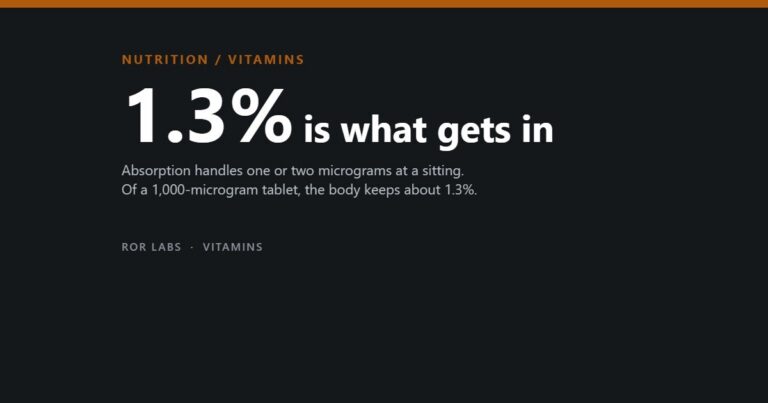
The dose-response curve turned out to be a sigmoid. The steep part — where extra intake genuinely raises blood levels — runs between 30 and 100 mg a day. The first dose beyond the steep portion is 200 mg. White cells saturate at 100 mg, holding at least fourteen times the plasma concentration. Complete plasma saturation arrives at 1,000 mg, and a single 200 mg dose is absorbed completely, while above 1 gram a day absorption falls below 50 per cent and the excess is excreted.
What a twelvefold dose increase buys
Steady-state plasma ascorbate, micromoles per litre, at two daily doses.
Source: Blanchard, J., Tozer, T.N. and Rowland, M., American Journal of Clinical Nutrition 66(5), 1997.
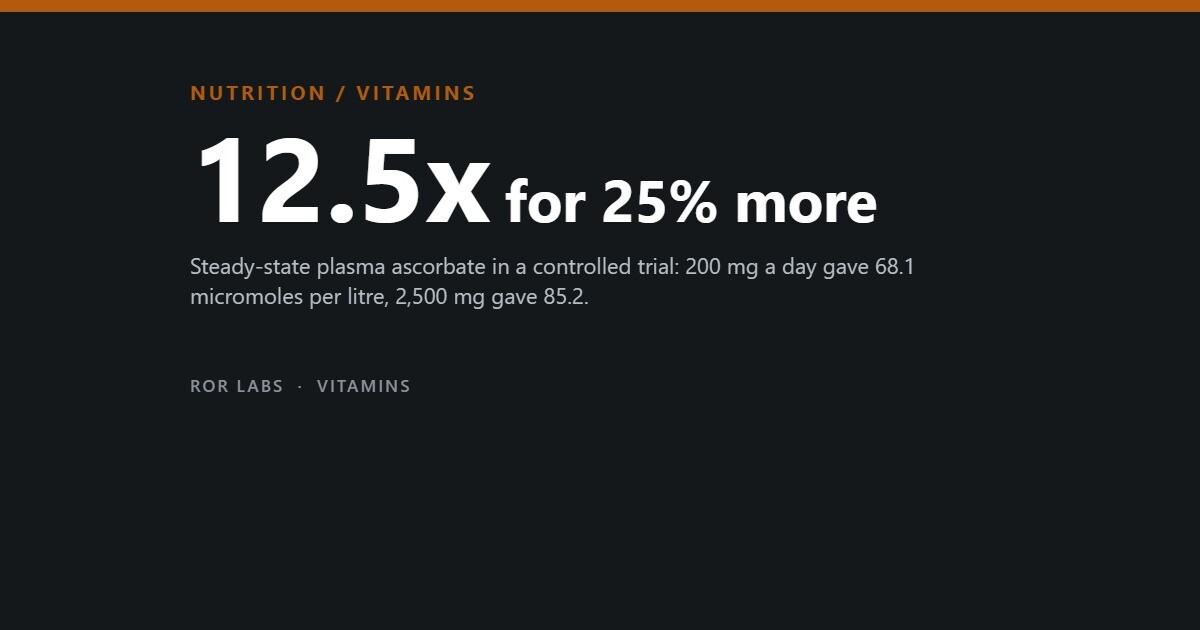
Blanchard’s pharmacokinetic study made the consequence explicit. Raising the daily dose from 200 mg to 2,500 — twelve and a half times as much — moved steady-state plasma from 68.1 to 85.2 micromoles per litre. The authors’ conclusion was that there is no pharmacokinetic justification for megadoses. Levine’s later work put a hard ceiling on it: oral dosing never takes plasma above about 250 micromoles per litre and usually keeps it under 150, whatever the dose, because absorption and renal excretion are both saturable.
That ceiling is why the intravenous work is a separate question rather than a stronger version of the same one. Given intravenously, vitamin C bypasses the gut and reaches 25 to 30 millimoles per litre, a hundred times what any pill achieves. Whatever is or is not true at those concentrations has no bearing on what a tablet does.
The cold
The claim that vitamin C prevents colds is the most tested proposition in the nutrition literature, and the answer has been stable for decades. Across twenty-three studies in the general community, at prophylactic doses up to 2 grams a day, regular supplementation did not alter how many colds people caught.
There is one exception, and it is specific. Six trials in marathon runners, skiers and soldiers on subarctic exercises found the incidence of colds roughly halved. Those are people under heavy short-term physical stress in cold conditions; nobody has shown the effect outside that setting.
Duration is where a real but small effect sits. Regular supplementation shortened colds by 8 per cent in adults and 14 per cent in children — on a week-long cold, hours rather than days. A 2023 analysis of fifteen comparisons from ten trials found severity reduced by 15 per cent, with a confidence interval from 9 to 21. And taking vitamin C after symptoms start, which is what most people actually do, has failed consistently: seven therapeutic trials found no effect on duration or severity, with one exception in a large trial using a single 8-gram dose on the first day.
Colds: what regular supplementation does
Cochrane review of prophylactic trials, and a 2023 analysis of severity.
Sources: Hemila, H. and Chalker, E., Cochrane Database of Systematic Reviews; Hemila, H. and Chalker, E., BMC Public Health 23, 2023. Full bar = 50 per cent.
There is a standing objection worth stating fairly. Correspondence from Hickey and Roberts has argued that the trials tested the wrong dosing schedule — that ascorbate is cleared fast enough that a single daily dose never holds a raised concentration, and that frequent smaller doses would behave differently. It is a coherent criticism of what was tested. It is not evidence that the untested schedule works, and until someone runs that trial it stays an argument rather than a result.
How much is too much
The upper level for adults is 2,000 mg a day, and it is set on gut tolerance rather than on organ damage: the common complaints are diarrhoea, nausea and abdominal cramps, caused by unabsorbed ascorbate drawing water into the bowel. It is a nuisance rather than a danger, and it resolves when the dose stops.
Two specific risks are worth knowing. High intakes raise urinary oxalate and uric acid excretion, which could contribute to kidney stones, and the best evidence for that is in people who already have hyperoxaluria. And in people with hereditary haemochromatosis, chronic high doses could worsen iron overload and damage tissue — the same iron-absorption effect that is useful in a vegetarian diet working against them.
The numbers
Recommended intakes, in milligrams a day
US Dietary Reference Intakes. Full bar = the adult upper level of 2,000 mg.
Sources: NIH Office of Dietary Supplements; Levine, M. et al., PNAS 93, 1996.
People who smoke need 35 mg a day more than people who do not, and that is written into the recommendation rather than added as advice. Pregnancy is 85 mg and lactation 120. Children run from 15 mg at ages 1 to 3 up to 75 for boys aged 14 to 18. Measured average intakes in the United States are 105.2 mg a day for adult men and 83.6 for women — above the recommendation before any supplement is counted, although about 12 per cent of adults take a separate vitamin C supplement anyway.
Questions people ask
How much vitamin C is in a tablespoon?
Raw acerola about 252 mg, wild rose hips 63.9, guava 34.2, yellow sweet pepper 27.6, blackcurrants 27.2, fresh parsley 20.0, raw red pepper 19.2. Further down: kiwifruit 13.9, broccoli 13.4, strawberries 8.8, orange 8.0, raw lemon juice 5.8.
Does 1,000 mg a day do anything?
It saturates plasma, which sounds useful and mostly is not. Going from 200 mg to 2,500 raises blood concentration by about a quarter; above 1 gram a day, less than half of it is absorbed and the remainder is excreted. If the question is whether it prevents colds, twenty-three community trials say no. If it is whether it shortens one, the honest answer is by about 8 per cent.
Does cooking destroy it?
It leaches more than it destroys, and the numbers are modest. Raw broccoli holds 89.2 mg per 100 g and boiled broccoli 64.9 — a loss of about 27 per cent. Potatoes boiled in their skins keep 13 mg against 7.4 for potatoes boiled peeled, so most of what is lost goes into the water rather than into the air.
Do smokers really need more?
Yes, and it is in the recommendation itself: 35 mg a day above the standard figure, which makes it 125 for men and 110 for women. Exposure to second-hand smoke raises the requirement too, though no separate number is set for it.
Can you take too much?
The upper level is 2,000 mg a day, set on gut tolerance. The real cautions are narrow: people who already form calcium oxalate kidney stones, and people with hereditary haemochromatosis, for whom high doses could worsen iron overload.
The short version
- Required for collagen synthesis. It also improves non-haem iron absorption and regenerates vitamin E.
- Per tablespoon: acerola 252 mg, wild rose hips 63.9, guava 34.2. Oranges are near the bottom — they supply so much because of how much of them people eat.
- Scurvy: plasma emptied at day 41 in a deliberate depletion, first visible signs at day 134, a wound that failed to heal at day 192. A few milligrams a day reverses it.
- The dose-response curve is a sigmoid. It is steep between 30 and 100 mg; 200 mg is the first dose past the steep part; 12.5 times that dose raises blood levels by a quarter.
- Colds: no effect on incidence in the general community, 8 per cent shorter in adults and 14 in children, 50 per cent fewer only in runners, skiers and soldiers. Taken after symptoms start, nothing.
- RDA 90 mg men and 75 women, plus 35 for smokers; upper level 2,000 mg, set on gut tolerance.
This is a reference page, not clinical guidance. Anyone taking high doses with kidney stones, haemochromatosis or kidney disease, or alongside cancer treatment, should raise it with a doctor rather than with an article.
Further reading: Levine’s 1996 paper is the rare piece of nutrition research that measured the thing everyone argues about, in people, at every dose. Crandon’s 1940 self-experiment is short, and its restraint is remarkable given what he was doing to himself.
- Ultra-Processed People, Chris van Tulleken (2023). A physician’s self-experimenting look at the evidence behind what we eat and supplement.
- How to Talk to a Science Denier, Lee McIntyre (2021). On engaging contested claims without dismissing or overselling them.
- The Data Detective, Tim Harford (2020). Ten rules for reading numbers in the news skeptically.
Sources
- NIH Office of Dietary Supplements, “Vitamin C”, fact sheet for health professionals. (RDA and UL tables; smokers +35 mg; absorption 70–90% at 30–180 mg/day and below 50% above 1 g; signs of scurvy within a month below about 10 mg/day, with the clinical picture and at-risk groups; mean intakes 105.2 and 83.6 mg/day and 12% taking a separate supplement; oxalate, uric acid and haemochromatosis cautions.)
- USDA FoodData Central, SR Legacy, vitamin C per 100 g. (Acerola 171686, 1,680 mg; rose hips 168998, 426; guava 173044, 228; yellow pepper 169383, 184; blackcurrants 173963, 181; parsley 170416, 133; red pepper 170108, 128; kiwifruit 168153, 92.7; broccoli raw 170379, 89.2 and boiled 169967, 64.9; strawberries 167762, 58.8; orange 169097, 53.2; lemon juice 167747, 38.7; potato boiled in skin 170438, 13 and peeled 170440, 7.4.)
- Levine, M. et al., PNAS 93(8), 1996, pp.3704–3709. (Seven volunteers depleted below 5 mg/day for four to six months, doses 30–2,500 mg; sigmoid relationship, steep portion 30–100 mg, first dose beyond it 200 mg; white cells saturate at 100 mg holding at least 14 times plasma; plasma saturation at 1,000 mg; complete bioavailability of a single 200 mg dose.)
- Blanchard, J., Tozer, T.N. and Rowland, M., AJCN 66(5), 1997. (Steady-state plasma 68.1 µmol/L on 200 mg/day against 85.2 on 2,500 mg/day; no pharmacokinetic justification for megadoses.)
- Levine, M., Padayatty, S.J. and Espey, M.G., Advances in Nutrition 2(2), 2011. (Oral dosing keeps plasma below about 250 µmol/L and usually under 150; intravenous administration reaches 25–30 mmol/L.)
- Hemila, H. and Chalker, E., “Vitamin C for preventing and treating the common cold”, Cochrane Database of Systematic Reviews. (23 community studies, doses to 2 g/day, incidence not altered; six trials of runners, skiers and soldiers, incidence halved; duration −8% adults and −14% children; seven therapeutic trials no benefit, except one large trial using a single 8 g dose on day one.) And BMC Public Health 23, 2023 (severity −15%, 95% CI 9–21%, from 15 comparisons in 10 trials).
- Hickey, S. and Roberts, H., correspondence on ascorbate dosing schedules. (The argument that trials of once-daily dosing did not test the regimen proposed.)
- Crandon, J.H., Lund, C.C. and Dill, D.B., “Experimental human scurvy”, NEJM 223, 1940. (Plasma ascorbate zero at day 41; follicular hyperkeratosis day 134; petechiae day 161; wound at day 85 healed normally, wound at day 192 histologically abnormal.)
- May, J.M., 2013, and related reviews. (Signs at two to three months of near-total deprivation, reversed by a few milligrams a day; scorbutic serum below about 11 µmol/L.)