Fifty-Two Contested Claims Were Corrected in One Study. Not One of Them Backfired.
Key takeaways · 12 min read
- The backfire effect comes from a 2010 paper whose own second experiment failed to reproduce it at the group level.
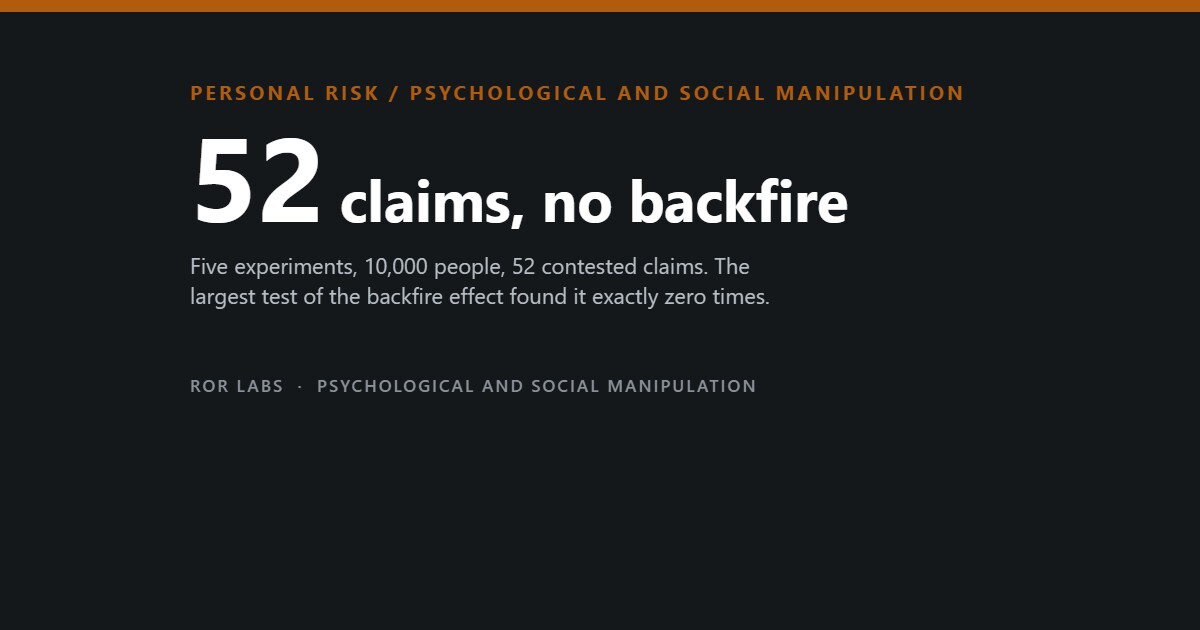
- The largest test since — five experiments, more than 10,000 people, 52 corrected claims — found it zero times.
- Across the literature, 81% of reported backfires used a single-question belief measure; backfires appeared in 37% of single-item measures against 8% of multi-item ones.
- Unreliable measures regress to the mean, which can manufacture a backfire in any subgroup that started low.
There is a piece of folk wisdom about arguing that has become almost unarguable itself: correcting someone’s false belief makes them hold it harder. It has a name, the backfire effect, and it is used to justify a lot — not fact-checking, not correcting a relative, not bothering. It appears in newsroom style guides and in advice about how to talk to people who are wrong.
It comes from one 2010 paper. The largest attempt to reproduce it ran five experiments with more than ten thousand people across fifty-two contested claims and found the effect exactly zero times. A 2020 methodological review then found something more uncomfortable: across the whole literature, the reported backfires cluster in studies that measured belief with a single question.
That is not the same as saying corrections work. It is saying the specific thing everyone repeats — that facts make people worse — is the one claim the evidence does not support, while the harder problems it distracted from are still there.
Where the idea came from
In 2010 Brendan Nyhan and Jason Reifler published four experiments in which people read a mock news article containing a misleading political claim, some of them followed by a correction. In the best-known one, the claim was that Iraq had stockpiles of weapons of mass destruction before the 2003 invasion; the correction was the Duelfer Report, which found none.
Liberals, whose politics fit the correction, updated. Conservatives, on average, came out believing the misinformation more strongly than the group that never saw a correction. That is the backfire effect: not resistance, not stubbornness, but movement in the wrong direction.
Two details from the original paper rarely travel with it. The authors ran a second experiment on the same item, and at the group level it did not reproduce the result — the backfire showed up only within a subset of conservatives who named Iraq the most important problem facing the country. And the authors themselves flagged that subgroup analysis as exploratory. The finding, in its own paper, was already conditional.
What the original paper reported, and what it did not
Nyhan and Reifler, four experiments, mock news articles with and without a correction.
Source: Nyhan, B. and Reifler, J., “When corrections fail: the persistence of political misperceptions”, Political Behavior 32(2), 2010, as characterised in Swire-Thompson, B., DeGutis, J. and Lazer, D., “Searching for the backfire effect”, Journal of Applied Research in Memory and Cognition 9(3), 2020.
The largest attempt to find it again
In 2019 Thomas Wood and Ethan Porter published five experiments designed to give the backfire effect every chance. The items were chosen to be ideologically charged — the sort of claim where a correction should sting. More than ten thousand people took part, and fifty-two separate false claims were corrected.
Not one of the fifty-two produced a backfire. Corrections moved people toward accuracy, including when the correction embarrassed their own side. The authors titled the paper after what they had gone looking for and not found.
It is not an isolated result. Kathryn Haglin, using the same materials and the same flu-vaccine items as a 2015 Nyhan and Reifler study, reproduced the part where the correction reduced the false belief and failed to reproduce the backfire. A 2020 review counted failures to replicate across at least eight separate research groups, using the original items.
Attempts to reproduce a worldview backfire effect
Studies using corrective information and comparing belief against a pre-correction or no-correction baseline.
Sources: Wood, T. and Porter, E., “The elusive backfire effect: mass attitudes’ steadfast factual adherence”, Political Behavior 41(1), 2019, pp.135–163; Haglin, K., “The limitations of the backfire effect”, Research and Politics 4(3), 2017.
What makes a backfire appear where there is none
The 2020 review by Briony Swire-Thompson, Joseph DeGutis and David Lazer did not simply count wins and losses. It asked what kind of study finds a backfire, and the answer is specific enough to be useful.
Eighty-one per cent of the backfire effects in their review of the worldview and familiarity literatures were measured with a single question. When they compared study designs directly, backfires turned up in 37 per cent of single-item measures and 8 per cent of multi-item measures — a difference unlikely to be chance.
The mechanism is unglamorous. A one-question belief measure is noisy, and noisy measures regress to the mean: people who happened to score low before the correction tend to score higher afterwards whatever the correction did. If you then look for a subgroup that moved upward, you will find one. The review illustrates this with simulated data and calls the region where post-correction belief exceeds pre-correction belief the backfire zone — a zone that fills up with people purely as the measure gets less reliable.
Two other design habits push the same way. Most backfire studies measure belief only once, after the correction, and compare two groups; if random assignment leaves those groups slightly different to begin with, the difference looks like an effect. And several of the reported subgroups appear to have been chosen after looking at the data.
How the backfire was measured, and how often it appeared
Backfire effects reported across the worldview and familiarity literatures, by the number of items in the belief measure.
Source: Swire-Thompson, B., DeGutis, J. and Lazer, D., “Searching for the backfire effect: measurement and design considerations”, Journal of Applied Research in Memory and Cognition 9(3), 2020. Difference between proportions Z = 2.96, p = .003.
The other backfire, and the paper it rests on
There is a second version of the idea that has nothing to do with politics. It says that repeating a myth in order to debunk it makes the myth more familiar, and familiar things feel true, so myth-versus-fact formats are self-defeating. This is the familiarity backfire effect, and it is the reason a generation of communication guides told people never to restate the claim they were correcting.
Its founding evidence is an unpublished manuscript from 2007, known mainly through a description of it in someone else’s book chapter. A direct replication in 2013 did not find it. In 2023 a team including two of the 2020 reviewers took the best-known published demonstration — a vaccine study whose myths-versus-facts condition had appeared to backfire — and failed to reproduce either the familiarity backfire or a fear-driven one.
The practical instruction that came out of it also does not survive testing. A meta-analysis compared corrections that repeated the misinformation with corrections that did not, and found no significant difference between them. Several studies since have found the opposite of the warning: stating the myth immediately before the correction helps people revise, apparently because seeing the two together is what makes the contradiction visible.
Does repeating the myth inside the correction make things worse?
Continued influence of misinformation after correction, by whether the correction restated the claim. Negative values mean the misinformation still had some effect.
Source: Walter, N. and Tukachinsky, R., “A meta-analytic examination of the continued influence of misinformation in the face of correction”, Communication Research 47(2), 2020 (published online 2019). Ten studies compared; Q(1) = 0.18, p = .18.
What is real, and how big
Something does survive a correction. It is called the continued influence effect: after a retraction people stop endorsing the claim but keep reasoning as though it were partly true. The same meta-analysis pooled thirty-two experiments with 6,527 participants and put it at r = −0.05 — statistically distinguishable from zero, and small.
The average hides a lot. Corrections that cut against what someone already believes leave four times as much residue as corrections that agree with them. A correction delivered after a delay leaves residue; one delivered immediately leaves none measurable. Misinformation that arrived from a source the person trusted is stickier than misinformation from a source they did not. And when the same source that spread the claim is the one retracting it, the residue disappears.
These are the numbers that should be carried around instead of the backfire effect. They say that corrections work, that the conditions under which they work least are common ones, and that none of those conditions involve people getting worse.
How much misinformation survives a correction, by condition
Pooled correlations from 32 experiments, N = 6,527. More negative means more of the misinformation is still in play after the correction.
Source: Walter, N. and Tukachinsky, R., Communication Research 47(2), 2020. Overall r = −.05, 95% CI [−.10, −.01], p = .045; heterogeneity I² = 80.2.
Why the debunking still fails
In 2021 Nyhan published a reassessment of his own finding in the Proceedings of the National Academy of Sciences. He wrote that subsequent research and media coverage had seized on the 2010 result, distorting its generality and exaggerating its role, and that the emerging consensus is that corrective information is typically at least somewhat effective when it reaches someone.
His argument is that the real problem was elsewhere the whole time. Corrective effects often do not last or accumulate; they decay, or are overwhelmed by a steady supply of more congenial claims from politicians and media. Misperceptions persist for years after being debunked, not because the debunking backfired but because it was a single event competing with a continuous one.
The distribution problem is starker still. Reviewing the field in 2023, Porter and Wood concluded that instances of backfire are exceedingly rare and may be an artefact of research design — and, in the same breath, that people who see misinformation are exceedingly unlikely to see a relevant correction. Every experiment in this literature places the correction directly in front of the participant. Nothing in the real world does.
What a correction moves, and what it leaves alone
Simultaneous experiments on YouGov samples in ten countries, n = 10,600, on COVID-19 vaccine misinformation. Belief accuracy measured on a 4-point scale.
Source: Porter, E., Velez, Y. and Wood, T., “Factual corrections and COVID-19 misinformation: evidence from simultaneous experiments in ten countries”, 2021.
Questions people ask
So the backfire effect is not real?
The honest statement is narrower. At the level of a whole sample it has repeatedly failed to appear, including in the largest test anyone has run. Where it has been reported it has almost always been inside a subgroup, usually with a one-question measure, and the reviewers who looked hardest concluded that unreliable measurement plus regression to the mean can manufacture exactly that pattern. They stop short of saying it never happens; they say the field cannot currently tell, because so few studies report whether their measures are reliable enough to support the claim.
Should I still avoid repeating a false claim when I correct it?
The evidence no longer supports treating that as a rule. Pooled across ten studies, corrections that restated the claim and corrections that did not were not significantly different, and several studies since have found that stating the claim immediately before the correction helps. What does still hold is that repetition without a correction increases belief, so the claim and the correction have to arrive together and with equal prominence — not a myth in the headline and a correction in the small print.
Does correcting someone actually change what they do?
Mostly not, on this evidence. In the ten-country vaccine experiments the correction improved belief accuracy and left stated vaccination intent untouched. A 2023 review of the field reaches the same conclusion: corrections affect belief accuracy, with minor to non-existent influence on downstream attitudes and behaviours. That is a real limitation, and it is different from backfiring.
Why did the idea spread so far if the evidence was this thin?
Nyhan’s own account is that coverage generalised a conditional subgroup finding into a law of human nature. It is also a comfortable idea: it explains disagreement without requiring anyone to keep arguing, and it gives a reason to stop. A finding that lets people off a difficult task travels faster than the replication that removes the excuse.
If corrections work, why do false beliefs last?
Because the correction is one event and the claim is a supply. The gains decay, and they are outcompeted by continued cues from elites and media. And most of the people holding the belief never encounter the correction at all — which is a problem about who sees what, not about how minds handle facts.
The short version
- The backfire effect comes from a 2010 paper whose own second experiment failed to reproduce it at the group level.
- The largest test since — five experiments, more than 10,000 people, 52 corrected claims — found it zero times.
- Across the literature, 81% of reported backfires used a single-question belief measure; backfires appeared in 37% of single-item measures against 8% of multi-item ones.
- Unreliable measures regress to the mean, which can manufacture a backfire in any subgroup that started low.
- The familiarity version rests on an unpublished 2007 manuscript; a direct replication failed, and a 2023 study failed to reproduce the best-known published demonstration.
- Repeating the myth inside the correction made no significant difference across ten pooled studies.
- What is real is the continued influence effect: r = −0.05 across 32 experiments, rising to −0.20 when the correction cuts against prior belief.
- Corrections do move belief — +0.16 on a 4-point scale across ten countries — and do not move stated behaviour.
- Nyhan’s own 2021 reassessment: the effect was overstated, corrections work, and the gains decay or are overwhelmed.
- The binding constraint is that people who see misinformation are exceedingly unlikely to see the correction.
This article summarises published experimental research on how people respond to corrections of false claims. It is not advice about any particular disagreement. The studies measure belief in a survey or laboratory setting, minutes or weeks after a single correction, which is not the same as a relationship or a public argument. Where the evidence cannot settle a question — whether backfire ever occurs in some untested circumstance, for instance — that is said rather than resolved.
Further reading: the 2020 review by Swire-Thompson, DeGutis and Lazer is the single best entry point. It is written for researchers, but its appendices list every study, the measure it used, and whether a backfire occurred — unusually honest bookkeeping for a contested field. Nyhan’s 2021 reassessment of his own finding is four pages and worth reading beside it.
- The Scout Mindset, Julia Galef (2021). On reasoning to see clearly rather than to defend a position — the mechanism behind the backfire effect itself.
- How to Talk to a Science Denier, Lee McIntyre (2021). On engaging contested claims without dismissing or overselling them.
- Noise, Daniel Kahneman, Olivier Sibony & Cass Sunstein (2021). On unwanted variability in judgment, the companion problem to bias.
Sources
- Nyhan, B. and Reifler, J., “When corrections fail: the persistence of political misperceptions”, Political Behavior 32(2), 2010, pp.303–330. (Four experiments. Experiment 1 found conservatives increased belief that Iraq held weapons of mass destruction after reading the Duelfer Report correction. Experiment 2 did not reproduce this at group level; the effect appeared only among conservatives rating Iraq the most important problem, an analysis the authors identified as exploratory.)
- Wood, T. and Porter, E., “The elusive backfire effect: mass attitudes’ steadfast factual adherence”, Political Behavior 41(1), 2019, pp.135–163. (Five experiments, more than 10,000 participants, items chosen as ideologically charged. Of 52 issues corrected, none triggered a backfire effect.)
- Swire-Thompson, B., DeGutis, J. and Lazer, D., “Searching for the backfire effect: measurement and design considerations”, Journal of Applied Research in Memory and Cognition 9(3), 2020, pp.286–299. (81% of backfire effects in the worldview and familiarity literatures used single-item measures. Backfires in 37% of single-item against 8% of multi-item measures, Z = 2.96, p = .003. Sets out regression to the mean, post-test-only designs and post hoc subgroups as routes to spurious backfire.)
- Haglin, K., “The limitations of the backfire effect”, Research and Politics 4(3), 2017. (Replication of the Nyhan and Reifler 2015 flu-vaccine study using the same items. The correction significantly reduced the false belief in the full sample and in both high- and low-concern groups; the backfire effect was not reproduced.)
- Walter, N. and Tukachinsky, R., “A meta-analytic examination of the continued influence of misinformation in the face of correction: how powerful is it, why does it happen, and how to stop it?”, Communication Research 47(2), 2020, pp.155–177. (32 studies, N = 6,527. Overall r = −.05, 95% CI [−.10, −.01], p = .045, I² = 80.2. Counter-attitudinal corrections −.20 against pro-attitudinal −.01; delayed correction −.13 against immediate +.01; misinformation from a high-credibility source −.18 against −.01 from a low-credibility source; same source correcting +.01 against different source −.10. Repetition of the misinformation within the correction −.10 against −.02 without, Q(1) = 0.18, p = .18.)
- Ecker, U.K.H., Sharkey, C.X.M. and Swire-Thompson, B., “Correcting vaccine misinformation: a failure to replicate familiarity or fear-driven backfire effects”, PLOS ONE 18(4), 2023. (Replication and extension of Pluviano et al. 2017, including the myths-versus-facts and infographic conditions. Neither backfire effect reproduced.)
- Nyhan, B., “Why the backfire effect does not explain the durability of political misperceptions”, Proceedings of the National Academy of Sciences 118(15), 2021. (The author of the 2010 study writes that subsequent research and media coverage distorted its generality and exaggerated its role, that an emerging consensus finds corrective information typically at least somewhat effective when received, and that the accuracy gains often decay or are overwhelmed by elite and media cues.)
- Porter, E., Velez, Y. and Wood, T., “Factual corrections and COVID-19 misinformation: evidence from simultaneous experiments in ten countries”, 2021. (YouGov samples, n = 10,600. Corrections raised belief accuracy by 0.16 on a 4-point scale; misinformation lowered it by 0.09. Neither affected intent to vaccinate. 39% of the correction effect was still detectable two weeks later.)
- Porter, E. and Wood, T., “Factual corrections: concerns and current evidence”, Current Opinion in Psychology 54, 2023. (Corrections improve belief accuracy across countries, political beliefs and demographics; instances of backfire are exceedingly rare and may be an artefact of research design; those who see misinformation are exceedingly unlikely to see relevant corrections.)
- Swire, B., Berinsky, A.J., Lewandowsky, S. and Ecker, U.K.H., “Processing political misinformation: comprehending the Trump phenomenon”, Royal Society Open Science 4(3), 2017. (No evidence of a worldview backfire effect in either experiment; post-explanation belief scores remained below pre-explanation levels. The authors conclude worldview backfire effects are not the norm.)
- Fenger, J. and Vinæs Larsen, M., “Do beliefs echo? On the persistent effects of misinformation after effective corrections”, Political Communication, 2026. (Preregistered high-powered replication of two experiments from the study that introduced “belief echoes”. Where the correction was demonstrably effective, no lingering attitudinal effect was found.)